
Table of Contents
Some links on The Justifiable are affiliate links, meaning we may earn a small commission at no extra cost to you. Read full disclaimer.
Awin platform walkthrough guide articles usually skip the part you actually need: what to click, what to set up first, and what matters once the account is live. This guide is built to fix that.
I’m going to walk you through Awin as a working platform, not as a sales page, so you can understand the dashboard, launch tracking correctly, recruit better partners, manage commissions, and avoid the mistakes that quietly drain performance.
I’ll focus mainly on the advertiser side because that is where most platform setup and optimization decisions happen.
Understand What Awin Is And How The Platform Is Structured
A quick orientation matters because Awin makes more sense once you see how the core pieces fit together: account setup, tracking, partner recruitment, commissions, and reporting.
What The Awin Platform Actually Does
At its core, Awin is a partnership marketing platform that connects advertisers with affiliate partners, creators, content publishers, loyalty sites, technology partners, and other traffic sources that can drive tracked conversions.
Awin’s public materials say advertisers can choose from more than 1 million vetted partners, and the Access plan also references availability across Awin and ShareASale networks.
What matters practically is this: Awin is not just a place to “list a program.” It is a system for attribution, partner management, commission control, and performance analysis.
On the advertiser side, you create a profile, install tracking, approve or recruit partners, define payout logic, upload offers, and validate transactions. On the publisher side, partners discover programs, apply, promote links, and monitor commissions.
I think this is the first mindset shift that helps. If you treat Awin like a directory, results tend to be mediocre. If you treat it like an operating system for partnership revenue, the interface suddenly feels much more useful.
The Main Areas You Will Use Most
Most advertisers will spend the majority of their time in a handful of places. Your profile setup lives under Account and Profile, where partners evaluate whether your program looks trustworthy and worth joining. Tracking setup centers on the Advertiser MasterTag, integrations, or API-based methods.
Recruitment happens through partner discovery tools, recommendations, and marketplace-style promotional opportunities. Optimization happens through commission groups, offer management, and reporting.
The newer Awin platform also leans hard into a more guided experience. In its Winter 2026 release notes, Awin highlights a new dashboard with clicks, revenue, trends, top partners, an AI-powered recommendation layer, and an actionable task list. It also mentions a guided campaign builder aimed at helping users launch programs with more support.
That tells you something important about the product direction. Awin wants the platform to be less “you figure it out” and more “the interface nudges you toward launch and optimization.”
For beginners, that is good news. For experienced teams, it means the dashboard can act as a fast health check rather than just a reporting screen.
Which Awin Plan Fits Different Use Cases
Awin currently presents multiple advertiser plans, including Access and Accelerate, with different levels of reporting, automation, and support. The pricing pages describe Access as the beginner-friendly option and position it for small businesses, startups, and agencies that want a lower-commitment entry point.
The Access page specifically mentions a three-month minimum term and a 3.5% Awin tracking fee on successful transactions.
Accelerate is positioned as the better fit if you want to scale, use APIs, and run more advanced workflows. That distinction is not just marketing language. Some help documentation explicitly says features such as the Transaction Validation API are only available on Accelerate and Advanced plans.
My advice is simple: Do not choose based only on budget. Choose based on operating complexity. If you are launching your first affiliate program with a modest product catalog and simple commission rules, Access can be enough. If you already know you need automation, bulk validation, or deeper reporting discipline, starting too small can slow you down.
Set Up Your Account The Right Way Before You Recruit Anyone
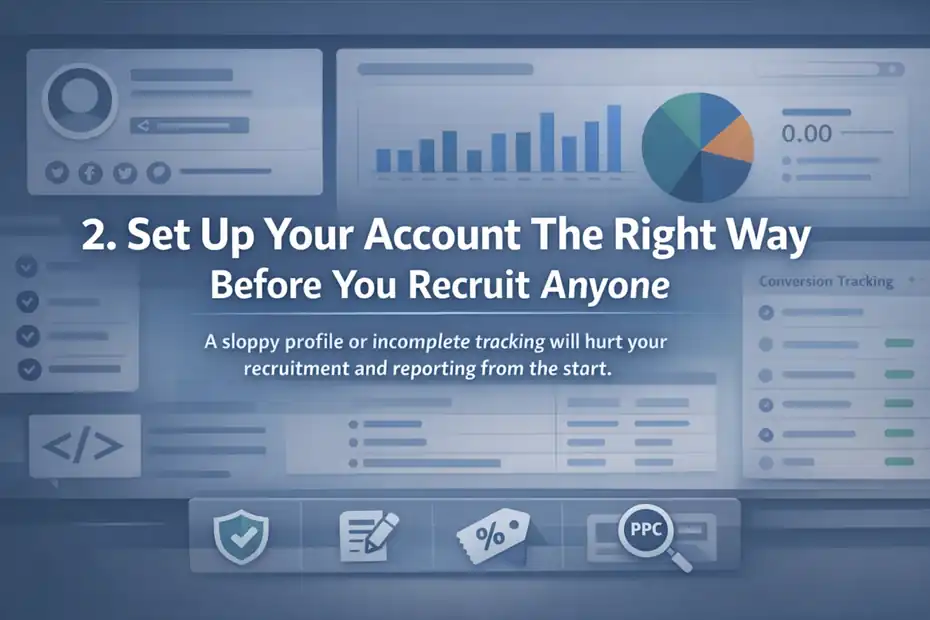
This is the stage many teams rush through. I would not.
A sloppy profile and half-finished tracking setup make partner recruitment harder and reporting less reliable from day one.
Build A Profile That Partners Can Actually Trust
Awin’s help documentation says your profile page is where partners learn about your program, and it specifically recommends adding a company logo, business summary, a fuller program description, plus website and social links under Account > Profile > Overview.
That sounds basic, but it has real commercial impact. A publisher deciding whether to apply is often making a fast judgment call. If your page looks thin, outdated, or generic, you create friction before anyone even clicks “join.”
In my experience, affiliate managers often underestimate how much conversion happens at the profile level. A good profile reduces uncertainty.
Here is what I suggest including from the start:
- Who you are: A short plain-English description of your brand and product category.
- Who you want: The partner types you actively welcome.
- What converts: Top products, price points, seasonal strengths, and audience fit.
- What partners get: Base commission, bonus opportunities, cookie logic if relevant, and response expectations.
- How to work with you: Approval timelines, contact details, and promotional preferences.
A real-world example: If you run a skincare ecommerce store, “premium skincare products” is vague. “Science-backed skincare for acne-prone adults, $35 to $95 AOV, strongest in bundles and seasonal routines” gives a publisher something usable.
Set Terms, Expectations, And Program Positioning Early
Your profile is only half the story. Awin also provides a Terms and Conditions area inside the advertiser profile, and its documentation says those terms improve transparency for the network and help complete your profile.
This is where many future headaches get prevented. If you are vague about voucher use, paid search rules, trademark bidding, cashback eligibility, content standards, or influencer disclosure expectations, you create room for conflict later. And once a program scales, “we forgot to define that” becomes expensive.
I believe this is the best place to be firm and helpful at the same time. You do not need legal-sounding fluff. You need operational clarity. Spell out whether coupon sites are allowed, whether browser extensions are acceptable, whether you allow PPC on brand terms, and whether there are traffic sources you will reject.
If certain products or regions are excluded from commission, say it before applications arrive.
A simple principle works well here: Write the terms the way you would want them written if you were the publisher. Clear rules attract better-fit partners and repel the ones who were likely to cause trouble anyway.
Install Tracking Before You Start Any Serious Recruitment
Awin’s Advertiser MasterTag is the platform’s core JavaScript tracking solution, and the official documentation says it should be appended unconditionally to every page, including the confirmation page, while excluding pages that display or process payment information or personally identifiable information.
That one detail is easy to miss and important. “Unconditionally” means you do not want patchy coverage across random templates. Incomplete installation creates attribution gaps, broken journeys, and ugly debugging later.
Awin also describes the MasterTag as a first-party tracking solution and notes that it supports broader services such as cross-device tracking, product feeds, and conversion optimization, with added support for deferred click browser tracking.
If your store uses Google Tag Manager, Awin’s GTM guide says you can add the Advertiser MasterTag through the Community Template Gallery and configure it with your Advertiser ID. That is a practical shortcut for teams that do not want a hard-coded install.
My recommendation: Do not recruit aggressively until your tracking is tested end to end. A publisher can forgive a late approval. They rarely forgive missing commissions.
Launch Tracking, Test Attribution, And Make Sure Sales Can Be Credited
Once the shell of the program is ready, the real make-or-break step is attribution. This is the part that determines whether clicks become trackable revenue inside Awin.
Choose The Right Tracking Method For Your Tech Stack
Awin supports more than one implementation route. The core option is the Advertiser MasterTag. Beyond that, Awin provides platform-specific guidance and integrations for systems like Shopify, WooCommerce, Adobe Commerce, Salesforce Commerce Cloud, and more, plus API documentation for deeper custom implementations.
The Shopify guide, for example, says Awin’s own app is the most efficient way to integrate tracking there, and it notes that your Advertiser ID can be found in Awin UI > Account > Overview.
This is where I would keep your decision simple:
- If you use a major ecommerce platform and Awin has an official app or extension, start there.
- If your site already relies heavily on GTM, use the GTM route.
- If your architecture is custom, lean on the API and developer docs from the beginning.
Trying to force a “quick workaround” usually costs more time later. A clean native implementation almost always wins because it is easier to audit, easier to maintain, and less fragile during site updates.
Understand Why Cookies, Parameters, And Confirmation Pages Matter
Awin’s cookie guidance explains that cookies support tracking and attribution, and it also notes the role of first-party versus third-party cookies and link parameters in enriching reporting.
In plain language, this means the click needs to be captured, the user journey needs to persist, and the order confirmation event needs to fire with the correct transaction details. If any of those parts break, the platform can only work with partial information.
That is why the confirmation page matters so much: it is usually where the final conversion signal is sent.
For teams new to affiliate platforms, the hidden lesson is this: tracking is not just about “did the tag load?” It is about whether the click ID or relevant parameters survive the journey and whether the order event sends the right data back.
Even a good-looking setup can fail silently if checkout steps strip parameters or if the order confirmation event lacks the right transaction values.
I suggest running test journeys across desktop and mobile, with and without discount codes, and on any international storefronts you use. Small edge cases become big commission disputes once traffic scales.
Use Backup And Privacy-Friendly Tracking Options Where Needed
Affiliate tracking has become more privacy-sensitive over the years, and Awin has clearly adapted for that. Its documentation highlights deferred click browser tracking inside the MasterTag and also offers voucher attribution, which it describes as a cookie-less tracking method based solely on the voucher code in use.
The Conversion API documentation also notes support for voucher attribution.
This matters more than many beginners realize. If your program depends heavily on codes, influencer campaigns, or editorial placements where codes are central to the call to action, voucher attribution can act as a useful safety net.
It is not a replacement for clean base tracking, but it can close gaps in environments where browser behavior or user flow weakens cookie reliability.
A simple scenario: Imagine an influencer drives mobile traffic from Instagram, the shopper returns later directly, but still uses the creator’s code at checkout. Voucher attribution can help preserve credit in cases where standard click-based continuity is less dependable.
I would not overcomplicate this on day one, but I would absolutely map which partner types rely most on links, which rely on codes, and where your backup attribution logic matters most.
Find Better Partners Instead Of Just More Partners
Once tracking works, growth comes down to partner quality. Awin gives you multiple ways to discover and recruit publishers, but volume alone is not the goal.
Start With Partner Fit, Not Vanity Numbers
Awin’s partner-type documentation breaks publishers into broad promotional categories such as content, display, email, and search, while its general partner overview explains that publishers can include websites, media owners, and other traffic-driving partners who earn commission when a tracked action occurs.
That matters because “more affiliates” is not really a strategy. A skincare brand, a SaaS company, and a home furnishings retailer should not recruit with the same logic. The partner mix that drives incremental revenue for one program can be wasteful for another.
I usually think in three buckets:
- Content and editorial partners for trust and upper-funnel demand.
- Loyalty, cashback, and voucher partners for conversion capture and scale.
- Specialist or niche partners for category depth and efficient reach.
The right mix depends on your margins, customer journey, and what kind of incrementality you care about. If you are a new brand, content and niche creators may build stronger foundations than chasing only coupon exposure.
If you already convert well and want volume, loyalty and offer-led placements may move faster.
Use Awin’s Discovery And Recommendation Tools Intelligently
Awin now offers several partner discovery routes. Its newer platform guide says the Partnerships overview and All Partnerships pages are used to discover, assess, and manage partners. Separate Awin resources also reference Publisher Recommendations and the Opportunity Marketplace.
One support article says the recommendations tool can generate up to 25 recommended partners per day inside the Publisher Directory.
That sounds convenient, but the real value is how you use it. Recommendations are best treated as a starting list, not an auto-approve queue. Review partner type, promotional method, brand fit, audience overlap, and likely incrementality before sending invitations or approvals.
Opportunity Marketplace is especially useful when you want paid promotional placements such as homepage takeovers, sponsored content, emails, or social posts. Awin describes it as a place where partners list extra advertising options with different costs and visibility levels.
In practice, this is great for seasonal pushes. Awin’s seasonal prep guidance even suggests using marketplace keyword searches tied to peak moments like Mother’s Day, Black Friday, or Christmas.
Write Outreach And Approvals Like A Real Human
The platform can help you find partners, but it cannot write persuasive context for you. That part still matters. A publisher is more likely to accept your invitation or prioritize your program if you show that you understand their audience, not just their traffic.
A weak message says, “We’d love to work together.” A stronger one says, “Your comparison content for sustainable home products is a strong fit for our $70 to $140 AOV line, and our best-converting categories are refill bundles and starter kits.” One feels automated. The other feels intentional.
I believe this is one of the easiest wins inside affiliate management because so many brands still sound generic. Your platform profile gets you to the door. Your outreach helps you open it.
As a rule, approve quickly, communicate clearly, and give partners actual selling angles: top categories, hero products, upcoming launches, average order values, and any offers already live in Awin. That lowers activation time and helps traffic turn into tracked revenue faster.
Configure Commissions, Offers, And Transaction Management
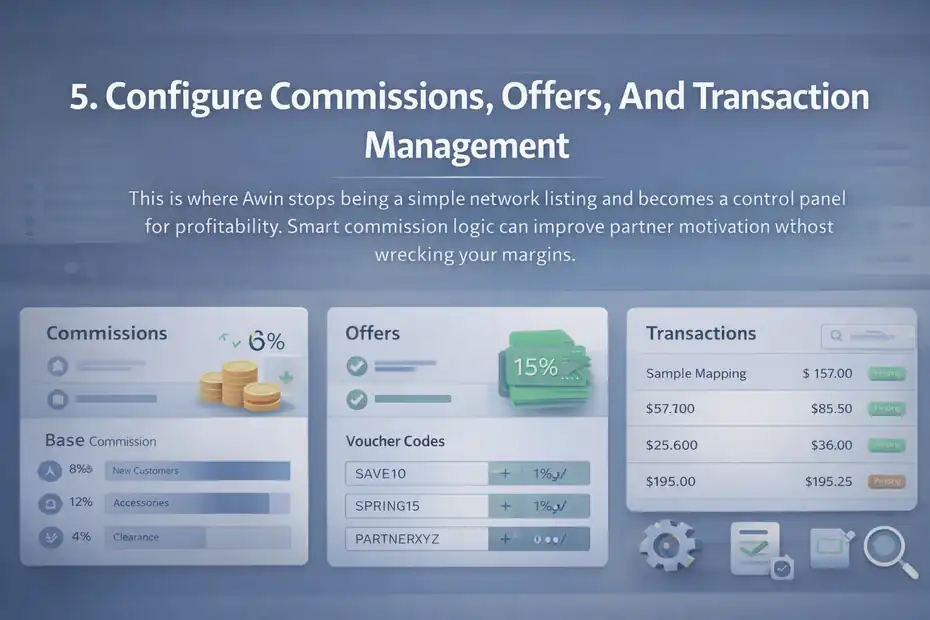
This is where Awin stops being a simple network listing and becomes a control panel for profitability.
Smart commission logic can improve partner motivation without wrecking your margins.
Set A Base Commission That Is Competitive And Sustainable
Awin’s commission-rate best practices are refreshingly sensible. The company says there is no single “right” rate, and the best rate is one that attracts partners, stays competitive in your market, and remains sustainable for your business. The same guidance suggests checking competitor offers and the Awin Advertiser Directory to understand typical sector rates.
That lines up with what I have seen. Too many brands either underpay and wonder why nobody meaningful joins, or overpay early and realize later they cannot maintain the economics. The right rate is not the highest rate. It is the rate that supports repeatable growth.
A practical way to think about it is margin layering. Start with product margin, subtract operational costs, factor in likely new-versus-existing customer mix, then decide how much room you have for acquisition versus conversion-assist partners.
A content partner introducing new customers may deserve more than a coupon partner closing demand you already created.
If your offer is not naturally standout, Awin’s own guidance suggests using targeted bonuses or higher incentives for specific partners rather than blindly raising the base rate for everyone.
Use Commission Groups To Match Payouts To Real Value
Awin’s Commission Groups feature lets advertisers set different commission rates based on criteria such as product category, customer type, and device type. The help center also mentions dedicated performance reporting for commission groups so you can analyze how those rules affect outcomes.
This is one of the strongest features on the platform if you care about profitability. Instead of paying one flat rate across everything, you can align payouts with business value.
New customers can earn a higher rate than returning ones. High-margin categories can pay more than low-margin ones. Premium bundles can be incentivized differently from clearance stock.
A simple example: Imagine your apparel store has 65% margin on accessories and 30% on footwear. A flat commission may be safe for one and painful for the other. Commission groups solve that without forcing you to rebuild the whole program.
I especially like this approach for brands with mixed catalogs. It lets you preserve partner enthusiasm while keeping finance comfortable. And because Awin supports passing commission group codes through parameters, your tracking setup can connect order-level conditions to the right payout logic.
Manage Offers, Voucher Codes, And Validation Without Chaos
Offer management in Awin matters more than it gets credit for. The platform supports promotions and vouchers through the MyOffers system, and Awin’s API docs say advertisers can also upload offers through the Create Offers API, although publisher exclusivity and voucher attribution still need UI-based handling.
Awin’s housekeeping guidance also recommends uploading generic discount codes regularly and supplying bespoke codes for specific partners when needed.
That gives you a clean operating model. Keep evergreen promotions up to date, use bespoke codes where strategic, and avoid sending one-off offers only by email if you want the platform data to stay organized.
On transaction management, Awin’s help content says you can review and validate transactions manually, while the Transaction Validation API allows bulk approve, amend, or decline workflows on eligible plans.
The API authentication docs also clarify that Awin APIs rely on user-level tokens using OAuth 2.0 bearer authentication for most endpoints.
For a lean team, manual validation may be fine at first. For scale, automation becomes hard to avoid.
Read The Reports Properly, Fix Common Problems, And Scale What Works
This is the stage where many programs separate into two groups: those that stay messy and reactive, and those that become measurable revenue channels.
Focus On The Metrics That Actually Change Decisions
Awin’s post-campaign analysis guidance says the platform’s Dashboard and Reports tabs let you review key measures including impressions, clicks, conversion rate, average order value, transactions, commissions, and revenue.
It specifically recommends the Publisher Performance report as a top-level view of partner mix and performance.
Those are the basics, but the useful move is to read them in combinations, not in isolation. A high-click partner with weak conversion rate may still be valuable if they introduce new customers upstream.
A lower-volume partner with unusually high AOV could justify higher rates or bespoke placements. A coupon-heavy partner may look strong on revenue while adding less net-new demand than you hoped.
This is why I suggest reviewing partners along four lenses at once: volume, efficiency, order quality, and strategic role. In other words, ask:
- Are they driving enough traffic?
- Does that traffic convert?
- Are the orders valuable?
- Is the partner creating demand or mostly harvesting it?
That one framework keeps you from overreacting to surface metrics.
Troubleshoot The Problems That Quietly Kill Performance
Awin’s support content on non-converting traffic notes that poor conversion can come from several causes, including advertiser-side issues.
The platform’s housekeeping and setup docs also repeatedly point back to profile completeness, fresh offers, and correct MasterTag implementation as foundational tasks.
From what I’ve seen, the most common problems are boring but expensive:
- Incomplete tracking on some templates.
- Slow transaction validation.
- Stale profile copy and expired offers.
- Weak communication after partner approval.
- Flat commissions that ignore margin reality.
- Too many low-fit publishers filling the program.
A very real scenario: A brand recruits 80 publishers in month one, sees clicks, but gets weak sales. They assume affiliate “isn’t working.” In truth, the issue is often one of three things: poor partner fit, thin conversion assets, or broken tracking. Awin can report only what the setup allows it to see.
The fix is rarely glamorous. Audit the implementation, refresh offers, tighten approvals, give partners better creative angles, and look at which partner types are actually producing approved revenue rather than just raw clicks.
Scale With Automation, Analysis, And Better Partner Segmentation
Once the program is stable, scaling on Awin becomes a matter of operating discipline. The platform’s newer product direction emphasizes guided setup, faster visibility into performance, AI-powered recommendations, and action-oriented dashboards.
On the more advanced side, Awin’s API documentation and plan comparisons make it clear that automation, data extraction, and bulk workflows are part of the scaling path for larger programs.
A mature Awin workflow usually includes a few habits:
- Segment partners by role, not just by revenue.
- Create commission groups tied to business value.
- Review post-campaign performance after every major promo.
- Refresh offers and creative priorities on a calendar.
- Use APIs where manual work slows response time.
- Test seasonal paid placements selectively through Opportunity Marketplace.
Awin also offers insights-oriented reports such as sector or subsector benchmarking on higher plans, which can help contextualize whether your program is underperforming or merely early in its growth curve.
If I were simplifying the whole platform into one idea, it would be this: Awin rewards operators who build a clean system. Good tracking, clear rules, strong partner fit, flexible commissions, and regular analysis usually outperform flashy tactics.
A Simple First-30-Days Game Plan Inside Awin
If the full platform still feels like a lot, this is the version I would follow in a real launch.
Week 1: Get The Foundations Right
In the first week, focus only on setup quality. Complete the profile under Account > Profile > Overview, write practical terms, install the MasterTag or your platform integration, and run conversion tests before inviting serious traffic.
Awin’s own documentation repeatedly points to profile completeness and correct tracking as foundational for advertiser success.
I recommend defining three internal rules at this stage: who approves partners, how quickly transactions get validated, and what counts as a high-fit publisher. That keeps the program from feeling chaotic the moment applications start arriving.
Week 2: Recruit A Small, Intentional Partner Set
In week two, use the partnership discovery tools, recommendations, and your own market knowledge to recruit a deliberately small first wave. Awin’s recommendation tooling and partnership pages are useful here, but I would still prioritize quality over volume.
A good first cohort might include one or two editorial partners, one niche creator group, one loyalty or cashback partner, and a few highly relevant content publishers. That mix gives you signal across different traffic types without flooding the program with noise.
Week 3 And 4: Tune Commissions And Read Early Data Carefully
By the third and fourth weeks, shift into optimization. Review clicks, conversion rates, AOV, revenue, approved transactions, and partner quality through the dashboard and reports.
If clear patterns show up, start introducing commission groups rather than forcing one flat rate across every product and audience.
This is also the right time to refresh outreach, upload offers, and fix anything slowing activation. Awin can absolutely support scale, but the programs that grow cleanly are usually the ones that treat the first month as a calibration period, not a race for vanity signups.
Final Thoughts On Using Awin Well
Awin is easiest to understand once you stop thinking of it as a single affiliate dashboard and start seeing it as a workflow: profile, tracking, partner fit, payout logic, validation, and reporting.
The platform has become more guided in 2026, with a more modern dashboard, recommendations, and clearer help resources, but the core truth has not changed. Clean setup beats clever hacks.
If you are just getting started, the best move is not to master every feature at once. Get the fundamentals right, recruit intentionally, and let the reports tell you where to deepen.
If you are already active on Awin, the biggest upside usually comes from refining commission groups, improving partner segmentation, and tightening the feedback loop between campaign analysis and partner management.
That is the real Awin platform walkthrough guide most teams need: less theory, more operating logic, and a clearer path from login to profitable program.
FAQ
What is the Awin platform and how does it work?
Awin is an affiliate marketing platform that connects businesses with partners who promote their products for commission. It tracks clicks, sales, and performance through tracking technology, allowing advertisers to manage partnerships, commissions, and campaigns while publishers earn revenue from successful referrals.
How do I set up tracking on Awin correctly?
To set up tracking on Awin, you need to install the MasterTag or use a platform integration like Shopify or GTM. Make sure it fires on all pages and correctly captures conversions on the confirmation page. Always test transactions before launching to ensure accurate attribution.
How do I find the right partners on Awin?
Finding the right partners on Awin involves using the platform’s discovery tools and focusing on relevance over volume. Look for partners whose audience matches your product, review their promotional methods, and prioritize quality publishers who can drive meaningful conversions instead of just traffic.
How are commissions managed on Awin?
Commissions on Awin are managed through base rates and commission groups. You can adjust payouts based on product type, customer value, or partner performance. This flexibility helps you stay competitive while maintaining profitability and rewarding partners who deliver high-quality results.
What are the most common mistakes when using Awin?
Common mistakes include poor tracking setup, approving low-quality partners, unclear program terms, and not updating offers regularly. Many advertisers also fail to analyze performance data properly, which leads to missed optimization opportunities and lower overall return on investment.

I’m Juxhin, the voice behind The Justifiable.
I’ve spent 6+ years building blogs, managing affiliate campaigns, and testing the messy world of online business. Here, I cut the fluff and share the strategies that actually move the needle — so you can build income that’s sustainable, not speculative.
Related posts:
 Types of Affiliate Partners: 7 Secrets for Massive Growth!
 Where To Promote Affiliate Links For Free
 How to Use Awin Shopify for Seamless Affiliate Sales
 10 Digital Marketing Affiliate Marketing Hacks That Work
 The Affiliate Marketing Guide No One Told You About
 10 Best Affiliate Marketing Products That Sell Like Crazy