
Table of Contents
Some links on The Justifiable are affiliate links, meaning we may earn a small commission at no extra cost to you. Read full disclaimer.
A later review for agencies usually starts with one simple question: will this platform actually help you manage more client work without adding more chaos? If you run social media for multiple brands, that question matters more than shiny features.
Later has a lot going for it, especially around scheduling, approvals, visual planning, and multi-platform posting. But it also has some clear boundaries that agencies should understand before they build client delivery around it.
In this guide, I’ll walk you through where Later helps, where it slows down, and who it fits best.
What Later Actually Is For Agencies
Later is not just a basic post scheduler anymore. The company positions itself as a social media management platform with planning, publishing, analytics, social listening, link-in-bio, and creator marketing capabilities under the broader Later brand.
For agencies, the core promise is simple: manage multiple client accounts in one place, reduce repetitive posting work, and make approvals easier.
Where Later Fits Best In An Agency Workflow
Most agencies do not need “all-in-one” software in every area. They need a tool that removes the annoying parts of delivery. That is where Later is strongest.
- Planning: The visual calendar is one of Later’s most practical advantages because it helps account managers see gaps, campaign timing, and platform mix without opening five tabs. User reviews repeatedly mention the calendar layout as one of the easiest parts of the product to work with.
- Publishing: Later supports scheduling across Instagram, Facebook, TikTok, Threads, Pinterest, LinkedIn, YouTube, and Snapchat, which is enough for many agencies serving SMBs, creators, and ecommerce brands.
- Collaboration: The Growth and Scale plans include internal collaboration, role controls, and external approval workflows, which matters a lot when clients want visibility without needing full platform access.
- Reporting: Later’s analytics are useful for ongoing client communication, especially once you reach the Scale tier where custom analytics and shareable reports are included.
In my experience, this makes Later more attractive for content execution agencies than for agencies that are deeply focused on paid media, CRM automation, or heavy enterprise reporting. It shines most when your service model depends on content calendars, steady publishing, quick approvals, and lean account management.
The Type Of Agency That Usually Gets The Most Value
Later tends to work best for agencies that manage recurring monthly social content, not highly custom enterprise operations.
- Best fit: Boutique social media agencies, creator-led agencies, ecommerce content teams, hospitality agencies, lifestyle brands, and service businesses with consistent content pipelines.
- Decent fit: Agencies that combine organic social with light influencer support and need one central workspace.
- Weak fit: Large enterprise agencies with complicated client permission layers, advanced BI reporting needs, heavy paid social dependencies, or custom approval chains that span many departments.
Later itself highlights agency use around scheduling, approvals, content management, analytics, and influencer marketing support. One agency testimonial on Later’s site says the platform helped social managers execute for “2x more brands with ease,” which tells you exactly how Later wants to be evaluated: operational leverage.
That claim should not be taken as a universal result, but the direction is fair. If your bottleneck is repetitive coordination, not creative strategy, Later can absolutely make an agency feel more scalable.
How Later Works Day To Day For Client Management
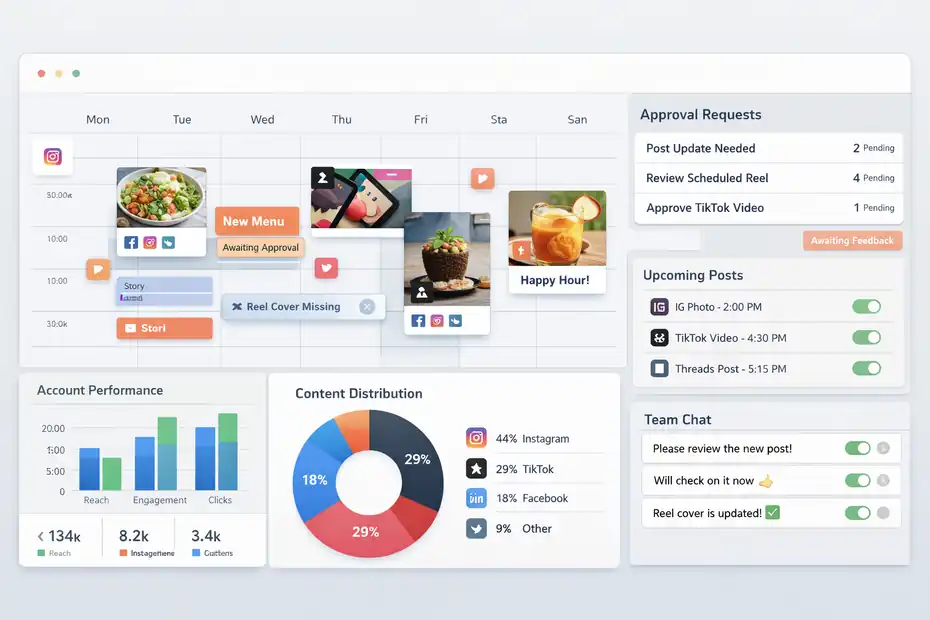
The real test of any agency tool is not the feature page. It is what happens on a random Tuesday when a client changes copy, someone forgets to upload a Reel cover, and three accounts need approval before lunch.
Content Planning And Calendar Management
Later’s calendar-first layout is a major reason agencies like it. Instead of treating social as a spreadsheet exercise, it gives your team a timeline view that makes campaign pacing easier to understand.
- Visual workflow: You can see what is scheduled, what is missing, and where content is clustered too heavily.
- Cross-platform planning: Because supported platforms sit inside the same workspace, your team can plan content themes without switching between native apps.
- Operational clarity: For account managers, this reduces one of the most common agency problems: losing track of what has already been promised to the client.
Imagine you run 12 restaurant accounts. Each one needs four Instagram posts, two Reels, three Stories, a couple of TikToks, and occasional Threads content every month. Without a visual scheduler, your team usually ends up building separate tracking systems outside the posting tool. With Later, much of that coordination can stay inside the calendar itself.
That does not sound dramatic, but it matters. Agencies rarely break because strategy is terrible. They usually break because the workflow becomes messy and expensive.
Client Approvals And Internal Collaboration
Approvals are where many social tools start sounding useful but fall apart in practice. Later does better than many lighter schedulers here.
- Internal approvals: Growth includes internal collaboration and approvals, so your team can assign roles, leave feedback, and keep content moving with in-app and email notifications.
- External approvals: Growth also supports external review workflows, and reviewers do not need a Later login. That is a meaningful quality-of-life feature for agencies because clients often resist learning another platform.
- Custom permissions: Growth and above include custom roles and permissions, which helps when coordinators, designers, and strategists need different levels of access.
I believe this is one of Later’s strongest agency-specific advantages. A lot of client friction comes from approval lag, not from poor content. If your current process involves emailing PDFs, sending screenshots in Slack, or chasing WhatsApp feedback, Later can clean that up quickly.
The limit is that approvals are still only one part of client service. If your client expects legal review, regional sign-off, asset versioning, and deep change history across many stakeholders, you may start to feel the edges of a lighter social-first platform.
The Features Agencies Will Care About Most
Not every Later feature matters equally. For agencies, a few capabilities directly affect profit margins, turnaround time, and retention.
Scheduling, Auto Publishing, And Multi-Profile Coverage
Later supports auto-publishing for major platforms and structures accounts through “Social Sets.” A Social Set includes one profile from each supported platform, and plans scale from 1 set on Starter to 2 on Growth and 6 on Scale.
That means the commercial model is less about one platform at a time and more about grouped brand coverage.
Here is why that matters in real agency terms:
| Plan | Social Sets | Total Profiles | Users | Post Limits |
|---|---|---|---|---|
| Starter | 1 | 8 | 1 | 30 per profile/month |
| Growth | 2 | 16 | 2 | 180 per profile/month |
| Scale | 6 | 48 | 4 | Unlimited |
Source: Later pricing and feature overview.
For a tiny agency with 2 to 4 clients, this can be very cost-effective. For a growing agency with 10 to 20 active retainers, the math becomes more important. Extra Social Sets are available for an added monthly fee, which is helpful, but you should model your cost per client before committing.
A practical shortcut I’d suggest: divide your expected monthly software cost by the number of retained social clients, then compare that against the hours saved in approvals and publishing. If Later saves even 20 to 30 minutes per client per week, it can justify itself fast.
Analytics, Reporting, And Client Communication
Analytics often decide whether a tool feels “professional” to clients. Later includes platform analytics on all plans, but the depth changes a lot by tier.
- Starter: Up to 3 months of platform analytics.
- Growth: Up to 1 year of analytics, which is much better for retention reporting and trend comparisons.
- Scale: Up to 2 years of data plus custom analytics, filters, cross-platform views, shareable reports, competitive benchmarking, future industry insights, brand health, and brand mentions.
This is a big deal because agencies are not just posting content. They are selling confidence. When a client asks, “Are we actually improving?” your reporting experience becomes part of the service.
Still, I would not overstate Later’s reporting power. It looks strongest for social performance reporting and brand monitoring inside the platform’s ecosystem.
If your agency relies on deeply customized client dashboards tied to web analytics, CRM attribution, ecommerce sales layers, and ad performance in one executive view, you may still need a separate reporting stack.
Content Creation Support And UGC Handling
Later also emphasizes content creation helpers like UGC collection, media library organization, and AI caption generation. On paper, that can sound like fluff. In practice, it helps agencies keep assets from becoming scattered.
For example, if you manage a skincare brand with creators, customer testimonials, before-and-after visuals, and brand photography arriving from multiple people, the ability to keep that content close to the publishing workflow matters.
The more disconnected your asset collection is from your scheduling process, the more project management overhead you create.
I would not buy Later just for AI captions. But I would absolutely value it for reducing admin drag around content organization.
Where Later Helps Agencies Scale Faster
This is the part most agency owners care about. Can Later help you take on more clients without immediately hiring more coordinators?
Time Savings In Repetitive Delivery
Later’s biggest scaling benefit is not strategy. It is repeatability.
- Reusable workflow: Monthly social retainers are built on recurring tasks: gathering assets, drafting captions, loading content, getting approvals, publishing, then reporting.
- Centralization: The more of that process you can keep in one system, the less time you waste copying information between tools.
- Lower coordination tax: Instead of asking “Where is the final version?” your team spends more time executing.
Later’s own positioning for agencies leans hard into this idea, promising help with repetitive social tasks, multi-account switching, client approvals, and consolidated management.
Here is a realistic scenario. Say your agency manages eight clients and each account manager spends 45 minutes per client per week on admin-heavy tasks like manual reminders, approval follow-up, and checking post status.
That is six hours a week. Even shaving off 30% of that gives you almost two hours back weekly from one role. Over a month, that becomes enough time to absorb another small retainer or improve reporting quality.
That is what “scaling” usually looks like in agency life. Not magic. Just less friction.
Better Client Experience Without More Meetings
Clients usually do not love social media management tools. They love clarity.
Later’s external approval setup gives agencies a cleaner client-facing process because reviewers can leave feedback without needing full platform access. That removes one of the biggest adoption barriers in agency operations: clients refusing to log into one more system.
That has two practical benefits:
- Faster approvals: Less training means fewer delays.
- Perceived professionalism: A clear review workflow makes your agency look more organized, even if your team is still lean behind the scenes.
I recommend thinking about this from a retention angle. Agencies do not always lose clients because performance is bad. Sometimes the working experience feels sloppy. If Later helps the client feel informed, supported, and less confused, that alone can improve account stability.
Cost Structure That Can Work For Smaller Agencies
Later’s pricing is relatively approachable compared with heavier social suites. The public plans currently start at $18.75 per month billed yearly for Starter, $37.50 for Growth, and $82.50 for Scale, with add-ons for extra Social Sets, users, and AI credits.
For many small agencies, that pricing structure is attractive because:
- It is not enterprise-gated from the start.
- The Growth tier includes the collaboration features agencies actually need.
- The Scale tier adds stronger analytics without forcing a custom sales contract, which Later explicitly calls out.
If you are in the 3-to-10-client range, Later can look like a smart margin-preserving choice.
Where Agencies Start Hitting Limits
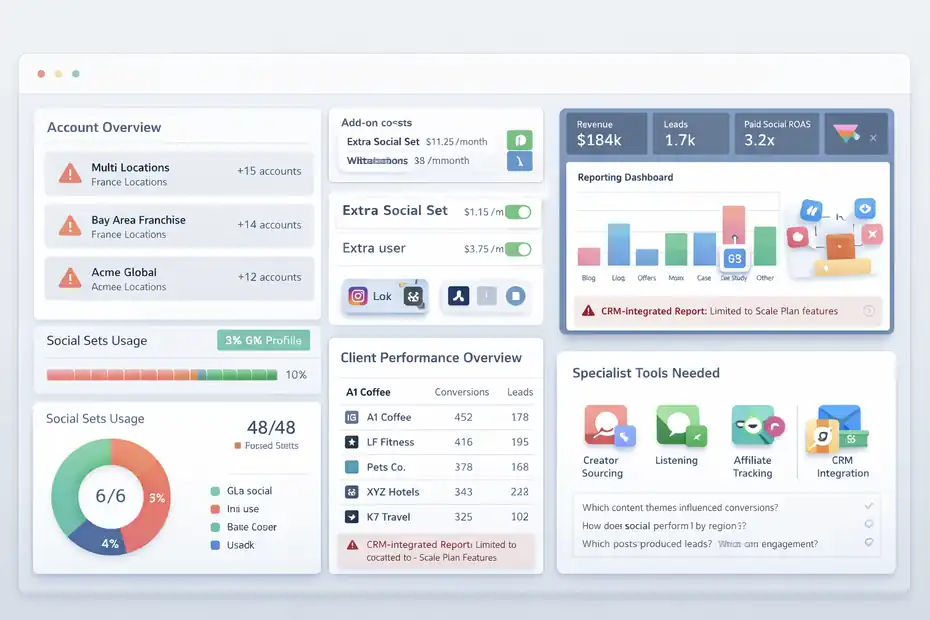
This is where a balanced later review for agencies matters. Later can absolutely help you grow, but it is not infinitely flexible.
Scaling Beyond Mid-Sized Client Loads
The first limit is structural. Social Sets are generous for small rosters, but agencies with many clients will need to model usage carefully. Six Social Sets on Scale equals 48 profiles total across supported networks. That sounds like a lot until you remember one client can easily use four to eight profiles alone.
If your agency serves:
- multi-location brands,
- franchise groups,
- enterprise clients with country-specific accounts,
- or brands with multiple sub-brands,
you may outgrow the default setup sooner than expected.
Yes, add-ons exist. But at that point, you should compare whether the total spend still makes sense versus tools built more explicitly for larger operational complexity.
In other words, Later scales nicely in the early and middle stages. It may feel tighter once you move from “agency with systems” to “agency with layers.”
Reporting Depth For High-Stakes Accounts
Later’s Scale plan adds custom analytics, competitor benchmarking, brand health, and mentions, which is a real step up. But some agencies need more than social reporting. They need blended business reporting.
For example, a client might ask:
- Which content themes influenced assisted conversions?
- How does organic social performance compare by region and buyer stage?
- Which social posts produced qualified leads, not just engagement?
- Can we combine paid, organic, site analytics, and CRM data in one executive summary?
Later is not pretending to be a full business intelligence platform. If that kind of reporting is central to your service offer, you will probably need another analytics layer on top. That does not make Later weak. It just means its strongest reporting value is within social performance management, not full-funnel agency analytics.
Not Every “All-In-One” Need Belongs In One Tool
Later now spans social management, social listening, influencer marketing, and affiliate-related capabilities through the broader company ecosystem after its integration path with Mavrck and the acquisition of Mavely. That makes the brand more expansive than it used to be.
But agencies should be careful here. More product surface does not automatically mean better operational fit.
I suggest separating your needs into two buckets:
- Core delivery needs: planning, approvals, scheduling, reporting, content workflow.
- Specialist needs: creator sourcing, affiliate tracking, advanced listening, sales attribution.
If Later covers your core delivery well, that is often enough. If you expect one login to perfectly solve all specialist agency services too, you may be disappointed.
Pricing, Value, And Margin Math For Agencies
Software reviews become much more useful when you translate features into margin impact. Agencies do not buy platforms. They buy delivery efficiency.
What The Current Plans Mean In Practical Terms
Here is the current public pricing snapshot based on Later’s official pricing page:
| Plan | Yearly-Billed Price | Best For | Key Agency-Relevant Additions |
|---|---|---|---|
| Starter | $18.75/month | Solo operator or 1 small brand | Basic scheduling, 1 user, limited analytics |
| Growth | $37.50/month | Small agency or freelancer with approvals | Internal/external approvals, roles, inbox, UGC, 1 year analytics |
| Scale | $82.50/month | Agency needing stronger reporting | Custom analytics, competitive benchmarking, brand mentions, unlimited posts |
Add-ons include extra Social Sets at $11.25/month each and extra users at $3.75/month each, with pricing billed in USD before applicable taxes.
That is honestly reasonable for many agencies. The catch is not price alone. It is fit.
A Simple Profitability Test Before You Commit
I recommend using a very plain internal test:
- Step 1: Estimate how many billable clients one team member can handle with your current workflow.
- Step 2: Estimate how many they could handle if approvals, scheduling, and reporting became more organized.
- Step 3: Compare the revenue lift against software cost and onboarding friction.
Example: if an account manager currently handles 8 clients and Later helps them handle 10 while maintaining quality, that is a 25% capacity increase. Even with conservative monthly retainer numbers, the ROI can be obvious.
On the other hand, if your agency is already bottlenecked by creative production, strategy, or client comms outside the platform, Later may not move the needle as much as you hope.
The lesson is simple: Later creates leverage when your bottleneck is workflow. It does less when your bottleneck is thinking, talent, or client expectations.
Common Mistakes Agencies Make With Later
A tool can be good and still disappoint you if you use it the wrong way.
Treating Later Like A Complete Agency Operating System
One of the easiest mistakes is expecting Later to replace project management, client communication, reporting, approvals, asset organization, and strategic planning all at once.
That expectation creates frustration. Later is strongest as a social delivery hub, not as your entire agency brain.
A better approach is this:
- Use Later for scheduling, calendar visibility, approvals, and core reporting.
- Keep your larger project management and strategic planning systems separate if needed.
- Decide in advance which team owns platform hygiene, asset naming, and approval deadlines.
When agencies skip that setup discipline, they blame the tool for problems that are actually process issues.
Buying Too Little Plan For Too Much Complexity
Another common mistake is starting too cheap. The Starter plan is fine for simple scheduling, but most agencies will want Growth quickly because approvals, collaboration, and deeper analytics are not “nice to have” once clients enter the picture.
I have seen this pattern many times with agency software in general: a team starts on the entry tier, tries to force a client workflow into it, gets annoyed, then declares the platform weak. In reality, they were evaluating the wrong plan.
For most real agencies, Growth is the minimum serious testing tier.
Ignoring Approval Speed As A Performance Metric
Agencies often obsess over reach, engagement, and follower growth while ignoring the metric that quietly kills capacity: approval lag.
You should measure things like:
- average approval turnaround time,
- percentage of posts approved on first pass,
- revision count by client,
- content published on schedule versus late.
Later’s approval workflow can improve those numbers, but only if your agency actually tracks them. Otherwise, you end up owning a feature without extracting its operational value.
Advanced Tips To Get More Out Of Later
Once you stop treating Later like a simple scheduler, it becomes more useful.
Build Service Packages Around Workflow Efficiency
Later works best when your agency packages services in ways that match the platform’s strengths.
Good examples include:
- monthly social management retainers,
- platform-specific content calendars,
- approval-based content production,
- recurring reporting packages,
- ecommerce content and link-in-bio support.
Later even publishes guidance around social media management packages for agencies and marketers, which fits this service-design logic.
The point is not to copy their packaging ideas. The point is to align your offer with repeatable operations. If your service is standardized enough to move smoothly through planning, approvals, and publishing, Later becomes a multiplier.
Use Reporting To Protect Retention, Not Just Prove Results
A smart agency does not use analytics only to defend performance. It uses analytics to shape the client conversation.
For example:
- show which content categories deserve more budget,
- explain why posting cadence changed,
- highlight platform-specific wins instead of generic vanity metrics,
- compare trends over several months instead of one campaign spike.
Later’s Scale plan is especially useful here because custom analytics and longer historical windows support better storytelling with clients.
That matters because clients rarely churn after one weak month. They churn when they stop understanding the value of the relationship.
Know When To Graduate
This might sound strange in a review, but a good software choice is also one you can outgrow at the right time.
If Later helps you go from disorganized execution to disciplined delivery, that is a win. You do not need it to solve every future problem forever.
I would consider “graduation” signs like:
- you need highly customized multi-source dashboards,
- client account architecture becomes too layered,
- approvals involve complex enterprise governance,
- social becomes only one small part of a much bigger reporting obligation.
That does not mean Later failed. It means it probably did its job.
Final Verdict: Should Agencies Use Later?
Later is a strong choice for agencies that want to scale client social delivery faster without paying enterprise-tool prices too early. Its best strengths are visual planning, multi-platform scheduling, approvals, collaboration, and agency-friendly workflow structure.
Public pricing is approachable, Growth includes the features most agencies actually need, and Scale adds meaningful reporting improvements without immediately forcing a sales-led contract.
Where it hits limits is also clear. If your agency needs deeply customized attribution, complex enterprise governance, huge account architectures, or a true all-in-one business intelligence layer, Later will eventually feel narrow.
Reviews also reflect that pattern: users often praise ease of use, visual scheduling, and time savings, while some point to feature limitations and certain scheduling constraints.
So, can Later help agencies scale clients faster? Yes, especially if your bottleneck is workflow, approvals, and publishing consistency. Can it hit limits? Also yes, especially once your agency grows beyond mid-sized social operations and needs broader reporting or operational depth.
My honest take is this: Later is not the perfect platform for every agency, but it is a very sensible one for many. If you run a social-first agency and want a cleaner path from content plan to published post to client report, it is easy to see the value. If you run a highly complex operation, treat it as a strong delivery layer, not a forever system.
FAQ
Is Later good for agencies managing multiple clients?
Later works well for agencies handling multiple social media accounts because it centralizes scheduling, approvals, and reporting in one platform. It helps reduce manual work and improves workflow visibility, making it easier to manage several clients without constantly switching tools or losing track of content timelines.
What are the main limitations of Later for agencies?
Later can feel limited for agencies with complex reporting needs or large client structures. It focuses mainly on social media workflows, so it may not fully support advanced analytics, deep attribution tracking, or enterprise-level collaboration systems that larger agencies often require.
Does Later support client approval workflows?
Yes, Later includes internal and external approval features, especially on higher-tier plans. Clients can review and approve content without needing full access, which simplifies communication, reduces delays, and helps agencies maintain a more organized and professional workflow.
How does Later help agencies scale faster?
Later helps agencies scale by reducing repetitive tasks like scheduling, content planning, and approval follow-ups. By streamlining these processes, teams can handle more clients without increasing workload significantly, allowing agencies to grow while maintaining consistent service quality.
Is Later worth it compared to other social media tools?
Later is worth it for agencies focused on content-driven social media management. It offers strong value in scheduling, collaboration, and ease of use. However, agencies needing advanced analytics or full marketing automation may need additional tools alongside it.

I’m Juxhin, the voice behind The Justifiable.
I’ve spent 6+ years building blogs, managing affiliate campaigns, and testing the messy world of online business. Here, I cut the fluff and share the strategies that actually move the needle — so you can build income that’s sustainable, not speculative.
Related posts:
 The Role of Social Media in Digital Marketing: How to Maximize Your Online Presence
 Sprout Social Competitors You Didn’t Know Existed
 How to Promote a Business
 How to Increase Social Media Followers
 Later Review For Small Business: Can It Actually Save You Time?
 Honest Later Review For Instagram Marketing: Real Growth Or Hype?