
Table of Contents
Some links on The Justifiable are affiliate links, meaning we may earn a small commission at no extra cost to you. Read full disclaimer.
B2B Commerce the Key to Your Next Revenue Jump. When I first started exploring B2B commerce, I quickly realized it wasn’t just a buzzword—it was a complete shift in how companies buy, sell, and grow.
Unlike traditional sales, B2B commerce blends technology, data, and relationships to open entirely new revenue streams.
Whether you’re a manufacturer, wholesaler, or service provider, the question isn’t if you should invest in B2B commerce—but how soon you can start scaling through it.
In this outline, we’ll unpack the strategies, opportunities, and key shifts that make B2B commerce one of the most powerful growth levers for modern businesses.
Understanding What Makes B2B Commerce So Powerful
When I first started exploring B2B commerce, what struck me most was how it transforms complexity into opportunity.
It’s not just selling between businesses—it’s an ecosystem built on efficiency, data, and long-term partnerships.
The Core Difference Between B2B and B2C Models
The key difference between B2B (business-to-business) and B2C (business-to-consumer) commerce lies in how transactions are made and why customers buy.
In B2C, decisions are often emotional and fast—think of buying a new gadget because it looks cool. B2B, on the other hand, is strategic. Buyers evaluate ROI, scalability, and long-term support before signing a contract.
Here’s what makes B2B unique:
- Longer Sales Cycles: Purchases involve multiple decision-makers, approvals, and often negotiations.
- Higher Order Values: Transactions typically involve large quantities or recurring contracts.
- Custom Pricing: Deals are rarely “one size fits all.” B2B commerce platforms allow tailored pricing and quoting systems.
In my experience, once a B2B company understands these nuances and adapts its digital experience accordingly, it unlocks a new level of growth.
Why Digital Transformation Is Accelerating B2B Growth
Digital transformation has turned B2B commerce from an operational task into a strategic advantage. Companies now use digital tools not just to sell, but to connect, analyze, and predict.
Think about this: According to McKinsey, over 70% of B2B buyers prefer remote or digital interactions over face-to-face ones. That’s a complete reversal from just a few years ago.
Here’s how digital transformation fuels growth:
- 24/7 Availability: Online platforms let buyers place orders anytime, removing dependence on sales reps.
- Smarter Data: Integrated CRMs and analytics give businesses insights into what clients want before they ask.
- Reduced Errors: Automation cuts down on manual entry, ensuring accuracy in pricing and orders.
I often suggest starting small—digitize your quoting or inventory first. Once you see the time saved, scaling the rest becomes a no-brainer.
The Hidden Efficiency Gains Driving Higher Margins
Behind every successful B2B commerce strategy is a web of invisible efficiencies that boost profits.
Automation and integration are the unsung heroes here. When your ERP (Enterprise Resource Planning) system talks to your CRM (Customer Relationship Management) tool, things move faster, cleaner, and cheaper.
Some hidden margin boosters include:
- Reduced Labor Costs: Automated invoicing and payment systems free up staff for higher-value tasks.
- Fewer Returns and Errors: Digital catalogs and accurate stock data reduce order mistakes.
- Smarter Procurement: Predictive analytics helps you restock before demand spikes, minimizing costs.
From what I’ve seen, companies that embrace these backend efficiencies often see margin improvements of 10–20% within the first year of implementation.
How B2B Commerce Expands Revenue Opportunities
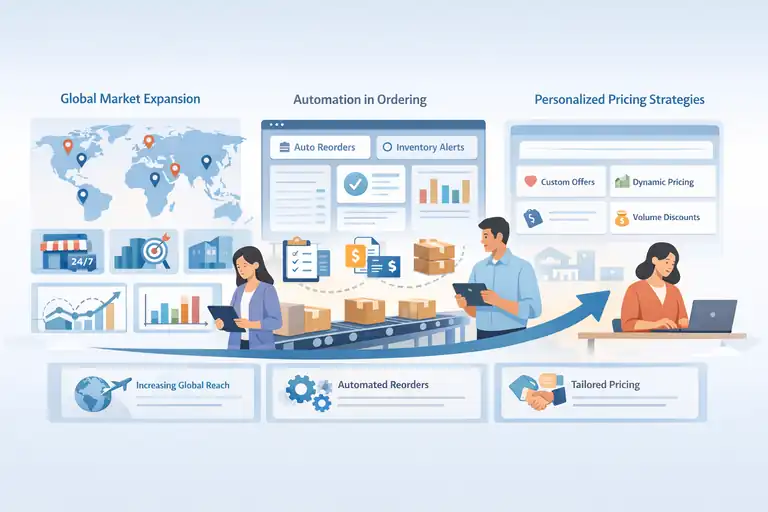
B2B commerce isn’t just about keeping up—it’s about scaling up. With the right strategy, businesses can reach new customers, increase order values, and create recurring revenue streams.
Unlocking New Market Segments Through Digital Channels
Going digital opens doors that traditional sales teams can’t always reach.
Imagine a small parts manufacturer that once relied solely on phone orders. By building an online B2B portal, they can now sell globally, 24/7, to distributors who prefer self-service.
Key benefits of expanding online:
- Global Reach: Tap into markets without setting up a physical presence.
- Micro-segmentation: Target niche industries using data-driven advertising.
- Faster Market Testing: Launch new products online with minimal risk.
One company I worked with used this approach and grew its international sales by 35% in just six months—simply by making its catalog digitally searchable.
The Role of Automation in Increasing Order Volume and Value
Automation doesn’t just save time—it multiplies revenue.
When repeat orders and reorders are automated, your team focuses less on admin and more on strategic sales. For example, automatic stock replenishment ensures that customers never run out of essential supplies.
Practical automation ideas:
- Reorder Reminders: Triggered by usage patterns or stock levels.
- Smart Invoicing: Reduces delays and improves cash flow.
- Cross-Sell Suggestions: Automated recommendations based on buying history.
In my experience, introducing just one automation—like auto-ordering consumables—can lift revenue per customer by 10–15% almost instantly.
Personalization and Dynamic Pricing as Revenue Drivers
Personalization isn’t just for retail—it’s transforming B2B too.
By tailoring catalogs, pricing, and offers to each buyer’s history or behavior, you create loyalty and reduce churn. Dynamic pricing tools can even adjust prices in real time based on demand, stock, or customer tier.
Here’s how it helps:
- Custom Experience: Each client sees only what’s relevant to them.
- Volume Discounts: Encourage larger orders automatically.
- Tiered Pricing Models: Reward long-term or high-volume clients.
One logistics supplier I spoke with implemented dynamic pricing and saw a 22% increase in average order size—all because clients felt they were getting tailored deals.
Proven B2B Commerce Strategies That Boost Profitability
The best B2B commerce strategies don’t reinvent the wheel—they optimize every spoke.
It’s about connecting the dots between sales, marketing, and data to create a seamless, scalable revenue engine.
Implementing Omnichannel Selling for Greater Reach
Omnichannel selling means meeting your buyers wherever they are—email, web, app, or even through a digital marketplace.
The key is consistency. No matter where a client interacts with your brand, their experience should feel unified.
What to focus on:
- Unified Inventory: Real-time stock levels across all platforms.
- Seamless Communication: Shared data between sales and support.
- Mobile-Friendly Portals: 70% of B2B buyers now research via mobile devices.
If you ask me, even a small business can go omnichannel—start by syncing your e-commerce platform with your CRM and email system.
Using Data-Driven Insights to Optimize Buyer Journeys
B2B commerce runs on data. The more you understand your buyer’s habits, the better you can serve—and sell to—them.
Analytics tools show where customers drop off, what products they explore most, and how they make decisions.
Actionable ways to use this data:
- Identify slow-moving inventory and promote it strategically.
- Spot top buyers and reward loyalty with exclusive offers.
- Use heatmaps and behavior analytics to refine your UX.
From what I’ve seen, even simple analytics can reveal powerful insights—like discovering that your top buyers are using mobile but your checkout isn’t optimized for it.
Leveraging Subscription and Reorder Models for Consistent Cash Flow
Recurring revenue is the holy grail of B2B commerce. Subscriptions and reorders ensure predictable income while keeping clients loyal.
Common models that work:
- Consumable Products: Offer auto-renewal or scheduled deliveries.
- Maintenance Services: Package support and upgrades on a monthly plan.
- Software Licensing: Move from one-time sales to subscription-based access.
One industrial supplier I advised introduced automated reorder scheduling and saw its monthly recurring revenue jump by 40% within a quarter. Customers loved not having to remember to reorder.
Pro tip: Test one recurring offer before rolling out across your catalog. Measure adoption and refine the process—it’s better to grow steady than chase quick wins.
How Technology Shapes the Future of B2B Commerce
Technology isn’t just supporting B2B commerce anymore—it’s defining it.
Every advancement, from artificial intelligence to cloud infrastructure, is transforming how companies sell, predict demand, and build relationships.
Integrating AI and Machine Learning for Smarter Sales Decisions
AI (artificial intelligence) and ML (machine learning) are like having a sales analyst that never sleeps. These tools don’t just process data—they learn from it, helping you anticipate buyer needs and improve decision-making.
How AI transforms B2B sales:
- Predictive Insights: AI can forecast which leads are most likely to convert or which customers might churn.
- Personalized Recommendations: It analyzes purchasing behavior and suggests relevant products automatically.
- Automated Quoting: Machine learning can adjust quotes based on historical pricing and negotiation outcomes.
I’ve seen B2B platforms like Salesforce Einstein or Adobe Experience Cloud drive conversion rates up by as much as 25% simply by delivering smarter product recommendations and automating outreach timing.
The key here is balance—use AI to support human judgment, not replace it. Let the algorithms handle the repetitive work while your sales team focuses on relationship building.
The Impact of Cloud-Based ERP and CRM Systems
Cloud-based ERP (Enterprise Resource Planning) and CRM (Customer Relationship Management) systems are the backbone of modern B2B commerce.
They centralize data, streamline operations, and ensure every department works from the same real-time information.
Here’s why the shift to cloud is a game-changer:
- Accessibility: Your team can access data anytime, anywhere—ideal for hybrid or remote work models.
- Scalability: Cloud solutions grow with your business, adding new modules or integrations easily.
- Cost Efficiency: You pay for what you use, without massive upfront infrastructure investments.
For instance, one manufacturing firm I worked with switched from a legacy ERP to a cloud-based solution like NetSuite. Within months, they cut order processing time by 40% and improved fulfillment accuracy across multiple regions.
In my experience, integrating ERP and CRM into one ecosystem also eliminates redundant work—no more updating three different systems after every sale.
Why Seamless API Integrations Are the Backbone of Modern B2B
APIs (Application Programming Interfaces) are what let your systems talk to each other. Without them, your tech stack becomes a maze of disconnected tools that slow everything down.
Why seamless integration matters:
- Real-Time Sync: APIs keep product data, stock levels, and pricing consistent across platforms.
- Customer Transparency: Buyers can see live inventory, accurate shipping times, and updated pricing instantly.
- Reduced Manual Work: Automated data sharing between ERP, CRM, and e-commerce platforms prevents human errors.
A simple example: connecting your e-commerce portal with your accounting software via an API means invoices are automatically generated when an order is placed. No delays. No manual entry.
I always tell clients—if your tools can’t talk to each other, your business will never move at digital speed. Start with essential integrations and expand from there.
Key Challenges That Can Hinder B2B Commerce Growth
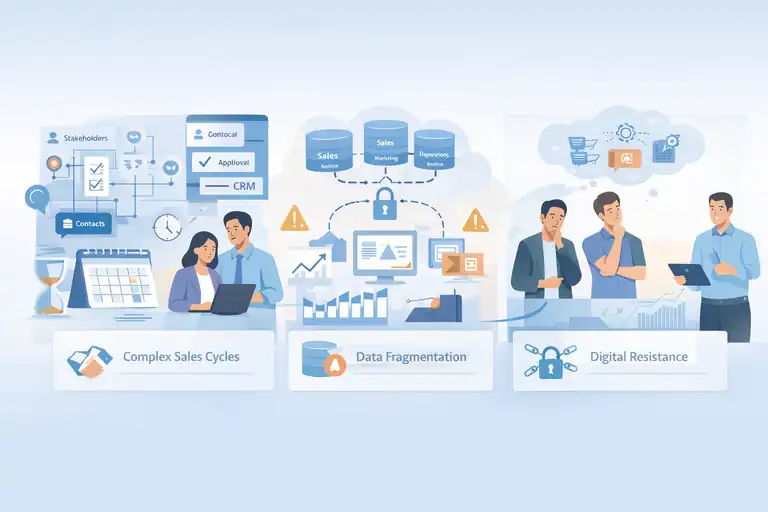
Even the best B2B commerce strategy can stumble without addressing internal and structural challenges.
The good news? Most of these roadblocks are fixable once you recognize them early.
Managing Complex Buyer Relationships and Long Sales Cycles
B2B buyers rarely make impulse purchases. Deals can stretch over weeks—or even months—because of multiple stakeholders, budget approvals, and compliance checks.
Here’s how to manage that complexity:
- Account Mapping: Identify all decision-makers early on and understand their priorities.
- CRM Automation: Use your CRM to track every touchpoint and maintain visibility across teams.
- Regular Check-Ins: Consistent, value-driven communication keeps deals from going cold.
One company I consulted struggled with stalled negotiations until they started using automated follow-ups triggered by inactivity. Within 60 days, they recovered nearly 30% of deals that had previously gone dark.
It’s about staying present without being pushy—automation helps you do that naturally.
Addressing Data Silos and Fragmented Technology Stacks
When data lives in separate systems, no one sees the full picture. Sales might have one set of figures, marketing another, and operations something completely different.
This lack of visibility leads to inefficiency and missed opportunities.
Ways to break down silos:
- Unified Data Platform: Choose systems that integrate natively or via middleware like Zapier.
- Central Reporting Dashboard: Use tools like Power BI or Tableau for shared visibility.
- Data Hygiene Routine: Regularly clean and update databases to maintain accuracy.
From what I’ve seen, companies that unify their data often experience faster decision-making and better cross-department collaboration. It’s not just about tools—it’s about alignment.
Overcoming Internal Resistance to Digital Adoption
Sometimes, the biggest challenge isn’t technology—it’s mindset. Many teams are used to manual workflows and see digital transformation as a threat, not a solution.
How to drive adoption:
- Start Small: Introduce one digital improvement at a time, like online quotes or automated invoicing.
- Show Quick Wins: Demonstrate measurable results early to build internal confidence.
- Train Continuously: Provide practical workshops, not just technical manuals.
I remember a client’s logistics team initially refusing to use their new digital order system. But after a few sessions showing how it saved hours of manual tracking, adoption hit 95% in three months.
The truth is, people don’t resist change—they resist confusion. Make technology approachable, and the rest follows.
Expert Tips for Building a High-Converting B2B Commerce Strategy
Building a high-converting B2B commerce strategy isn’t about chasing trends—it’s about aligning people, processes, and platforms around what your buyers truly value.
Aligning Sales, Marketing, and IT Around Common KPIs
Departments often chase different goals, which creates friction. Aligning KPIs (Key Performance Indicators) helps everyone move in the same direction.
Example KPIs to align on:
- Conversion rate per segment
- Customer acquisition cost (CAC)
- Average deal size and sales velocity
- Buyer retention and satisfaction scores
In my experience, when IT understands what sales is optimizing for—and marketing has visibility into conversion data—teams stop competing and start collaborating. Use regular cross-department meetings to share insights and progress.
Simplifying the Buying Process to Reduce Friction
The simpler the process, the faster the sale. Modern B2B buyers expect self-service convenience similar to B2C experiences.
Here’s how to streamline:
- Reduce Clicks: Limit checkout steps and simplify registration.
- Offer Guest Quotes: Let prospects explore pricing before committing.
- Enable Real-Time Support: Add chatbots or instant messaging for quick questions.
One industrial brand I advised reduced checkout fields from 14 to 6—and saw a 27% boost in completed orders. Sometimes, it’s the smallest usability tweak that drives the biggest results.
Prioritizing Mobile and Self-Service Capabilities for Buyers
Mobile-first design isn’t optional anymore—it’s how most B2B buyers now research, compare, and even order products.
Steps to strengthen mobile and self-service:
- Ensure your site loads fast and adapts perfectly to mobile screens.
- Build self-service dashboards where buyers can view past orders, track shipments, and manage invoices.
- Add AI chat assistants that help with common queries or reorders.
According to Gartner, 80% of B2B sales interactions will occur through digital channels by 2025. In other words, your digital storefront is your sales rep.
A good self-service experience makes buyers feel empowered. And when they feel in control, they buy more—plain and simple.
Measuring the ROI of Your B2B Commerce Investment
One of the biggest mistakes I see businesses make is investing in B2B commerce platforms without defining how success will be measured.
It’s not enough to know your sales went up—you need to understand why they did and whether that growth is sustainable.
Setting the Right Performance Metrics and Benchmarks
Before diving into metrics, take a step back and ask yourself: What does success look like for us? Every business has different priorities—some want more customers, while others focus on improving margins or retention.
Key performance indicators (KPIs) worth tracking:
- Average Order Value (AOV): Measures how much customers spend per transaction.
- Conversion Rate: Tracks how many site visitors become paying customers.
- Customer Acquisition Cost (CAC): Helps you measure how efficiently you attract new clients.
- Sales Velocity: Shows how quickly leads turn into closed deals.
I once worked with a distributor who tracked only revenue growth but overlooked AOV. After introducing targeted upselling through their B2B portal, they increased AOV by 18% within a quarter—without gaining a single new customer.
It’s about choosing metrics that match your goals and benchmarking regularly so you can spot trends early.
Tracking Customer Lifetime Value and Retention Rates
Customer Lifetime Value (CLV) is one of the most powerful metrics in B2B commerce. It tells you how much a customer is worth over their entire relationship with your company.
Simple formula to calculate CLV: CLV = (Average Purchase Value × Purchase Frequency × Customer Lifespan) – Acquisition Cost
Tracking this helps you focus not just on new customers but on keeping existing ones happy.
Retention is another key signal. According to Bain & Company, increasing customer retention by just 5% can boost profits by 25–95%. That’s huge.
Practical ways to boost retention:
- Offer loyalty discounts or exclusive pricing tiers.
- Provide dedicated account managers for top clients.
- Use post-purchase surveys to improve experience continuously.
From what I’ve seen, B2B companies that track CLV and retention together tend to invest more wisely in customer experience—and that’s what builds long-term revenue.
Using Analytics to Identify New Revenue Streams
Data analytics isn’t just for reporting—it’s a roadmap for future growth. With the right insights, you can uncover new opportunities that weren’t obvious before.
Examples of how analytics reveal new revenue streams:
- Spot frequently purchased product combinations and bundle them.
- Identify markets or industries showing unexpected interest in your catalog.
- Monitor search queries within your platform to discover unmet demand.
One client noticed that many of their industrial customers were searching for “eco-friendly materials” on their site. They added a small line of sustainable products—and those items now account for 12% of their total sales.
The lesson? Analytics doesn’t just tell you what’s happening—it shows where to go next.
The Future Landscape of B2B Commerce in 2025 and Beyond
The future of B2B commerce looks smarter, faster, and more values-driven than ever.
As technology evolves, so do buyer expectations, and businesses that adapt quickly will dominate the next decade.
How AI-Powered Platforms Will Redefine Buyer Expectations
AI is moving from optional to essential in B2B commerce. Buyers increasingly expect personalized, predictive, and seamless digital experiences—similar to what they get in B2C.
How AI is reshaping B2B buying:
- Predictive analytics suggests products before the buyer searches for them.
- Natural language chatbots guide complex orders or provide instant support.
- Smart pricing adjusts dynamically based on demand and client status.
Imagine logging into a supplier portal that already knows what you need to restock and offers it at your negotiated price. That’s not science fiction—it’s already happening in advanced B2B systems like SAP Commerce Cloud and Oracle CX.
I believe the real shift won’t just be in automation but in anticipation. AI will make commerce feel proactive instead of reactive.
The Rise of Sustainable and Ethical B2B Buying Practices
Sustainability isn’t a nice-to-have anymore—it’s a competitive differentiator. Buyers are actively choosing suppliers who align with their environmental and social values.
Trends driving sustainable B2B commerce:
- Preference for low-carbon shipping options and recyclable packaging.
- Transparency around sourcing and labor practices.
- Integration of sustainability ratings within procurement software.
For example, a mid-sized construction supplier I advised started offering eco-certified materials. Within six months, they became the preferred vendor for two large corporate clients committed to green sourcing.
This isn’t just good PR—it’s smart business. Sustainable practices lower waste, attract conscious buyers, and often qualify for tax incentives or partnerships.
Preparing Your Business to Stay Competitive in a Digital-First Market
The businesses that thrive in the coming years will be those that treat digital commerce as a strategy, not a side project.
Ways to future-proof your B2B business:
- Adopt Scalable Platforms: Choose technology that can grow with you, not limit you.
- Invest in Data Security: As transactions grow, so does the risk. Build trust through transparency and compliance.
- Empower Your Team: Regularly train staff to use new tools and interpret data insights effectively.
I often tell clients: think of digital transformation as a marathon, not a sprint. Keep evolving, testing, and improving—because in B2B, standing still is the fastest way to fall behind.
Final Thoughts: Turning B2B Commerce Into a Growth Engine
If there’s one thing I’ve learned about B2B commerce, it’s that success isn’t about having the biggest platform—it’s about using it intelligently.
When strategy, technology, and people align, growth becomes inevitable.
Why Early Adopters Gain a Long-Term Competitive Edge
Businesses that move early into digital B2B commerce consistently outperform those that wait. They gain real-time insights, lock in customer loyalty, and establish brand authority before competitors catch up.
According to Deloitte, digital leaders in B2B grow revenue at five times the rate of digital laggards. That’s not coincidence—it’s compounding innovation.
Early adoption also gives you time to experiment and refine before the market floods with competitors. It’s easier to lead than to play catch-up later.
How Continuous Innovation Keeps Your Commerce Model Scalable
A successful B2B strategy is never static. Buyer behavior, technology, and expectations evolve constantly.
Here’s how to stay adaptable:
- Regularly review and optimize your digital workflows.
- Use A/B testing to refine site experience and messaging.
- Encourage innovation internally—let teams suggest process improvements.
One global supplier I worked with updates their B2B site every quarter, adding new features based on user feedback. That constant evolution keeps them ahead, both in experience and profitability.
Innovation doesn’t have to be revolutionary—sometimes it’s just about removing a friction point that slows down the buyer journey.
Pro Tip: Start Small, Measure Fast, and Scale What Works
If I could leave you with one practical takeaway, it’s this: Don’t wait for perfection.
Start with one improvement—a smarter quoting tool, a more intuitive product catalog, or a faster checkout process. Measure its impact, learn from it, then scale the winning ideas.
That’s how sustainable growth happens in B2B commerce: step by step, insight by insight.
From what I’ve seen, the companies that thrive are the ones that stay curious, humble, and agile. And that’s the real secret behind every great revenue jump.
FAQ
What is B2B commerce and how does it work?
B2B commerce, or business-to-business commerce, involves online transactions between companies. It streamlines purchasing, automates workflows, and enables businesses to buy and sell directly through digital platforms.
How can B2B commerce increase revenue?
B2B commerce boosts revenue by expanding market reach, improving customer retention, and using automation to handle more orders efficiently. Personalized pricing and self-service portals also drive higher sales volumes.
What technologies drive B2B commerce growth?
Key technologies include AI for predictive insights, cloud-based ERP and CRM systems for efficiency, and APIs that connect sales, inventory, and payment data across platforms. These tools make operations faster and more profitable.

I’m Juxhin, the voice behind The Justifiable.
I’ve spent 6+ years building blogs, managing affiliate campaigns, and testing the messy world of online business. Here, I cut the fluff and share the strategies that actually move the needle — so you can build income that’s sustainable, not speculative.
Related posts:
 How a Skilled B2B eCommerce Developer Adds Value
 B2B Ecommerce Guide: How to Sell Smarter Online
 Advantages of a Dropshipping Company: Genuine Business Knowledge
 Ecommerce Strategy Boost: 8 Simple Steps to Increase Profits
 What Is Headless Commerce and Why Does It Matter?
 B2B Ecommerce Platforms That Power Serious Growth