
Table of Contents
Some links on The Justifiable are affiliate links, meaning we may earn a small commission at no extra cost to you. Read full disclaimer.
Bluehost pricing is one of the most searched topics for anyone considering web hosting. With so many options—shared hosting, VPS, dedicated servers, and WordPress hosting—the real challenge is figuring out which plan gives the best value.
Is Bluehost truly affordable while still delivering performance and features, or do the costs add up in ways you don’t expect?
Let’s break down every Bluehost plan, review its pros and cons, and see where the real value lies.
Bluehost Shared Hosting Pricing Plans Explained
Shared hosting is often the first stop for anyone dipping their toes into websites. Bluehost pricing for shared hosting is built to be budget-friendly without stripping away the essentials.
You’ll find three main plans—Starter, Business, and Ecommerce Essentials—each stacking more features on top of the last. Let’s unpack what you actually get.
What You Get With Starter, Business, and Ecommerce Essentials
- Starter: This is the barebones option, perfect if you just want one website live without paying much. You get a free domain for the first year, free SSL (that little padlock in your browser bar), and 10 GB NVMe storage. It’s lean, but it works if your site is small.
- Business: Here’s where things start to feel more professional. You can host up to 50 websites, storage jumps to 50 GB, and you also get free CDN (Content Delivery Network) which helps speed up loading times globally.
- Ecommerce Essentials: This plan is clearly angled at online sellers. You can host up to 100 sites with 100 GB storage, WooCommerce support, and built-in ecommerce tools that make selling smoother.
I’d say the Starter plan is like dipping your feet in the pool. The Business plan is swimming with floaties. Ecommerce Essentials? That’s diving headfirst with goggles, ready to play.
Comparing Features Like Storage, Domains, and Monthly Visits
If you’re wondering what separates these plans besides the obvious pricing, here’s a snapshot:
| Plan | Websites | Storage | Monthly Visits | Extras |
| Starter | 1 | 10 GB | ~15k | Free SSL, Free Domain |
| Business | 50 | 50 GB | ~200k | Free CDN, SSL, 1 Month Pro Email |
| Ecommerce Essentials | 100 | 100 GB | ~200k | WooCommerce, SSL, CDN |
The jump isn’t just in numbers—it’s in capacity. Imagine traffic doubling or tripling on your site. With the Starter plan, you’ll feel that pinch fast. The higher tiers give breathing room.
Pros and Cons of Choosing Shared Hosting Over Other Plans
Pros:
- Cheapest way to get started (Starter plan is under €3/month if you sign long-term).
- Includes key freebies: domain, SSL, and CDN.
- Easy for beginners—no server management headaches.
Cons:
- Shared resources can mean slower performance if your neighbors hog bandwidth.
- Storage caps are tight on Starter and Business.
- Renewal rates are higher than the promotional prices.
It’s a bit like renting an apartment. Cheap at first, everything’s included, but you’re sharing walls, water pressure, and sometimes noisy neighbors.
Who Should Choose Bluehost Shared Hosting?
I believe shared hosting is perfect if you’re:
- Launching a personal blog or small portfolio site.
- Running a local business site that won’t see more than 10–20k visits monthly.
- Testing the waters of ecommerce before investing in something bigger.
If you already know your site will be heavy on traffic, images, or online sales, I suggest skipping straight to High Performance or VPS hosting. It saves the hassle of migrating later.
Bluehost High Performance Hosting: Worth the Upgrade?
If shared hosting feels like training wheels, Bluehost High Performance hosting is the step where you add suspension, gears, and stronger tires.
Pricing here jumps, but so do the benefits. The key question is: is it worth paying extra?
Key Features That Justify the Higher Price
High Performance plans are designed to handle heavier loads. Here’s what makes them stand out:
- More Power: You get up to 10x the CPU power compared to shared hosting. This means faster load times under stress.
- Bigger Storage: NVMe storage ranges from 100 GB to 250 GB depending on the tier.
- Higher Traffic Allowance: Plans support ~400k visits monthly, which is massive compared to shared hosting.
- Freebies Stacked In: Domain, SSL, CDN, and Pro email trial are included.
For context, if you run a small business site with 100 products and regular blog posts, this tier ensures you don’t slow to a crawl when 50 people hit your site at once.
How Performance Hosting Differs From Standard Plans
- Standard Shared Hosting: You’re on the same server with many websites, pulling resources from the same pool.
- High Performance Hosting: You get prioritized resources, so even when others on the server spike traffic, your site stays fast.
Think of it like flying economy vs. premium economy. You’re still on the same plane, but your seat is bigger, meals come faster, and you don’t feel cramped.
Pros and Cons of High Performance Hosting
Pros:
- Serious speed upgrades under high traffic.
- Storage and bandwidth scale up to support growth.
- Handles ecommerce and content-heavy sites much better.
Cons:
- Pricing is significantly higher—starting around €10.99/month and going above €40/month.
- Overkill for small, low-traffic websites.
- Still technically “shared,” so you don’t have full control like with VPS.
It’s like paying for a sports car to drive to the corner store—you’ll love the horsepower, but it’s wasted if you only need short trips.
Is It a Smart Investment for Growing Businesses?
I suggest High Performance hosting if you’re:
- Running a medium-sized ecommerce store with daily sales.
- Growing a blog or content site with 100k+ monthly readers.
- A small business relying on the website as your main storefront.
From what I’ve seen, this upgrade often pays for itself. Faster sites improve conversion rates and SEO rankings, so even a 1–2 second speed boost can translate into real money.
But if you’re not expecting serious traffic or sales, shared hosting still gets the job done at a fraction of the cost.
Bluehost Commerce Plans for Online Stores
If you’re planning to sell products online, Bluehost pricing for its Commerce plans can save you from the headache of bolting tools together yourself.
These plans are built with WooCommerce already baked in, so you’re not starting from scratch.
The question is: do you go with the Essential plan or the Premium one?
Essential vs Premium Commerce Pricing: What’s Included
Here’s what you’re really comparing:
| Plan | Storage | Domains | Extras | Monthly Price (36mo) |
| Ecommerce Essentials | 100 GB | 1 free | WooCommerce basics, free SSL, free CDN, email trial | ~€9.99 |
| Ecommerce Premium | 100 GB | 1 free | Everything in Essentials + advanced store tools (subscriptions, bookings, customizable products) | ~€18.79 |
Both come with NVMe storage (faster than traditional SSDs), free SSL for secure checkouts, and a free domain for the first year. The Premium plan stands out if you want to offer complex features like memberships or appointment bookings.
From experience, I’d say Essentials is plenty if you’re just listing products and selling them. Premium makes sense once you want automation, recurring revenue, or advanced customization.
Tools for WooCommerce and E-Commerce Growth
Here’s where Bluehost’s Commerce plans shine:
- Pre-installed WooCommerce: No fiddling with setup—just log in and your store skeleton is ready.
- Yoast SEO pre-integrated: Helps optimize product pages for search engines without needing a plugin hunt.
- Email marketing tools: Create campaigns right from your dashboard to promote new products.
- Free CDN: Speeds up your product pages for international buyers.
It’s all manageable from the Bluehost dashboard. You’ll find an “Online Stores” tab that centralizes WooCommerce settings, which is much easier than juggling multiple plugins on your own.
Pros and Cons of Bluehost Commerce Hosting
Pros
- WooCommerce already integrated, saving hours of setup.
- Affordable pricing compared to building a store manually.
- Security features (SSL, CDN) included by default.
- Premium plan includes advanced features like subscriptions and bookings.
Cons
- Both plans cap storage at 100 GB, which could feel tight if you host lots of high-resolution product images.
- Some premium WooCommerce add-ons are still paid, even on the Premium plan.
- Pricing renewals nearly double after the first term.
In short: It’s plug-and-play ecommerce, but not unlimited growth without eventually upgrading.
Best Fit: Which Type of Online Seller Benefits Most?
- Ecommerce Essentials: Great if you’re a small business or side hustler selling under 50 products, like handmade crafts or digital downloads.
- Ecommerce Premium: Best for service-based sellers (like booking yoga classes) or subscription businesses (like monthly product boxes).
If you’re just dipping into online selling, I suggest starting with Essentials—you can always upgrade once sales justify it.
Bluehost VPS Hosting Pricing and Features
Now let’s talk about VPS hosting, the sweet spot between shared hosting and full-on dedicated servers. Bluehost pricing here feels like a step up, but you get real horsepower.
VPS stands for Virtual Private Server, which means you’re still on a shared machine but with guaranteed resources reserved just for you.
Standard, Enhanced, and Ultimate VPS Compared
Here’s a breakdown of Bluehost VPS tiers:
| Plan | CPU Cores | Storage | RAM | Bandwidth | Monthly Price (36mo) |
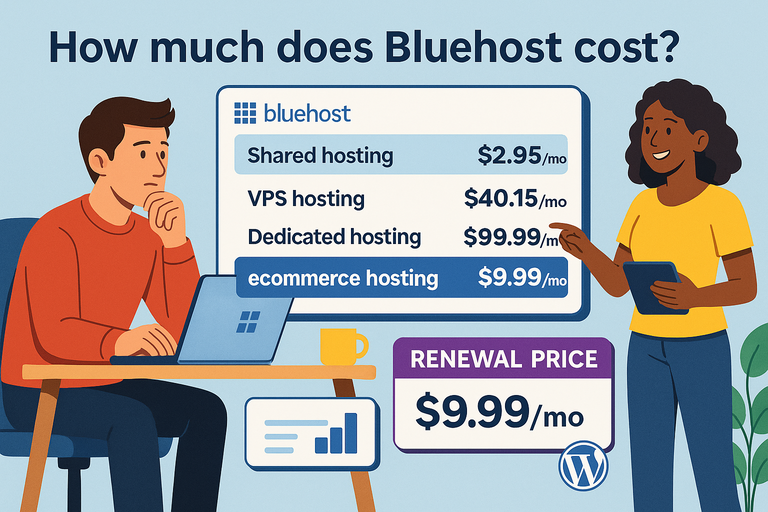
| Standard | 2 | 100 GB | 4 GB | Unmetered | ~€40.15 |
| Enhanced | 4 | 200 GB | 8 GB | Unmetered | ~€56.39 |
| Ultimate | 8 | 450 GB | 16 GB | Unmetered | ~€81.17 |
All three include a dedicated IP address and cPanel license, which is a big win for control and ease of management.
Resources Like CPU, RAM, and Storage Explained
- CPU Cores: More cores = more simultaneous processing. If you expect lots of people browsing at once, Enhanced or Ultimate is your friend.
- RAM: Think of this as your store’s short-term memory. 4 GB is fine for smaller sites, but 16 GB gives breathing room for resource-heavy apps.
- Storage: With 450 GB NVMe on Ultimate, you can comfortably host large databases, media-heavy websites, or multiple clients.
- Unmetered Bandwidth: This basically means you won’t get billed for spikes in traffic, which is reassuring during promotions or viral content surges.
From a hands-on perspective, the cPanel interface makes managing VPS much less intimidating. You can restart your server, allocate resources, and install apps with a few clicks.
Pros and Cons of VPS Hosting With Bluehost
Pros
- Dedicated resources, so you don’t feel the drag of “noisy neighbors.”
- Scalable for mid-sized ecommerce sites or busy blogs.
- Full control with cPanel, without the complexity of bare-metal servers.
- Strong performance for the price compared to dedicated hosting.
Cons
- Significantly more expensive than shared or high performance hosting.
- Not fully customizable—you’re still in a managed environment.
- Requires more technical knowledge than shared hosting (though cPanel softens the blow).
So while it’s powerful, VPS isn’t for “set it and forget it” beginners.
When VPS Hosting Is the Right Choice for Your Site
I believe Bluehost VPS is the right fit if you:
- Run an established ecommerce store expecting thousands of transactions monthly.
- Host membership or community sites where users log in simultaneously.
- Manage multiple client websites and need stable performance across the board.
If you’re starting fresh with a single blog or portfolio, VPS is overkill. But if you’ve outgrown shared hosting and feel your site straining under traffic, VPS is the logical next step before investing in a dedicated server.
Bluehost Dedicated Hosting Plans Reviewed
Dedicated hosting is Bluehost’s top-shelf option—the hosting equivalent of buying the whole building instead of renting an apartment.
It’s expensive, yes, but you get every ounce of power for yourself. Let’s break down what you actually get for the price.
Comparing Dedicated Server Tiers and Pricing
Here’s how Bluehost lays out its dedicated server plans:
| Plan | CPU Cores | Storage | RAM | Bandwidth | Monthly Price (36mo) |
| Standard | 4 cores | 500 GB (RAID1) | 4 GB | 5 TB | ~€120+ |
| Enhanced | 4 cores | 1 TB (RAID1) | 8 GB | 10 TB | ~€160+ |
| Premium | 4 cores | 1 TB (RAID1) | 16 GB | 15 TB | ~€200+ |
All plans include cPanel/WHM for management, which is a big relief if you’re not a command-line wizard. RAID1 storage (mirrored drives) means redundancy—if one drive fails, your site keeps running.
Benefits of Having a Dedicated Server With Bluehost
- Full Control: You don’t share resources. CPU, RAM, storage—all yours.
- Maximum Speed and Stability: Traffic surges won’t touch you. If 10,000 people flood your store during a sale, your server won’t blink.
- Custom Configurations: Install specific applications, set custom firewalls, or tweak server settings.
- Scalability for Enterprise: Perfect for brands running multiple high-traffic sites.
I’d compare this to owning a private office building. You can paint the walls, lock the doors, and run the AC at midnight if you want—because nobody else has a say.
Cons and Hidden Considerations of Dedicated Hosting
- Cost: It’s the most expensive Bluehost option. Entry-level dedicated hosting costs as much as a small car lease.
- Overkill: Most small and medium businesses don’t need it.
- Maintenance: While Bluehost offers managed support, you’ll still need to understand more technical aspects than with shared hosting.
- Renewals: Just like other plans, renewal pricing jumps, and at this tier, that’s a hefty bill.
In short: it’s incredible, but like buying a sports car, you need to ask yourself if you’ll actually use the horsepower.
Ideal Users Who Should Opt for Dedicated Hosting
I suggest dedicated hosting if you:
- Run a large ecommerce store with constant transactions.
- Host enterprise apps or SaaS platforms where downtime is costly.
- Manage client-heavy operations, like an agency running multiple demanding sites.
- Have compliance or security requirements that need isolated servers.
If you’re just running a single WordPress blog, dedicated hosting is like hiring a bodyguard for a goldfish—serious overkill.
Bluehost WordPress Hosting and Value
Bluehost and WordPress go hand in hand, so if you’re building on WordPress, it’s worth looking at their tailored hosting plans.
Bluehost WordPress Hosting Pricing Breakdown
Here’s what you’ll see in WordPress-focused hosting tiers:
- Basic WordPress Hosting: Around €2.95/month, includes 1 site, 10 GB storage, SSL, and free domain.
- Plus/Choice Plans: Add more sites, storage, and some performance boosts.
- Managed WordPress (WP Pro): Higher tier with automatic updates, staging environments, and premium themes included.
If you’ve ever worried about breaking your WordPress site after an update, the WP Pro tier is like a safety net—it lets you test changes in a sandbox before pushing them live.
Why WordPress.org Recommends Bluehost
WordPress.org officially recommends Bluehost for three reasons:
- One-click install: You don’t need technical know-how to launch.
- Optimized servers: Hosting is tuned specifically for WordPress.
- Support knowledge: Bluehost’s team deals with WordPress issues daily.
I believe this recommendation holds weight, especially for beginners who don’t want the hassle of complex setups.
Pros and Cons of WordPress Hosting Plans
Pros
- Cheap entry-level pricing with free domain and SSL.
- Seamless WordPress installation and setup.
- WP Pro includes tools like Jetpack and SEO features.
- Staging environments reduce “oops” moments.
Cons
- Basic plans can feel cramped with storage limits.
- Renewal pricing jumps sharply.
- WP Pro costs significantly more, edging into VPS territory.
In my experience, if you’re running just one or two blogs, the lower tiers are fine. If you want a serious content site with multiple plugins and heavy customization, WP Pro is worth the bump.
Who Should Choose Bluehost for WordPress Websites
- Beginners: If you’re launching your first blog, Bluehost makes setup painless.
- Small Business Owners: Need a professional site without wrangling code? This is your lane.
- Content Creators: Bloggers, podcasters, or media sites benefit from WP Pro’s staging and SEO tools.
If your site grows into six figures in monthly traffic, you may eventually outgrow these plans and move to VPS—but for most people, Bluehost WordPress hosting is the sweet spot.
Extra Services That Affect Bluehost Pricing
Beyond hosting itself, Bluehost nudges you toward extras. Some are worth it, some are not. Let’s sort through them.
Website Design Services and SEO Packages
Bluehost offers professional web design where their team builds your site for you. This can range into hundreds of dollars, depending on complexity. They also sell SEO packages, promising improved rankings.
I’d say: If you’re not comfortable designing, the service is helpful, but expensive compared to hiring a freelance designer.
For SEO, I recommend learning the basics or using free plugins like Yoast before paying extra.
Email Hosting and Pro Services Add-Ons
Bluehost has professional email hosting (yourname@yourdomain.com) powered by Microsoft 365. The first 30 days are free, then it costs monthly.
This is one add-on I actually recommend—having a professional email boosts trust if you’re selling or offering services.
SSL Certificates, Security, and Backup Costs
- SSL Certificates: Basic SSL is free, but advanced SSL for ecommerce can cost extra.
- SiteLock Security: Malware protection add-on.
- CodeGuard Backups: Automated daily backups, which I strongly suggest if you don’t want to manually back up your site.
These extras can add $5–$15/month easily, so factor them into your real Bluehost pricing.
Pros and Cons of Paying for Extra Features
Pros
- Convenience: Everything’s managed in one dashboard.
- Peace of mind: Backups and security help you sleep at night.
- Professional image: Email hosting makes you look credible.
Cons
- Upselling can get aggressive during checkout.
- Some tools are overpriced compared to third-party alternatives.
- Easy to overspend if you tick every box.
My advice: Only pay for what you can’t manage yourself. At minimum, invest in backups. Losing a website without them is like deleting a novel without saving—it hurts.
Pros of Bluehost Pricing and Plans
Bluehost pricing often looks appealing at first glance, but what actually makes it a good deal? Here’s where Bluehost really shines.
Affordable Introductory Pricing for Beginners
The biggest draw of Bluehost is its low starting price. Shared hosting starts around €2.49/month if you commit to three years. That’s cheaper than a cup of coffee in most places.
For beginners who don’t want to spend hundreds upfront, this affordability makes launching a blog, business site, or portfolio realistic. I often recommend Bluehost to people who just want to “try out” a website idea without overspending. The risk is low, and you can always upgrade later.
Freebies That Add Value: Domain, SSL, and CDN
Bluehost throws in several free perks that would otherwise cost money:
- Free domain for your first year (normally ~$10–$15).
- Free SSL certificate to secure your site (a must for ecommerce and SEO).
- Free CDN (Content Delivery Network), which speeds up your site globally.
On their own, these might not sound huge, but if you’ve ever had to buy them separately, you’ll know they quickly add up. Bluehost packaging them in saves you setup headaches and money.
Scalable Hosting Options as Sites Grow
One underrated benefit of Bluehost pricing is the upgrade path. You can start with shared hosting and move to:
- High Performance hosting,
- VPS hosting,
- or even Dedicated servers.
This means you’re not locked in. I like that you don’t have to change providers when your traffic scales—you just click to upgrade in the dashboard.
Transparent Renewal Rates Compared to Competitors
While renewal rates always sting (more on that soon), Bluehost is fairly upfront. They show you the promo price and the renewal price during checkout, which isn’t always the case with competitors.
Some hosts bury renewal costs in fine print. Bluehost at least makes it clear what you’re signing up for long-term.
Cons of Bluehost Pricing and Plans
No hosting service is perfect, and Bluehost pricing has its drawbacks. Here are the main ones to watch out for.
Higher Renewal Rates After the First Term
That €2.49/month starter plan? It jumps to around €9.99/month at renewal. This is the classic hosting “gotcha.” If you want the lowest pricing, you need to lock in for 36 months upfront.
I always advise people to budget with the renewal price in mind, not just the promo price. Otherwise, it’s a rude surprise three years down the line.
Upselling of Add-Ons Can Get Expensive
During checkout, Bluehost will present you with a buffet of add-ons—SiteLock, backups, SEO tools, email hosting. If you tick every box, your bill can double.
Some of these are genuinely useful (like automated backups). Others you can get cheaper or free elsewhere. My rule of thumb: start with the basics, then add features as you learn what you actually need.
Limited Storage on Lower-Tier Plans
On the cheapest shared hosting, you’re limited to 10 GB of storage. That’s fine for a simple blog, but it gets tight if you’re uploading large images, videos, or running a store with hundreds of products.
I’ve seen beginners run into storage issues faster than expected, especially if they install too many plugins or themes. If you know your site will be heavy on media, go straight to a mid-tier plan.
Performance Trade-Offs on Cheaper Plans
Because shared hosting means sharing resources, your site speed depends partly on your “neighbors.” If another site on the same server has a traffic spike, your site may slow down.
This isn’t unique to Bluehost—it’s the nature of shared hosting. But it does mean you shouldn’t expect lightning-fast performance on the cheapest plan.
Is Bluehost Really Worth It? Final Verdict
So after weighing the pros and cons, is Bluehost actually worth the money? Let’s break it down.
Overall Value Compared to Other Hosting Providers
Compared to competitors, Bluehost balances affordability, ease of use, and scalability better than most. It’s not the cheapest long-term, but the beginner-friendly setup and included freebies often make it the best value for new users.
Best Plan Recommendations Based on Needs
- Starter/Basic Shared Hosting: Best if you’re launching a single blog or personal site and want to keep costs ultra-low.
- Business or High Performance Plans: Great for small businesses needing reliability and faster speeds.
- Commerce Plans: A fit if you’re starting an online store and want WooCommerce ready to go.
- VPS Hosting: Ideal for established sites with steady traffic or multiple projects.
- Dedicated Hosting: Only worth it if you’re running large-scale ecommerce or enterprise-level sites.
Long-Term Pros and Cons to Consider Before Buying
Pros long-term: Easy upgrades, reliable support, steady performance on mid to high-tier plans.
Cons long-term: Renewal rates, upselling pressure, and storage limits on entry-level plans.
If you go in knowing those trade-offs, you’ll avoid the classic buyer’s regret.
Final Thoughts: Who Gets the Most Out of Bluehost?
I believe Bluehost makes the most sense for:
- Beginners who need something affordable and simple.
- Small businesses looking for a trustworthy, all-in-one hosting provider.
- WordPress users who want a host recommended by WordPress.org itself.
If you’re building a massive ecommerce empire or want complete server control, you may outgrow Bluehost. But for the vast majority of people starting online, Bluehost pricing hits the sweet spot between cost and convenience.
Pro tip: If you do sign up, go for the 36-month plan. It locks in the lowest rate, saves you from the renewal sticker shock for three years, and gives you plenty of time to grow before you need to upgrade.

I’m Juxhin, the voice behind The Justifiable.
I’ve spent 6+ years building blogs, managing affiliate campaigns, and testing the messy world of online business. Here, I cut the fluff and share the strategies that actually move the needle — so you can build income that’s sustainable, not speculative.
Related posts:
 Comparing All InMotion Hosting Plans (With Features)
 Hostinger Hosting Plans 2025: Best Value for Your Budget
 Hostinger Hosting Review 2025: Honest Pros and Cons
 HostGator Hosting Review: Speed, Support, And Real Costs
 How Much Does Bluehost Cost? (Full 2025 Pricing Breakdown)
 HostGator Hosting Plans 2025: Features, Prices, Verdict