
Table of Contents
Some links on The Justifiable are affiliate links, meaning we may earn a small commission at no extra cost to you. Read full disclaimer.
CallRail pricing explained starts with one simple truth: the sticker price is only part of what you’ll actually pay.
If you are comparing plans for a small business, agency, or multi-location team, you need to look past the monthly starting rate and understand included numbers, minute limits, SMS allowances, add-ons, overages, and billing rules. That is where most buyers get surprised.
In this guide, I’ll break down CallRail’s plans, real cost drivers, likely hidden fees, and the practical scenarios that help you choose the right tier without overspending.
What CallRail Pricing Actually Looks Like
CallRail does not price the product as one flat unlimited subscription.
It uses a base monthly plan plus usage-based charges and optional add-ons, which means your final bill depends on how heavily you use tracking numbers, minutes, texting, forms, and AI features.
What The Main Plans Cost
Right now, CallRail’s public pricing page shows four primary plans: Lead Tracking at $50 per month, Lead Tracking Complete at $95 per month, Lead Conversion at $150 per month, and Lead Conversion Complete at $195 per month.
Voice Assist is listed separately starting at $95 per month, but it requires a Lead Tracking plan starting at an additional $55 according to the pricing note on the same page. That matters because Voice Assist is not really a standalone cost in practice.
Here is the easiest way to think about those tiers:
| Plan | Starting Price | Best For | Core Difference |
|---|---|---|---|
| Lead Tracking | $50/mo | Small businesses needing basic attribution | Call and text tracking |
| Lead Tracking Complete | $95/mo | Teams that also care about forms | Adds form tracking and attribution |
| Lead Conversion | $150/mo | Businesses optimizing lead quality | Adds premium conversation analysis |
| Lead Conversion Complete | $195/mo | Teams needing forms plus AI analysis | Combines forms and conversation intelligence |
| Voice Assist | Starts at $95/mo + required tracking plan | Businesses missing inbound calls | AI call handling add-on |
That table reflects the public structure, but I always suggest treating “starts at” as your entry point, not your true budget number. The plans include bundled usage, and once you outgrow that bundle, extra charges begin.
What Is Included Before Overage Charges Start
All four core plans include 5 local numbers and 250 local minutes. The pricing table also shows 25 SMS messages included on each plan, marked as available after trial.
Lead Tracking Complete and Lead Conversion Complete include 1,000 form submissions, while the conversion-focused plans also include AI-related usage allowances such as call transcription or analysis minutes, depending on the pricing table variation displayed.
This bundled model is important because it changes how you compare plans. A $50 plan can become more expensive than a $95 plan if you add enough extra numbers, minutes, and form usage. In my experience, that is where many buyers misread the value.
They compare base fees instead of comparing total monthly operating cost. That is the wrong benchmark for software like this.
Why The Pricing Feels Simple At First And More Complex Later
At first glance, CallRail’s pricing page is straightforward. You see clean monthly numbers and clear plan names. But the page also repeatedly says “plus additional usage,” and that is the real budgeting signal. If your business runs a lot of paid search, tracks multiple campaigns, or uses pools of numbers for website visitor attribution, those overages can stack quickly.
Imagine a home services company running Google Ads, Local Services Ads, direct mail, and local SEO at the same time. Five numbers may disappear fast. The base subscription still matters, but the operating model matters more.
What Each CallRail Plan Is Really Designed For
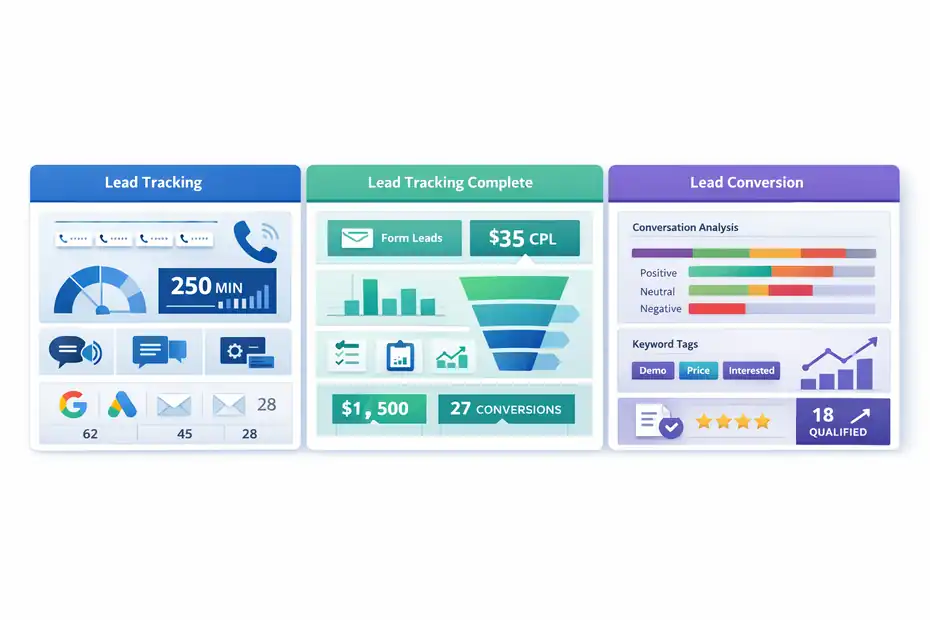
The plan names sound similar, so it helps to translate them into real-world use cases instead of feature jargon.
CallRail sells progressively more attribution depth and conversation analysis, not just more seats or storage.
Lead Tracking: Best For Basic Call Attribution
Lead Tracking is the entry plan at $50 per month. It includes 5 numbers, 250 minutes, call and text tracking, call recording and routing, call transcription and analysis, and automation rules. For many smaller businesses, this is enough to answer one core question: which campaign made the phone ring?
If you run a plumbing company, legal practice, dental office, or local service business, this plan can work well when your main goal is source attribution. You want to know whether calls came from Google Ads, organic search, direct mail, or a specific landing page. You do not necessarily need advanced AI scoring or form attribution on day one.
I believe this is the smartest starting point for businesses new to call tracking because it gives you the infrastructure without forcing you into a more expensive intelligence layer too early. The catch is that it stays cost-effective only if your usage remains modest. Once you need more numbers or heavier call volume, the “cheap” plan gets less cheap.
Lead Tracking Complete: Best For Businesses That Rely On Forms Too
Lead Tracking Complete starts at $95 per month and adds form tracking and attribution, a custom form builder, and multi-touch cost-per-lead reporting. This is a stronger fit for businesses where the customer journey includes both calls and form fills.
That distinction matters more than it seems. Some businesses assume call tracking alone is enough, then realize half their leads come through website forms.
At that point, they are optimizing only half the funnel. With Lead Tracking Complete, you can connect more of the buyer journey instead of treating forms and phone calls like separate systems.
A realistic scenario: An HVAC company runs service pages, financing pages, and coupon landing pages. Some visitors call immediately. Others request estimates through forms. Without form attribution, the reporting is incomplete. In that case, paying the extra $45 over the base tier can make the budget easier to justify because your reporting becomes much closer to actual lead volume.
Lead Conversion And Lead Conversion Complete: Best For Teams Optimizing Quality
Lead Conversion starts at $150 per month, while Lead Conversion Complete starts at $195 per month. These tiers add premium conversation intelligence features such as call transcripts, keyword analysis, call summaries, sentiment analysis, conversation trend reports, and automatic conversion tagging. The Complete version also adds form tracking features.
This is where CallRail shifts from “what drove the lead” to “was the lead any good?” That is a meaningful upgrade for agencies, sales-led businesses, and teams spending enough on acquisition that lead quality matters as much as lead volume.
For example, imagine you spend $12,000 per month on Google Ads and book 140 calls. If only 35 are qualified, attribution alone is not enough. You need the software to help separate real opportunities from spam, wrong numbers, poor-fit leads, and low-intent callers.
That is where transcript-based analysis and automatic conversion tagging can pay for themselves.
The Hidden Fees Most Buyers Miss
This is the section that usually saves the most money.
CallRail is not unusual in having usage-based pricing, but several costs can surprise you if you only read the headline plan number.
Additional Numbers Are Not Free
Every plan includes 5 local numbers, and extra local numbers are priced at $3 each. Extra toll-free numbers are priced at $5 each. On paper, that sounds small. In practice, it adds up when you create numbers for campaign-level attribution, location-specific routing, or website pools.
A local business with one website and one main ad channel may stay under the included 5 numbers. An agency managing several campaigns across multiple clients absolutely will not.
The same goes for franchise groups, multi-location service brands, and companies that want clean attribution by source, medium, campaign, and location.
This is one of those “hidden” fees that is not exactly hidden, but it is easy to underestimate. I have seen marketers budget for the plan and forget that number architecture is part of the operating cost.
If you need 20 numbers instead of 5, that alone adds 15 x $3, or $45 per month before minute overages even begin.
Minute Overage Charges Matter More Than Most People Expect
CallRail includes 250 local minutes per plan, then bills additional usage. The pricing page currently shows extra local minutes at $0.06 each in one rendered comparison block, but other rendered sections show $0.05 each.
The page also states that additional minutes not included in your chosen plan are billed on top of your base fee and are non-refundable.
That inconsistency is worth paying attention to. I would not ignore it. I would verify your exact in-account rate before signing off on a forecast, especially if minutes will be a big line item.
There is another detail many buyers miss: For monthly billing, additional usage from the previous month is invoiced with your next billing cycle; for annual billing, the base fee for 12 months is charged upfront, while overages are still billed monthly. The pricing page also says minutes are calculated by rounding each call up to the nearest minute and then summing the total.
That rounding rule can materially increase your effective per-minute cost if you get lots of short calls.
SMS Costs And Compliance Fees Can Sneak In
The pricing table shows 25 SMS messages included on all plans after trial, then $0.03 each for additional SMS. Support documentation also says MMS messages with images or attachments cost $0.06 per message.
On top of that, CallRail’s messaging compliance documentation states a monthly 10DLC registration fee of $1.50 per registered account.
For many businesses, those are small charges. For texting-heavy teams, they are not trivial.
Imagine a sales team using tracked numbers for lead follow-up and appointment confirmations. A few hundred outbound messages per month can turn into a real budget line.
That does not make the product bad. It just means messaging should be budgeted as an active channel, not treated as a free bonus.
Voice Assist Is An Add-On, Not A Complete Replacement Cost
Voice Assist starts at $95 per month, but the pricing note says all plans include Lead Tracking starting at an additional $55, and extra calls over the included threshold are charged at $1 per call after 50 or 55 Voice Assist calls over 15 seconds depending on the rendered pricing block.
So if you thought Voice Assist was a flat $95 all-in service, it is not. The practical minimum budget is higher because you also need the base tracking layer. This is especially relevant for businesses evaluating it as an after-hours lead capture tool.
I suggest thinking about Voice Assist as an optimization add-on for missed-call recovery, not as the core plan itself.
How CallRail Bills You Month To Month
Understanding the billing logic is just as important as understanding the feature grid.
Software bills become frustrating when the invoice structure is unclear, and CallRail’s own documentation gives a few details that are worth knowing upfront.
Monthly Billing Is A Mix Of Prepay And Rear-Billed Usage
For customers on monthly billing, CallRail says it automatically invoices the base fee for the upcoming month and the additional usage from the previous month. In other words, your subscription is partly forward-billed and partly usage-billed in arrears.
This matters because the first invoice can look cleaner than later invoices. Month one may feel close to your expected budget. Month two is often when reality shows up, because overages and operational usage get layered in.
For a small business owner who is not used to telecom-style billing, this can feel confusing. You might think the product suddenly got more expensive, when the real issue is that usage-based charges only became visible after a full billing cycle.
Annual Billing Lowers Friction, Not Necessarily Complexity
CallRail states that annual customers pay the base fee for the upcoming 12 months upfront, while additional usage from each prior month is still billed monthly. So annual billing may simplify your subscription commitment, but it does not eliminate monthly variability if your usage changes.
That is an important distinction. Annual billing is useful if you know CallRail is a long-term fit and you want budgeting certainty around the platform fee. It does not make your overage exposure disappear.
Plan Changes Can Trigger Proration
CallRail’s help center says administrators can upgrade, downgrade, and add add-ons in account settings, and if you upgrade your plan, you will be charged the prorated amount for the new plan on your next invoice. New features become available immediately after the change is saved.
That is normal SaaS behavior, but it is still worth noting. If you change plans mid-month because you hit limits, your next invoice may include both usage overages and a prorated plan increase. For budgeting, that can create a short-term spike.
How To Estimate Your Real Monthly Cost Before You Buy
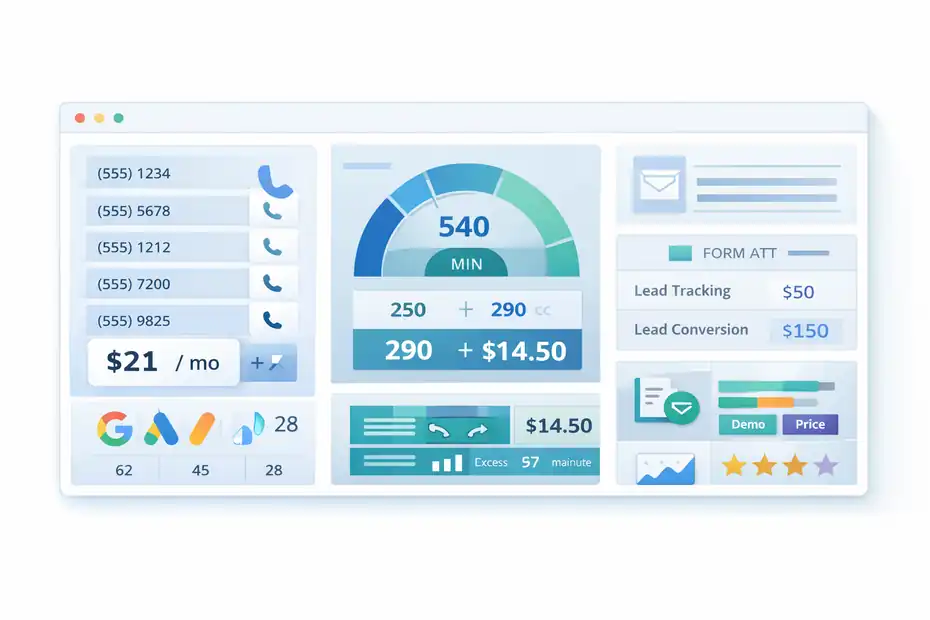
This is where I think most buyers should spend their time. Do not ask, “Which plan is cheapest?” Ask, “What will my real monthly bill look like after numbers, minutes, messaging, and add-ons?”
Start With Your Tracking Architecture
Before you choose a plan, map how many numbers you actually need. This is the simplest forecasting exercise and one of the most valuable.
Use this rule of thumb:
- One number for your main business line replacement
- One number for each major paid channel
- One number for each offline campaign you want isolated
- Additional numbers for locations, teams, or routing use cases
- Potential number pools for website visitor-level attribution
If you need more than five numbers on day one, the entry plan’s real cost moves immediately. A business using 12 local numbers would add 7 extra numbers, which at $3 each is another $21 per month before any overage minutes.
I recommend writing out the architecture first. It sounds boring, but it is one of the fastest ways to avoid under-budgeting.
Forecast Minutes Conservatively, Not Optimistically
The included 250 local minutes can go faster than people expect, especially if calls are rounded up to the nearest minute. A business with 180 calls averaging 2.2 minutes would likely consume meaningfully more billed minutes than the raw duration suggests because of that rounding policy.
Here is a practical framework I like:
- Estimate monthly call count.
- Estimate average call duration.
- Add a 10% to 20% buffer for rounding and seasonal spikes.
- Compare the result to the included 250 minutes.
- Multiply likely overage by the rate visible in your quote or account.
If you are a legal office or home services company where calls tend to be longer, minute forecasting matters a lot more than it does for a quick reservation-based business.
Decide Whether Form Attribution Or AI Analysis Is Revenue-Critical
This is the fork in the road. Lead Tracking is enough if call attribution solves the main problem. Lead Tracking Complete is worth it if form submissions are a real part of lead flow. Lead Conversion becomes easier to justify when lead quality, sales coaching, or keyword and sentiment analysis affect revenue decisions.
A good test: If you would act differently based on call transcripts, automatic conversion tagging, or conversation trends, the higher-tier plans may create real return. If you would not use those insights consistently, paying for them is probably waste.
Which Plan Makes Sense For Different Types Of Buyers
CallRail pricing makes more sense when you match it to a business model instead of reading it like a generic SaaS menu. Different buyer types value different parts of the platform.
Small Local Businesses
If you are a single-location local business, I would usually start with Lead Tracking unless forms are a major conversion path. It is the cleanest way to prove call attribution value without overcommitting.
This is especially true for businesses like:
- Plumbers
- Roofers
- Dentists
- Law firms
- Med spas
- Restoration companies
These businesses often care most about source tracking, call recordings, and basic routing. They do not always need premium conversation analysis immediately. The main mistake here is buying advanced intelligence before the team has even built a reporting habit.
Agencies Managing Multiple Clients
Agencies usually feel the pinch on number counts, reporting depth, and client proof. That often pushes them beyond the cheapest tier faster than expected.
CallRail also has add-ons such as Agency Tools and premium integrations listed in its help documentation, which can further change cost depending on the setup.
For agencies, I think the better question is not whether the software costs more, but whether it helps you defend client retention. If conversation intelligence helps prove lead quality, tag conversions, and show why one campaign outperformed another, that can be worth much more than the subscription delta.
Multi-Location Or Franchise Brands
These teams often need more numbers, tighter routing logic, clearer location-level attribution, and more complex reporting. In practice, they are more likely to feel overages and add-on charges. That does not mean CallRail is a poor fit. It means the starter price is rarely the right budgeting number.
In my experience, multi-location buyers should build a spreadsheet model before committing. Otherwise, the invoice can drift away from the original budget very quickly.
Common Mistakes People Make When Comparing CallRail Costs
A lot of pricing frustration comes from bad comparison logic, not bad software. When people say a tool was “more expensive than expected,” it is often because they compared the wrong numbers.
Mistake 1: Comparing Base Price Instead Of Total Operating Cost
The $50 starting plan looks attractive, but it is only the platform entry point. If you need more numbers, more minutes, more SMS, form tracking, or AI analysis, your actual cost will be higher.
I recommend building your comparison around total monthly cost under expected usage, not the advertised starting price.
Mistake 2: Ignoring Minute Rounding
Because CallRail says each call is rounded up to the nearest minute before totals are summed, lots of short calls can create a higher billed-minute total than many teams forecast.
This is one of those tiny billing rules that can make a big difference over time.
Mistake 3: Treating Texting As Free
CallRail includes some SMS, but messaging is not unlimited. Additional SMS costs extra, MMS costs extra, and 10DLC registration adds another fee.
If your team uses tracked texting heavily for appointment reminders or lead nurture, budget for it.
Mistake 4: Buying AI Features Without A Clear Workflow
Lead Conversion plans can be powerful, but only if your team will actually use transcripts, summaries, sentiment, and tagging in sales or marketing decisions.
I have seen teams pay for advanced reporting and never operationalize it. That is not a pricing problem. That is an adoption problem.
Practical Ways To Keep Your CallRail Bill Under Control
The good news is that most CallRail cost creep is manageable. A few operational decisions make a noticeable difference.
Trim Unnecessary Numbers
Audit your number inventory regularly. If a campaign ended three months ago and the number is still active, you are paying for dead tracking structure. Extra local numbers cost $3 each and extra toll-free numbers cost $5 each, so cleanup is worth doing.
A simple monthly review can cut waste without reducing attribution quality.
Match Your Plan To Your Conversion Mix
If forms are a major lead source, it may be cheaper to move into a form-enabled plan than to stay on a lower tier and accept fragmented reporting. If forms barely matter, paying extra for that functionality may be unnecessary.
The right plan is not the one with the most features. It is the one that matches how leads actually arrive.
Watch Usage After The Trial Ends
CallRail offers a 14-day free trial and says no credit card is required to get started. That is useful, but remember that some included items are marked “available after trial,” including SMS. So your post-trial operating pattern may not look exactly like your trial experience.
I suggest reviewing your first full invoice closely. That is where the real pricing picture becomes clear.
Is CallRail Pricing Worth It?
For the right business, yes. For the wrong setup, it can feel expensive fast. That is my honest take.
CallRail becomes worth the price when attribution, lead qualification, and call intelligence materially improve how you spend marketing dollars or how your team handles leads.
If one insight helps you reallocate a few thousand dollars in ad spend or recover missed opportunities, the software can pay back quickly. Its public pricing structure makes that possible, especially for businesses where phone calls are a primary conversion path.
Where buyers get burned is not usually the base fee. It is poor forecasting. They do not plan for extra numbers, minute rounding, messaging charges, compliance fees, or AI add-ons. Then the invoice feels like a surprise.
My advice is simple: Treat CallRail like revenue infrastructure, not a flat SaaS utility. Forecast usage, map your number needs, decide whether forms and AI really matter, and verify the exact overage rates shown in your account or quote since the public page currently shows some pricing table inconsistencies on minute-related allowances and overages.
If you do that, you can usually choose the right plan with a lot more confidence.
Final Verdict On CallRail Pricing Explained
CallRail pricing explained in plain English looks like this: the platform starts at a reasonable base monthly rate, but your real cost depends on how many numbers you need, how many minutes you use, whether you text leads, whether you need form attribution, and whether premium conversation intelligence will actually influence decisions.
The four main plans range from $50 to $195 per month, with included usage bundles and overage charges layered on top. Voice Assist begins at $95 per month but also requires a tracking plan.
For most small businesses, Lead Tracking is the practical entry point. For lead-gen businesses that rely on both calls and forms, Lead Tracking Complete is often the more honest budget choice. For teams serious about lead quality, sales coaching, and AI-assisted reporting, the conversion tiers can be worth the jump.
The smartest way to buy is not to chase the lowest sticker price. It is to estimate your total monthly operating cost and choose the tier that fits your real lead flow.
FAQ
What does CallRail pricing include?
CallRail pricing includes a base monthly plan with bundled usage such as tracking numbers, minutes, and SMS. Additional costs apply when you exceed included limits or add features like form tracking or conversation intelligence. Your total cost depends on how much you use the platform.
How much does CallRail cost per month?
CallRail plans start at $50 per month for basic lead tracking and go up to $195 per month for advanced features. However, most businesses pay more than the base price due to extra numbers, additional minutes, and optional add-ons that increase the total monthly cost.
Are there hidden fees in CallRail pricing?
CallRail does not hide fees, but many costs are usage-based and easy to overlook. Extra charges can include additional phone numbers, call minutes, SMS messages, and compliance fees. These can significantly increase your bill if you do not plan your usage carefully.
Is CallRail pricing worth it for small businesses?
CallRail pricing can be worth it for small businesses that rely on phone calls for leads. It helps track which marketing channels drive calls and improves decision-making. However, value depends on usage, and costs can rise quickly if tracking needs grow.
How can I reduce my CallRail monthly costs?
You can reduce CallRail costs by limiting unused tracking numbers, monitoring call minutes, and choosing the right plan based on your needs. Regularly reviewing usage and avoiding unnecessary add-ons helps keep your monthly bill predictable and under control.

I’m Juxhin, the voice behind The Justifiable.
I’ve spent 6+ years building blogs, managing affiliate campaigns, and testing the messy world of online business. Here, I cut the fluff and share the strategies that actually move the needle — so you can build income that’s sustainable, not speculative.
Related posts:
 Why CallRail Cost Might Be Worth the Investment
 CallRail Pros And Cons For Businesses: What Matters Most
 What is CallRail? Discover the Power of Call Tracking and Analytics
 10 Reasons Your Website Traffic Checker is Your Best Growth Hack
 Top 7 CallRail Alternatives for Affordable Call Tracking
 Is CallRail Worth It For Local Businesses Or Agencies?