
Table of Contents
Some links on The Justifiable are affiliate links, meaning we may earn a small commission at no extra cost to you. Read full disclaimer.
CallRail worth it for local businesses is a fair question, especially when every software subscription has to earn its place.
If you run a home service company, law firm, med spa, dental office, real estate team, or local agency, the real issue is not whether call tracking sounds useful.
It is whether CallRail helps you make better decisions, recover missed leads, and prove ROI clearly enough to justify the cost.
In my experience, that answer is often yes, but only when your business depends on phone calls and you actually use the data.
What CallRail Actually Does For Local Businesses And Agencies
CallRail is not just a “call tracking tool.”
At its core, it helps you see which marketing channels, campaigns, keywords, pages, and sources drove a call, text, or form lead so you can stop guessing where revenue came from.
What Problem It Solves
For many local businesses, the biggest reporting problem is simple: a customer clicks an ad, reads reviews, visits the site, then calls instead of filling out a form. Without call tracking, that lead often disappears from your attribution.
You know the phone rang, but you do not know whether SEO, Google Ads, Local Services Ads, direct mail, or your Google Business Profile created the opportunity.
That matters more than most owners realize. A campaign can look weak in Google Analytics while quietly producing high-intent phone calls.
Local service businesses especially deal with this every day because a lot of buyers prefer to call when the purchase is urgent, expensive, or trust-sensitive. CallRail is built to close that visibility gap by tying the conversation back to the marketing source.
A realistic example: Imagine you own a plumbing company spending $3,000 a month on Google Ads and $2,000 on SEO. Forms make SEO look better, but tracked calls reveal Google Ads is producing more emergency jobs with higher average ticket values. That changes your budget decision fast.
What You Are Really Paying For
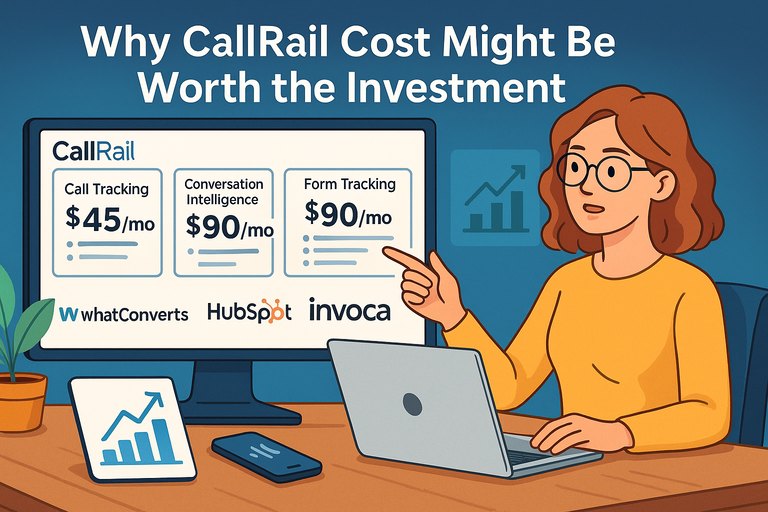
The base Call Tracking plan starts at $50 per month and includes 5 numbers and 250 minutes, with extra usage billed separately.
From there, businesses can add capabilities around form tracking, conversation intelligence, messaging, and AI-driven workflows depending on their needs. CallRail also offers a 14-day free trial without requiring a credit card.
What you are really buying is not phone numbers. You are buying three things:
- Attribution clarity: Knowing what made the phone ring.
- Operational visibility: Seeing how your team handles leads.
- Optimization leverage: Shifting budget toward channels that create revenue, not vanity metrics.
That distinction is important. If you only want a second business line, CallRail is overkill. If you want marketing accountability, call quality insight, and better lead handling, it becomes much easier to justify.
Why Agencies Care So Much About It
Agencies often feel the value of CallRail faster than single-location businesses do. That is because agencies live or die by reporting, proof, and retention.
If you can show a client not just clicks and impressions but actual phone calls, call outcomes, and lead quality patterns, your reporting becomes much harder to dismiss. CallRail says it serves 7,000+ agencies, which fits that use case well.
For an agency, this can turn a shaky monthly review into a confident one. Instead of saying, “Traffic improved,” you can say, “Organic search produced 43 calls, Google Ads produced 27, and the calls from branded campaigns were shorter and less qualified than the non-branded service campaigns.” That is a completely different client conversation.
Who Gets The Most Value From CallRail
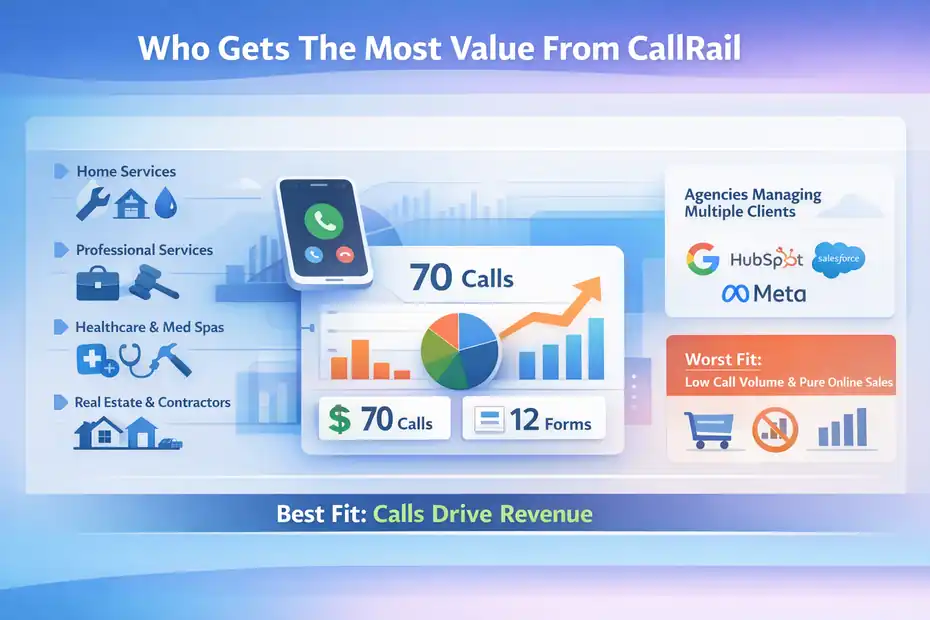
CallRail is not equally valuable for every company. The businesses that win with it usually have a sales process that begins with a phone call, depends on lead quality, or involves meaningful marketing spend across more than one channel.
Best Fit: Businesses Where Calls Drive Revenue
In my view, CallRail makes the most sense for local businesses where calls are part of the buying journey, not just a support channel. That includes:
- Home services: Plumbing, HVAC, roofing, electrical, pest control, garage door, cleaning.
- Professional services: Law firms, accountants, consultants, financial planners.
- Healthcare-adjacent local services: Dentists, med spas, chiropractors, specialty clinics.
- High-trust local categories: Real estate teams, remodeling contractors, restoration companies.
These categories tend to have urgent or complex buying decisions. People want answers fast. They call because they need pricing, availability, reassurance, or a same-day appointment. In those situations, attribution from forms alone gives you an incomplete picture.
A roofing company, for example, may get only 12 web forms in a month but 70 qualified calls. If those calls are invisible in reporting, the owner may wrongly cut the campaign that is actually producing the highest-value jobs.
Best Fit: Agencies Managing Multiple Clients
Agencies benefit when they need call attribution by channel, clean client reporting, and a way to review lead quality without listening to every recording manually.
CallRail also connects with platforms like Google Analytics, Google Ads, HubSpot, Salesforce, Meta, Zapier, RingCentral, Clio, Jobber, and others, which helps agencies fit it into existing reporting and workflow systems. CallRail says it supports 700+ integrations.
This matters because agency profitability often depends on operational efficiency. When call data flows into analytics or CRM systems, you reduce manual reporting work and make client performance easier to defend.
Worst Fit: Businesses That Rarely Need The Phone
CallRail may not be worth it if:
- Most conversions happen entirely online: For example, pure ecommerce with little phone volume.
- You have tiny traffic and tiny call volume: You may not generate enough data to act on.
- You will never review the insights: If nobody will use the recordings, attribution, or reports, the subscription becomes dead weight.
- You only need a basic phone system: There are cheaper options for simple calling needs.
This is where a lot of bad software decisions happen. Owners buy a reporting tool when they really needed better sales follow-up, a faster website, or more reviews. CallRail cannot fix weak demand generation by itself. It can only show you what is happening and help you improve what already exists.
How CallRail Works In Plain English
Before deciding whether CallRail is worth it for local businesses, it helps to understand how the system works behind the scenes. The idea is simpler than the software category makes it sound.
Dynamic Number Insertion And Source Tracking
One of CallRail’s core methods is dynamic number insertion. That sounds technical, but the concept is straightforward. Different website visitors can see different tracking numbers based on how they arrived at your site.
One visitor from Google Ads may see one number. Another visitor from organic search may see another. When they call, CallRail attributes the lead back to the source.
This is especially useful when the same landing page serves traffic from multiple campaigns. Without dynamic tracking, all calls appear to come from one number, and attribution breaks down. With it, you can tell which traffic source actually produced the call.
There are also static tracking numbers for offline channels like yard signs, mailers, radio, vehicle wraps, or print ads. That gives local businesses a cleaner way to measure offline marketing, which is still important in many service industries.
What Happens After The Call Comes In
Once the call happens, CallRail can record it, transcribe it, tag it, route it, and help you review what happened. Depending on your plan and setup, you can use automation rules, call summaries, call analysis, and AI-powered conversation insights to identify qualified leads or missed opportunities. Premium Conversation Intelligence requires a Call Tracking account.
That is where the tool moves beyond simple attribution. Instead of only asking, “Which channel drove the call?” you can also ask:
- Was the caller a good fit?
- Did staff answer quickly?
- Did the caller book an appointment?
- Were key questions handled well?
- Are certain campaigns generating junk or spam leads?
For a busy office manager or agency account lead, that level of visibility can save a lot of guesswork.
Why This Matters More Than Most Dashboards
Most local marketing reports still focus too much on surface metrics like clicks, traffic, cost per click, and impression share. Those metrics matter, but they are incomplete. The actual revenue event may begin when someone picks up the phone.
I believe this is the main reason CallRail remains attractive in local marketing. It puts reporting closer to real buyer behavior. And when your customers are calling because they are ready to hire, schedule, or get an estimate, that matters far more than a pretty chart full of top-of-funnel numbers.
The Real Benefits That Make CallRail Worth Paying For
The strongest argument for CallRail is not that it has a lot of features. Plenty of tools do. The stronger argument is that it solves a revenue blind spot most local businesses and agencies still have.
Better Marketing Attribution
This is the headline value. When you know which channels, campaigns, and pages produce calls, you stop making budget decisions based on half the story. CallRail tracks calls, texts, and forms, and it can pass data into systems like GA4 so those conversions are easier to analyze alongside the rest of your marketing.
That means you can answer practical questions like:
- Is SEO producing consultation calls or just blog traffic?
- Are branded search campaigns cannibalizing direct traffic?
- Which landing page produces longer, better-quality calls?
- Do offline campaigns still contribute enough to justify the spend?
A lot of businesses discover their “best” marketing channel changes once call data is included.
Better Lead Handling And Team Accountability
Attribution is only half the value. The other half is operational. If calls are going unanswered, mishandled, or poorly qualified, marketing performance suffers even when the campaigns are good.
One recent small-business phone study reported businesses answered only 37.8% of inbound calls, with many calls going to voicemail or no response at all. Even if that number varies by industry, the broader point is real: missed calls quietly destroy ROI.
CallRail’s call recording, transcription, and analysis features make that visible. You can spot patterns like front-desk delays, weak intake scripts, after-hours gaps, or repeated objections that should be addressed on the website.
Better Client Reporting For Agencies
Agencies need proof. Not just traffic proof. Business proof. CallRail helps turn fuzzy marketing conversations into measurable ones.
Instead of defending a campaign with abstract performance language, an agency can show tracked calls, call source attribution, timestamps, lead quality markers, and conversation patterns. That is much closer to what clients care about: “Did this campaign help my phone ring with the right people?”
That level of reporting can improve retention, especially with skeptical clients in legal, home services, or healthcare-style local markets where phone leads carry obvious value.
The Costs, Limits, And Drawbacks You Should Think About
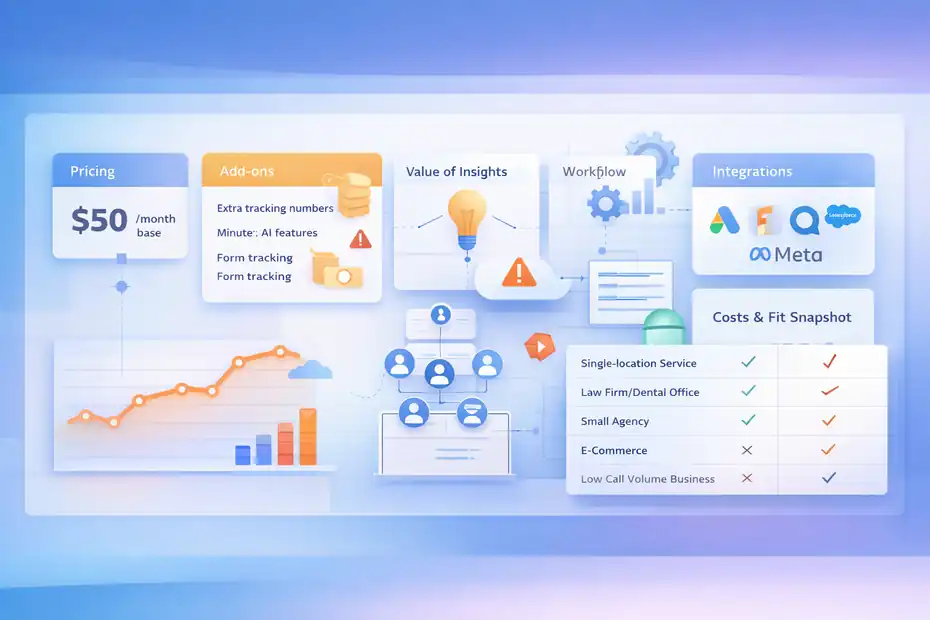
No tool is automatically worth it, and CallRail has real tradeoffs. I think the smartest buying decision comes from understanding what can go wrong before you subscribe, not after.
Pricing Adds Up Faster Than Some Owners Expect
The base pricing looks approachable: $50 per month for 5 numbers and 250 minutes. But real-world costs can climb when you add more tracking numbers, more usage, form tracking, conversation intelligence, or AI-related features.
Messaging is billed within the base call tracking plan with limited included volume, and additional messages cost extra. Annual plans are also available for some products.
For a single-location service business with moderate call volume, this may still be completely reasonable. For an agency managing multiple clients, multi-location businesses, or campaigns that require several number pools, the cost needs to be modeled carefully.
Here is a simple way to think about it: If one recovered customer covers a month of software, the economics probably work. If you need dozens of tracked interactions before the math makes sense, you should pause.
You Still Need Someone To Use The Data
This is the hidden cost people forget. CallRail only creates value when someone looks at the reports, reviews call patterns, and adjusts the business or marketing based on what they learn.
A local owner who never opens the dashboard will not suddenly get better marketing. An agency that installs call tracking but never audits lead quality will still miss the most important client insights.
Software does not create discipline. It rewards it.
Integration And Process Friction Can Be Real
CallRail offers broad integrations, but broad does not always mean effortless. G2 reviews in 2026 still praise ease of use and reporting, while some users note integration limitations depending on stack and workflow complexity.
In practical terms, this means the tool may fit beautifully into one business and feel awkward in another. A simple local setup with Google Ads and GA4 is usually easier than a layered stack involving CRM rules, custom routing, multiple locations, and agency reporting automation.
That does not make CallRail bad. It just means you should judge it against your actual workflow, not a generic software demo.
Quick Cost-And-Fit Snapshot
| Business Type | Why CallRail May Be Worth It | Main Risk | My Take |
|---|---|---|---|
| Single-location home service business | Strong call attribution and missed-call visibility | Underusing the dashboard | Usually worth it if calls drive jobs |
| Local law firm or dental office | High lead value makes call tracking easier to justify | Compliance/process setup needs care | Often worth it |
| Small agency with 5–15 clients | Better reporting and client retention | Costs scale with usage and numbers | Strong fit |
| Ecommerce-first business | Limited phone dependence | Weak ROI from call tracking | Usually not a fit |
| New business with low call volume | Easy trial, but little data to act on | Not enough signal | Test first |
Step-By-Step: How To Decide If CallRail Is Worth It For Your Business
You do not need a complicated software procurement process here. You need a simple business case. Let me break it down in a practical way.
Step 1: Measure How Important Calls Are In Your Sales Process
Start with one question: how often does a qualified customer call before buying or booking?
If you run HVAC, legal, roofing, med spa, or restoration, the answer may be “a lot.” If you are mostly appointment-based or quote-based, calls often signal stronger intent than casual form fills. That makes attribution more valuable.
Estimate three things:
- Monthly inbound call volume
- Average close rate from calls
- Average customer value
Here is a simple scenario. Say you receive 80 relevant calls per month, close 20%, and the average first-sale value is $900. That is 16 customers and $14,400 in first-sale revenue flowing through the phone channel. In that context, even modest attribution and handling improvements can justify the software quickly.
Step 2: Identify Where You Are Blind Today
Next, ask where you lack visibility now.
Common blind spots include:
- You do not know whether SEO or PPC drives more phone leads.
- You cannot prove lead source to clients.
- You suspect staff miss calls, but cannot quantify it.
- You have no idea which landing pages generate qualified conversations.
- You run offline ads and cannot measure them well.
The more of these blind spots you have, the stronger the case for CallRail becomes. If none apply, you may not need it.
Step 3: Compare Cost Against One Recovered Win
I like using a “one recovered customer” test. If the tool helps you recover one lost lead, shift budget toward one better-performing channel, or prove the value of one client campaign more clearly, does the monthly cost make sense?
For many local businesses, the answer is yes because one booked legal consult, emergency plumbing call, or dental treatment plan can cover the subscription. For a low-ticket business with low phone dependency, the answer may be no.
This is a better way to judge software than staring at the subscription price alone.
How Local Businesses Should Set Up CallRail For The Best ROI
A lot of buyers get disappointed with software because they install it halfway. CallRail works best when setup matches the way your leads actually move through the business.
Start With The Right Tracking Structure
The first setup decision is whether you need static tracking numbers, dynamic website number insertion, or both.
Use static numbers when you want to track a specific offline source like a postcard, radio ad, truck wrap, or Google Business Profile-style placement. Use dynamic website tracking when you need to attribute online sessions by source, medium, campaign, or landing page. Most local businesses with active SEO and PPC need both.
I suggest keeping the structure simple at first. Do not create a confusing number sprawl. Start by tracking your highest-spend and highest-value lead sources. That often means:
- Organic search
- Google Ads
- Google Business Profile or local listing traffic
- Major landing pages
- One or two offline campaigns
A clean setup is easier to trust and easier to explain.
Route Calls Intentionally
Routing is where many local teams quietly win or lose. If every call goes to the same general line and sits unanswered, attribution is useful but incomplete. CallRail includes call routing and automation options, so use them with your real business hours and staffing patterns in mind.
For example, a restoration company might route after-hours emergency calls differently from standard estimate requests. A law firm might send personal injury calls to one intake group and family law calls to another.
This is not about fancy automation. It is about reducing friction between the lead and the right human response.
Review Calls Like A Revenue Manager, Not A Technician
Once setup is live, avoid the trap of listening to calls randomly. Review them with purpose:
- Which sources generate the best-fit leads?
- Which calls are short because they were spam or mismatched?
- Which objections repeat often?
- Where do staff lose momentum?
- How many callers ask questions the website should answer better?
That turns CallRail from a logging tool into an optimization tool. And that is where the real ROI shows up.
How Agencies Should Use CallRail Differently Than Local Businesses
Agencies should not use CallRail exactly the way a single business owner uses it. The goals are different. Agencies need scalability, reporting consistency, client-proof outcomes, and operational leverage across multiple accounts.
Use It To Prove Value, Not Just Track Calls
The agency mistake is treating CallRail as a passive add-on instead of a reporting asset. If all you do is install tracking numbers and export call counts once a month, you are leaving most of the value on the table.
A better approach is to use call data to answer client-facing questions:
- Which campaigns drive qualified calls?
- Which landing pages produce longer, better-intent conversations?
- What is the trend in missed or unanswered lead opportunities?
- Are branded campaigns inflating performance while non-branded campaigns do the actual prospecting?
That makes the software part of your strategic narrative, not just your tech stack.
Standardize Reporting Across Clients
Agencies with multiple local clients benefit from a standardized measurement framework. I recommend defining a few consistent KPIs across accounts, such as:
- Tracked calls by source
- First-time callers
- Answer rate or response coverage
- Qualified calls
- Calls during business hours vs after hours
- Form leads compared with phone leads
This helps clients compare performance month to month and makes internal account reviews much more efficient.
Use Conversation Data To Improve Retention
Here is something agencies often overlook: call recordings and transcripts can uncover client-side problems that affect results. Maybe the campaign is generating great leads, but the front desk takes too long to answer. Maybe the intake script is weak. Maybe callers keep asking about a service not listed clearly on the site.
When you bring those insights to a client, you stop sounding like “the traffic vendor” and start sounding like a growth partner. That is retention gold.
Features That Matter Most And Which Ones You Can Ignore At First
Not every feature deserves equal attention. One reason software feels expensive is because businesses pay for capabilities they never operationalize.
CallRail has a lot going on, but only a few functions usually matter at the beginning.
Start With The Core Features First
For most local businesses and smaller agencies, the first layer of value comes from:
- Call tracking and attribution
- Call recording
- Transcriptions
- Basic routing
- Form tracking if forms matter in your funnel
These features answer the essential questions: who called, where they came from, and what happened on the call. That alone can justify the platform for a phone-driven business.
GA4 integration can also be useful early because it helps you see tracked call and form events inside a broader analytics view.
Add AI And Advanced Features Only With A Use Case
CallRail also promotes AI-powered conversation insights, automation rules, and Voice Assist, its AI voice agent that can capture lead intake details, answer business questions, and even handle appointment requests. Those may be valuable, but only when they solve a real operational issue.
For example, Voice Assist may help if your business misses a lot of after-hours calls or has predictable intake questions. But if your team already answers quickly and the lead flow is manageable, you may not need that layer yet.
I generally recommend earning ROI from the core tracking setup first. Then expand into advanced features once you know exactly where the process is leaking.
Practical Feature Priority Table
| Feature | Best For | Why It Matters | Start Now Or Later |
|---|---|---|---|
| Call Tracking | All phone-driven businesses | Connects calls to marketing sources | Start now |
| Call Recording | Businesses with intake teams | Reveals call handling quality | Start now |
| Transcriptions | Busy teams and agencies | Faster review than listening manually | Start now |
| Form Tracking | Mixed call/form funnels | Improves attribution completeness | Start now if forms matter |
| Conversation Intelligence | Teams reviewing lead quality at scale | Speeds qualification insight | Later unless volume is high |
| Voice Assist | Businesses missing calls or needing 24/7 intake | Captures leads after hours | Later, use case dependent |
Common Mistakes That Make CallRail Feel “Not Worth It”
A surprising number of bad software reviews are really setup or usage problems. CallRail can absolutely feel overpriced if you use it poorly.
Mistake 1: Tracking Everything Before You Track What Matters
Some teams create too many numbers, too many sources, and too many reporting views before they even know which channels deserve the closest attention. That creates confusion, bloated costs, and reporting fatigue.
Start with the fewest moving parts possible. Track your highest-value lead sources first. Expand once the data is clearly improving decisions.
Mistake 2: Watching Call Counts Instead Of Lead Quality
A lot of owners get excited seeing more tracked calls, then disappointed later because revenue did not move much. Usually the issue is lead quality, not the tool.
Fifty calls from bad-fit traffic are not better than ten calls from ideal buyers. This is why recordings, transcripts, and qualification logic matter. You need to know whether the campaign brought the right people, not just more phone activity.
Mistake 3: Ignoring What The Calls Reveal About The Business
This is the big one. CallRail often exposes uncomfortable truths:
- Staff are slow to answer.
- The intake process is weak.
- The website sets the wrong expectations.
- The ad copy attracts poor-fit leads.
- After-hours lead capture is broken.
When businesses ignore those lessons, they blame the software. But the software did its job. It showed the leak.
Mistake 4: Failing To Connect Marketing And Operations
The best ROI happens when marketing and front-line lead handling work together. If your agency never shares call quality insights with the client’s intake team, or if the owner never updates scripts based on call patterns, you lose much of the value.
CallRail works best when used as a bridge between lead generation and lead conversion.
Advanced Ways To Increase ROI After Setup
Once the basics are working, CallRail becomes much more powerful. This is where experienced marketers and operators usually separate themselves from casual users.
Use Call Patterns To Improve Campaign Targeting
When you review call outcomes by source, campaign, landing page, or keyword theme, you can often find patterns that normal dashboard metrics hide.
For instance, imagine a personal injury firm sees plenty of calls from a broad match campaign, but most are short, low-intent, or unrelated. Meanwhile, a smaller campaign targeting specific case types generates fewer calls but far stronger consults.
CallRail helps you see that difference more clearly, especially when conversation review is part of the process.
That lets you shift budget toward quality, not noise.
Improve Website Messaging Based On Real Questions
One of my favorite uses for call transcripts is message mining. If callers repeatedly ask the same questions, your site may be underselling clarity.
Examples:
- “Do you offer financing?”
- “Do you service my area?”
- “How soon can someone come out?”
- “Do you handle insurance claims?”
- “What does the consultation cost?”
When those questions appear over and over, they belong on key pages, in ad copy, or in intake messaging. This is an underrated conversion improvement loop.
Build Better Sales And Intake Coaching
CallRail can also support coaching. If one staff member converts leads consistently better than others, their calls become a training asset. If objections tend to stall at a certain point, that is a coaching opportunity.
This matters because software ROI is not only about better attribution. Sometimes the largest gains come from improving what happens after the lead arrives.
Final Verdict: Is CallRail Worth It For Local Businesses Or Agencies?
For most phone-driven local businesses and agencies, yes, CallRail is worth it when calls play a meaningful role in revenue and someone on the team will actually use the insights.
The software is strongest when you need better attribution, clearer proof of ROI, visibility into missed opportunities, and a practical way to connect marketing performance with what happens on the phone.
The base Call Tracking plan starts at $50 per month, CallRail supports broad integrations, and the company positions its platform around tracking calls, texts, and forms with AI-powered insights layered on top.
If you run a local business where one good lead can be worth hundreds or thousands of dollars, the economics are often easy to justify. If you run an agency, the value can be even larger because better attribution and better client reporting protect retention and strengthen trust.
Where CallRail becomes less compelling is when phone leads barely matter, call volume is low, or nobody has the time to review the data and act on it. In that case, it can feel like another dashboard subscription instead of a profit tool.
My honest take is this: CallRail is not worth it because it is “feature rich.” It is worth it when it helps you answer the questions that actually affect growth. Which channels drive calls? Which calls become customers? Where are leads being lost? Which campaigns deserve more budget? If those are your real questions, CallRail has a strong case. If they are not, save the money.
FAQ
What does CallRail do for local businesses?
CallRail helps local businesses track where phone calls, texts, and form leads come from. It shows which marketing channels drive real customer inquiries, making it easier to measure ROI, improve campaigns, and identify missed opportunities that would otherwise go unnoticed.
Is CallRail worth it for small local businesses?
CallRail is worth it for small local businesses if phone calls play a key role in generating revenue. It provides clear attribution and call insights that help improve marketing decisions, recover missed leads, and increase conversions, especially in service-based industries.
How much does CallRail cost and is it affordable?
CallRail starts at around $50 per month, but costs can increase based on usage, tracking numbers, and added features. It is generally affordable if one or two additional customers per month can cover the subscription through improved tracking and lead handling.
Who should not use CallRail?
CallRail may not be a good fit for businesses that rely mostly on online purchases or have very low call volume. If phone leads are not important or the team will not review call data regularly, the platform may not deliver enough value.
Can agencies benefit from using CallRail?
Yes, agencies benefit from CallRail by gaining clear call attribution and stronger client reporting. It helps prove campaign performance with real lead data, improves transparency, and allows agencies to identify both marketing and operational issues affecting client results.

I’m Juxhin, the voice behind The Justifiable.
I’ve spent 6+ years building blogs, managing affiliate campaigns, and testing the messy world of online business. Here, I cut the fluff and share the strategies that actually move the needle — so you can build income that’s sustainable, not speculative.
Related posts:
 CallRail Pros And Cons For Businesses: What Matters Most
 What is CallRail? Discover the Power of Call Tracking and Analytics
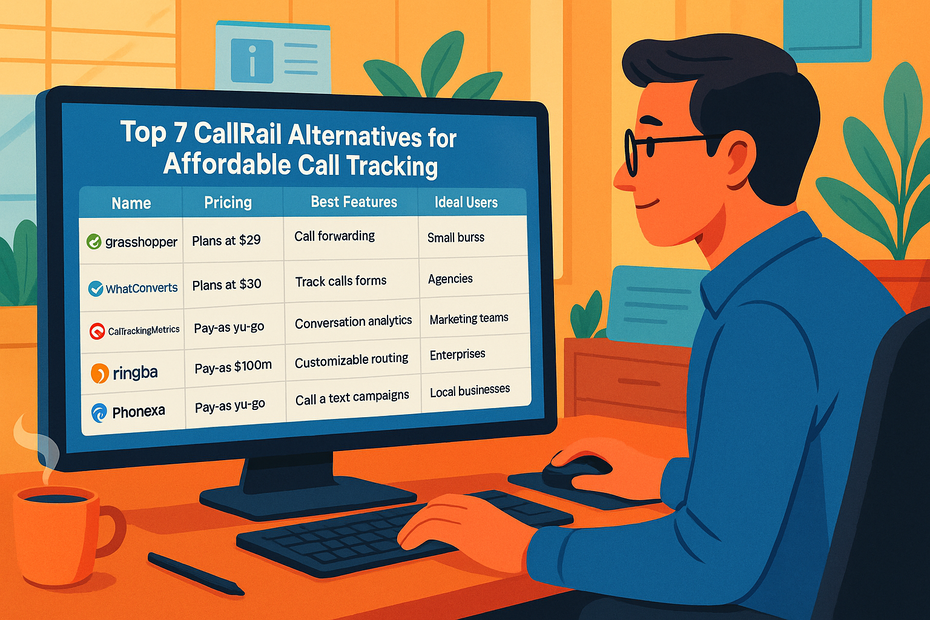 Top 7 CallRail Alternatives for Affordable Call Tracking
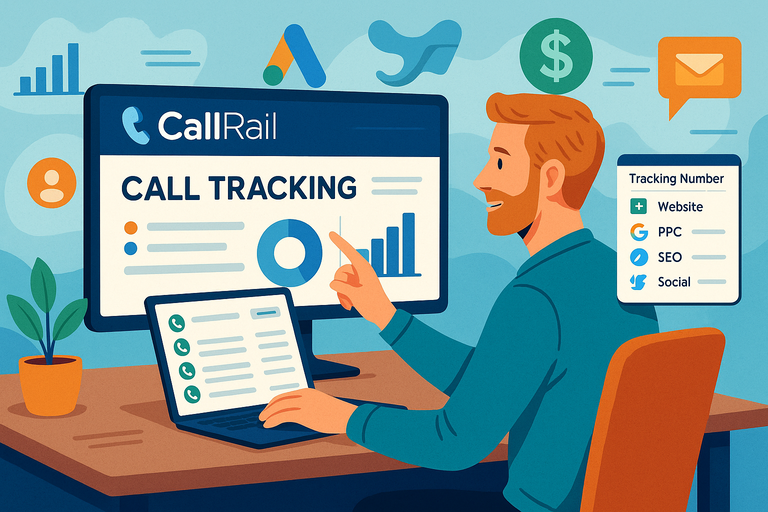 CallRail Call Tracking: How It Works and Why It Matters
 CallRail Reviews: What Real Users Are Saying
 Why CallRail Cost Might Be Worth the Investment