
Table of Contents
Some links on The Justifiable are affiliate links, meaning we may earn a small commission at no extra cost to you. Read full disclaimer.
If you are researching monday limitations for small teams, you are probably not looking for another shiny feature roundup. You are trying to figure out where the platform feels helpful, where it starts to feel restrictive, and whether those limits will quietly cost your team time, money, or patience.
I think that is the right question to ask before you commit. Monday.com can be flexible and fast to launch, but small teams often feel the trade-offs earlier than bigger companies do, especially around seats, dashboards, automations, reporting, and plan upgrades.
What Small Teams Usually Expect From Monday
Small teams usually adopt monday.com because they want one place to manage projects, tasks, deadlines, owners, and status updates without building a giant operations system.
That is a reasonable goal, and monday.com does a lot well at the entry level.
But small teams often assume “easy to start” also means “easy to scale,” and that is where the real evaluation starts.
What Most Small Teams Actually Need
Most small teams do not need enterprise-grade governance on day one. They need visibility, speed, and enough structure to stop work from slipping through the cracks.
In practice, that usually means a few essentials: shared boards, simple reporting, clear ownership, recurring workflows, and some lightweight automation.
The problem is that small teams often hit functional limits before they hit company-size limits.
A five-person marketing agency, a three-person SaaS operations team, or a startup founder with two coordinators may all need cross-board reporting, guest access, time tracking, or more advanced automation surprisingly early.
That is not “advanced usage.” It is normal usage once real work starts stacking up.
From what I have seen, this is why the focus keyword matters so much. monday limitations for small teams are not just about missing features. They are about the mismatch between what a small team expects from a modern work platform and what the lower-tier plans actually allow.
When a tool blocks something basic to your workflow, your team starts inventing workarounds, and that is usually where efficiency drops.
Why monday.com Feels Great At First
Monday.com is strong at first impressions because the visual setup is friendly. Boards are easy to understand, templates reduce setup time, and the interface gives small teams a sense of momentum fast. Even the Free plan includes mobile apps, templates, up to three boards, and up to three docs, which is enough to get a simple process off the ground.
That early win matters. When you are moving from spreadsheets, scattered Slack threads, or half-used task tools, almost any structured workspace will feel like a major upgrade. I believe this is one reason monday.com is so appealing to small businesses and lean operators. It makes work look organized almost immediately.
But feeling organized is not the same as being operationally efficient. The real test comes when you want to connect boards, build a meaningful dashboard, automate repeated work, or collaborate with clients or contractors. That is when the gap between basic usability and long-term fit becomes visible.
The Difference Between “Usable” And “Sustainable”
A platform can be usable for a small team and still not be sustainable for one. That difference is easy to miss when you are evaluating software during a trial or first month. During that period, you usually have fewer projects, lower data volume, and a more forgiving team.
Sustainability shows up later. Can your reporting still work when projects are spread across several boards? Can you support client collaboration without upgrading too aggressively? Can you automate routine admin without burning through action limits? Can you add one or two new hires without your software cost jumping awkwardly?
This is the lens I recommend using throughout the rest of this guide. Do not ask only whether monday.com works today. Ask whether it will still feel light, clean, and cost-effective when your small team gets busier. That is where monday limitations for small teams become a strategic issue instead of a minor annoyance.
The Biggest monday Limitations For Small Teams
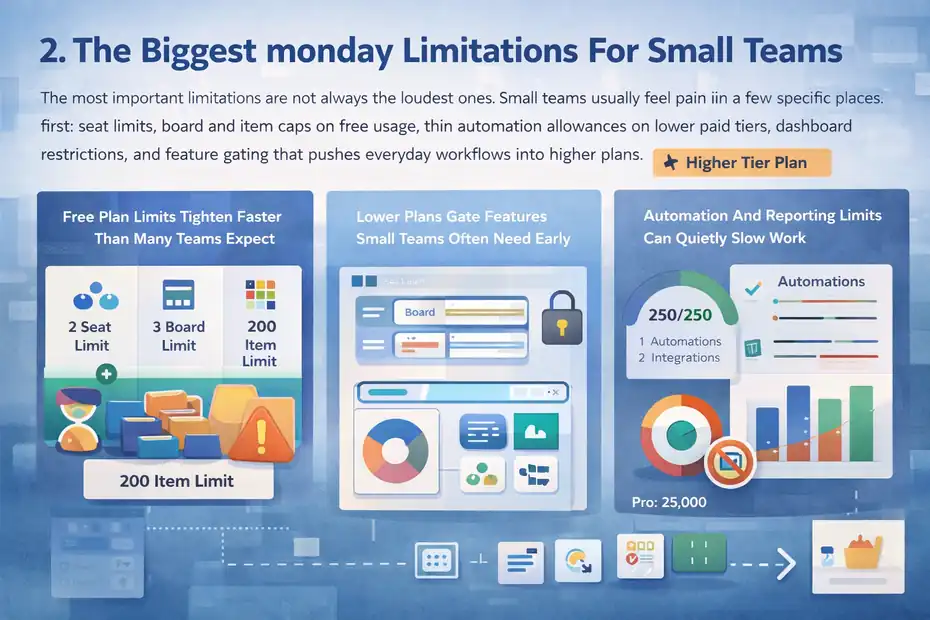
The most important limitations are not always the loudest ones.
Small teams usually feel pain in a few specific places first: seat limits, board and item caps on free usage, thin automation allowances on lower paid tiers, dashboard restrictions, and feature gating that pushes everyday workflows into higher plans.
Free Plan Limits Tighten Faster Than Many Teams Expect
The Free plan sounds useful on paper, but it narrows quickly for any real team workflow. monday.com’s Free plan is capped at two seats, up to three boards, and 200 total items across the account. It also removes automations, integrations, guests, and viewers, and limits dashboards to one board connection.
That means the Free plan is less of a “small team plan” and more of an individual or very early testing environment. If you are managing multiple client projects, sprint cycles, content calendars, or onboarding flows, 200 items disappears fast. Even a modest setup with recurring tasks, subitems, and active work can run into that ceiling much sooner than people think.
Here is the bigger issue: The plan can create false confidence. A founder and one assistant may build a nice system, but the moment a third person joins or your workflow depends on automation, the setup no longer fits. In my experience, that makes the Free plan useful for validation, not stability.
Lower Plans Gate Features Small Teams Often Need Early
The Basic plan removes the harshest Free plan caps, but it still keeps reporting and workflow sophistication fairly light. It includes unlimited items and 5 GB file storage, but dashboards can still pull from only one board.
That sounds small until you picture actual work. Imagine a team with one board for campaigns, one for content production, one for design requests, and one for approvals.
A one-board dashboard does not give leadership a real picture.It gives a partial picture. So instead of better visibility, the team ends up manually checking several boards or creating duplicate tracking structures.
Then Standard unlocks features that many small teams already consider basic, such as Timeline and Gantt views, guest access, 250 automation actions per month, 250 integration actions per month, and dashboards that combine up to five boards.
That is the core pattern: monday.com often places “operationally normal” small-team needs one tier above where budget-conscious buyers hope to stay.
Automation And Reporting Limits Can Quietly Slow Work
Automation is one of the clearest examples. Standard includes 250 automation actions and 250 integration actions per month, while Pro jumps to 25,000 for each. monday.com also notes that two-way syncs and frequent usage are not a good fit for Standard.
For a tiny team, 250 can sound generous. It often is not. One recurring automation that updates statuses, creates follow-up items, sends notifications, and syncs with another system can chew through actions surprisingly fast. The same is true if you use email integrations, lead routing, or client request workflows.
This matters because small teams use automation to compensate for having fewer people. A larger company can throw headcount at repetitive admin. A small team cannot.
So when automation limits are low, the platform is not just restricting convenience. It is limiting leverage, and leverage is exactly what small teams buy project software for.
Where Those Limits Show Up In Real Work
It is easier to understand monday limitations for small teams when you stop thinking in features and start thinking in weekly friction.
The limitations become obvious in reporting, client collaboration, recurring operations, and project visibility across several workflows.
Cross-Board Visibility Breaks First
A lot of small teams organize work by function. Marketing has one board, operations has another, product requests live elsewhere, and leadership wants one clean dashboard. That is a smart setup because it keeps each workflow focused. The issue is that reporting across those boards is limited by plan.
Basic dashboards can connect to only one board, Standard can connect five boards, Pro can connect 20, and higher tiers go further. monday.com also caps connected dashboard volume at 20,000 total items, subitems, and linked items across connected boards.
So the friction shows up like this: your team is organized, but your reporting is fragmented. A founder cannot see campaign output next to delivery progress and support backlog in one place unless the plan supports it.
Then people start rebuilding summary boards manually, which creates duplicate data and stale reporting. I have seen this turn a “single source of truth” promise into three sources of almost-truth.
Guests, Clients, And Contractors Complicate The Setup
Small teams often work with freelancers, agencies, contractors, or clients. That is normal. But collaboration with outside users becomes awkward if guest access is unavailable or limited to higher plans. Guest access is included on Standard and above, not on the Free plan.
This matters more than it seems. A three-person internal team might be working with two writers, a designer, and a client-side reviewer. Without a clean way to bring outside collaborators into the right project space, updates move back to email or chat. Once that happens, monday.com stops being the place where decisions live.
A realistic example: Imagine a boutique agency running five client deliverables at once. Internal tasks sit in monday, but approvals happen in email because the team wants to avoid higher access costs or plan restrictions. Every round of feedback then has to be copied back manually. That is not just messy. It is a delay multiplier.
Time Tracking, Formulas, And Deeper Control Arrive Later
On monday.com, features like time tracking, the Formula column, Chart View, and private boards appear on Pro rather than the lower plans.
On the Free plan, even useful columns such as Formula, Time Tracking, Progress Tracking, and Files are restricted.
For small teams, these are not vanity upgrades. Time tracking helps with resource planning and client profitability. Formula fields help calculate effort, costs, or weighted priority. Private boards help keep sensitive internal work separate from broader collaboration spaces.
This is where small teams often feel the platform becoming more expensive than expected. The team does not necessarily need a “power user” environment. It just needs a few practical controls to run work responsibly.
When those controls sit behind a bigger plan jump, the limitation is less about software capability and more about budget friction.
How Pricing Can Become A Hidden Bottleneck
Pricing is not only about the listed monthly number.
For small teams, the real cost is shaped by minimum seat bundles, feature gating, and the upgrade jumps required to unlock workflows that become necessary earlier than expected. monday.com’s pricing starts from three users on paid plans, even if your team is smaller.
Minimum Seats Can Penalize Very Small Teams
This is one of the most overlooked monday limitations for small teams. If you have two active users but need paid-plan features, monday.com states that plans start from three users.
For a bootstrapped business, that matters. A two-person consulting team may need guest access, dashboards across multiple boards, or simple automations. But the upgrade is not just “pay for the features you use.” It is “pay for a minimum team size that may not reflect your actual usage.”
On paper, the difference between free and paid can look manageable. In practice, minimum seats make the first upgrade feel steeper, especially for founders trying to keep software spend lean.
I suggest calculating software by workflow value, not by headline seat price. Ask: “Will this upgrade save enough time or prevent enough mistakes to justify the extra paid seat we do not really use?”
The Real Upgrade Trigger Is Usually Workflow Complexity
Most small teams do not upgrade because they suddenly become larger. They upgrade because their workflow gets more interconnected. A few examples make this obvious:
- A marketing team needs cross-board campaign reporting.
- A services team needs guest access for client collaboration.
- An operations team needs automations to reduce repetitive admin.
- A founder needs formulas and time tracking for cost control.
None of those are exotic use cases. They are normal signs that the business is maturing. Yet on monday.com, those needs can pull a team from Free to Standard or even Pro faster than expected.
That is why small teams sometimes feel “surprised” by the cost curve. The platform still looks affordable at the surface level, but the needed workflow maturity lives one or two plans higher than planned.
Cheap Software Gets Expensive When It Creates Manual Work
Here is the part many teams miss: software does not become expensive only when the invoice goes up. It also becomes expensive when it creates manual work that employees repeat every week.
If your team is manually copying updates between boards, rebuilding reports in spreadsheets, or chasing task status in Slack because your current plan lacks the right views or automation headroom, that labor has a cost. It is harder to measure, but it is real.
I believe this is the most useful way to judge monday.com for a small team. Do not compare only subscription prices. Compare the total operational cost of the plan you can actually afford. Sometimes the cheaper plan is truly enough. Sometimes it is the reason your team keeps doing admin by hand.
Which Plans Create The Most Friction
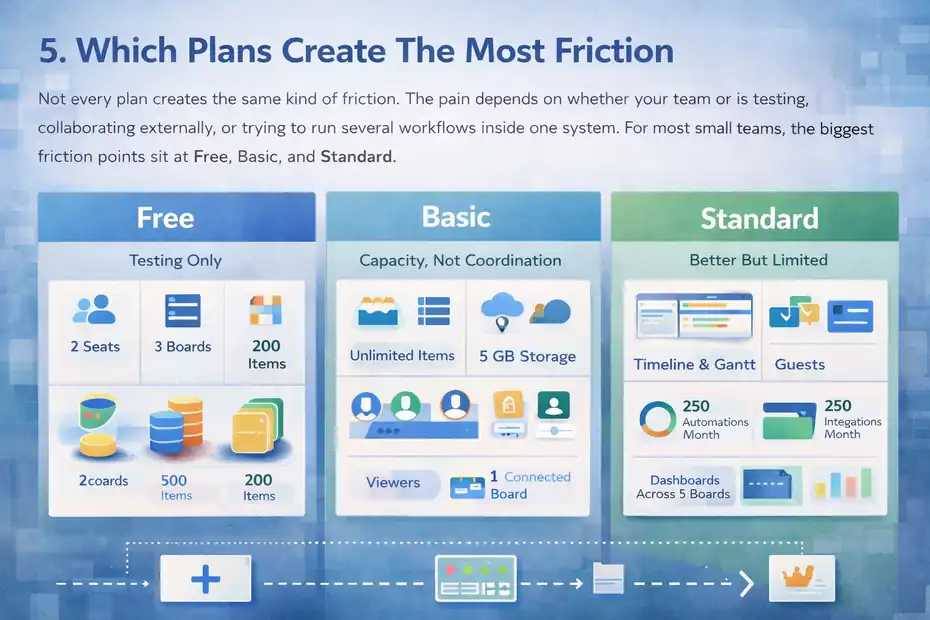
Not every plan creates the same kind of friction. The pain depends on whether your team is testing, collaborating externally, or trying to run several workflows inside one system.
For most small teams, the biggest friction points sit at Free, Basic, and Standard.
Free Is Best For Testing, Not For Team Operations
The Free plan is fine for proving that your team likes the interface. I would even recommend it for that exact reason. But once real work begins, the limits show up fast: two seats, three boards, 200 items, no automations, no integrations, no guests, no viewers, and only one board per dashboard.
That combination makes the plan poor for ongoing team operations. You can track work, but you cannot build much workflow around it. It becomes more like a demo environment than a durable workspace.
For a founder-led team, this often creates a false first impression. “We got organized in a week” turns into “We now have to rebuild our setup because the plan cannot support the way we actually work.” That is not a dealbreaker, but it is a migration headache inside the same platform.
Basic Solves Capacity, But Not Coordination
Basic removes item pressure and gives unlimited items, file storage, and viewers, which is a meaningful upgrade. But the dashboard limit of one connected board still makes it weak for teams that want leadership visibility across projects.
I think of Basic as a capacity upgrade, not a coordination upgrade. It gives you room to store more work, but not enough connective tissue to understand that work at a broader level.
So if your small team mostly works inside one operational board, Basic can be sufficient. If you split work by function, client, or department, it starts feeling cramped. This is the point where teams begin asking for “just a little more reporting,” and monday.com’s answer is often a bigger plan.
Standard Is Better, But Automation Limits Stay Tight
Standard is where monday.com starts to feel more complete for small teams. You get Timeline and Gantt views, guest access, integrations, automations, and dashboards across five boards.
That said, the 250 monthly automation actions and 250 integration actions remain the catch. monday.com’s own guidance suggests Standard is better for occasional, simple usage rather than daily, two-way synced operational workflows.
So Standard often works well for light project management, but can still frustrate a small team that wants its system to do more of the administrative lifting. In other words, Standard is often the first “serious” plan, but not always the first “comfortable” one.
Common Mistakes Small Teams Make Early
The platform does not create all the friction by itself. Sometimes the team’s setup decisions make the limitations feel worse.
Small teams can save themselves a lot of pain by avoiding a few common patterns early.
Building Too Many Boards Too Soon
When teams first use monday.com, they often create a board for everything. One for content, one for bugs, one for ideas, one for approvals, one for meetings, one for each client, and one for each internal process. It feels organized, but it multiplies reporting complexity immediately.
This becomes a problem because dashboard connections are plan-limited. So a board explosion forces the team into fragmented visibility faster than necessary. On lower plans, that means leadership loses the big picture or someone starts maintaining a summary board manually.
I usually suggest the opposite approach: fewer boards, better structure inside them. Use groups, statuses, owners, tags, and filtered views before splitting work into separate boards. That keeps reporting cleaner and reduces the chance that your plan limitations become painful too early.
Assuming Automation Will Fix A Messy Process
Automation is helpful, but it is not a rescue plan for unclear workflows. A lot of small teams say, “We’ll automate this later,” before they have defined who owns what, when statuses change, or what “done” means.
Then, once they reach Standard, they add automations on top of fuzzy processes and burn through limited action counts without getting much value. Since Standard includes only 250 automation and 250 integration actions monthly, waste matters.
A better approach is simple: Map your process first. Decide the trigger, owner, deadline rule, and exception path. Then automate only the repeatable part that truly saves time. That keeps your system lean and makes every action count work harder.
Choosing A Plan Based On Today’s Size Instead Of Next Quarter’s Work
This is probably the biggest planning mistake. Teams choose a plan based on the number of people they have right now, not the complexity of work they expect soon.
A three-person startup may assume it only needs a low-tier setup because it is “small.” But if that startup is running product launches, investor follow-ups, support issues, recruiting tasks, and agency coordination all at once, it is not operating like a simple team. It is operating like a dense team.
From what I have seen, small teams get better results when they choose a plan based on workflow density. Ask how many processes, collaborators, and recurring actions you need to manage. That gives a much more honest picture than headcount alone.
How To Work Around monday Limitations Without Chaos
Not every limitation requires an upgrade right away. Small teams can often stretch monday.com further by simplifying board design, protecting automation usage, and being more intentional about who uses the platform and how.
Simplify Your Workspace Before You Upgrade
Before spending more, reduce complexity. Many teams can recover enough efficiency just by reworking the structure they already have.
A practical reset looks like this:
- Keep one main board per core workflow, not per tiny sub-process.
- Use views and filters instead of duplicating boards for every audience.
- Standardize status labels so reporting stays consistent.
- Archive old work aggressively to keep boards easier to manage.
This does not magically remove product limits, but it delays friction. It also makes it clearer whether the bottleneck is really the platform or just a messy setup. In my experience, teams often discover they do not need more software yet. They need less sprawl.
Be Ruthless With Automation Priorities
If your plan includes limited actions, do not automate low-value tasks first. Automate the work that happens often, is easy to standardize, and has a real cost when missed.
For example, I would prioritize:
- Recurring task creation.
- Status-triggered handoffs.
- Deadline reminders.
- Intake routing for repeated requests.
I would not prioritize cosmetic updates or “nice to have” alerts until the team proves they are worth the action usage. monday.com makes automation appealing, but small teams should treat actions like a budget. Standard users especially need to do this because the jump from 250 monthly actions to 25,000 on Pro is huge.
Separate Internal Needs From Client-Facing Needs
One smart workaround is to stop expecting one board structure to serve everyone perfectly. Internal teams need detail. Clients and contractors usually need a filtered version of that detail.
So instead of overbuilding one workspace, design internal workflows for execution and use controlled sharing, guest spaces on eligible plans, or simplified views for outside collaborators.
This reduces clutter and helps your team avoid building duplicate systems for every audience. Guest access is available from Standard upward, so this becomes much easier once your collaboration model depends on outside users.
The key idea is this: Small teams stay fast when they protect the workspace from trying to be everything to everyone.
When To Stay, Upgrade, Or Switch
At some point, you have to make a decision. Keep the current setup, move up a plan, or look at another platform entirely.
The right answer depends less on brand preference and more on where your friction is coming from.
Stay If Your Team Has Simple, Board-Centered Work
You should probably stay with monday.com on a lower plan if your team works mostly inside one or two boards, does not depend heavily on outside collaborators, and can live with limited automation.
This is especially true if the platform is already adopted well. Adoption is worth a lot. A tool that your whole team actually uses can outperform a “better” tool that nobody opens consistently.
If your workflow is straightforward and the limitations are only occasional annoyances, forcing a migration may cost more than it saves. In that situation, a cleaner setup often beats a more powerful platform.
Upgrade If Limits Are Causing Weekly Manual Work
Upgrade when the limitations are creating recurring labor, not just occasional frustration. That means:
- You rebuild reports manually every week.
- You avoid inviting clients or contractors because access is awkward.
- Your automation usage runs out before the month ends.
- Your team needs formulas, time tracking, or deeper reporting to make decisions.
Those are not edge cases. They are signs the software is now constraining operations. When that happens, an upgrade can be justified because it buys back time and reduces process risk.
The leap is often uncomfortable, but so is repeating avoidable admin forever. monday.com’s plan ladder makes this especially visible around dashboards, guest access, automation allowances, and Pro-only controls such as time tracking and formulas.
Switch If Your Team Keeps Building Workarounds
A switch becomes worth considering when your team is no longer adapting workflows to fit business goals. Instead, the business is adapting itself to fit the platform.
That usually looks like this:
- Work is split awkwardly to stay under plan limits.
- Reporting lives half in monday and half in spreadsheets.
- Client collaboration stays outside the platform.
- Teams avoid useful automations because action budgets are too tight.
- You need features from a higher tier, but the cost jump no longer makes sense.
I do not think every small team should leave monday.com when it gets expensive or restrictive. But I do think small teams should be honest about the hidden cost of workarounds. When the tool becomes something your team constantly negotiates with, instead of something that supports the work naturally, that is your signal to reevaluate.
Final Thoughts
The real issue with monday limitations for small teams is not that monday.com is a weak platform. It is that small teams often need more operational flexibility than entry-level plans assume.
Free is narrow, Basic improves storage more than coordination, Standard unlocks important functionality but keeps automation tight, and Pro is where several practical controls finally appear.
If I were advising a small team today, I would keep the decision simple. Map your next 90 days of work, not just your current team size. Count how many boards you truly need, how often you want automations to run, whether guests matter, and whether leadership needs cross-board visibility.
That gives you a much better answer than feature checklists alone.
Monday.com can absolutely work for small teams. But only when the plan, workflow complexity, and collaboration model match. When they do not, the limitations are not minor. They are the exact things that slow a small team down.
FAQ
What are the main monday limitations for small teams?
The main monday limitations for small teams include restricted automation actions, limited dashboard connections, minimum seat requirements, and feature gating across plans. These limits often affect reporting, collaboration, and workflow efficiency, especially as small teams begin handling multiple projects or need cross-board visibility.
Is monday.com free plan enough for small teams?
The monday.com free plan is usually not enough for small teams because it only supports two users, limited boards, and no automation or integrations. While it works for testing or very simple workflows, most teams quickly outgrow it once collaboration and recurring processes become essential.
Why do small teams struggle with monday.com automation limits?
Small teams rely heavily on automation to save time, but monday.com’s lower-tier plans cap automation actions monthly. This means frequent workflows like task creation, notifications, and updates can quickly hit limits, forcing teams to either upgrade or handle repetitive work manually.
How does monday.com pricing affect small teams?
Monday.com pricing can impact small teams due to minimum seat requirements and feature-based upgrades. Even very small teams may need to pay for more users than they have, and essential features like dashboards or guest access often require higher-tier plans, increasing overall costs.
When should a small team upgrade or switch from monday.com?
A small team should upgrade or switch when limitations start causing weekly inefficiencies, such as manual reporting, limited collaboration, or automation shortages. If the platform begins slowing down workflows instead of supporting them, it is a clear sign to reassess the plan or consider alternatives.

I’m Juxhin, the voice behind The Justifiable.
I’ve spent 6+ years building blogs, managing affiliate campaigns, and testing the messy world of online business. Here, I cut the fluff and share the strategies that actually move the needle — so you can build income that’s sustainable, not speculative.
Related posts:
 How To Set Up Monday For Beginners Step By Step Without Confusion
 7 Monday Alternatives For Small Teams On A Budget That Save Money
 Project Management Tools Monday: Complete Beginner’s Guide
 Project Management Software Monday: My Review
 Is Monday Project Management Software Worth It?
 Project Management Monday Tips That Save Hours Each Week