
Table of Contents
Some links on The Justifiable are affiliate links, meaning we may earn a small commission at no extra cost to you. Read full disclaimer.
If you’ve ever spent hours scrolling through suppliers trying to find the next big product, you know how exhausting it can be.
That’s where the SaleHoo products list really shines. It takes the guesswork out of product research by showing you exactly which items are trending, profitable, and worth your attention.
In this guide, I’ll walk you through how to use SaleHoo’s data-driven lists to uncover winning items fast—without wasting time on guesswork or hype.
Understanding The Power Of The Salehoo Products List
The SaleHoo products list is like having a shortcut to e-commerce success — it gives you real data on what’s selling, who’s supplying it, and what kind of profits you can expect.
Let’s break down how this tool actually works and why it’s so powerful when used right.
How Salehoo’s Product Database Works
SaleHoo’s database is built from verified suppliers and products across multiple niches.
Unlike random product lists you might find online, SaleHoo pulls data from wholesalers and dropshippers that have been vetted for legitimacy.
You can search thousands of products using specific filters like:
- Category: Electronics, fashion, beauty, homeware, and more.
- Supplier Type: Dropshipping or wholesale.
- Location: U.S., U.K., or global suppliers.
- Profit Margin: Shows potential ROI for each item.
I like to think of it as your product radar. Instead of testing hundreds of random items, you get a curated list of products that already show signs of buyer demand and supplier reliability.
Why Product Data Matters More Than Hype
Most new sellers fall into the trap of chasing what “looks popular” on social media — but viral doesn’t always mean profitable. SaleHoo flips that approach. It gives you data-first validation, showing real metrics like:
- Sell rate: How often the product is purchased.
- Competition score: How saturated the market is.
- Average supplier rating: Based on verified reviews.
When you use hard data, you’re not guessing — you’re making decisions backed by evidence. That’s what separates long-term sellers from those who burn out after a few failed launches.
Key Metrics That Define A “Winning” Product
Every successful e-commerce product shares a few traits. SaleHoo highlights these metrics clearly so you can spot them fast:
- Profit Margin: At least 30–40% is ideal for sustainable growth.
- Steady Demand: Consistent sales volume over 3+ months.
- Low Competition: Enough room to enter without fighting massive brands.
- Reliable Supply: Supplier can handle bulk orders and fast shipping.
In my experience, focusing on these four alone can save you months of trial and error.
The Role Of Verified Suppliers In Product Success
Even the best product idea fails if the supplier can’t deliver. That’s why SaleHoo’s verification process is gold.
Each supplier is vetted for:
- Business legitimacy (licenses, trade history)
- Customer service responsiveness
- Shipping reliability
This matters because your supplier’s reliability = your store’s reputation. Using SaleHoo means you’re partnering with people who already meet strict quality standards, not just taking a gamble on unknown sources.
How To Use The Salehoo Products List To Find Winning Items
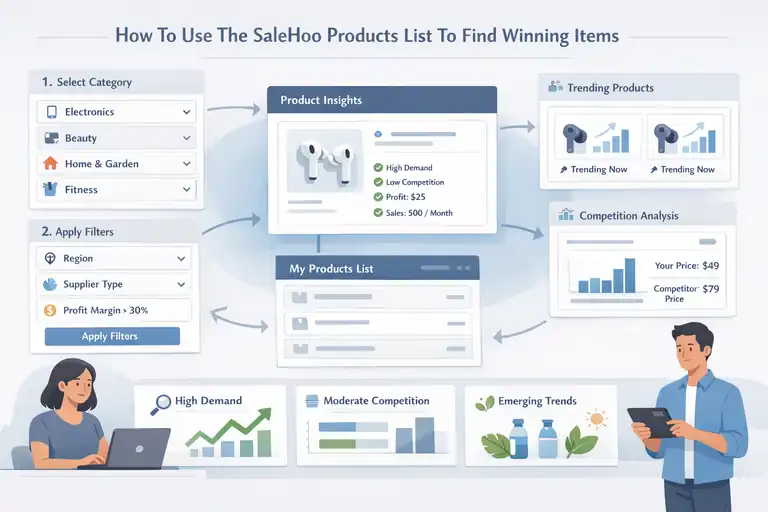
Now that you know the “why” behind SaleHoo’s list, let’s talk about the “how.”
Here’s how to actually navigate and use it to find products that sell quickly and profitably.
Step-By-Step Guide To Navigating The Dashboard
SaleHoo’s dashboard is clean and intuitive, even if you’re new to product research.
Here’s a simple walkthrough:
- Log in and head to “Products.”
- Choose your category — say electronics or beauty.
- Apply filters like region, supplier type, and profit margin.
- View detailed insights on each product, including competition, pricing, and sales volume.
- Add favorites to your “My Products” list for ongoing tracking.
Once you’ve done this a few times, you’ll start to notice patterns — like which niches consistently produce bestsellers.
How To Filter Products Based On Profit Margin And Demand
Filtering is where the magic happens. SaleHoo lets you set parameters that help you focus only on worthwhile items.
- Start with a profit margin filter above 30%.
- Sort by “High Demand” products first.
- Then narrow by competition — look for moderate competition for balance.
You’ll quickly see which products offer strong returns without entering a market that’s already saturated.
Using The Trending Section To Spot Emerging Opportunities
The “Trending Products” section in SaleHoo is your early-warning system for what’s about to blow up. It’s updated regularly based on marketplace data.
A practical way to use it:
- Check for products with a rising sell rate but still low competition.
- Search for seasonal or emerging lifestyle trends (e.g., eco-friendly gadgets, reusable items).
- Add those to your test list for small-scale ads or store trials.
That’s how many successful sellers catch trends early — they use SaleHoo’s trending data to get ahead of the crowd.
How To Validate Product Ideas Using Salehoo’s Research Tools
Before you invest in inventory or build a marketing campaign, validate the product. SaleHoo includes tools that help confirm whether your idea has real potential.
Here’s a simple process I follow:
- Check demand and sell rate in SaleHoo.
- Cross-check Google Trends for rising search interest.
- Compare competitor listings on Shopify.
- Test with small ad campaigns to gauge audience reaction.
This method ensures that your product isn’t just “interesting” — it’s actually profitable and proven.
Top Categories In The Salehoo Products List For Fast Growth
Not all product categories perform equally. Some have stable demand all year, while others spike seasonally.
SaleHoo’s database makes it easy to identify which categories are consistently profitable.
Best-Selling Electronics With Consistent Demand
Electronics are a powerhouse category in the SaleHoo products list. Think Bluetooth headphones, power banks, and smart home accessories.
Why they work:
- Evergreen demand: People always upgrade tech.
- High resale value: Margins often exceed 40%.
- Scalable: You can start small and expand into bundles or accessories.
Just be sure to double-check warranties and supplier ratings since tech returns can be costly.
Home And Kitchen Products That Dominate Online Sales
Home and kitchen goods are another top performer, especially post-pandemic when home-based living became the norm.
Examples that sell well include:
- Reusable storage containers
- Multifunctional kitchen gadgets
- Minimalist décor items
What makes them ideal is repeatability. Customers often buy more than one or come back for replacements.
Beauty And Personal Care Items With High Repeat Buyers
Beauty products have a loyal fan base and predictable buying patterns.
The SaleHoo list includes items like:
- Organic skincare
- Hair styling tools
- Men’s grooming kits
These categories thrive because they combine high margins with brand loyalty. If you position yourself as a quality-focused seller, you’ll get recurring customers.
Fashion And Accessories That Trend Year-Round
Fashion remains a hot e-commerce niche because it adapts fast to trends. SaleHoo helps identify which subcategories (like minimalist jewelry or activewear) are growing.
To win in this space:
- Focus on timeless items (e.g., classic tees or neutral-tone bags).
- Avoid overly seasonal inventory.
- Look for suppliers offering flexible sizing or customization.
That’s how smaller fashion brands compete with bigger ones — through smart curation.
Hidden Niches With High-Profit Margins
Some of the most profitable categories aren’t obvious at all. SaleHoo’s data can reveal hidden gems in niches like:
- Pet accessories
- Eco-friendly lifestyle goods
- Hobby or craft supplies
These niches often have passionate audiences and low competition, making them perfect for new or boutique sellers.
Advanced Filtering Techniques To Refine The Salehoo Products List
One of the biggest strengths of the SaleHoo products list is how deep you can go with filters. These filters help you move from browsing to real product discovery — fast.
Here’s how to refine your searches so you’re not just finding products, but finding the right ones for your business model.
How To Combine Filters For Laser-Focused Product Research
Think of SaleHoo’s filters as your precision tools. Instead of manually scrolling through hundreds of listings, you can narrow your search in seconds.
Here’s a method I use:
- Start broad: Choose your main category like “Home & Kitchen” or “Beauty.”
- Add filters for supplier type and region: This cuts irrelevant results.
- Set profit margin and sell rate parameters: Aim for at least a 30% margin and consistent demand.
- Apply competition filters: Medium competition often gives the best balance.
This layered approach helps you find products that check every box — demand, profit, and supplier quality — without drowning in data.
A small example: I once searched for “wireless chargers” globally, but when I applied U.S.-based dropshipper + 30% margin + low competition, I found two suppliers that were perfect for fast shipping and healthy margins.
Sorting By Supplier Type To Find Dropshipping Opportunities
SaleHoo lets you sort by supplier type, which is especially useful if you run a dropshipping store.
When you filter for dropshipping suppliers, you’re only seeing sellers that:
- Handle storage and shipping for you.
- Offer product data feeds for easy store import.
- Support small minimum order quantities (or none at all).
If you’re testing new products, this filter helps reduce risk. You can try multiple items without buying stock upfront.
Later, when something starts performing well, you can switch to a wholesale supplier for better pricing and margins.
It’s a strategy I’ve used myself — start lean, then scale with confidence.
Identifying Local Vs. International Supplier Advantages
Choosing between local and international suppliers often depends on your business goals. SaleHoo’s region filters help make that choice clear.
- Local suppliers (U.S., U.K., Australia):
- Faster shipping and returns.
- Easier communication and trust.
- Slightly higher costs but better customer experience.
- International suppliers (mainly Asia):
- Lower wholesale prices.
- Broader product variety.
- Longer shipping times — manageable if customers know upfront.
Here’s a practical tip: If your target market is in the U.S., start with local suppliers for customer satisfaction. Once your store builds momentum, consider expanding internationally to increase profit margins.
Using Price Range Filters To Match Your Business Model
Price range filtering is more powerful than most people think. It helps you align products with your brand’s price point and audience expectations.
For example:
- If your brand sells affordable lifestyle products, set your filters between $5–$20.
- For premium stores, look at products $50 and up with high perceived value.
In my experience, combining price filters with profit margin data quickly reveals “sweet spot” products — those that are affordable for customers yet profitable for you.
Proven Ways To Validate Products From The Salehoo List

Before you jump into selling, it’s smart to double-check whether a product is actually worth your time.
Validation ensures you’re not betting on a trend that’s already fading or a niche that’s too crowded.
Checking Competition Levels Before Investing
Competition is a double-edged sword — too high and you get lost; too low and demand might not exist.
Here’s a simple framework to balance it:
- Use SaleHoo’s competition indicator. Medium competition is ideal.
- Search on Amazon or Shopify to see how many similar products are selling.
- Check ad platforms (like Facebook Ads Library) to see if brands are actively promoting it.
If you find consistent marketing activity but not extreme saturation, that’s a strong sign you’ve found a viable product space.
Using Google Trends To Confirm Market Demand
Google Trends is one of my favorite validation tools because it shows real search interest over time.
Steps to validate:
- Enter the product keyword (e.g., “reusable water bottle”).
- Set the time frame to at least 12 months.
- Look for steady or rising interest, not sharp spikes.
A steady upward curve signals sustainable demand. If it’s seasonal (like “Christmas lights”), plan your campaigns accordingly.
SaleHoo’s data combined with Google Trends gives you a near-complete demand picture — marketplace data meets real-world search interest.
How To Test Product Interest With Social Media Ads
Running small test ads is a fast, inexpensive way to measure real interest before scaling.
Try this:
- Create a simple landing page or Shopify product page.
- Run a $20–$50 ad on Facebook, Instagram, or TikTok.
- Measure click-through rates (CTR) and engagement.
If you get high engagement or add-to-carts without heavy discounts, that’s your validation green light.
I’ve found that even small ad tests can save you from overstocking a product that looks good on paper but doesn’t attract buyers.
Evaluating Long-Term Profitability Before Scaling
Profit isn’t just about margins — it’s about sustainability. Ask yourself: Will this product still make money six months from now?
Look for:
- Stable demand trends (not seasonal hype).
- Repeat purchase potential.
- Low return rates based on supplier feedback.
If a product has steady interest, a loyal customer base, and predictable fulfillment costs, it’s a safe candidate for scaling.
How To Turn Salehoo Products Into E-Commerce Winners
Once you’ve validated a few products, it’s time to build momentum. The goal now is to turn those SaleHoo items into consistent revenue — and that starts with presentation, positioning, and smart marketing.
Building A Store Around High-Margin Products
It’s easier to build a brand when your best products share a theme or solve related problems.
For example, if you’re selling eco-friendly home goods, every product in your store should fit that lifestyle. It creates brand coherence and encourages bundle buying.
High-margin products (40% or higher) give you more room for ads, influencers, and packaging upgrades without losing profit. That’s why I always start my product selection from the margin up, not just what’s trending.
Crafting Unique Product Listings That Convert
Your listing is where curiosity turns into action. Even with great products, weak descriptions can kill conversions.
Focus on three parts:
- Headline: Clear benefit (e.g., “Cut Drying Time in Half with This Ionic Hair Dryer”).
- Visuals: Use real photos and short demo videos when possible.
- Copy: Highlight pain points, benefits, and proof (reviews, certifications).
Tip: Use language that speaks to the reader’s emotion — convenience, savings, or lifestyle improvement. That’s what triggers action.
Using Customer Reviews To Strengthen Credibility
Reviews are the digital equivalent of word-of-mouth. SaleHoo suppliers often have review data available; use that to build trust early.
Ways to maximize them:
- Showcase supplier credibility (e.g., “4.8-star rated supplier on SaleHoo”).
- Add verified purchase badges on your store.
- Encourage new customers to leave feedback post-purchase.
Social proof can double your conversion rate — it’s not just about stars, it’s about trust signals that reassure buyers.
How To Bundle Products For Higher Average Order Value
Product bundling is one of the simplest ways to increase profits without increasing traffic.
For example:
- Pair a “wireless charger” with a “phone stand.”
- Offer “buy 2, get 1 free” for consumables like skincare items.
Bundles add perceived value and subtly raise your store’s average order value (AOV).
From what I’ve seen, well-thought-out bundles can boost revenue by 20–30% with almost no added cost.
Common Mistakes To Avoid When Using The Salehoo Products List
Even with a powerful tool like the SaleHoo products list, small mistakes can quietly eat away at your profits.
I’ve made a few of these myself in the early days, so let’s talk through the most common traps and how you can sidestep them.
Relying Only On Product Popularity Without Research
It’s easy to fall in love with “hot” products that seem to be everywhere online. The problem is, by the time you see them trending, the market might already be crowded.
Instead of chasing hype:
- Cross-check SaleHoo’s popularity score with your own market research.
- Look at profit margins and supplier availability before committing.
- Search Google Trends to see if demand is growing or plateauing.
I once tested a “smart posture corrector” because it looked viral. Sales started strong, but competition killed margins within weeks. That experience taught me: popularity doesn’t equal profit.
Ignoring Shipping Times And Supplier Reliability
Shipping speed is one of those behind-the-scenes details that can make or break your reputation. Customers might love your products, but long or unpredictable shipping can cause refund requests and bad reviews.
Before listing any product:
- Check the supplier’s average fulfillment time.
- Review SaleHoo’s supplier reliability score — this data exists for a reason.
- Message suppliers directly to confirm delivery expectations.
It’s better to pick a slightly higher-cost product with faster shipping than a cheaper one that takes weeks to arrive. Customer experience wins long-term.
Overlooking Seasonal Demand Fluctuations
Some products shine for a few months, then sales nosedive. Seasonal demand isn’t a bad thing — but you need to plan for it.
How to manage seasonality:
- Review 12-month sales trends before committing to inventory.
- Use SaleHoo’s “demand over time” graphs to identify recurring peaks.
- Build a product rotation plan — for example, focus on outdoor items in summer, cozy products in winter.
Think ahead. If you sell Christmas lights, start marketing in October, not December. Timing is everything.
Failing To Differentiate Your Product Offer
Selling the same product as 50 other stores? That’s a quick race to the bottom. Differentiation doesn’t always mean inventing something new — it means positioning it differently.
You can stand out by:
- Creating better product descriptions and photos.
- Offering bundles or bonus items.
- Building a brand story around your niche.
I’ve seen two stores sell identical items, but the one with lifestyle-focused branding outperformed the other by 3x. It wasn’t the product — it was the presentation.
Expert Tips To Maximize Your Salehoo Product Research
Once you’re comfortable with the SaleHoo products list, the goal shifts from finding products to mastering the research process.
Here are proven ways to turn your workflow into a repeatable, profitable habit.
Schedule Regular Product Research Sessions
Treat product research like a business meeting, not an afterthought. The e-commerce market changes fast, and new opportunities pop up weekly.
Here’s what works for me:
- Set aside 30–60 minutes twice a week to browse new products.
- Compare week-to-week trend shifts in SaleHoo’s trending data.
- Track notes on promising items in a simple spreadsheet.
Doing this consistently keeps you ahead of slow-reacting competitors who only check once a month.
Track Profit Trends Over Time For Better Insights
SaleHoo shows estimated margins, but real insight comes from tracking your own performance over time.
Create a “profit trend log” that includes:
- Supplier cost
- Retail price
- Conversion rate
- Advertising spend
- Return rate
When you start seeing consistent 25–40% margins with low refunds, that’s a green flag to scale. Numbers tell the story — not guesses.
Use Multiple Salehoo Lists To Diversify Risk
Relying on one niche or product category is risky. Diversifying across multiple lists keeps your revenue stable, even if one market slows down.
Here’s how I do it:
- Pick one core category for your brand (e.g., eco-living).
- Add two backup categories with complementary appeal (e.g., sustainable fashion or home tools).
- Rotate testing every quarter to find new winning products.
This mix of stability and exploration keeps your business agile.
How To Build Long-Term Supplier Relationships
Suppliers aren’t just vendors — they’re partners in your business. Building strong relationships can unlock better pricing, exclusive deals, and faster service.
Tips to maintain good supplier rapport:
- Communicate regularly and clearly.
- Always pay on time.
- Give feedback — suppliers appreciate knowing what’s selling well.
- Be transparent about your growth plans.
I’ve had suppliers bump me to priority status just because I treated them with respect and shared my goals. It’s that human connection that pays off.
Comparing Salehoo’s Products List With Other Platforms
When it comes to product sourcing, SaleHoo isn’t the only name out there. But its approach to verified suppliers and data-driven research sets it apart.
Let’s see how it stacks up against some major platforms.
How Salehoo Stacks Up Against AliExpress And Alibaba
AliExpress and Alibaba are massive marketplaces, but they can be overwhelming. SaleHoo simplifies things by offering curated, verified lists — no guesswork required.
Key differences:
- SaleHoo: Focuses on verified, reliable suppliers.
- AliExpress/Alibaba: Open platforms with variable quality control.
- SaleHoo: Offers real performance data (sell rate, competition).
- AliExpress/Alibaba: Relies mostly on product descriptions and seller ratings.
So while AliExpress gives you more variety, SaleHoo gives you clarity and trust. That’s priceless when scaling your store.
Why Salehoo’s Verification System Saves You Time
Every supplier on SaleHoo is screened for business legitimacy, responsiveness, and track record. That’s huge because supplier verification is usually a hidden time drain.
Instead of spending hours checking trade records, you can go straight to the selling part. From what I’ve seen, this can shave up to 80% off your research time compared to doing it manually.
For small business owners, time saved is money earned.
The Cost-To-Value Ratio Of Using Salehoo For Product Discovery
Some people hesitate because SaleHoo isn’t free. But when you compare what you get — verified suppliers, real data, and a constantly updated list — it’s easily worth it.
Think about it this way: one bad supplier or product mistake can cost hundreds (or more). SaleHoo helps prevent those losses before they happen. It’s an investment in accuracy and trustworthiness, not just access.
Which Platform Is Best For Your Business Stage
- Beginners: SaleHoo is ideal because it filters out risky suppliers and provides educational support.
- Intermediate sellers: Combine SaleHoo’s data with marketplaces like Alibaba for custom sourcing.
- Advanced sellers: Use SaleHoo for trend validation and supplier diversification.
So it’s not an “either-or.” SaleHoo often complements other sourcing platforms rather than replaces them.
Final Strategy: Turning Data Into Daily Sales
Data means nothing if it doesn’t translate into action. The real power of the SaleHoo products list comes from turning insights into repeatable, sales-driven systems.
Creating A Repeatable System For Product Research
Make product discovery a structured process instead of a random hunt.
Here’s a simple cycle I use:
- Identify trends using SaleHoo data.
- Validate with Google Trends and test ads.
- Track performance metrics weekly.
- Scale only the top 20% of performers.
This “test and refine” approach keeps your store fresh while minimizing risk.
Automating Supplier Communication For Faster Fulfillment
Speed is everything in e-commerce. Automating routine supplier communication helps you respond to orders quickly.
Tools like order management systems or integrated dropshipping apps can:
- Send automatic purchase orders.
- Track shipment status.
- Update customers in real-time.
You can also set up simple email templates for supplier coordination. It’s a small tweak that frees up hours every week.
Monitoring Product Performance For Continuous Growth
Your top sellers today might not be your best sellers next month. Keep a pulse on product performance metrics such as:
- Sales volume
- Refund rates
- Customer reviews
- Ad conversion rates
Every few weeks, replace underperforming products with new ones from your SaleHoo list. This ongoing refresh keeps your store relevant and profitable.
Pro Tip: Combine Salehoo Insights With Marketing Data
Here’s where the magic happens — when you merge SaleHoo’s sourcing data with your marketing analytics.
By aligning SaleHoo’s high-demand products with your audience data (from Facebook Ads, Google Analytics, or Shopify), you can pinpoint exactly which products your customers are ready to buy.
That’s how real e-commerce growth happens — not just finding winning products, but matching them with the right audience at the right time.
FAQ
What is the SaleHoo products list?
The SaleHoo products list is a curated database of trending, high-demand items from verified suppliers, helping you quickly find profitable products to sell online.
How does the SaleHoo products list help find winning items fast?
It uses real-time sales data, competition analysis, and profit margin filters to highlight products with proven market demand, saving hours of manual research.
Can beginners use the SaleHoo products list effectively?
Yes. The SaleHoo products list is beginner-friendly, offering clear filters, supplier verification, and step-by-step insights for choosing reliable, profitable products.

I’m Juxhin, the voice behind The Justifiable.
I’ve spent 6+ years building blogs, managing affiliate campaigns, and testing the messy world of online business. Here, I cut the fluff and share the strategies that actually move the needle — so you can build income that’s sustainable, not speculative.
Related posts:
 How the Salehoo Catalog Helps You Spot Winning Items Quickly
 How To Start A Dropshipping Business With No Money
 Ecommerce Marketing Guide: Turn Traffic Into Sales
 Salehoo Directory Free: What You Can Access Without Paying
 Why the Salehoo Wholesale Directory Helps You Scale
 How to Sell on SaleHoo: A Simple Guide for New Sellers