
Table of Contents
Some links on The Justifiable are affiliate links, meaning we may earn a small commission at no extra cost to you. Read full disclaimer.
Here’s my take on this Squirrly SEO review, because I’ve seen a lot of tools promise “real results” and only deliver clever dashboards.
If you’re wondering whether Squirrly SEO actually helps you rank or if it’s just smart marketing wrapped in shiny features, this breakdown is designed to help you decide with clarity and confidence.
What Squirrly SEO Claims To Solve For Website Owners
Squirrly SEO positions itself as a tool for people who want traffic and rankings without drowning in technical SEO details.
Instead of assuming you already know SEO, it tries to guide you step by step, almost like having an SEO coach sitting next to you while you work.
Positioning As An AI-Powered SEO Assistant
Squirrly SEO frames its core value around AI-driven guidance, but in plain terms, this means it actively watches what you’re doing and reacts in real time.
When you write content in WordPress, Squirrly analyzes it instantly and tells you what to improve before you publish.
How this shows up in practice:
- You type a paragraph and immediately see feedback on keyword usage, readability, and structure.
- The tool adjusts suggestions based on your selected goal, such as traffic growth or authority building.
- It prioritizes actions so you’re not guessing what matters most.
From my experience, this feels less like a static checklist and more like a live SEO companion. It’s especially helpful if SEO usually feels overwhelming or fragmented.
Promises Around Ranking Without SEO Expertise
One of the boldest promises in any Squirrly SEO review is that you don’t need SEO knowledge to rank. That’s a strong claim, and it’s partially true, with some nuance.
Squirrly simplifies complex SEO concepts like:
- Search intent, explained through content goals.
- Semantic keywords, shown as natural phrases instead of technical jargon.
- On-page SEO, broken into clear, actionable tasks.
However, it’s not magic. What it really does is remove decision paralysis. You’re not learning SEO theory; you’re following guided actions.
For beginners, this dramatically lowers the barrier to entry. For advanced users, it may feel restrictive at times.
Target Audience And Use Cases Squirrly Focuses On
Squirrly SEO is clearly designed with specific users in mind, and it doesn’t try to be everything for everyone.
It works best for:
- Bloggers who write their own content and want guidance while writing.
- Small business owners managing SEO themselves.
- Content teams that need consistency without deep SEO training.
It’s less ideal for:
- Agencies managing dozens of client sites.
- Technical SEOs who want granular control over every signal.
If you’ve ever thought, “I just want someone to tell me what to fix,” this tool speaks directly to you.
How Squirrly SEO Differentiates Itself From Competitors
Most SEO plugins focus on optimization after content is written. Squirrly flips that by guiding you during creation.
Key differences you’ll notice:
- Real-time feedback instead of post-publish audits.
- Focus Pages that act like SEO roadmaps.
- A learning system that adapts based on your progress.
Compared to tools like Yoast or Rank Math, Squirrly feels more proactive and less rule-based. It trades flexibility for clarity, which can be a fair deal depending on your goals.
Core Features Inside Squirrly SEO Explained Clearly

Squirrly SEO’s feature set looks large at first glance, but most tools revolve around one idea: guiding you toward measurable SEO progress without technical overwhelm.
Live SEO Assistant And Real-Time Optimization Guidance
The Live Assistant is the feature most users remember. It evaluates your content as you write and updates instantly.
What it analyzes in real time:
- Keyword placement and natural usage.
- Content length compared to top-ranking pages.
- Readability and structural clarity.
I like this because it removes the “publish and pray” approach. You know before hitting publish whether your content meets basic SEO standards.
Focus Pages And Keyword Strategy Capabilities
Focus Pages are Squirrly’s version of priority SEO targets. You choose pages you want to rank, and Squirrly builds a task list around them.
Each Focus Page includes:
- A primary keyword and related phrases.
- Weekly tasks tied directly to ranking improvement.
- Progress tracking tied to visibility metrics.
This is one of the few features that actually encourages long-term SEO thinking instead of chasing random keywords.
SEO Audit Tools And Weekly Performance Reports
Squirrly runs automated audits and delivers weekly reports that are readable even if you’re not technical.
Reports typically cover:
- Indexing and technical errors.
- Content optimization gaps.
- Ranking movement for Focus Pages.
Instead of dumping raw data, it translates findings into actions. That’s a small detail, but it saves a lot of mental energy.
Content Optimization And Semantic SEO Support
Semantic SEO sounds complex, but Squirrly simplifies it by suggesting related phrases that real users search for.
You’ll see:
- Keyword alternatives that fit naturally into sentences.
- Topic coverage suggestions instead of density rules.
- Content scoring based on topical relevance.
This aligns well with how Google evaluates content today, especially after helpful content updates.
Automation Features Designed For Non-Technical Users
Automation is where Squirrly quietly shines. Many tasks run in the background without setup.
Examples include:
- Automatic keyword tracking.
- Scheduled audits and progress checks.
- Priority alerts when something needs attention.
Here’s a quick comparison to put this into perspective:
| Feature Area | Squirrly SEO | Yoast SEO | Rank Math |
| Real-time writing guidance | Yes | Limited | Limited |
| Long-term page tracking | Focus Pages | No | Partial |
| Beginner-friendly automation | High | Medium | Medium |
| Learning curve | Low | Low | Medium |
If you value guidance over control, these features make Squirrly SEO feel less like software and more like a system that keeps you moving forward.
Squirrly SEO Workflow From Setup To Daily Use
This is where Squirrly SEO either clicks for you or doesn’t. The workflow is opinionated, guided, and very different from traditional SEO plugins that just sit there waiting for input.
Initial Setup Process And WordPress Integration
Setting up Squirrly SEO is straightforward, especially if you’re already using WordPress. Once installed, it walks you through a configuration wizard that feels more like onboarding than setup.
Here’s what actually happens:
- You connect Google Search Console and Google Analytics so Squirrly can pull real performance data.
- You define your main goals, such as traffic growth, rankings, or authority.
- You answer a few questions about your SEO experience level.
What I appreciate is that it doesn’t assume you know what schema, indexing, or crawl budget means. It configures defaults automatically and explains why certain options are enabled.
For beginners, this reduces setup anxiety. For experienced users, it’s fast but slightly restrictive.
Dashboard Navigation And Learning Curve Assessment
The dashboard is busy, but intentional. Instead of a single score, you see tasks, progress bars, and recommendations.
You’ll mainly interact with:
- The SEO Goals section, which shows what needs attention.
- Weekly objectives tied to measurable outcomes.
- Notifications that explain issues in plain language.
There is a learning curve, but it’s not technical. It’s more about trusting the system. If you’re used to tweaking everything manually, this may feel uncomfortable at first. If you prefer guidance, it feels relieving.
Daily SEO Tasks And Recommended Actions System
This is where Squirrly SEO becomes very hands-on. Each day, it recommends specific actions instead of vague advice.
Examples of daily tasks include:
- Improving internal links for a Focus Page.
- Expanding content depth based on competing pages.
- Updating metadata to match current search intent.
From what I’ve seen, completing these consistently creates momentum. It’s not instant ranking magic, but it builds SEO habits that compound over time.
How Focus Pages Guide Long-Term SEO Efforts
Focus Pages are the backbone of Squirrly’s long-term strategy. You select pages that matter most, and the tool tracks them obsessively.
Each Focus Page includes:
- Ranking position tracking.
- Optimization completeness.
- Suggested next steps based on performance trends.
This prevents the common mistake of publishing content and forgetting it. I’ve found this especially useful for cornerstone content that needs ongoing improvement, not one-time optimization.
Real Ranking Impact Based On Practical SEO Scenarios
This is the section most people care about in a Squirrly SEO review. Does it actually move rankings, or does it just make you feel productive?
On-Page Optimization Results For Blog Content
For blog posts, Squirrly shines in on-page optimization. It catches issues many writers miss, especially around intent matching and topical depth.
In practice:
- Posts optimized with Squirrly tend to be longer and more comprehensive.
- Content structure improves naturally through suggestions.
- Thin content warnings prevent premature publishing.
I’ve seen posts move from page two to the bottom of page one after applying recommendations, but only when combined with decent backlinks and content quality.
Keyword Movement Tracking And Visibility Changes
Squirrly tracks keyword movement automatically for Focus Pages. Instead of overwhelming charts, it highlights directional trends.
What works well:
- Visibility changes are easy to understand.
- You’re notified when rankings stagnate.
- Progress is tied to completed tasks.
This makes SEO feel less abstract. You can connect actions to outcomes, which is motivating, especially for solo site owners.
Content Scoring Accuracy Versus Actual SERP Results
Content scoring is helpful, but not perfect. A high score doesn’t guarantee top rankings, and Squirrly doesn’t claim it does.
From my experience:
- Scores are best used as readiness indicators, not predictions.
- Pages with mid-range scores can still rank if authority is strong.
- Over-optimizing to chase a perfect score can hurt readability.
Used wisely, the scoring system keeps content competitive without pushing spammy tactics.
Where Squirrly SEO Performs Well And Falls Short
Squirrly performs well in guidance, consistency, and on-page clarity.
Where it struggles:
- Limited technical SEO customization.
- Less useful for link-building strategies.
- Can feel slow for advanced SEOs who want raw data.
It’s a coach, not a control panel.
How Squirrly SEO Compares To Other SEO Tools
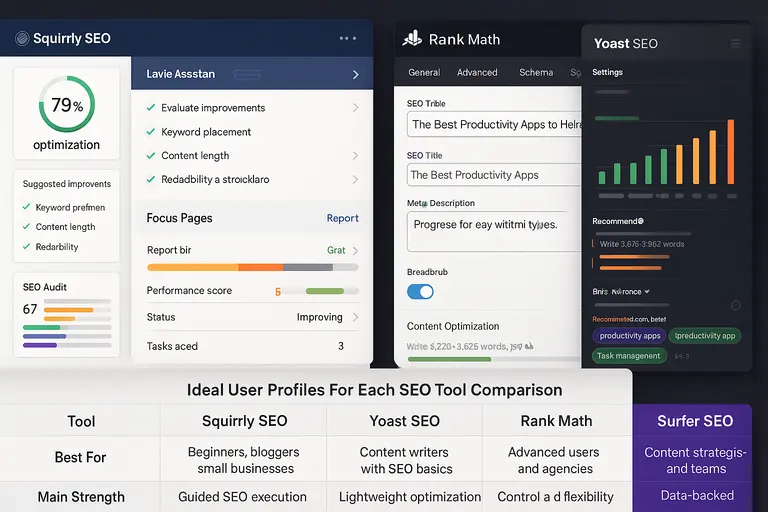
Comparisons matter because no tool exists in isolation. Each platform solves a slightly different problem.
Squirrly SEO Vs Yoast SEO For Content Optimization
Yoast is rule-based. Squirrly is guidance-based.
Key differences:
- Yoast checks boxes after writing.
- Squirrly influences how you write in real time.
- Yoast is lighter; Squirrly is more involved.
If you already understand SEO, Yoast may feel faster. If you want direction, Squirrly wins.
Squirrly SEO Vs Rank Math For Automation And Control
Rank Math offers deep customization and automation options.
Comparison highlights:
- Rank Math gives more control over technical SEO.
- Squirrly prioritizes simplicity and guidance.
- Rank Math suits power users managing many settings.
I’d choose Rank Math for technical flexibility and Squirrly for structured progress.
Squirrly SEO Vs Surfer SEO For Data-Driven Content
Surfer SEO is heavily data-driven and research-focused.
Differences in approach:
- Surfer excels at SERP analysis and content outlines.
- Squirrly focuses on execution and ongoing improvement.
- Surfer is better for content teams; Squirrly fits solo creators.
They’re not direct replacements. Some people even use both.
Ideal User Profiles For Each SEO Tool Comparison
Here’s a quick snapshot to make the choice clearer:
| Tool | Best For | Main Strength |
| Squirrly SEO | Beginners, bloggers, small businesses | Guided SEO execution |
| Yoast SEO | Content writers with SEO basics | Lightweight optimization |
| Rank Math | Advanced users and agencies | Control and flexibility |
| Surfer SEO | Content strategists and teams | Data-backed content planning |
If you want SEO to feel manageable instead of intimidating, Squirrly SEO often makes more sense than chasing raw metrics alone.
Pricing Plans Value And Feature Access Breakdown
Pricing is where most people pause during a Squirrly SEO review.
On paper, the plans look generous, but the real question is whether the limits actually match how people use SEO tools day to day.
Free Version Limitations And Use Cases
The free plan is genuinely usable, which is rare in SEO software. It’s not a demo; it’s a constrained version of the real product.
Here’s what the free plan realistically supports:
- One website connected.
- A small number of Focus Pages.
- Limited keyword research and audits per month.
- Access to core on-page guidance and basic SEO tasks.
In practice, this works well if you’re:
- Running a personal blog.
- Validating whether Squirrly’s workflow fits your style.
- Learning SEO fundamentals without paying upfront.
Where it falls short is scale. Once you publish consistently or want to track multiple keywords, you’ll hit the ceiling fast. I see it as a solid test drive, not a long-term solution.
Premium Plans And What You Actually Unlock
The paid plans are where Squirrly SEO becomes a system instead of a helper. Each tier mainly increases limits rather than changing the core experience.
What you really unlock with premium:
- More Focus Pages to track long-term rankings.
- Higher monthly keyword research and audit caps.
- Full access to Holistic SEO features.
- Support for multiple sites depending on the plan.
Here’s a simplified snapshot based on current pricing:
| Plan | Monthly Cost | Sites | Focus Pages | Best Fit |
| Free | $0 | 1 | Very Limited | Beginners |
| Pro | ~$10 | Up to 5 | Moderate | Bloggers, freelancers |
| Web Dev Kit | ~$51 | Up to 10 | High | Agencies |
| Business | ~$72 | Up to 7 | High | In-house teams |
The jump from Free to Pro is the most meaningful upgrade for solo creators.
Cost Versus Value For Bloggers And Small Businesses
For bloggers, Pro is the sweet spot. At roughly the cost of a couple of coffees, you get:
- Enough Focus Pages to build authority content.
- Weekly audits that actually guide updates.
- Keyword tracking without extra tools.
For small businesses, the value depends on how content-driven your marketing is. If SEO content is a primary channel, the cost is easy to justify. If SEO is secondary, it may feel underused.
Who Gets The Best ROI From Squirrly SEO Pricing
From what I’ve seen, the best ROI comes from people who:
- Publish consistently.
- Follow the recommended tasks weekly.
- Focus on improving existing pages, not just publishing new ones.
If you log in once a month, even the best pricing won’t save you.
Pros And Cons Based On Real-World Usage
No tool is perfect, and Squirrly SEO is no exception. Its strengths are clear, but so are its trade-offs.
Strengths That Make Squirrly SEO Stand Out
Squirrly’s biggest strength is guidance. It reduces guesswork and decision fatigue.
Standout positives include:
- Real-time content feedback.
- Clear prioritization of SEO tasks.
- Beginner-friendly explanations without dumbing things down.
It’s one of the few tools that actually teaches good SEO habits through use.
Weaknesses That Can Limit SEO Growth
The same structure that helps beginners can frustrate advanced users.
Common limitations:
- Limited control over advanced technical SEO settings.
- Less emphasis on backlink analysis.
- Fewer raw data exports compared to enterprise tools.
If you love digging into spreadsheets, this may feel restrictive.
Common Complaints From Long-Term Users
From long-term user feedback, recurring complaints tend to be:
- Interface feeling crowded at first.
- Notifications feeling overwhelming early on.
- Needing time to trust the recommendations.
Most of these ease with familiarity, but the adjustment period is real.
Situations Where Squirrly SEO May Not Be Ideal
Squirrly SEO may not be the best fit if:
- You manage dozens of client sites.
- You rely heavily on custom technical SEO setups.
- You prefer manual analysis over guided workflows.
It’s opinionated by design.
Final Verdict Real Results Or Smart Marketing Hype
So, after everything, does this Squirrly SEO review land on results or hype? Honestly, it’s a bit of both, depending on who you are.
Who Should Use Squirrly SEO With Confidence
You should feel confident using Squirrly SEO if:
- SEO feels confusing or time-consuming.
- You want clear next steps instead of theory.
- You’re building rankings steadily, not chasing hacks.
For these users, it delivers real, measurable improvements over time.
Who Should Consider Alternative SEO Tools
You may want alternatives if:
- You already understand advanced SEO deeply.
- You need heavy-duty competitor and backlink analysis.
- You prefer full manual control over automation.
Tools like Rank Math or Surfer SEO may fit better in those cases.
How To Decide If Squirrly SEO Fits Your Goals
Here’s the simplest way I’d frame it.
If you want:
- Direction over data overload.
- Consistency over complexity.
- Progress you can actually sustain.
Then Squirrly SEO makes sense. It’s not a shortcut to rankings, but it is a reliable guide if you’re willing to show up and do the work.

I’m Juxhin, the voice behind The Justifiable.
I’ve spent 6+ years building blogs, managing affiliate campaigns, and testing the messy world of online business. Here, I cut the fluff and share the strategies that actually move the needle — so you can build income that’s sustainable, not speculative.
Related posts:
 Squirrly SEO – The Ultimate WordPress SEO Plugin for Boosting Your Website’s Rankings
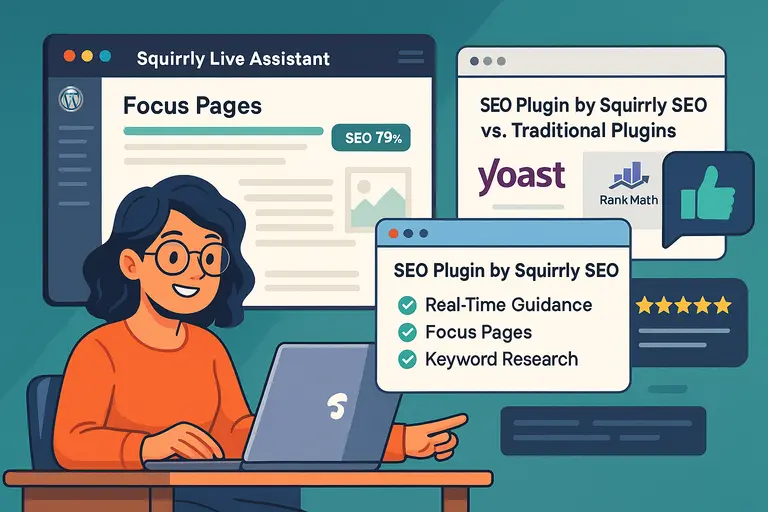 SEO Plugin by Squirrly SEO: What Makes It Different?
 How to Increase Your SEO Ranking
 Drive Organic Traffic: Increase Visits by 200% with 4 Tips
 Link Assistant: 6 Quick Fixes for Immediate Results
 Squirrly SEO Pro Nulled: Why It’s a Risky Shortcut