Table of Contents
Some links on The Justifiable are affiliate links, meaning we may earn a small commission at no extra cost to you. Read full disclaimer.
Starting a blog can be exciting, but figuring out the best way to start a blog and make money can feel overwhelming at first. Should you focus on building an audience first—or dive straight into monetization?
The truth is, successful blogging isn’t just about writing; it’s about strategy, consistency, and knowing where to invest your time.
In this guide, I’ll walk you through every step—from choosing your niche to making your first dollar online—so you can start a blog that actually pays off.
Choose a Profitable Niche That Matches Your Passion
Finding the best way to start a blog and make money begins with choosing a niche that aligns both with your interests and with what people are willing to pay for.
Your niche determines your audience, your content direction, and ultimately your earning potential.
How to Identify Niches with Long-Term Earning Potential
When I first started blogging, I made the mistake of choosing a niche that excited me but didn’t attract buyers—it taught me a valuable lesson: passion alone isn’t enough.
A profitable niche has three main ingredients—interest, demand, and monetization opportunities.
Here’s how to identify one that lasts:
- Check evergreen appeal: Look for topics people always need, like personal finance, health, parenting, travel, or productivity. These topics don’t fade with trends.
- Analyze search volume: Use Google Keyword Planner to see if your topic gets consistent monthly searches. I suggest aiming for at least 10,000+ monthly searches on core keywords to ensure stable interest.
- Explore monetization angles: Ask yourself—can you recommend products (affiliate marketing), create digital courses, or sell services related to this topic? If yes, it’s a strong signal of profitability.
A quick example: If you’re into fitness, a niche like “home workouts for busy moms” is more focused and monetizable than a broad “fitness” blog. Narrowing your niche gives you authority faster and helps target the right audience.
Balancing Passion and Profitability for Sustainable Growth
You might be wondering—should I choose something I love or something that makes money? The truth lies in the balance.
From what I’ve seen, the most successful bloggers combine genuine interest with real market potential.
Here’s how to find your sweet spot:
- List your passions and expertise. Write down 5–10 topics you could talk about for hours without running out of ideas.
- Validate each idea’s market. Type your topics into Google Trends. Are they growing or declining? A consistent or upward trend usually means long-term viability.
- Check competitors. Search your potential topic and note the top-ranking blogs. If they’re monetizing (ads, courses, affiliate links), that’s a great sign—it means there’s money in the niche.
Pro Tip: Passion fuels consistency. You’ll need to create content for months before income starts flowing, so pick something you can stick with even when traffic is low.
Researching Market Demand Using Free and Paid Tools
Before you settle on a niche, validate demand with data. I recommend using both free and paid tools to make smarter decisions.
Free Tools to Start With:
- Google Trends: Helps you see if interest in your topic is stable or seasonal.
- AnswerThePublic: Visualizes what people are asking about your topic.
- Reddit and Quora: These forums reveal real user pain points—perfect for content ideas.
Paid Tools for Deeper Insights:
- SEMrush: Analyze competitors’ traffic, keywords, and backlinks to estimate market size.
- KeySearch (affordable alternative): Great for beginners to find keyword gaps.
Example in practice: If you’re considering a blog about “sustainable fashion,” Google Trends can confirm rising interest, while Ahrefs shows that brands and influencers in that space attract high-volume keywords like “eco-friendly clothing brands” and “ethical fashion tips.”
Pick the Right Blogging Platform for Growth and Monetization
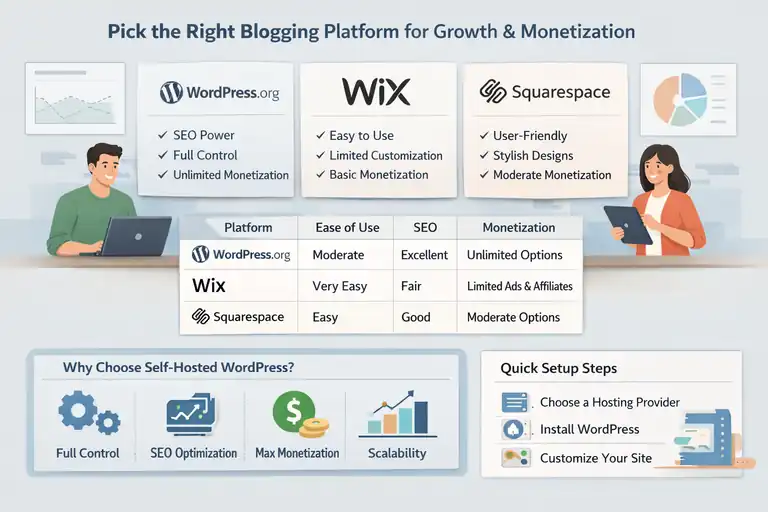
Once you’ve chosen your niche, it’s time to set up your blog on a platform that allows you to grow easily and monetize effectively.
The platform you choose can make or break your long-term success, so choose carefully based on flexibility, cost, and scalability.
Comparing WordPress, Wix, and Squarespace for New Bloggers
Each platform offers unique advantages, but they’re not all equal when it comes to monetization and SEO.
Let’s break down the top options:
| Platform | Ease of Use | SEO Capability | Customization | Monetization Options |
| WordPress.org | Moderate | Excellent | High | Unlimited (ads, affiliate links, products) |
| Wix | Very Easy | Fair | Limited | Moderate (some ad and affiliate restrictions) |
| Squarespace | Easy | Good | Medium | Moderate (suitable for small businesses) |
Quick Takeaway: If you’re serious about blogging as a business, WordPress.org gives you the best balance of control, flexibility, and scalability.
Wix and Squarespace are great for personal blogs or portfolio sites, but they limit growth potential over time.
Why Self-Hosted WordPress Is Often the Smartest Choice
I always recommend starting with self-hosted WordPress (WordPress.org)—not to be confused with WordPress.com.
Here’s why it stands out:
- Full ownership: You control your site, design, and income streams.
- SEO control: You can install plugins like Yoast SEO or Rank Math to fine-tune your optimization.
- Monetization freedom: No restrictions on ads, affiliate links, or products.
- Scalability: Easily expand from a small blog to a full business site as you grow.
How to set it up (simplified):
- Choose a hosting provider (e.g., Hostgator, Bluehost, or Hostinger).
- Install WordPress with one click from your hosting dashboard.
- Pick a clean, responsive theme (Astra and GeneratePress are great starter options).
- Customize with your logo, colors, and navigation.
From what I’ve seen, beginners who start with WordPress save time (and money) later since they don’t need to migrate their blog once traffic grows.
Essential Plugins to Set Up Before Launch
Plugins are like apps that add extra functionality to your WordPress blog. Before launching, install a few must-haves to get your site performing smoothly.
Recommended Plugins for Beginners:
- Rank Math: For optimizing titles, URLs, and meta descriptions.
- LiteSpeed Cache: To speed up your blog (fast sites rank better).
- UpdraftPlus: For automatic backups—just in case something goes wrong.
- Wordfence: Adds a layer of security against hacks.
- Social Snap or Grow Social: Simplifies social sharing and engagement.
Pro Tip: Don’t overload your site with plugins. I suggest keeping it under 15 active ones—quality over quantity always wins in speed and stability.
Build a User-Friendly and SEO-Optimized Blog
Building a user-friendly and SEO-optimized blog is one of the most crucial steps in finding the best way to start a blog and make money.
A well-designed, intuitive, and optimized blog not only attracts readers but keeps them coming back—turning casual visitors into loyal fans and buyers.
Designing a Blog That Keeps Readers Engaged
If your blog doesn’t feel good to read, people will leave faster than they arrived. I always remind new bloggers: good design is about experience, not decoration.
Here’s what I recommend focusing on:
- Choose a clean, mobile-responsive theme: WordPress themes like Astra or Kadence load fast and adapt perfectly to different screen sizes. A simple layout makes your content shine.
- Keep navigation intuitive: Stick to 4–5 top-level menu items (Home, Blog, About, Contact, and one category). Overcomplicating menus confuses readers.
- Prioritize readability: Use large enough fonts (16–18px), short paragraphs, and plenty of white space. A clean look invites people to keep scrolling.
- Add visual breaks: Insert subheadings, bullet points, and images every few paragraphs to reduce text fatigue.
Example in practice: When I redesigned one of my older blogs using the Astra theme and structured the homepage with a clear “Start Here” section, the average session time jumped from 1:10 to 3:04 minutes within two weeks. That’s the power of design clarity.
Key On-Page SEO Elements Every Beginner Should Master
On-page SEO might sound intimidating, but it’s really about helping Google understand your content—and helping your readers find what they need faster.
Here’s a quick breakdown of what to get right:
- Title Tag and Meta Description: These are what people see in search results. Include your focus keyword naturally and make it sound like a promise.
Example: “The Best Way to Start a Blog and Make Money from Day One.” - URL Structure: Keep URLs short and descriptive (e.g., yourblog.com/start-a-blog). Avoid filler words like “the” or “and.”
- Header Tags (H1–H3): Use them logically. H1 for your title, H2 for main topics, and H3 for supporting points.
- Internal Linking: Link to your older posts where relevant. It helps users explore and signals topical authority to Google.
- Image Optimization: Compress images using TinyPNG and always add descriptive alt text (e.g., “SEO blog design example”).
If you’re using Rank Math or Yoast SEO, you’ll see a simple checklist on your post editor. Green lights mean your post is optimized—an easy, visual guide for beginners.
Creating a Content Plan Around High-Value Keywords
A content plan keeps your blog strategic, not random. Instead of writing whatever feels right, you write what people actually search for.
Here’s how to build a simple keyword-driven plan:
- Step 1: Use Ubersuggest to find keywords with good search volume (1,000–10,000 monthly searches) and moderate competition.
- Step 2: Map 10–15 keywords that relate to your niche. For example, if you’re in personal finance: “budgeting tips,” “saving for retirement,” “best side hustles.”
- Step 3: Turn these into content pillars—main categories with supporting posts.
Example:
If your pillar post is “How to Start a Blog,” supporting topics could include:
- “Choosing the Best Blogging Platform”
- “Essential WordPress Plugins for Beginners”
- “How to Create SEO-Friendly Blog Posts”
This structure helps you build authority fast, while guiding readers naturally through related topics.
Create High-Quality, Monetizable Content Consistently
Even with a beautiful design, your blog won’t earn if your content doesn’t build trust or drive action.
The key is to create content that not only informs but converts.
Writing Blog Posts That Convert Readers into Subscribers
Every blog post should lead readers toward the next step—joining your email list, signing up for something, or taking an action.
Here’s how I do it:
- Start with empathy: Speak directly to a reader’s pain point (“If you’ve ever felt stuck trying to grow your blog…”).
- Offer clear, actionable steps: Break big ideas into easy wins your reader can try immediately.
- End with a call to action (CTA): Invite readers to subscribe for a checklist, free guide, or template that complements the post.
I’ve found that placing CTAs mid-post (not just at the end) often increases conversions by 20–30%.
Using Content Clusters and Pillar Pages to Boost Traffic
If SEO feels like a maze, this is the map you need. A content cluster is a group of related articles that link back to one main pillar page. This signals to Google that your site covers a topic deeply.
Here’s how it works:
- Choose a core topic: Example: “Start a Blog.”
- Write related articles: “Best Blogging Tools,” “Blog SEO Tips,” “How to Write Posts That Rank.”
- Link them all to your main pillar: Your main guide acts as the hub, with smaller posts feeding into it.
This structure improves SEO dramatically—I’ve seen posts jump from page 3 to page 1 within a month using this strategy.
How to Use AI Tools Ethically to Streamline Content Creation
AI tools can be your best writing assistant—if used wisely. I personally use tools like ChatGPT and Jasper for brainstorming, not for replacing human writing.
Here’s how to use them ethically:
- Idea generation: Use AI to find outlines or content angles, not full drafts.
- First drafts: Let AI create a rough version, then rewrite it in your authentic voice.
- Editing and research: Tools like Grammarly and SurferSEO help refine tone and keyword optimization.
AI should help you write faster, not sound robotic. Always add your personal experience—it’s what builds trust and authority.
Drive Consistent Traffic to Your Blog Strategically
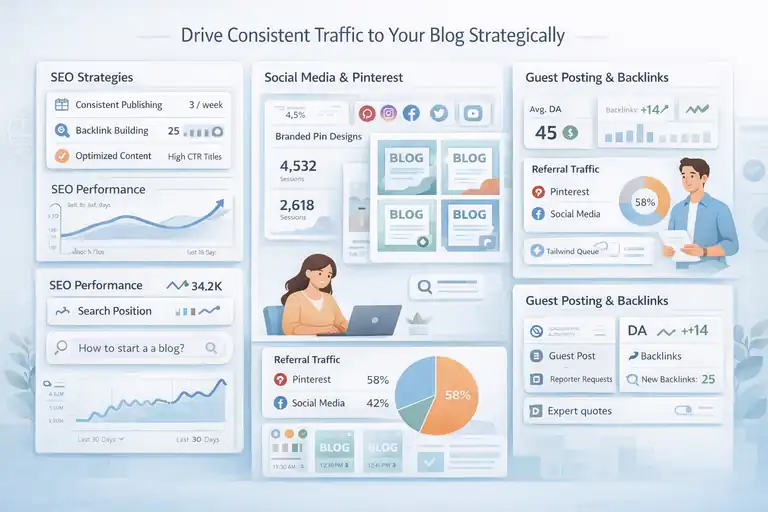
You’ve built your blog and written solid content—now you need eyes on it.
Driving traffic consistently requires a blend of SEO, social media, and strategic networking.
Proven SEO Strategies to Rank Faster on Google
Ranking on Google takes time, but the right habits accelerate it. I suggest focusing on three core areas:
- Consistent publishing: Google rewards active blogs. Aim for at least one high-quality post per week.
- Backlink building: Reach out to other bloggers in your niche for guest post exchanges. Quality backlinks signal credibility.
- Optimize for user intent: Write posts that directly answer search questions (e.g., “How do I start a blog that makes money fast?”).
Quick metric to track: Aim for an average CTR (click-through rate) above 3% in Google Search Console—it means your titles are performing well.
Leveraging Pinterest and Social Media for Early Growth
When you’re just starting, SEO takes months—but Pinterest can drive traffic in weeks.
Here’s what’s worked for me:
- Create 5–10 branded pin designs per blog post using Canva.
- Use keywords in pin titles and descriptions (Pinterest acts like a search engine).
- Join group boards and Tailwind communities to boost exposure.
You can also repurpose your blog posts into short videos or carousels for Instagram and LinkedIn to reach new audiences.
Guest Posting and Backlink Strategies for Domain Authority
Backlinks are like online endorsements—they tell Google your blog is worth trusting.
Here’s how to build them without spammy tactics:
- Guest post for mid-tier blogs: Write valuable posts for blogs with Domain Authority (DA) between 30–60.
- Offer expert quotes: Platforms like HARO (Help a Reporter Out) connect you with journalists seeking expert input.
- Create shareable resources: Infographics, free templates, and tools attract organic backlinks naturally.
When I started guest posting twice a month, my domain authority increased by 12 points in under 90 days—proof that consistency compounds.
Monetize Your Blog Through Multiple Income Streams
Once your blog starts gaining traction, it’s time to explore monetization strategies that actually make money without sacrificing reader trust.
The best way to start a blog and make money isn’t about choosing just one income stream—it’s about layering multiple sources that complement each other over time.
How to Start Affiliate Marketing Without Losing Credibility
Affiliate marketing is one of the easiest and most rewarding ways to earn from your blog—if you do it right.
I’ve seen too many bloggers rush into it and lose reader trust by promoting anything that offers a commission.
Here’s how to approach it ethically and effectively.
- Promote only what you genuinely use or trust: Readers can tell when a recommendation is honest. I personally test or research every product before linking it. For instance, if I recommend Bluehost for hosting, it’s because I’ve set up real blogs on it and know the pros and cons.
- Integrate links naturally: Don’t turn your posts into sales pitches. Mention affiliate products in context, like in tutorials or list posts (e.g., “Here’s how I optimized my site speed using WP Rocket”).
- Use disclosure and transparency: Add a short disclosure at the top of posts with affiliate links. It builds trust and also keeps you compliant with FTC guidelines.
- Track performance: Use tools like Pretty Links or ThirstyAffiliates to manage and track your affiliate links. They also make links look clean and user-friendly.
In my experience, the most profitable affiliate blogs are those that educate first and sell later. People buy when they trust you, not when they feel pressured.
Placing Ads Strategically Without Hurting User Experience
Ads can bring in passive income, but if you overdo them, you’ll drive readers away. The trick is to find the right balance between monetization and user experience.
Here’s how I suggest approaching it:
- Start small: Use Google AdSense when your traffic is under 10,000 monthly visits. It’s easy to set up and lets you test ad placements.
- Upgrade as you grow: Once you hit 50,000+ monthly sessions, switch to premium ad networks like Mediavine or AdThrive. They pay better and handle optimization for you.
- Placement strategy:
- Header ad: visible but not intrusive
- In-content ads: after the first and middle paragraph
- Sidebar ad: only if it doesn’t clutter the design
Example in practice: On one of my blogs, I reduced sidebar ads and focused on in-content placements. My bounce rate dropped by 12%, and ad RPM (revenue per 1,000 views) actually increased.
Pro tip: Always test your ad layouts on mobile devices—most of your visitors are probably reading from their phones.
Selling Digital Products, Courses, or Services Effectively
This is where long-term income begins. Selling your own products gives you full control and scalability.
- Start with simple digital products: Ebooks, templates, or checklists are great first offers. Use Canva or Notion to design them, and sell via Gumroad or SendOwl.
- Expand into courses: If you’re confident teaching a topic, platforms like Teachable or Podia make setup easy. Start with a mini-course to test demand.
- Offer services or coaching: Your blog positions you as an expert—use it to attract clients. Add a “Work With Me” page outlining your services and pricing.
Example: One of my students started a “Pinterest Strategy” blog and later turned her expertise into a $297 course that now earns her consistent monthly income.
If you want to build sustainable earnings, diversify across affiliates, ads, and your own products. That’s how you future-proof your blog income.
Build an Email List to Increase Blog Revenue
If there’s one thing I’d tell every blogger early on—it’s to start an email list immediately. Social media algorithms change, SEO takes time, but your email list is yours.
It’s the most direct way to build relationships and boost revenue.
Setting Up an Email Funnel That Converts Readers into Buyers
An email funnel guides readers from “just visiting” to “loyal customer.” I recommend starting with a simple 3-step funnel:
- Welcome email: Introduce yourself and what your blog offers. Keep it warm and personal.
- Value emails (2–3): Share helpful content, free tips, or personal stories that build trust.
- Offer email: Introduce your paid product, affiliate recommendation, or service once you’ve built a connection.
Example path: User downloads your free “Blog Startup Checklist” → they receive your 3-part “How to Grow Fast” email series → final email gently promotes your “Beginner Blog Bootcamp” course.
You can easily automate this using ConvertKit or MailerLite. Both have visual workflows where you can drag and drop emails in sequence.
Choosing the Best Email Marketing Platforms for Bloggers
I’ve tested a few, and here’s my honest breakdown:
| Platform | Best For | Pricing | Pros |
| Kit (ConvertKit) | Bloggers & creators | Free up to 1,000 subs | Easy automation, strong deliverability |
| MailerLite | Beginners | Free up to 1,000 subs | Drag-and-drop editor, great UI |
| Flodesk | Design lovers | Flat $38/month | Beautiful templates, simple analytics |
If you’re just starting, MailerLite is perfect—it’s affordable and intuitive. As your list grows, ConvertKit’s automation becomes worth the investment.
Crafting Lead Magnets That Attract and Retain Subscribers
A lead magnet is a free incentive you offer in exchange for someone’s email. The trick is to make it both relevant and irresistible.
Great lead magnet ideas:
- Quick-start checklists (e.g., “10 Steps to Launch Your Blog”)
- Short ebooks (5–10 pages packed with value)
- Free templates (like blog content planners or SEO checklists)
- Email courses (3-day or 5-day formats)
Pro tip: Don’t overcomplicate it. I once grew a list by 2,000 subscribers in three months using just a simple “SEO for Beginners” checklist. What matters is that your freebie solves a specific problem your reader is facing right now.
Analyze Performance and Optimize for Higher Earnings
You can’t improve what you don’t measure. Tracking how your blog performs helps you focus on what’s working—and cut what’s not.
Using Google Analytics and Search Console for Insights
Both tools are free, and together they’re your performance dashboard.
- Google Analytics: Tracks user behavior—like how long visitors stay, what pages they visit, and which posts bring in conversions.
Example path: Navigate to “Reports > Engagement > Pages and Screens” to see your top-performing posts. - Google Search Console: Shows how your blog performs in search—click-through rates, impressions, and keyword positions.
Example path: Go to “Performance > Queries” to find which keywords drive the most clicks.
I advise checking these weekly. It helps you catch issues early (like broken links or declining traffic).
A/B Testing Content and Monetization Strategies
Testing is how you refine your approach. Even small tweaks can double your conversions.
Here’s what to test:
- CTA placement: Try moving your signup form from bottom to middle of posts.
- Headline versions: Write two different headlines and track which one gets higher CTR.
- Affiliate link positioning: Compare results between contextual links (within text) and banners.
Tools like Thrive Optimize make A/B testing simple—just pick your goal and they’ll handle tracking.
Mini example: I once tested two email opt-in headlines. “Join 2,000 Bloggers Growing Fast” outperformed “Subscribe for Free Tips” by 47%.
Tracking KPIs to Maximize Profit and Minimize Effort
The right data shows where your time brings the biggest return. Focus on these key performance indicators (KPIs):
- Traffic growth: Monthly visitors and session duration
- Conversion rate: Email signups, affiliate clicks, or purchases
- Revenue per 1,000 visitors (RPM): How much you earn per 1,000 pageviews
- Bounce rate: Lower is better—it means readers are engaging with your content
I suggest reviewing KPIs monthly and noting patterns. If one traffic source performs better (say, Pinterest), double down there instead of spreading yourself too thin.
Scale Your Blog into a Sustainable Online Business
Once your blog starts earning consistently, the next challenge is scaling it into something that lasts.
The best way to start a blog and make money long-term isn’t just about adding income—it’s about building a brand, delegating smartly, and creating systems that free up your time while your business continues to grow.
Outsourcing Content and Technical Tasks Efficiently
I remember reaching a point in my blogging journey where I couldn’t do everything myself. Between writing, editing, SEO, and social media, burnout was inevitable.
That’s when I learned that outsourcing isn’t an expense—it’s leverage.
Here’s how to approach it without losing control of your brand:
- Start with repetitive tasks: Outsource blog graphics, content repurposing, or formatting before giving up core writing. Use platforms like Fiverr or Upwork for one-time jobs, and OnlineJobs.ph for long-term help.
- Document your processes: Create short Loom videos or Google Docs showing how you do things (e.g., how to format posts, upload to WordPress, or schedule pins). This ensures consistency even when someone else handles the work.
- Hire for skill, not cost: Cheap labor can lead to sloppy work. I suggest hiring fewer people but paying fairly for expertise—it saves time fixing errors later.
- Use project tools: Manage everything in Trello or Asana so you can keep track of tasks, deadlines, and communication easily.
Example: When I hired a part-time content assistant to handle formatting and internal linking, I gained 10 extra hours a week—which I used to write higher-value posts and develop digital products.
Building a Brand and Expanding Across Platforms
To grow from “just a blogger” to a recognizable brand, you need visibility beyond your website. Think of your blog as the home base—then expand outward.
- Develop consistent branding: Use the same tone, colors, and voice across your website, email, and social media. Tools like Canva Brand Kit make this easy—you can store logos, fonts, and palettes in one place.
- Repurpose content: Turn blog posts into short-form videos, Pinterest pins, or podcast episodes. For instance, a blog about “SEO for beginners” can become a YouTube tutorial or a carousel post on Instagram.
- Build authority through collaborations: Guest on podcasts, do blog swaps, or host webinars with other creators. It helps new audiences discover you and strengthens your brand credibility.
Mini case insight: When I started sharing snippets of my blogging tips on LinkedIn, traffic to my blog increased by 40% within two months—proof that expanding beyond your blog creates powerful ripple effects.
Creating Passive Income Streams for Long-Term Freedom
The ultimate goal is freedom—earning money while you sleep. But passive income doesn’t mean “no work”; it means building systems that continue paying off long after setup.
Top ways to create passive income from your blog:
- Evergreen courses: Record once, sell forever. Use Podia or Teachable to automate sales.
- Digital product bundles: Combine existing products (e.g., templates, ebooks, workbooks) into a value-packed offer.
- Affiliate content: Create “evergreen” tutorials or reviews that consistently attract organic traffic.
- Email funnels: Use automated sequences to sell products and affiliate links while you focus on content creation.
Example in practice: I built a 5-day “Start Your Blog Challenge” that runs automatically. It now adds about 150 new subscribers monthly and promotes my paid course—no manual effort required.
Scaling smartly is about building systems once that keep paying off repeatedly.
Common Blogging Mistakes That Kill Profit Potential
Every blogger hits roadblocks, but many of them are avoidable. I’ve made a few of these mistakes myself, and they cost me months of growth.
Here’s what to steer clear of if you want your blog to stay profitable and sustainable.
Ignoring SEO and Keyword Strategy from the Start
Many beginners write from inspiration alone—no keyword research, no structure—and then wonder why nobody’s finding their posts.
If you skip SEO early, you’ll end up rewriting later (and trust me, it’s harder to fix than to start right).
Here’s what I suggest:
- Use Ubersuggest or KeySearch before writing to find topics your audience searches for.
- Focus on one main keyword per post and use it naturally in your title, first paragraph, and URL.
- Don’t obsess over algorithms—write for humans first, then optimize.
SEO is what makes your blog discoverable. Even one well-optimized post can bring thousands of readers each month.
Overlooking Branding and Reader Trust
Readers return for connection, not just information. You can have great content, but if your blog feels inconsistent or impersonal, it won’t convert.
Ways to build reader trust:
- Use a real photo and short “About” blurb in your sidebar or footer.
- Share snippets of personal experience within your posts (it makes you relatable).
- Keep your design simple—avoid too many pop-ups or ads that feel pushy.
In my experience, adding a “Welcome” section and a short personal story on my homepage doubled my email signups because it helped readers see the person behind the brand.
Focusing on Quantity Over Quality in Content Creation
Publishing more doesn’t mean earning more. It’s better to have 30 well-optimized, evergreen posts than 100 shallow ones.
A few reminders:
- Update old posts before writing new ones.
- Use analytics to identify high-performing articles and expand on them.
- Write content that solves specific problems, not just general advice.
A single in-depth article targeting the right keyword can generate far more leads and income than five short, unfocused posts.
Pro Tips to Stay Consistent and Keep Earning Long-Term
Consistency—not luck—is what separates hobby bloggers from those who build six-figure incomes. The goal is to make your blog run like a business while staying creative and motivated.
Building a Routine That Keeps You Publishing Consistently
I believe in working smarter, not harder. A simple, repeatable routine keeps your blog alive even when motivation dips.
Try this structure:
- Monday: Research keywords and plan topics.
- Tuesday–Wednesday: Write or edit your main article.
- Thursday: Create visuals, schedule posts, and handle email updates.
- Friday: Analyze metrics and make tweaks.
Pro tip: Batch similar tasks. When I started batching my content writing days, I cut my weekly blogging time from 25 hours to around 15 without losing quality.
Networking with Other Bloggers to Grow Faster
Blogging might feel solo, but community accelerates growth. Connecting with others helps you gain backlinks, collaboration opportunities, and exposure.
Where to start:
- Join Facebook groups for bloggers in your niche.
- Comment meaningfully on others’ blogs (not just “Great post!”).
- Attend virtual summits or co-author posts with peers.
Networking helped me land my first guest post on a site with 100K monthly readers—and that single post brought me over 2,000 new visitors.
How to Reinvest Profits to Scale Smarter
Once money starts flowing in, resist the temptation to pocket it all. The smartest bloggers reinvest strategically to grow faster.
Here’s how I’d prioritize reinvestment:
- Hosting and performance tools: Upgrade to faster hosting like SiteGround or WPX.
- Email marketing tools: Move to premium plans once your list grows (automation pays off).
- Content help: Hire a part-time writer or designer to free up your creative bandwidth.
- Education: Take advanced SEO or copywriting courses to sharpen your edge.
Reinvesting even 20–30% of your profits can compound your results dramatically over time. Think of it as fueling your blog’s next stage of growth, not as an expense.
Scaling your blog into a full-fledged business isn’t about hustling harder—it’s about refining systems, deepening connections, and creating assets that keep generating income while you focus on the bigger picture.
FAQ
What is the best way to start a blog and make money?
The best way to start a blog and make money is to choose a profitable niche, set up a self-hosted WordPress blog, publish SEO-optimized content, and monetize through affiliate marketing, ads, and digital products.
How long does it take to make money from a blog?
Most bloggers start earning within 3 to 6 months with consistent content creation, SEO strategy, and audience building. However, sustainable income usually takes 12 months or more.
Can beginners really make money blogging?
Yes. Beginners can make money blogging by focusing on a clear niche, learning basic SEO, and promoting products or services that match their audience’s needs.

I’m Juxhin, the voice behind The Justifiable.
I’ve spent 6+ years building blogs, managing affiliate campaigns, and testing the messy world of online business. Here, I cut the fluff and share the strategies that actually move the needle — so you can build income that’s sustainable, not speculative.