
Table of Contents
Some links on The Justifiable are affiliate links, meaning we may earn a small commission at no extra cost to you. Read full disclaimer.
Finding the best HubSpot alternatives for small business usually comes down to one simple question: do you really need an all-in-one platform, or do you need a tool that solves your biggest problem without stretching your budget?
I’ve seen a lot of small teams sign up for HubSpot because it feels like the safe choice, then realize they’re paying for complexity they do not fully use.
The good news is that there are strong alternatives now, from lean CRMs to automation-first platforms, and several start at far lower entry prices than most people expect.
Why small businesses start looking beyond HubSpot
HubSpot is popular for a reason, and I want to be fair about that before we compare anything.
Its Starter Customer Platform bundles marketing, sales, and service tools around HubSpot’s Smart CRM, and the official starter bundle is currently promoted at $9 per month or $15 per seat per month depending on plan structure and current offer.
That sounds approachable, especially if you want one system instead of a stack of separate tools.
When HubSpot is still a smart choice
If your team wants one shared system for forms, basic email marketing, pipeline tracking, meeting scheduling, and support workflows, HubSpot still makes sense. It is especially attractive when you care more about ease of use and a clean interface than squeezing every dollar out of your software budget.
HubSpot’s free CRM also includes common small-business features like contact and deal management, email tracking, meeting scheduling, live chat, and quotes, which is enough for many early-stage teams.
In my experience, HubSpot works best when your business has a broad operational need. For example, a five-person agency that wants sales follow-up, newsletter capture, chat, and light customer support in one place will probably enjoy the convenience. The real friction starts when you only need one or two of those jobs done really well.
The signs you need a HubSpot alternative
Most small businesses switch for one of three reasons: cost, depth, or simplicity. Cost is obvious. A platform can look affordable at the front door, then become expensive once contacts grow, more users need seats, or advanced automation becomes necessary.
Depth is the second issue. Some teams need stronger email automation than a generalist platform gives them. Others need a simpler CRM that sales reps can learn in an afternoon.
The third reason is the one people underestimate: mental overhead. A small team usually does not need more dashboards. It needs fewer clicks between lead capture and follow-up. If your staff is avoiding the CRM, forgetting stages, or sending campaigns from a separate tool anyway, that is your signal.
The best alternative is not the one with the biggest feature list. It is the one your team will actually use every day.
The best HubSpot alternatives for small business right now
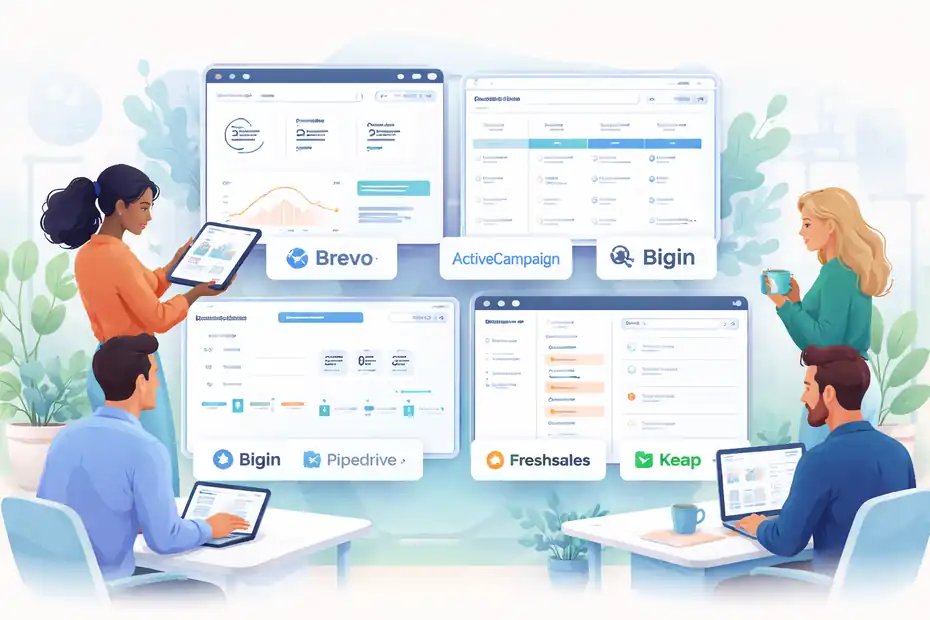
Not every alternative is trying to “beat” HubSpot in every category. Some are better because they stay smaller, simpler, or cheaper.
That is often exactly what a small business needs.
Brevo: Best for affordable marketing plus CRM basics
Brevo is the first platform I would look at if your main use case is email marketing, basic CRM, and multichannel communication without HubSpot-style sprawl. Brevo positions itself as an all-in-one customer engagement platform with email, SMS, WhatsApp campaigns, transactional messaging, live chat, and CRM tools.
Its pricing page shows a free plan and a Starter tier aimed at single users starting with email and multichannel marketing, with plans beginning from 5,000 emails per month.
What I like here is the business logic. Many small businesses do not need a heavy CRM first. They need a reliable way to capture leads, segment people, automate follow-ups, and send campaigns that actually land in the inbox.
Brevo’s own 2026 guide highlights deliverability, segmentation, automation, analytics, and scalability as core selection criteria, and that framing is useful because it mirrors what small teams actually care about once the shiny demo ends.
It also notes global email use is projected to reach 5 billion users by 2026, which is a nice reminder that email is still a growth channel, not an old channel.
A practical example: imagine you run a local clinic, coaching business, or small ecommerce brand. You may care more about newsletters, reminders, automations, and transactional messages than complex sales forecasting.
In that case, Brevo often feels lighter and more cost-efficient than HubSpot. I suggest Brevo when your revenue engine is communication-first, not pipeline-first.
ActiveCampaign: Best for automation-heavy growth
If your biggest frustration with HubSpot is that your automations feel too basic or too expensive to scale, ActiveCampaign is probably the strongest alternative. Its official comparison page says the Starter plan is $15 per month for 1,000 contacts and includes a CRM, branching automations, multiple triggers, and AI capabilities.
The Plus plan is listed at $49 per month for 1,000 contacts and adds unlimited automation actions, landing pages, site messages, AI-powered content, and sales automation features.
That matters because automation is where many small businesses either save time or waste money. A good automation platform lets you do things like send a welcome series, branch contacts by behavior, alert sales when someone revisits a pricing page, or move cold leads into a re-engagement path without manual work.
That is not “advanced marketing” in some abstract sense. That is fewer forgotten leads.
ActiveCampaign also highlights free 1:1 onboarding, migration services, tutorials, live chat, and support resources for small businesses. For a lean team with no dedicated ops person, that onboarding help is not a small detail. It can be the difference between launching in a week and stalling for a month.
I would choose ActiveCampaign over HubSpot when your business wins through nurture sequences, lead scoring, behavior-based emails, and lifecycle marketing. If you sell higher-ticket services or B2B offers, that extra automation depth can pay for itself quickly.
Bigin by Zoho: Best simple CRM for very small teams
Bigin is one of those tools I recommend when someone says, “I do not want a platform. I want a simple CRM that my team will actually open.” That is the right mindset. Bigin is built specifically for small businesses, and its pricing details show a free plan for one user, with paid tiers scaling from there.
Official Bigin pricing references free access plus low-cost paid editions, and Bigin’s feature messaging is explicitly centered on the needs of small businesses rather than enterprise complexity.
This is where I think many owners overbuy software. If your business mainly needs contact management, deal tracking, pipelines, reminders, lightweight automation, and a clean view of what happens next, Bigin is often enough.
The value is not that it has every feature. The value is that it removes friction. Bigin also says its paid plans allow unlimited users while charging per user license, which makes it easier to model cost as your team grows.
A realistic scenario: A home services company, boutique consultancy, or small real estate team usually needs fast follow-up and stage visibility more than a full marketing cloud. In those cases, Bigin can feel refreshingly focused. I recommend it when you want a CRM first and a marketing system second.
Pipedrive: Best for sales pipeline visibility
Pipedrive is the option I reach for when the pain point is not marketing at all. It is sales discipline. On its pricing page, Pipedrive currently lists a Lite plan at €14 per seat per month billed annually, with a free 14-day trial and no credit card required.
The next tiers add email automation, nurturing sequences, forecasting, lead routing, enrichment, e-signatures, and broader sales tools.
What makes Pipedrive different is its operating philosophy. The product is built around activity-based selling, which basically means the system pushes you to focus on the actions that move deals forward. That sounds simple, but it is powerful for small sales teams that are drowning in sticky notes, inboxes, and memory.
If your team closes deals through calls, demos, proposals, or follow-up tasks, Pipedrive is often easier to adopt than HubSpot. Reps usually understand it quickly because the pipeline is the star of the show.
I would not choose it as my first option for marketing-heavy lifecycle automation, but for sales-led businesses it is one of the clearest HubSpot alternatives on the market.
Freshsales: Best free CRM for small sales teams
Freshsales sits in a useful middle ground. It offers a free plan for up to three users, and Freshworks says that free tier includes Kanban views, email templates, built-in phone, and live chat. Its paid pricing starts from $9, which keeps it in the realistic range for small teams that need structure without enterprise pricing shock.
I like Freshsales for companies that want sales functionality without building a Frankenstein stack on day one. The free plan is genuinely relevant for a new team, not just a teaser.
Built-in phone and live chat are especially helpful if you are juggling inbound inquiries and want to keep communication tied to contact records. Freshworks also positions its suite as a way to align sales and marketing around one customer record, which is valuable if you have one or two people wearing both hats.
This is a solid fit for early SaaS teams, local B2B service companies, and founders managing their own pipeline. If HubSpot feels too broad and Pipedrive feels too sales-only, Freshsales is a reasonable middle option.
Keap: Best for established small businesses that want automation plus service
Keap is not the cheapest option on this list, and I think it is important to say that clearly. Its pricing page currently starts at $299 per month billed annually, with the platform positioned around CRM, forms, landing pages, email marketing, broadcasts, and automation.
So why include it? Because some small businesses are small in headcount but not small in revenue or operational complexity.
A mature coaching company, digital agency, or local multi-location service brand may need stronger built-in automation and communications than a lightweight CRM can provide.
Keap also supports texting tiers and positions itself very directly as a business automation platform for small businesses.
I would only shortlist Keap if you already know automation drives revenue for you. If you are still figuring out your sales process, skip it. If you already have a validated funnel and want to automate follow-up, appointments, forms, and nurture paths in one place, it can be a serious option.
How to choose the right alternative without overcomplicating it
The smartest choice usually comes from matching the platform to your business model, not to the longest feature page.
That sounds obvious, but a lot of teams still buy software by brand reputation.
Match the platform to your main growth bottleneck
Here is the simplest framework I use:
- Choose Brevo when your biggest need is email marketing, campaigns, newsletters, and customer communication.
- Choose ActiveCampaign when automation depth is the real reason you are leaving HubSpot.
- Choose Bigin when you want a low-friction CRM for a very small team.
- Choose Pipedrive when pipeline visibility and rep accountability matter most.
- Choose Freshsales when you want a low-cost sales CRM with a generous free starting point.
- Choose Keap when you already run a proven funnel and need heavier automation.
I believe this is the part most reviews miss. They compare platforms as if every small business is the same. A three-person landscaping company and a seven-person SaaS startup should not buy software the same way.
Use a simple cost reality check
Before you switch, do this math:
- Step 1: Estimate contact growth for 12 months.
- Step 2: Count paid seats, not just current logins.
- Step 3: List the automations you actually need in quarter one.
- Step 4: Check migration and onboarding support.
- Step 5: Price the minimum plan that covers those needs today, then the next likely tier six months from now.
This matters because cheap software becomes expensive when it forces workarounds. At the same time, expensive software is wasteful when you never use the advanced features.
For email-driven businesses, benchmark context helps here too: Mailchimp’s current benchmark page shows average email open rates of 35.63% and average click rates of 2.62% across all users, with ecommerce averaging 29.81% opens and 1.74% clicks.
Those numbers are useful because they remind you to evaluate software by campaign performance and workflow efficiency, not by how fancy the dashboard looks.
How to migrate from HubSpot without breaking your pipeline
Switching platforms feels scary mostly because people do it in the wrong order. The cleanest migrations are boring, and that is a compliment.
Follow a staged migration plan
Start with data hygiene. Export contacts, companies, deals, tasks, forms, and email assets, then remove junk before you import anything. Old CRMs tend to accumulate duplicate records, dead fields, and custom properties nobody understands anymore. If you move that mess into a new tool, you are not migrating. You are relocating chaos.
Next, rebuild only the essential workflows first. I suggest starting with one pipeline, one lead capture path, one follow-up automation, and one reporting dashboard. That gives your team a usable system fast.
ActiveCampaign’s migration help and onboarding support are particularly relevant if you expect workflow rebuilding to be the hardest part of the move. Pipedrive’s free trial and Freshsales’ free tier also make it easier to test structure before fully committing.
Finally, run both systems briefly only if you need validation. For many of us, dual-running too long creates confusion. A short overlap for testing is useful. A month of indecision is not.
Avoid the migration mistakes small businesses make most
The biggest mistake is importing everything. The second is recreating every old process just because it already exists. I advise the opposite. Treat migration like a reset. Ask what your team must do every day to create revenue and retain customers. Build that first.
Another mistake is training too late. Your new system should come with a one-page operating rule set: where leads enter, how stages work, when tasks are created, and what counts as done. Without that, even the best CRM turns into a digital junk drawer.
One more thing I have seen repeatedly: owners obsess over integrations before they confirm user adoption. That is backwards. A CRM nobody updates does not become strategic because it connects to ten apps. Adoption first, automation second, integrations third.
Final verdict: Which HubSpot alternative is best for your small business?
The best HubSpot alternatives for small business are not all trying to win the same job.
Brevo is my top value pick for communication-driven businesses. ActiveCampaign is the better choice for serious automation.
Bigin is excellent for very small teams that want simplicity. Pipedrive is strongest for sales pipeline management.
Freshsales is a smart low-cost middle ground, especially with its free plan for up to three users. Keap is the specialist choice for established small businesses that already know automation is a profit center.
If I had to give one practical recommendation, it would be this: buy for the bottleneck you have now, not the imaginary company you might become later.
Small businesses usually grow faster with a tool that is slightly limited but heavily used than with a platform that is endlessly powerful but barely adopted.
Comparison table: Which HubSpot alternative fits your small business best?
If you want a faster way to narrow your options, this comparison table gives you the practical view. I suggest using it to match the tool to your main bottleneck first, then worry about extra features later.
| Tool | Best for | Main strength | Possible limitation | Best fit scenario |
|---|---|---|---|---|
| Brevo | Small businesses focused on email and customer communication | Strong value for email marketing, SMS, and basic CRM in one place | Less appealing if your sales team needs deep pipeline management | A local business or ecommerce brand that wants campaigns, automations, and contact tracking without a heavy CRM |
| ActiveCampaign | Businesses that rely on automation to convert leads | Advanced automation, segmentation, and nurture workflows | Can feel more complex if you only need simple contact management | A service business or B2B company running lead nurture sequences and behavior-based follow-up |
| Bigin by Zoho | Very small teams that want a simple CRM | Easy to learn, low-friction pipeline and contact management | Not the strongest choice for advanced marketing automation | A founder-led business that needs a clean sales process without extra complexity |
| Pipedrive | Sales-driven teams that want clear deal visibility | Excellent pipeline tracking and activity-focused selling | Not as marketing-centric as some alternatives | A team closing deals through calls, demos, proposals, and repeat follow-up |
| Freshsales | Small sales teams that want affordability and core CRM features | Good balance of usability, lead tracking, and built-in sales tools | May not go as deep in automation as more specialized platforms | A startup or small B2B company that wants structure without overbuilding its stack |
| Keap | Established small businesses that already use automation heavily | Strong automation for follow-up, forms, and lifecycle communication | Higher cost, so it makes less sense for early-stage teams | A mature service business with proven funnels and repeatable lead generation |
FAQ
What are the best HubSpot alternatives for small business?
The best HubSpot alternatives for small business include Brevo, ActiveCampaign, Bigin by Zoho, Pipedrive, and Freshsales. Each tool focuses on different strengths like email marketing, automation, or sales pipelines, so the best choice depends on your specific business needs and growth stage.
Why do small businesses look for HubSpot alternatives?
Small businesses often look for HubSpot alternatives due to pricing, complexity, or unused features. Many teams prefer simpler or more affordable tools that match their exact needs, such as email marketing, CRM management, or automation, without paying for an all-in-one platform they do not fully use.
Which HubSpot alternative is best for email marketing?
Brevo is one of the best HubSpot alternatives for small business focused on email marketing. It offers strong deliverability, automation, and multichannel messaging like SMS and WhatsApp, making it ideal for businesses that rely heavily on communication and customer engagement.
Is there a free HubSpot alternative for small business?
Yes, tools like Freshsales and Bigin by Zoho offer free plans suitable for small businesses. These platforms provide basic CRM features like contact management and deal tracking, allowing teams to manage sales processes without upfront costs while scaling gradually.
How do I choose the right HubSpot alternative?
To choose the right HubSpot alternative, focus on your main business need such as sales tracking, email marketing, or automation. Then compare pricing, ease of use, and scalability. The best tool is the one your team will actually use consistently to drive growth.

I’m Juxhin, the voice behind The Justifiable.
I’ve spent 6+ years building blogs, managing affiliate campaigns, and testing the messy world of online business. Here, I cut the fluff and share the strategies that actually move the needle — so you can build income that’s sustainable, not speculative.
Related posts:
 Constant Contact Pricing: Which Plan Is Right for You?
 MailerLite Free: What You Actually Get Without Paying
 Freshsales CRM Pricing Comparison: Save More on Upgrades
 Omnisend Free Plan Review: What You Really Get
 10 Online Marketing Solutions That Turn Clicks Into Customers
 How To Set Up HubSpot For Small Business Fast And Easy