
Table of Contents
Some links on The Justifiable are affiliate links, meaning we may earn a small commission at no extra cost to you. Read full disclaimer.
ManyChat pros and cons for businesses become a lot clearer once you stop looking at the platform like a magic growth hack and start looking at it like what it really is: a conversation automation tool with real strengths, real limits, and a very specific best-fit use case.
If you run a brand that gets constant DMs, comments, or repeat questions, ManyChat can save serious time and turn attention into leads or sales.
But it is not perfect, and for some businesses, the tradeoffs are bigger than the upside.
What ManyChat Actually Does For A Business
ManyChat sits in the middle of your inbound conversations and automates parts of them, which sounds simple, but it changes how your marketing and support workflows run day to day.
What The Platform Is Built To Handle
At its core, ManyChat helps businesses automate conversations across Instagram Direct Messages, Facebook Messenger, WhatsApp, TikTok, SMS, and email, with features for flows, tags, keywords, sequences, analytics, and integrations.
Its current pricing structure includes a free plan, Pro starting at $15 per month, and an Elite tier, with Pro pricing scaling based on contact volume.
That matters because ManyChat is not just a “chatbot” in the old clunky sense. In practice, businesses use it to reply to comments automatically, send links in DMs, collect email addresses, qualify leads, recover abandoned conversations, and route people toward booking pages or product recommendations.
ManyChat also now pushes AI-related features such as intention recognition, AI steps, text improvement, and a flow builder assistant on Pro and Elite plans.
I think this is where a lot of businesses misunderstand the tool. They assume it replaces human communication. It does not. It works best when it handles the repetitive front end of a conversation so your team can step in only when judgment, empathy, or closing skill is actually needed. That is a huge difference.
Why Businesses Keep Looking At It
The main reason ManyChat keeps getting attention is that it matches how people already behave on social platforms. Instead of forcing someone to fill out a long form, click through a landing page, and wait for a follow-up email, you can meet them inside the channel where they are already active.
For example, imagine you run a skincare brand. Someone comments “routine” on a Reel. ManyChat can instantly DM them a quiz, ask about skin type, collect their email, and send a product guide.
That feels faster and more personal than a generic “link in bio” funnel. For businesses selling education, services, appointments, digital products, or ecommerce offers, that reduction in friction can matter more than a prettier website funnel.
There is also a practical reason behind the platform’s popularity: it is relatively approachable for non-technical teams. On G2, ManyChat holds a 4.5 out of 5 rating from 159 reviews, and review summaries repeatedly highlight ease of use and time savings as key benefits.
The Biggest Pros Of ManyChat For Businesses
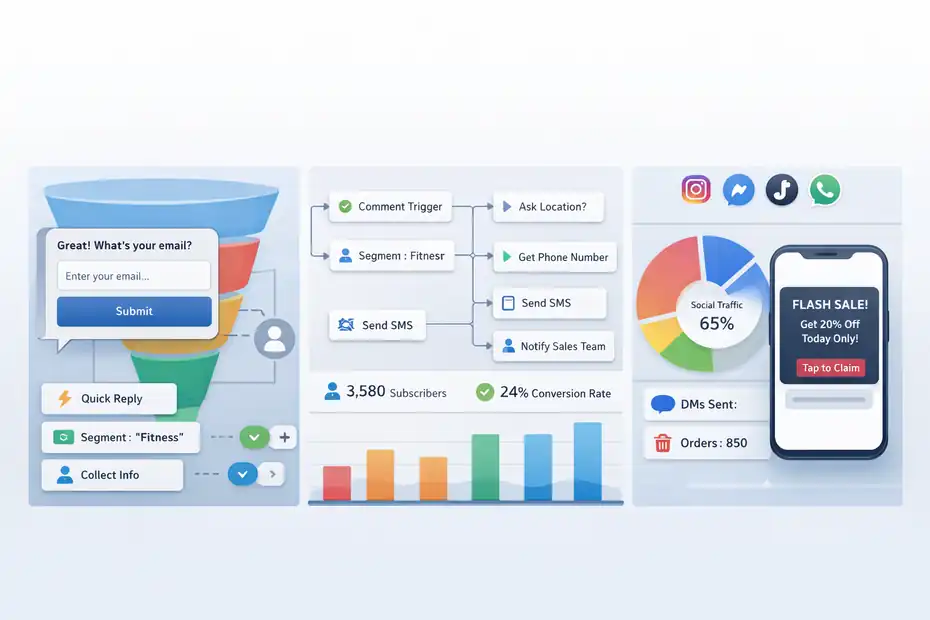
This is the part most articles oversimplify. The upside is real, but it depends on your business model, traffic source, and how disciplined you are with automation design.
Pro 1: It Removes Friction From Lead Capture
Many businesses lose leads not because their offer is weak, but because the path to action is too slow. ManyChat can reduce that friction by letting someone take the next step inside a DM thread instead of pushing them somewhere else immediately.
A few practical wins:
- Faster opt-ins: A person can reply with a keyword, tap a button, or answer a short prompt instead of filling out a long form.
- Warmer context: Because they came from a post, story, ad, or comment, the conversation starts with intent already present.
- Better segmentation: Tags and custom fields let you sort people by interest, behavior, or source before your sales or support team ever touches the lead.
In my experience, this is where ManyChat feels strongest. It turns passive engagement into an actionable workflow. If you are getting solid reach on Instagram or Messenger-based campaigns, the platform can help you capture momentum that would otherwise disappear.
That is especially useful for coaches, agencies, local service businesses, course creators, and brands that sell through short-form content.
The catch is that the lead quality depends heavily on what you ask after the first trigger. A lazy “Here’s the link” flow often creates shallow leads. A better flow asks one or two smart qualifying questions before sending the resource.
Pro 2: It Is Easier To Launch Than Heavier Automation Systems
ManyChat’s strongest commercial advantage is usability. The platform comparison and pricing pages show unlimited custom flows across plans, while Pro unlocks unlimited tags, custom fields, advanced segments, more triggers, integrations, and analytics.
User reviews also consistently mention that setup feels accessible even without heavy technical skills.
That ease matters more than people admit. A tool does not help your business if your team avoids using it. Many businesses buy powerful software that ends up half-configured because nobody wants to touch it after the first week. ManyChat usually does better here because the logic is visual and the early wins are obvious.
Let me put that into a realistic scenario. A small gym wants to automate trial pass requests from Instagram. With ManyChat, the owner can set up a comment trigger, ask for the visitor’s preferred location, collect a phone number or email, and notify the sales desk. That is a setup a lean business can actually maintain.
I would still call this a “low-code” tool, not a “no-thinking” tool. The builder may be easier than more enterprise-style systems, but once flows become complex, you still need naming conventions, documentation, and ongoing cleanup. Ease of launch is a real pro. Ease of scale is more mixed.
Pro 3: It Fits Social-First Businesses Very Well
If your business depends on Instagram attention, creator-style content, or DM-based selling, ManyChat is unusually aligned with that environment.
Official pages emphasize automations for Instagram DMs, Facebook Messenger, TikTok, WhatsApp, SMS, and email, and ManyChat’s own positioning still leans heavily into social engagement and comment-to-DM style campaigns.
That makes ManyChat a better fit for some businesses than a classic email-first CRM automation tool. Social-first brands need quick responses, not slower form-based funnels. When someone comments on a Reel or replies to a story, speed matters. A delayed response often means a dead lead.
This is why ecommerce brands, creators, personal brands, and agencies often like ManyChat. It lets them monetize attention while it is still fresh. For many of us, that matters more than having the most advanced back-end logic in the world.
Still, I would be careful not to mistake channel-fit for total-fit. ManyChat is strongest when your buyer journey starts in a social conversation.
If your business runs on long B2B cycles, internal approvals, complex quoting, or multi-stakeholder sales, the platform may help at the top of funnel, but it will not carry the whole process gracefully.
The Most Important Cons Businesses Need To Understand
Here is the honest part: ManyChat can absolutely create headaches if you adopt it for the wrong reasons or expect it to behave like a full business operating system.
Con 1: Pricing Can Climb As Your Contact List Grows
ManyChat’s Pro plan starts at $15 per month and scales with contacts, while WhatsApp messaging can add separate usage-based charges depending on market and message category.
ManyChat’s own help documentation also notes that pricing structures changed on March 2, 2026, and that regional availability and account-age differences may affect which plan options a business sees.
That combination is not necessarily bad, but it does mean budgeting can get fuzzy fast.
Here is where businesses get surprised:
- More contacts does not always mean more value: You may be paying for a larger audience even if only a portion is commercially active.
- Channel costs stack: WhatsApp especially needs careful tracking because message charges vary by country and use case. For example, ManyChat’s March 2026 pricing guide shows noticeable differences between markets such as India, Germany, the United Kingdom, and North America.
- Scale punishes messy list hygiene: If you keep low-intent contacts too long, your software bill can grow faster than your revenue.
I suggest treating contact growth like ad spend: worth it only if the downstream conversion system is tight. If you are not cleaning segments, suppressing dead leads, and mapping clear revenue paths, ManyChat can become one more recurring expense that feels useful without being efficient.
Con 2: Complex Flows Get Harder To Manage Than They Look
This is one of the most under-discussed problems. ManyChat is easy to start, but complex automations can become difficult to maintain.
G2 review summaries specifically mention that advanced use cases may require more technical configuration than expected and that limited features or complexity can frustrate users with broader needs.
That sounds mild until you live through it.
A simple flow is fine:
- Someone comments.
- They get a DM.
- They answer a question.
- They receive a link.
A real business flow often looks more like this:
- Comment trigger from multiple campaigns.
- Different replies depending on product interest.
- Fallback logic if no response comes in.
- Branching for cold lead versus returning customer.
- Sync into email or CRM.
- Human handoff if purchase intent is high.
- Re-engagement later through another channel.
Now multiply that across campaigns, promotions, and seasonal offers. Suddenly your automation map starts looking like a subway network drawn by a stressed marketer at midnight.
I am not saying ManyChat cannot handle complexity. I am saying complexity becomes an operational discipline problem. If your team does not document flows, archive old logic, standardize naming, and review edge cases regularly, the system turns fragile.
Con 3: Platform Rules Limit What You Can Do
ManyChat does not operate in a vacuum. A lot of what it can or cannot do depends on the channel’s own messaging rules. WhatsApp is the clearest example.
ManyChat’s help center states that a regular broadcast reaches only users who interacted with the business in the past 24 hours, while template-based messages can go beyond that window but may trigger business-initiated conversation charges; broadcasts also require prior opt-in.
This is a huge point, because many businesses blame the tool for restrictions that actually come from the channel ecosystem.
What this means in practice:
- You cannot assume every contact is freely reachable anytime.
- Broadcast economics may differ from one campaign to another.
- Compliance and consent matter more than growth-hack enthusiasm.
- Your marketing strategy has to respect platform windows, templates, and policy shifts.
I believe this is one of the biggest reasons expectations go wrong. Businesses hear “automation” and assume unlimited reach. But social messaging is permission-based, policy-shaped, and increasingly guarded. ManyChat helps you operate inside those constraints. It does not erase them.
Which Types Of Businesses Usually Benefit Most
Not every business should use ManyChat. The best results usually happen when the offer, channel, and conversation style all line up.
Best Fit: Social-Driven Brands With Repetitive Buyer Questions
ManyChat shines when your audience already reaches out through social platforms and tends to ask similar questions before taking action. Think ecommerce brands answering product fit questions, service businesses handling appointment inquiries, creators delivering lead magnets, or agencies pre-qualifying discovery calls.
The reason is simple. Automation works best when the early conversation follows a repeatable pattern. If 60 to 80 percent of your inbound messages fall into a few common paths, ManyChat can save real labor while keeping response speed high.
That can improve both lead capture and customer experience, especially when your team is small.
A realistic example: A local med spa gets constant Instagram DMs asking about pricing, treatment suitability, and booking links. Instead of answering manually every time, ManyChat can guide people to the right treatment page, gather a few qualifying details, and push warm prospects to booking.
That said, best fit does not mean “hands off.” The businesses that usually win with ManyChat still monitor inboxes, review conversion paths, and refine scripts. The tool handles repetition. Humans still handle nuance.
Riskier Fit: Businesses With Long, Complex, Or Highly Custom Sales Cycles
If your average sale involves multiple calls, custom proposals, legal review, demos, stakeholder buy-in, or technical scoping, ManyChat is less likely to be your central engine.
It can still help in those businesses, but mostly at the entry point:
- Capturing top-of-funnel interest.
- Routing inquiries.
- Delivering resources.
- Booking consultations.
- Filtering out poor-fit leads.
Where it starts to feel thin is when the conversation becomes deeply consultative. A chatbot-style sequence can only carry so much nuance before the experience starts feeling rigid. That is especially true in higher-ticket B2B, healthcare with compliance complexity, custom manufacturing, or enterprise service sales.
From what I have seen, businesses in these categories often do better using ManyChat as a front-door assistant rather than a full relationship manager. Used that way, it can still be valuable. Used as a replacement for thoughtful sales process design, it usually disappoints.
Setup Realities Most Businesses Discover After Launch
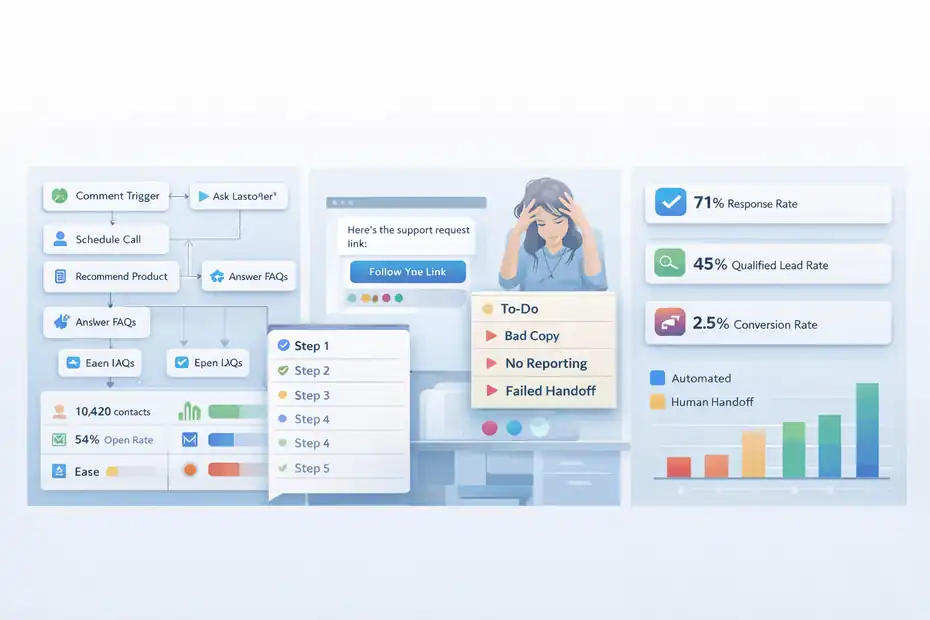
This is where the glossy marketing claims meet actual operations.
The tool can work well, but only if you build it around real workflow needs instead of vanity automations.
What A Smart Starter Setup Looks Like
A good ManyChat setup is usually smaller than people expect. I recommend starting with one high-intent use case, not ten. That might be comment-to-DM lead delivery, appointment request routing, FAQ triage, or simple product recommendation logic.
A lean starting framework:
- Step 1: Choose one conversation path tied to revenue or qualified leads.
- Step 2: Map the top 3 to 5 user intents and write plain-language replies.
- Step 3: Collect only the data you truly need.
- Step 4: Add tags or fields that matter for follow-up.
- Step 5: Define where human takeover happens.
This approach lines up with ManyChat’s strongest native features, including flows, tags, triggers, sequences, and analytics. Pro also adds unlimited contact engagement, more growth tools, advanced segmentation, integrations, and no ManyChat branding.
I advise against starting with a giant “automation ecosystem.” Most businesses do not need that on day one. They need one reliable, measurable flow that solves one painful bottleneck.
Where Setup Usually Goes Wrong
The most common failure is not technical. It is strategic. Businesses often build automations around what is possible instead of what is useful.
Common mistakes include:
- Too many branches: The flow tries to cover every edge case and becomes confusing.
- Weak copy: Messages sound robotic, vague, or overly promotional.
- Bad qualification: The bot collects data that no team member actually uses.
- No handoff rules: Hot leads get stuck in automation when they should go to a person.
- No reporting plan: Nobody defines what success means before launch.
This is why some teams feel disappointed after the first month. The tool worked. The system design did not.
If I were setting up ManyChat for a business today, I would focus on only three numbers first: response rate, qualified lead rate, and downstream conversion rate. Those metrics tell you whether the automation is helping or just creating activity.
The Hidden Operational Pros And Cons
Beyond marketing, ManyChat changes how a team works. That operational layer is where a lot of the real value, and real frustration, shows up.
Operational Advantage: Faster Response With Less Manual Repetition
ManyChat can reduce repetitive workload significantly because it automates the most common opening steps of a conversation. Official plan details include live chat capability, team member seats, contact tagging, drip sequences, triggers, analytics, and integrations, while the Inbox product brings multiple channels into one workspace.
For a small team, that matters more than flashy AI language. When someone asks “How much is it?”, “Do you ship internationally?”, or “How do I book?”, your staff should not spend the day rewriting the same answer. Automation protects attention.
This can also improve consistency. Every prospect gets the same core information, the same offer delivery flow, and the same qualification prompts. That means less variation between staff members and fewer dropped leads.
I have seen this matter a lot for businesses with evening and weekend traffic. Social inquiries do not arrive neatly during office hours. ManyChat gives you a way to respond immediately even when your team is offline, which helps maintain momentum until a human can step in.
Operational Drawback: Maintenance Never Really Ends
Here is the part vendors rarely emphasize: automation is not a one-time build. It is ongoing maintenance. Product offers change. Channel rules change. landing pages change. Team ownership changes.
Pricing changes. ManyChat itself changed its pricing model in March 2026 for some customers, which is a good reminder that the platform evolves too.
That means you need recurring operational habits:
- Monthly flow reviews: Check broken links, outdated copy, and stale branches.
- Naming discipline: Keep flows, tags, and custom fields understandable.
- Inbox governance: Define who handles what and when automation pauses.
- Policy awareness: Especially on WhatsApp and other regulated messaging channels.
If no one owns these tasks, performance decays quietly. The bot still “works,” but conversions slip, user experience gets awkward, and the team starts distrusting the system.
Advanced Optimization: How To Get The Good Without More Chaos
Many businesses install ManyChat. Fewer businesses optimize it properly. That is the difference between having an automation tool and getting a measurable return from it.
Use Automation To Qualify, Not Just To Deliver
The weakest ManyChat campaigns act like vending machines. Someone comments a keyword, and the system spits out a link. That can work, but it often wastes intent. A smarter approach is to add one or two decision points before the resource or offer is delivered.
For example:
- A service business can ask whether the lead wants pricing, booking, or a recommendation.
- An ecommerce brand can ask about product goal, size, or budget.
- A coach can ask whether the person is a beginner, intermediate, or advanced buyer.
Why this matters: Every answer gives you segmentation data you can actually use later. ManyChat’s Pro plan specifically supports unlimited tags, custom fields, and advanced segmentation, which is where a lot of its business value sits.
I believe this is the most practical advanced tip in the whole article. Do not just automate delivery. Automate understanding. That one shift makes follow-up smarter, retargeting cleaner, and handoff to sales more useful.
Keep The Flow Shorter Than You Think
One of the easiest ways to improve performance is to shorten the flow. Messaging channels reward speed and clarity. People do not enter DMs hoping to complete a 14-step decision tree.
A better principle is this: one goal per flow.
That might be:
- Deliver the lead magnet.
- Book the call.
- Recommend the product.
- Answer the top FAQ.
- Hand off to support.
When flows try to educate, qualify, sell, cross-sell, and collect too much data at once, completion rates usually suffer. Even if your reporting dashboard looks active, actual business outcomes can weaken because people drop off.
I suggest reviewing every message and asking, “Does this step increase clarity or just satisfy our internal curiosity?” If it is the second one, cut it.
Honest Verdict: Are The ManyChat Pros Worth The Cons?
For the right business, yes. For the wrong business, not even close.
When I Would Recommend ManyChat
I would recommend ManyChat to a business that gets meaningful engagement through Instagram, Messenger, WhatsApp, or similar channels and wants to turn that attention into a cleaner lead or sales process.
It is especially strong when repetitive questions are eating up team time, when speed-to-response matters, and when early-stage qualification can be standardized.
The case becomes stronger when:
- Your audience already interacts through social DMs.
- You have one or two repeatable inbound paths.
- Your team is small and needs leverage.
- You are willing to monitor and refine flows regularly.
- You understand that channel rules still apply.
In those situations, ManyChat can be a very practical growth tool. Not magical, but practical. And practical tools often create the best return.
When I Would Hold Back
I would hesitate if your business has low social engagement, highly customized sales conversations, messy data discipline, or no one internally who can own automation quality.
I would also be cautious if your budget is tight and your audience growth is likely to outpace your ability to monetize contacts, since contact-based pricing and channel-specific costs can creep upward.
The honest bottom line is this: ManyChat is best as a focused conversation automation layer, not as a miracle machine. Its pros are real: ease of use, channel fit, speed, and lead capture efficiency. Its cons are just as real: scaling cost, maintenance burden, complexity creep, and platform-rule dependency.
If you treat it like a sharp, limited tool, it can be excellent. If you expect it to solve weak strategy, weak offers, or weak follow-up, it will disappoint you very quickly.
FAQ
What is ManyChat used for in business?
ManyChat is used to automate conversations across messaging platforms like Instagram, Facebook Messenger, and WhatsApp. Businesses use it to capture leads, answer common questions, qualify prospects, and guide users toward purchases or bookings without manual effort.
Is ManyChat good for small businesses?
ManyChat can be very effective for small businesses that rely on social media engagement. It helps reduce response time, automate repetitive tasks, and capture leads efficiently, especially when the team is small and needs to scale communication without hiring more staff.
What are the main disadvantages of ManyChat?
The main disadvantages of ManyChat include rising costs as your contact list grows, increasing complexity in managing advanced automation flows, and limitations based on messaging platform rules like WhatsApp’s 24-hour messaging window and opt-in requirements.
Does ManyChat increase sales or conversions?
ManyChat can increase conversions by reducing friction in the customer journey and responding instantly to user intent. When set up properly, it helps qualify leads, deliver offers faster, and guide users toward action, which often improves overall conversion rates.
Is ManyChat worth it for businesses in 2026?
ManyChat is worth it for businesses that generate consistent engagement through social channels and need automation to manage conversations. However, its value depends on proper setup, ongoing optimization, and whether the business model fits messaging-based customer journeys.

I’m Juxhin, the voice behind The Justifiable.
I’ve spent 6+ years building blogs, managing affiliate campaigns, and testing the messy world of online business. Here, I cut the fluff and share the strategies that actually move the needle — so you can build income that’s sustainable, not speculative.
Related posts:
 10 Similar Sites To Apollo IO Every Marketer Should Try
 Apollo IO Similar Sites Compared: Top Picks For Lead Gen
 ManyChat Facebook Ads Guide: Automate Leads Fast
 ManyChat Chatbot Not Sending Messages Fix You Can Do Fast
 ManyChat Conversational Marketing Strategy That Drives Sales
 Hello Bar Review For Marketers: Hidden Wins