
Table of Contents
Some links on The Justifiable are affiliate links, meaning we may earn a small commission at no extra cost to you. Read full disclaimer.
Starting an Amazon ecommerce business can feel like stepping into the world’s largest marketplace with both excitement and uncertainty.
I remember the first time I launched a product—it wasn’t the best start, but those early lessons taught me how to find quick wins that actually moved the needle. The truth is, you don’t need to spend months experimenting before you see results.
With the right strategies, you can unlock early revenue opportunities that fuel growth, improve cash flow, and give you momentum fast. This guide breaks down proven ways to do exactly that.
Identify Profitable Product Niches Quickly
Finding your first profitable niche is where your Amazon ecommerce business starts to take off.
The key is to balance data with instinct—understanding what people actually want while ensuring you can compete effectively. Let’s walk through how you can do this step by step.
Analyze Market Demand Using Data Trends
When I first started, I made the mistake of choosing products I personally liked instead of what buyers were searching for. Don’t do that. You need data-driven demand.
Here’s how to get it right:
- Use Amazon’s Best Seller Rank (BSR): Look at products in your target category with a BSR under 10,000. It signals strong demand.
- Check Google Trends: Search your product idea and filter by region to spot consistent or growing interest.
- Use tools like Jungle Scout or Helium 10: These show you search volume, sales estimates, and seasonal fluctuations.
A good niche shows consistent search volume with manageable competition. If sales spike only during certain months, consider it a seasonal product, not a sustainable niche.
Find Low-Competition Products With High Sales Velocity
High demand is great—but if hundreds of sellers dominate the same listings, breaking in will be tough.
Look for opportunities where:
- There are fewer than 100 active listings for your main keyword.
- Top sellers don’t have thousands of reviews.
- You can offer a small differentiator, like eco-friendly packaging or a bundled accessory.
A trick I use: scroll through reviews of top competitors and note what people complain about. Fixing that one issue can give you a unique selling edge.
Validate Profit Margins Before Sourcing Products
Revenue means nothing without profit. Before ordering anything, make sure the math works.
Here’s a quick formula I use:
- Profit Margin = (Selling Price – Amazon Fees – Product Cost – Shipping Cost) ÷ Selling Price × 100
Aim for at least 30–40% profit margin after all costs. This gives you breathing room for ads, discounts, and unexpected expenses.
Also, request sample orders from multiple suppliers on platforms like Alibaba or 1688. You’ll be surprised how much prices (and quality) vary.
Use Amazon Search Data to Predict Product Performance
Amazon itself gives you some of the best insights. Start typing your product idea into the search bar—Amazon’s autocomplete suggestions show what shoppers are actively searching for.
For example, typing “reusable water bottle” might show “reusable water bottle with straw” or “insulated reusable water bottle.” Those long-tail variations are your goldmine—they reveal unmet demand.
Then, analyze those phrases using a keyword tool to see which have high volume but moderate competition. That’s where early wins happen.
Optimize Product Listings for Instant Visibility
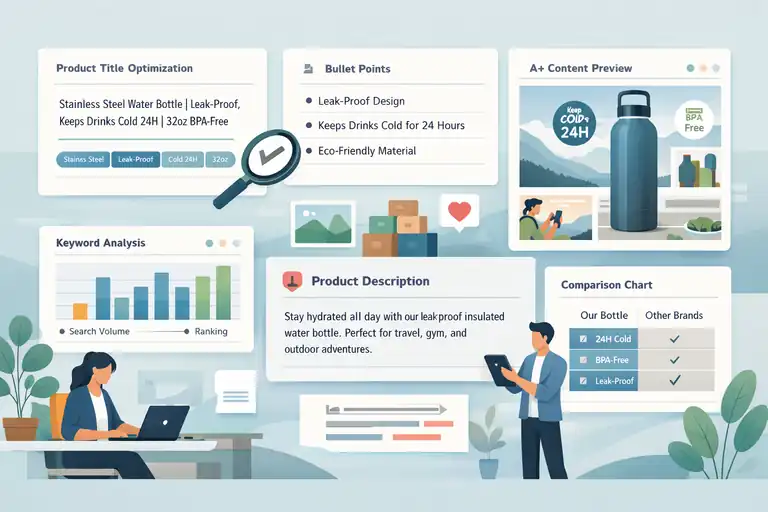
Once you’ve chosen your niche, your next job is getting noticed. Think of your Amazon listing like your storefront—it’s where browsers become buyers.
Optimizing it properly can skyrocket your visibility and conversion rate.
Write Click-Boosting Titles That Match Buyer Intent
Your title is your first impression. It tells both Amazon’s algorithm and potential buyers what your product is about.
Quick formula for Amazon titles: Primary Keyword + Main Benefit + Key Feature + Size/Quantity/Variation
Example: “Stainless Steel Insulated Water Bottle – Leak-Proof, Keeps Drinks Cold 24H – 32oz BPA-Free”
That structure works because it naturally includes keywords, appeals to the buyer’s need, and looks professional without stuffing.
Craft Compelling Bullet Points That Highlight Value
The bullet points under your title are where you convert attention into trust. Focus less on features and more on benefits.
Each bullet should answer: “Why should I buy this?”
For example:
- Leak-Proof Design: Stay hydrated without worrying about spills during workouts.
- Temperature Control: Keeps your drink cold for 24 hours or hot for 12.
- Eco-Friendly Materials: Made from 100% BPA-free, recyclable stainless steel.
Keep it concise, emotionally appealing, and benefit-driven.
Use Keywords Strategically in Product Descriptions
Your description should flow naturally, not read like a keyword dump. Write for humans first, algorithm second.
Break it into short paragraphs or bullet sections, and naturally sprinkle in semantic variations of your main keyword (like “Amazon FBA product,” “Amazon ecommerce brand,” or “online retail item”).
Add storytelling elements if relevant—like a short line about how your product solves a real problem. That emotional touch can lift conversions by 10–15%.
Leverage A+ Content to Enhance Conversions
If you’re enrolled in Amazon Brand Registry, you can use A+ Content (formerly Enhanced Brand Content). It allows you to add high-quality images, comparison charts, and storytelling sections.
Here’s how to make it effective:
- Use lifestyle photos showing the product in real use.
- Include comparison tables to highlight advantages over similar products.
- Tell a short brand story—why you created the product and how it benefits customers.
Amazon says A+ Content can boost sales by up to 10%, and in my experience, it’s absolutely worth it.
Leverage Amazon Advertising for Fast Traffic
Even the best listings need traffic. Amazon Ads can accelerate visibility, especially when your product is new. The trick is using ad data smartly, not blindly spending.
Set Up Sponsored Product Ads With Precision Targeting
Start with Sponsored Products—they appear in search results and on competitor listings.
Here’s what to do:
- Choose 5–10 primary keywords based on research.
- Set a small daily budget ($10–20) at first.
- Target exact match and phrase match keywords for better control.
Keep an eye on your ACOS (Advertising Cost of Sales). Ideally, you want it under 30% to stay profitable.
Use Automatic Campaigns to Discover Winning Keywords
Amazon’s automatic campaigns are underrated. They let Amazon test keywords for you based on your listing.
Run an automatic campaign for 7–14 days, then:
- Download the search term report.
- Identify high-converting keywords.
- Move those into manual campaigns for tighter control.
It’s one of the easiest ways to gather real data without overthinking keyword strategy.
Optimize Bids Based on Conversion Performance
Once you’ve collected data, it’s time to adjust bids.
- Increase bids on keywords that bring profitable sales.
- Reduce bids on those with high clicks but low conversions.
- Pause irrelevant terms that waste spend.
I usually check performance twice a week at first. It’s tedious, yes—but it saves money and refines targeting fast.
Retarget Viewers With Sponsored Display Campaigns
If someone viewed your product but didn’t buy, Amazon lets you retarget them through Sponsored Display Ads.
This is perfect for increasing conversions from warm leads.
For best results:
- Target users who visited your product or similar items.
- Use strong visuals with your product in use.
- Keep copy short and benefits-focused, like “Still thinking? Grab 10% off today.”
These ads often deliver some of the highest ROI because they reach shoppers already interested.
Implement Smart Pricing Strategies to Maximize Sales
Pricing is one of those areas in your Amazon ecommerce business that can quietly make or break your profits. Set it too high, and you’ll lose clicks. Set it too low, and you’ll erode your margins.
The goal is balance—competitive pricing that attracts buyers while keeping your profits healthy.
Use Dynamic Pricing Tools to Stay Competitive
Manually adjusting prices every day is exhausting, especially when competitors change theirs constantly. That’s where dynamic pricing tools come in.
These tools automatically adjust your prices based on competitors, market demand, and stock levels. Some reliable options include RepricerExpress, BQool, and Informed.
Here’s what I’ve learned using them:
- Set a minimum profit margin before you enable automation. This prevents price wars.
- Test different pricing rules—for example, being $0.50 lower than the Buy Box leader versus matching them.
- Review weekly results to see if automation is helping or hurting your conversion rate.
In my experience, automated repricing works best for products with consistent demand. For niche or seasonal items, manual adjustments are usually more profitable.
Apply Psychological Pricing for Better Conversions
Humans are funny when it comes to numbers. The difference between $20.00 and $19.99 might look tiny, but psychologically, it feels cheaper.
Here’s how to use psychological pricing effectively on Amazon:
- Charm pricing: Use prices ending in .99 or .95 to make the cost appear lower.
- Tiered pricing: Offer multiple options—like single, pack of 2, or pack of 5—to create perceived value.
- Anchor pricing: Display a “Was $29.99, Now $24.99” label to show a discount.
Amazon’s own data shows that products using these small visual cues often see a 5–10% increase in conversions. It’s a simple tweak with a big payoff.
Monitor Competitor Prices Without Undercutting Profit
You don’t have to win the race to the bottom to succeed. Instead, monitor your top competitors using tools like CamelCamelCamel to track their pricing history.
When you see patterns—like price drops on weekends or before holidays—you can adjust strategically without slashing profits.
A smart approach is to:
- Maintain a price buffer (for example, stay within 2–3% of your main competitor).
- Add extra perceived value like faster shipping, premium packaging, or bonus items.
- Keep prices steady during low competition periods.
I’ve found that holding your price confidently while improving your offer often builds long-term trust with buyers.
Offer Time-Limited Discounts to Trigger Urgency
Scarcity works. When shoppers see a deal expiring soon, they act fast. You can use Amazon’s Lightning Deals or 7-Day Deals to tap into this urgency.
For best results:
- Choose slow-moving items or products with high inventory.
- Combine the deal with social media promotion or email campaigns.
- Use compelling phrasing like “Limited Stock” or “Ends Tonight.”
From what I’ve seen, a well-timed limited offer can boost sales by up to 40% in just a few days—and clear inventory without lowering long-term prices.
Boost Reviews and Social Proof Authentically
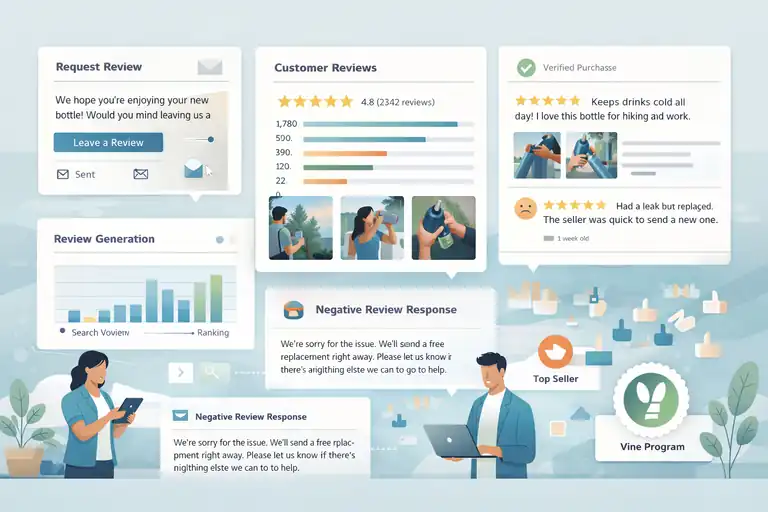
Your reviews are your reputation on Amazon. Shoppers trust other buyers far more than brand claims, and authentic reviews can make or break conversion rates.
Let’s explore how to build that trust the right way.
Encourage Verified Reviews Through Post-Purchase Emails
After a customer buys, they’re most open to leaving feedback if they’ve had a smooth experience. The key is to ask genuinely and at the right moment.
Here’s what works:
- Send a polite, non-pushy follow-up 3–5 days after delivery.
- Use Amazon’s Request a Review button or approved email templates.
- Keep it short and authentic: “I hope you’re enjoying your new bottle! Your review helps small sellers like us improve.”
Even a small increase in verified reviews can dramatically improve ranking and trustworthiness.
Handle Negative Reviews Professionally to Build Trust
Negative reviews are inevitable—but how you handle them defines your brand.
My rule of thumb: respond quickly, respectfully, and with solutions.
If someone complains about a defect, reply publicly offering a replacement or refund. It shows others you care about service, not just sales.
You can’t remove all bad reviews, but you can offset them by demonstrating professionalism. In fact, listings with a mix of 4–5 star reviews and genuine responses often convert better than those with perfect but suspicious-looking scores.
Use Amazon’s Vine Program to Generate Early Credibility
If you’re launching a new product, reviews can feel impossible to get at first. That’s where the Amazon Vine Program helps.
It allows trusted reviewers (called Vine Voices) to receive your product for free in exchange for honest feedback.
Pros of using Vine:
- You get credible, detailed reviews quickly.
- Early reviews boost your visibility in search results.
- It helps establish trust for new listings.
Just make sure your product packaging and instructions are polished—Vine reviewers are thorough and brutally honest.
Showcase Ratings Visibly to Influence Buying Decisions
Social proof isn’t just about having good reviews—it’s about showing them effectively.
You can:
- Highlight average star ratings in your title images using A+ Content.
- Include customer photos in your gallery (real images build trust instantly).
- Mention verified review count in marketing copy outside Amazon, like ads or social posts.
Amazon’s algorithm also prioritizes listings with higher review activity, so keeping a steady stream of new reviews supports both credibility and SEO.
Streamline Fulfillment for Faster Delivery and Growth
Efficient fulfillment isn’t just about getting packages out the door—it’s about maintaining customer satisfaction, keeping your seller rating high, and scaling sustainably.
Let’s make sure your Amazon ecommerce business runs smoothly behind the scenes.
Choose Between FBA and FBM Based on Business Model
Amazon offers two fulfillment options: FBA (Fulfilled by Amazon) and FBM (Fulfilled by Merchant).
- FBA means Amazon stores, packs, and ships your products for you. It’s great for scaling fast and winning Prime badges.
- FBM gives you more control over packaging, inventory, and costs but requires your own logistics system.
If you’re just starting, I’d recommend FBA—it simplifies operations, ensures fast shipping, and boosts buyer confidence. Later, as you grow, a hybrid model (FBA for fast sellers, FBM for bulky or custom items) often works best.
Optimize Inventory Levels to Avoid Stockouts or Excess
Running out of stock can tank your ranking. On the other hand, overstocking ties up capital and can lead to storage fees.
Here’s what works:
- Use tools like Restock Pro or SoStocked to forecast demand.
- Monitor your Inventory Performance Index (IPI) in Seller Central—aim for 400 or above.
- Reorder when you reach 25–30% of your average monthly sales volume.
Keeping inventory balanced not only improves your profitability but also signals Amazon that you’re a reliable seller worth ranking higher.
Track Shipping Metrics to Maintain High Seller Ratings
Amazon tracks metrics like Late Shipment Rate and Order Defect Rate. Consistent delays or errors can hurt your visibility and even risk suspension.
To stay in good standing:
- Ship orders within 24–48 hours if doing FBM.
- Use reliable carriers with tracking (Amazon loves data consistency).
- Regularly check your performance dashboard to catch issues early.
I’ve seen sellers save their accounts by simply catching and fixing a 1% spike in late shipments early. Small numbers matter here.
Use Amazon’s Global Fulfillment Network to Expand Reach
Once your business stabilizes domestically, consider tapping into Amazon Global Selling. It lets you sell in regions like Europe, Canada, or the Middle East using Amazon’s international logistics network.
Why it matters:
- You gain access to millions of new buyers with minimal extra setup.
- Amazon handles international fulfillment, customs, and delivery.
- It diversifies your revenue and protects you from local market slowdowns.
Just make sure you understand regional tax rules and adapt your listings for local language and preferences.
Increase Average Order Value With Bundles and Upsells
Once your Amazon ecommerce business starts generating steady sales, one of the smartest ways to grow revenue quickly is by increasing the average order value (AOV).
In simple terms, this means encouraging shoppers to buy more per transaction—without spending more on ads.
Create Product Bundles That Solve Multiple Needs
One of my favorite tactics is creating bundles—grouping related products that make sense together. Instead of selling a single item, offer a full solution.
For example, if you sell yoga mats, bundle them with straps or a carry bag. This adds value for the buyer while boosting your total sale amount.
Here’s what works best:
- Bundle products that solve a specific customer need, not just random combinations.
- Use “Bundle and Save” messaging to show clear financial advantage.
- Price it so the bundle feels like a deal—usually 10–15% cheaper than buying items separately.
Amazon’s data shows that effective bundles can increase AOV by up to 25%. And personally, I’ve found they’re also great for reducing inventory of slower-moving SKUs.
Use “Frequently Bought Together” Data to Find Pairings
Amazon literally gives you data on what customers often buy together—it’s that “Frequently Bought Together” section under listings.
Pay attention to these insights because they reflect real purchase behavior, not assumptions.
Here’s how I use it:
- Visit top competitor listings in your niche.
- Note which items appear frequently in the “bought together” section.
- Test those pairings in your own catalog as bundles or suggested add-ons.
For example, if you sell phone cases and Amazon shows “screen protectors” frequently paired, that’s a sign you should sell them together or offer a small discount for both.
This approach helps you align with natural buyer intent, not forced upsells.
Offer Add-On Items to Complement Main Purchases
Add-on items are small, low-cost products that make the main purchase more useful. Think of batteries for a flashlight, filters for a water bottle, or extra tips for stylus pens.
They work beautifully because the customer is already buying—your job is simply to enhance that purchase.
Here’s what to keep in mind:
- Keep add-ons priced under 20% of the main item.
- Mention them in your bullet points (“Pairs perfectly with our replacement filters”).
- Use Amazon’s “Frequently Bought Together” feature to promote them automatically.
When done right, these little extras can quietly raise profits by 10–20% per order.
Design Promotions That Encourage Multi-Item Purchases
Buyers love feeling like they’re getting a deal. You can use this to encourage them to buy multiple products in one go.
Try these options:
- Buy 2, Get 1 Free: Works best for consumable or repeat-use products.
- Spend $50, Get 10% Off: Encourages larger carts.
- Cross-category discounts: For example, “Buy any kitchen utensil, get 20% off cutting boards.”
Amazon’s coupon and promotion tools make this easy to set up. In my experience, even a small incentive like 5% off can nudge people to add an extra item—especially when displayed prominently on your listing.
Use Data Analytics to Refine Strategy Continuously
Success on Amazon isn’t about guessing—it’s about learning from your own data.
Your Amazon ecommerce business already generates a goldmine of insights; you just have to know where to look and what to act on.
Track Conversion Rates and Click-Through Trends
Your conversion rate (CVR) tells you how many people buy after visiting your listing, while click-through rate (CTR) shows how many click your ad or product in search results.
You can find both metrics in Amazon Seller Central → Business Reports → Detail Page Sales and Traffic.
How to use them:
- If CTR is low: Improve your product title, main image, and pricing.
- If CVR is low: Rework your bullet points, reviews, or images to address buyer hesitation.
- Track month-over-month changes to identify what’s working.
A healthy Amazon listing should maintain at least a 10–15% CVR depending on your niche.
Analyze Customer Behavior for Optimization Opportunities
Amazon provides detailed buyer data through Brand Analytics (available to Brand Registered sellers).
Use it to answer questions like:
- Which keywords are driving the most purchases?
- Which competitor listings are buyers comparing you against?
- Which ASINs have the highest repeat purchase rate?
When I looked into my own reports, I discovered that many customers were searching for my product under a slightly different term than I’d optimized for.
Updating my listing around that phrase alone lifted conversions by 12%.
Identify Underperforming Products and Adjust Quickly
Not every product will be a winner—and that’s okay. The key is identifying the laggards early.
Check these warning signs:
- High ad spend but low sales.
- Poor reviews (below 4 stars).
- Increasing returns or negative feedback.
Then decide whether to:
- Optimize: Update images, titles, and keywords.
- Reprice: Adjust for competitiveness.
- Retire: Stop investing in products with long-term decline.
Regularly auditing your catalog keeps your store lean, profitable, and focused on what works.
Use Amazon Business Reports to Guide Decisions
Your Amazon Business Reports give a snapshot of your performance—from sessions and buy box percentage to units ordered.
Focus on these core metrics:
- Unit Session Percentage: Measures conversion rate.
- Buy Box Percentage: Shows how often your listing wins the buy box.
- Sessions: Indicates how many visitors land on your listing.
I like to export this data weekly and plug it into a simple Google Sheet. Tracking changes visually helps me connect trends—like how a small pricing tweak or photo update affects performance over time.
Expand Beyond Amazon for Sustainable Growth
While Amazon is a powerful starting point, relying on it entirely can limit your growth potential.
To future-proof your Amazon ecommerce business, start building a presence beyond the platform.
Build a Brand Presence on Social Media Platforms
Platforms like Instagram, TikTok, and Pinterest can drive awareness and organic traffic to your listings.
Focus on content that shows your product in real life. For example, short demo videos, customer testimonials, or behind-the-scenes clips from your packaging process.
Social proof outside Amazon builds trust and directs new audiences back to your store. Plus, if your posts go viral, you might see an organic sales spike overnight—I’ve seen it happen with even small creators.
Create a Shopify Store to Diversify Sales Channels
A Shopify store gives you full control—your branding, pricing, and customer experience. It also protects your business if Amazon changes its policies or algorithms (and trust me, it happens).
You can even connect your Shopify store to your Amazon listings for seamless order management.
Start small: one product collection, clean design, clear brand story. Over time, you can add upsells, loyalty programs, and blog content to attract traffic through SEO.
Use Email Marketing to Retain and Re-Engage Customers
Email might sound old-school, but it’s still one of the most profitable marketing channels.
Here’s how you can use it:
- Send thank-you emails after purchase (if you capture emails through your website).
- Offer loyalty discounts or sneak peeks at new products.
- Use simple drip campaigns to nurture repeat buyers.
Even a modest email list can generate recurring revenue with almost zero ad cost.
Develop a Long-Term Branding Strategy Beyond Amazon
Your ultimate goal should be to build a brand, not just an Amazon storefront.
Think about your brand’s identity—its tone, promise, and visual style. Use consistent messaging across Amazon, your website, and social channels.
This consistency helps customers recognize you anywhere, turning one-time buyers into long-term fans.
Pro Tips for Sustaining Long-Term Profitability
Running an Amazon ecommerce business isn’t about short-term wins; it’s about building something that lasts.
Once you’ve established steady sales, focus on systems, reinvestment, and adaptability.
Reinvest Profits Into Scalable Product Development
When you hit profit milestones, avoid the temptation to withdraw everything. Reinvest strategically—launch new SKUs, upgrade packaging, or improve branding.
Diversifying your product line helps you stay relevant and resilient during market shifts. A rule I use is to reinvest at least 30% of profits back into growth every quarter.
Build Systems to Automate Repetitive Business Tasks
Automation saves time and sanity.
Use tools that handle:
- Inventory forecasting
- Price adjustments
- Email responses
- Ad management
This gives you room to focus on strategy instead of daily firefighting. Think of it as building a business that runs with you, not because of you.
Stay Updated With Amazon Policy and Algorithm Changes
Amazon’s rules and search algorithm evolve constantly. Missing an update can mean losing visibility or even account suspension.
Stay informed by following the Amazon Seller Central News section, listening to podcasts like “Serious Sellers,” or joining active seller forums.
I make it a habit to review updates weekly—it’s five minutes that can save hours of damage control later.
Network With Other Sellers to Exchange Insights and Tools
Connecting with fellow sellers is one of the best learning hacks out there.
Join Facebook groups, attend virtual meetups, or participate in conferences like Prosper Show. Real conversations often reveal tools, suppliers, and strategies you’d never find online.
I’ve met sellers who turned one casual chat into six-figure partnerships. You never know where those connections might lead.

I’m Juxhin, the voice behind The Justifiable.
I’ve spent 6+ years building blogs, managing affiliate campaigns, and testing the messy world of online business. Here, I cut the fluff and share the strategies that actually move the needle — so you can build income that’s sustainable, not speculative.
Related posts:
 Amazon Ecommerce Guide: How to Start and Grow Fast
 How to Make Money Dropshipping: 7 Secrets to a $10K/Month
 Dropshipping Marketing Strategies That Actually Drive Sales
 Ecommerce Automation That Saves Time Without Breaking Sales
 Ecommerce Inventory Management Made Simple for Faster Growth
 Ecommerce Marketing Agencies That Actually Drive Sales