
Table of Contents
Some links on The Justifiable are affiliate links, meaning we may earn a small commission at no extra cost to you. Read full disclaimer.
CallRail real marketing attribution case study searches usually come from one simple question: how do you actually prove which marketing dollars are driving calls, leads, and revenue?
I get why this matters so much. Plenty of businesses invest in Google Ads, SEO, landing pages, and local campaigns, but still end up guessing what caused the phone to ring.
In this guide, I’ll walk you through a practical, realistic attribution case study, show you how CallRail fits into the bigger measurement picture, and help you connect campaign activity to ROI in a way that feels usable, not theoretical.
What A Real Marketing Attribution Case Study Should Actually Prove
A good attribution case study should do more than say “leads went up.” It should show how traffic sources, campaigns, calls, forms, and closed revenue connect in a way a business owner can actually act on.
What Marketing Attribution Means In Plain English
Marketing attribution is the process of figuring out which channel, campaign, keyword, or touchpoint helped create a lead or sale. In simple terms, it answers the question, “What actually worked?”
For businesses that rely on phone calls, this gets tricky fast. A customer might find you through Google Ads, leave, come back through organic search, call from a mobile phone, and then book after speaking with your team. If you only look at the last click in your analytics platform, you miss most of the story.
That is where a platform like CallRail becomes useful. It helps connect call tracking, form tracking, conversation insights, and source-level reporting so you can stop treating every lead like it appeared out of nowhere. I believe this is one of the biggest mindset shifts in modern marketing. We are no longer just buying clicks. We are trying to understand revenue paths.
A real case study should prove five things: Where the lead came from, what they did before converting, which campaigns influenced the sale, what the lead was worth, and whether the return justified the spend. Without those five pieces, attribution is usually just dressed-up reporting.
Why Phone Calls Break Basic Attribution Models
Many businesses still use a reporting setup that works fine for ecommerce but falls apart for lead generation. If your conversions happen through calls, front-desk bookings, or sales conversations, standard analytics often misses the most valuable moments.
Here is the core problem: Phone calls usually happen off-page. A visitor clicks an ad, reads a service page, and then calls the number on the site. If that number is static and not tied to source tracking, the call becomes disconnected from the marketing journey that created it.
This leads to familiar mistakes. Paid search looks expensive because you only see click costs. SEO looks stronger than it really is because returning visitors often come back through branded search. Social looks weak because it assists early but rarely gets direct credit. Offline referrals get over-counted because staff ask callers vague questions like “How did you hear about us?”
In my experience, once a business adds dynamic number insertion and source tracking, the picture changes almost immediately. The issue is usually not that marketing is failing. It is that measurement is incomplete.
A strong CallRail attribution case study should highlight this exact turning point: before tracking, the business guessed; after tracking, the business could connect calls to real sources and make better budget decisions.
The Difference Between Lead Attribution And Revenue Attribution
A lot of marketers stop at lead attribution. They celebrate the fact that a campaign generated 50 calls or 30 form submissions. That is helpful, but it is not the full picture.
Lead attribution tells you what generated inquiries. Revenue attribution tells you what generated money. Those are not always the same thing. One campaign may bring lots of low-intent calls, while another brings fewer calls but a much higher close rate.
Imagine a home services company running two campaigns. Campaign A produces 80 calls at a low cost per lead, but most callers are price shoppers. Campaign B produces 25 calls, but those callers book premium jobs worth three times more. If you only optimize for lead volume, you may scale the wrong campaign.
This is why a useful attribution case study must connect the top of the funnel to the bottom of the funnel. CallRail helps with source tracking, but the real ROI story becomes clearer when call data is tied to CRM outcomes, booking values, or sales status.
I suggest thinking of attribution in layers. First, identify what drove the call. Then identify whether that call was qualified. Then identify whether it became revenue. That progression turns reporting into a decision-making system.
The Business Scenario Behind This CallRail Case Study
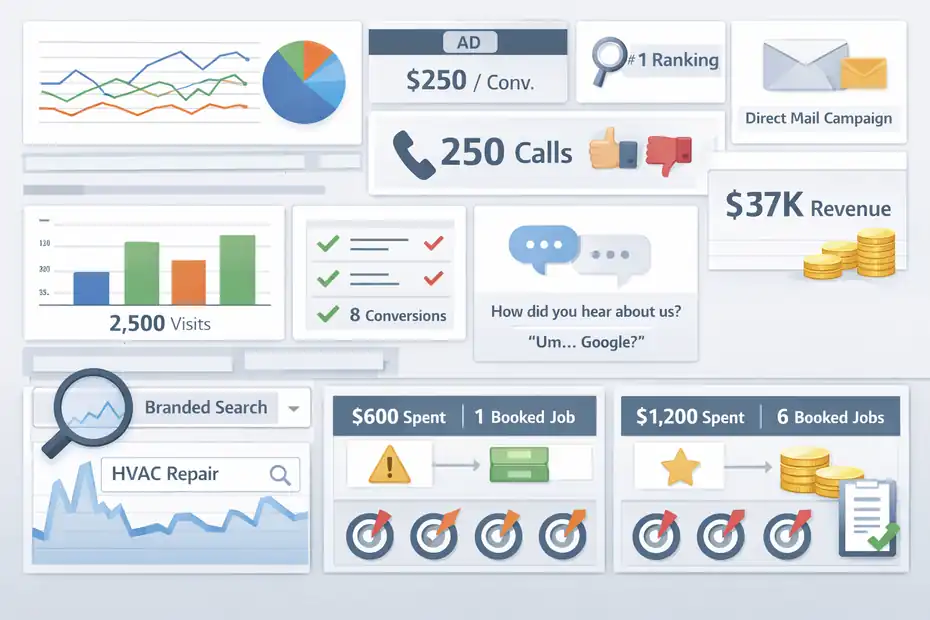
To make this practical, let’s build a realistic case study based on a service business that depends heavily on inbound calls and wants to understand true ROI across multiple channels.
The Company Profile And Marketing Problem
Imagine a mid-sized HVAC company serving one metro area plus surrounding suburbs. The business has 12 technicians, a small in-house office team, and monthly marketing spend spread across Google Ads, Local SEO, Google Business Profile optimization, direct mail, and a few seasonal landing pages.
The company’s biggest frustration is familiar: the owner sees leads coming in, but cannot confidently say which channels are profitable. The paid media agency reports cost per conversion. The SEO consultant reports rankings and traffic growth. The call center says phone volume feels strong. But none of those reports line up well enough to support budget decisions.
Before using better attribution, the business tracked success using broad numbers: total calls per month, total booked jobs, and total revenue. That sounds reasonable, but it hides huge inefficiencies. The owner does not know whether emergency repair ads, AC installation pages, or branded search are producing the best customers.
This is the exact type of environment where a CallRail real marketing attribution case study makes sense. There is enough lead volume to identify patterns, enough channel complexity to create confusion, and enough revenue at stake that bad attribution leads to expensive mistakes.
The Original Measurement Setup And Its Limitations
Before improving attribution, the HVAC company used a static phone number across the website, paid ads, and directory profiles. The site had form submissions tracked in a basic analytics setup, but calls were mostly invisible from a channel perspective.
The team relied on three weak signals. First, they looked at traffic by source in analytics. Second, they reviewed ad platform conversions. Third, office staff asked callers how they found the company. None of these methods gave trustworthy insight.
Traffic reports were misleading because traffic did not equal calls. Ad platform conversions were incomplete because not every call came directly from an ad click. Manual staff notes were inconsistent because callers often said things like “Google” or “online,” which is not specific enough to support real optimization.
One especially costly issue involved branded search. The business assumed organic SEO was driving many new customers because branded organic traffic converted well. After deeper tracking, they learned a large share of that traffic had first interacted through paid search or local service campaigns and returned later through brand terms.
That matters because it changes budget logic. Without attribution, SEO looked like the hero and paid acquisition looked overpriced. With attribution, paid campaigns turned out to be doing more demand creation than anyone realized.
The Goals Of The Attribution Project
The business did not just want prettier dashboards. It had four clear goals tied directly to ROI.
- Goal 1: Identify which channels generated qualified calls, not just total calls.
- Goal 2: Understand which campaigns influenced booked jobs and high-value installations.
- Goal 3: Reduce wasted spend on ads or pages that produced poor-fit callers.
- Goal 4: Build a repeatable reporting system that the owner, office manager, and marketing partners could all trust.
I think this is where many businesses finally get serious. Attribution becomes urgent when leadership realizes they are not debating numbers because they enjoy analysis. They are debating numbers because money is being allocated based on incomplete evidence.
In this case, the company wanted to prepare for peak summer demand. That meant they needed confidence before increasing spend. Scaling broken tracking would only multiply confusion. So the project focused first on measurement clarity, then on optimization, then on budget expansion.
How CallRail Was Set Up To Capture Attribution Data
The setup phase is where attribution either becomes reliable or stays messy. Good reporting starts with clean tracking architecture, not with dashboards.
Dynamic Number Insertion And Source Tracking
The first major step was implementing dynamic number insertion on the website. This lets different visitors see a tracked phone number based on how they arrived, while the business still routes calls to the same real destination.
If someone arrived through Google Ads, they saw one tracking number. If they came from organic search, they saw another. If they came from direct traffic or referral traffic, those sources could also be segmented. This is what makes source-level call attribution possible.
Without dynamic number insertion, you can track that calls happened. With it, you can track where they came from. That difference is huge.
The HVAC company also assigned tracking numbers to key offline and external placements, including direct mail, directory listings, and major campaign assets. This helped isolate which channels were driving inbound calls beyond the website itself.
A practical shortcut I recommend is keeping the first tracking setup simple. Start by separating paid search, organic search, direct, referral, and major offline campaigns. You can add more granularity later. Too many businesses overcomplicate the early setup and then struggle with clean reporting because naming conventions and routing rules become chaotic.
Form Tracking, Session Data, And Lead Context
Calls were only one part of the picture. The business also wanted to know which pages and campaigns drove form submissions for maintenance plans, estimate requests, and installation consultations.
Form tracking was configured so each lead submission included source data, landing page details, and session-level context. This matters because many leads do not call on the first visit. They may browse, compare, and convert later through a form.
CallRail’s value in a setup like this is not just that it records a conversion. It helps preserve attribution context around that conversion. Instead of seeing “new lead received,” the team can see that the lead came from a non-brand paid search campaign, landed on an AC repair page, viewed financing information, and then submitted a form.
That level of context changes how marketers improve pages. You are no longer optimizing a generic website. You are optimizing specific journeys.
For example, the team noticed that visitors from high-intent repair terms often skipped educational blog content and converted quickly from service pages. Meanwhile, visitors researching full system replacement viewed multiple pages before contacting the business.
That led to different page strategies for different intents, which is exactly what good attribution should unlock.
CRM And Sales Outcome Connection
This is the stage where attribution becomes financially useful. The company connected tracked leads to sales outcomes so booked jobs, job values, and closed revenue could be reviewed by source and campaign.
Even a lightweight CRM connection can create major clarity. The important thing is not perfection on day one. The important thing is linking inbound lead data to outcome data consistently enough to spot patterns.
Once the office team began tagging leads by outcome, several important differences emerged. Some sources created high call volume but low booking rates. Some produced modest lead counts but excellent average ticket value. Some campaigns generated calls outside service areas, which wasted staff time.
I recommend focusing on three sales fields at minimum: qualified or unqualified, booked or not booked, and revenue value. Those three fields let you move from vanity metrics into ROI analysis fast.
In this case study, that connection revealed that not all conversions deserved equal credit. A 90-second price-check call and a financed installation booking should not be treated as the same success event. That seems obvious, but many dashboards still count them as one conversion each.
What The Data Revealed After 90 Days
Once the tracking setup had enough data, the business could finally compare channels in a way that reflected real performance instead of assumptions.
Which Channels Actually Drove Qualified Calls
Over a 90-day period, the HVAC company reviewed inbound calls by channel, call quality, booking rate, and resulting revenue. The results surprised almost everyone involved.
Google Ads generated the highest number of first-time qualified calls, especially from service-intent campaigns tied to urgent repair terms. Organic search delivered strong lead volume too, but many of those users were returning visitors who had already encountered the brand elsewhere.
Google Business Profile drove a meaningful number of direct phone conversions, particularly on mobile, but average job value was slightly lower than leads coming through installation-focused paid campaigns.
Referral traffic had excellent close rates but low volume. Direct mail generated fewer leads than expected but performed well in certain zip codes. Social media created engagement and occasional form fills, but almost no high-intent inbound calls.
This is why I always tell people not to judge a channel by one metric. Volume, quality, booking rate, and revenue all matter. One channel can look weak in traffic and still be profitable. Another can dominate lead count and still underperform financially.
The business learned that its previous “best channel” rankings were too simplistic. They had been rewarding whichever source produced the most visible conversions, not the most valuable ones.
The Gap Between Reported Leads And Real Revenue
One of the biggest insights came from comparing top-funnel lead counts against closed revenue. The mismatch was hard to ignore.
A campaign targeting low-cost AC repair keywords produced lots of calls, but many of those callers wanted immediate price comparisons or service outside the company’s coverage area. The calls made reporting look healthy, yet the revenue outcome was mediocre.
Meanwhile, a campaign focused on higher-end system replacement terms produced fewer inquiries but much stronger close rates and significantly better average revenue per job. The campaign had looked “expensive” in the old reporting model because cost per lead was higher. Once revenue was layered in, it was clearly one of the most profitable investments.
This is a classic attribution lesson. Cheap leads are not always efficient leads. In many service businesses, the right question is not “How many leads did we get?” It is “How many profitable jobs did we create?”
The company adjusted its scorecard to emphasize cost per qualified lead, booking rate, revenue per lead, and return on ad spend where applicable. That simple shift stopped the team from chasing volume for the sake of volume.
Example Results From The Case Study
Here is a simplified version of what the business saw after tying source data to outcomes:
| Channel | Leads | Qualified Leads | Booked Jobs | Revenue | Estimated ROI Trend |
|---|---|---|---|---|---|
| Google Ads – Repair | 148 | 82 | 39 | $27,500 | Moderate |
| Google Ads – Install | 46 | 31 | 18 | $64,000 | High |
| Organic Search | 91 | 57 | 28 | $36,800 | Strong |
| Google Business Profile | 73 | 41 | 24 | $21,400 | Moderate |
| Direct Mail | 19 | 14 | 9 | $18,900 | Strong In Select Areas |
| Referral | 17 | 15 | 10 | $22,600 | Very High |
| Social Media | 22 | 7 | 2 | $2,100 | Low |
This table tells a much better story than raw lead counts alone. The install campaign did not “win” by volume, but it clearly outperformed on revenue efficiency. Referral traffic was tiny but highly valuable. Social media was not useless, but it was not a meaningful direct-response driver in this case.
That is what a real marketing attribution case study should do. It should turn vague channel opinions into measurable tradeoffs.
How Attribution Changed Budget Decisions And ROI
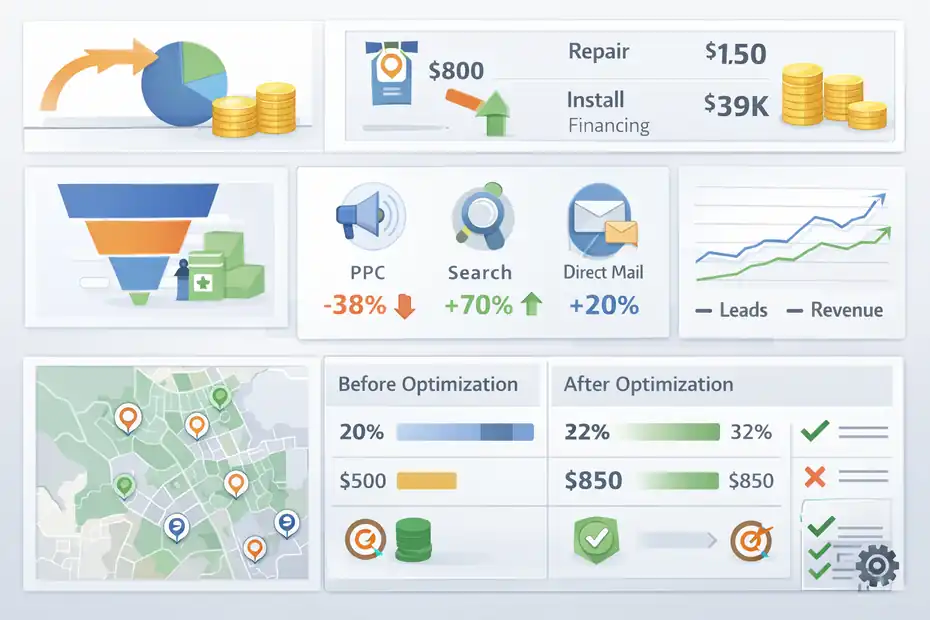
Good attribution only matters if it changes action.
Once the HVAC company trusted the data, it began reallocating spend and improving lead handling based on what was actually producing return.
Budget Reallocation Based On Revenue, Not Guesswork
The first major move was shifting spend away from low-intent campaigns and into high-value service lines. The company reduced budget for broad repair keywords that created low-quality calls and increased investment in campaigns tied to installation, financing, and high-margin services.
This did not mean eliminating lower-funnel repair demand entirely. Repair calls still mattered, especially for relationship-building and future upsell opportunities. But the business stopped treating every click category equally.
Organic search strategy changed too. Instead of publishing more broad informational content just to grow traffic, the team prioritized commercial pages tied to high-converting demand clusters. They improved location pages, rewrote service pages for conversion clarity, and strengthened internal linking around installation and replacement topics.
Direct mail was refined geographically. Instead of mailing large zones evenly, the company doubled down on neighborhoods where tracked response rates and average job values were strongest.
I believe this is where attribution becomes powerful in a very human way. It gives you permission to stop funding channels out of habit. That alone can improve ROI even before lead volume grows.
Improvements In Lead Quality And Sales Efficiency
The case study did not just improve marketing. It also improved operations. Once the office team could see which sources produced weak-fit calls, they updated scripts, qualification questions, and routing logic.
For instance, the team noticed that certain campaigns generated many calls after hours. That insight led to a scheduling change and better voicemail handling for urgent requests. Another report showed that some landing pages attracted calls from outside the company’s service area. The team fixed the copy, added location qualifiers, and reduced wasted conversations.
Call recordings and conversation tagging also helped identify why some campaigns underperformed. In several cases, the marketing was fine, but lead handling was the issue. Calls were being answered inconsistently, or staff were not guiding installation inquiries toward consultations effectively.
This is an important point that many attribution discussions skip. Better attribution can expose operational leaks, not just marketing weaknesses. If a campaign brings qualified callers and your team fails to convert them, the fix is not always in the ad account.
The ROI Shift After Optimization
After the first optimization cycle, the business saw a noticeable improvement in efficiency over the next quarter. Total lead volume did not explode, but qualified lead rate improved, booked revenue rose, and spend became more concentrated around profitable segments.
A realistic summary looked something like this:
- Overall lead volume increased modestly.
- Qualified lead percentage rose significantly.
- Average revenue per tracked lead improved.
- Wasted spend on poor-fit campaigns dropped.
- Management confidence in reporting increased.
That last one matters more than it sounds. When leadership trusts the reporting, decisions happen faster. Agencies get clearer direction. Internal teams spend less time arguing about channel credit and more time improving results.
In my experience, attribution projects often create two returns: a visible financial return and a decision-speed return. The second one is harder to measure, but it often compounds faster than people expect.
Common Attribution Mistakes That Distort Results
Even with a solid platform, attribution can still break when setup, interpretation, or team process is weak. These mistakes show up all the time.
Mistaking Call Volume For Marketing Success
The first trap is treating every phone call as a win. More calls can mean more interest, but they can also mean more confusion, more bad-fit traffic, or more wasted staff time.
A campaign that triggers lots of short, unqualified calls may look strong in a surface-level dashboard. But if those calls do not book, do not close, or pull your staff away from real buyers, the campaign may be underperforming.
This is why I suggest classifying calls beyond simple duration thresholds. A long call is not always a qualified lead, and a short call is not always worthless. The best systems combine source data with call outcomes, booking status, or conversation quality indicators.
Imagine two sources. One drives 100 calls with a 10 percent booking rate. Another drives 40 calls with a 50 percent booking rate. If you optimize for call count alone, you will likely scale the wrong source.
The solution is simple in theory but requires discipline in practice: define what a valuable lead actually looks like, then measure against that definition consistently.
Giving Too Much Credit To Last-Touch Channels
Last-touch attribution is easy to understand, but it often over-rewards channels that happen near the end of the buyer journey. This is especially common with branded search, direct traffic, and repeat visitors.
A prospect may discover your business through a non-brand ad, read reviews, compare options, come back through organic search, and call after seeing your branded result. If you only credit the final interaction, you may wrongly conclude that brand search created the customer from scratch.
This leads to dangerous budget decisions. Awareness and acquisition campaigns get cut because they look expensive. Branded and direct channels get overvalued because they capture final conversions.
For many lead-gen businesses, I recommend reviewing at least first-touch, last-touch, and assisted-path patterns together. You do not need a perfect multi-touch model to improve decisions. You just need enough visibility to stop pretending every customer journey is linear.
In this case study, understanding assisted influence helped the company avoid underfunding demand-generation campaigns that were quietly creating future conversions.
Ignoring Offline And Team-Level Variables
Another big mistake is assuming the data tells the whole story automatically. Attribution is powerful, but it still reflects real-world operations. If sales response time is inconsistent, if call handling changes by shift, or if the business has seasonal service fluctuations, those factors affect results.
For example, a campaign may appear to decline in performance when the real issue is staffing shortages during peak demand. A landing page may look weak when the true problem is delayed callback time. A zip-code campaign may underperform because technicians cannot serve that area quickly enough.
I think the healthiest way to use attribution is as part of a business system, not as a magic scoreboard. It helps you ask better questions. It does not eliminate the need for judgment.
That is why the best case studies include context. They explain what changed in marketing, what changed operationally, and what assumptions had to be corrected along the way.
Advanced Optimization Strategies After Attribution Is Working
Once tracking is reliable, the next step is using the data to improve conversion rates, customer value, and scale efficiency.
Segment Campaigns By Intent And Customer Value
One of the smartest moves after attribution maturity is separating campaigns by intent, not just by topic. A person searching for emergency repair has different urgency, price sensitivity, and expected timeline than someone researching full system replacement.
When you segment by intent, you can align ad messaging, landing page structure, and lead handling more precisely. High-urgency campaigns should prioritize speed, trust, availability, and mobile call conversion. High-value installation campaigns should emphasize financing, credibility, consultation flow, and long-term benefits.
This also improves ROI analysis because you stop blending fundamentally different lead types into one average. The HVAC company in this case study learned that installation leads deserved separate budget logic from repair leads. Their value profiles, close rates, and sales cycles were too different to manage together.
I recommend creating channel reports by service line, lead type, and average revenue potential whenever possible. That extra segmentation often reveals opportunities hiding inside “average” performance data.
In practical terms, it helps answer questions like: should you spend more to win fewer but better leads? Often, the answer is yes.
Use Conversation Insights To Improve Messaging
Attribution shows where leads came from. Conversation data helps explain what those leads cared about. That combination can improve ads, pages, scripts, and even offer design.
For example, if repeated call recordings show that prospects ask about same-day availability, warranties, financing, or service area coverage, those topics should appear earlier and more clearly in campaign messaging. If callers repeatedly misunderstand pricing or service scope, your ads or landing pages may be attracting the wrong expectations.
This is one of those areas where hands-on marketers gain an edge. We often think optimization starts in dashboards, but some of the best wins come from listening to actual customer language.
The HVAC company used conversation patterns to update headlines, FAQs, and intake scripts. That improved message match and reduced friction during the booking process.
I suggest treating call insights like qualitative SEO and CRO research. You are hearing the real phrases, concerns, and objections that shape conversion behavior. That is incredibly valuable, especially in local and service-based marketing.
Build A More Useful Reporting Cadence
Advanced attribution is not about drowning in reports. It is about reviewing the right data at the right frequency with the right level of detail.
A strong cadence might look like this: weekly checks for lead quality issues, monthly channel and campaign review, and quarterly budget strategy decisions based on revenue patterns. This keeps teams responsive without encouraging reactive over-optimization.
The HVAC company eventually built a reporting system around four core questions each month:
- Which sources created qualified demand?
- Which campaigns produced the best revenue efficiency?
- Where did lead handling or conversion rate break down?
- What budget shifts should happen next month?
That is a much healthier framework than staring at dashboards full of disconnected metrics. It connects attribution to action.
From what I’ve seen, many businesses do not need more data. They need fewer, sharper questions tied to real decisions. That is where attribution stops being a reporting project and starts becoming a growth system.
Who This Type Of Attribution Setup Works Best For
Not every business needs the same depth of attribution. But for some models, it is hard to improve ROI without it.
Best-Fit Business Types
This kind of setup works especially well for businesses where calls and lead quality matter more than simple online transactions. Good examples include HVAC, plumbing, legal services, med spas, dental offices, real estate teams, auto services, insurance agencies, and home remodeling companies.
These businesses usually share a few traits. They have multiple acquisition channels, rely on inbound calls or forms, and close revenue offline rather than directly on a checkout page. That makes traditional ecommerce-style measurement incomplete.
If your customers call before buying, if different services produce very different margins, or if you serve specific locations and need cleaner source data, attribution tracking becomes much more valuable.
I would also say this setup matters more once spend reaches a point where mistakes are expensive. A company spending a small amount can sometimes survive rough measurement. A company spending heavily across SEO, paid media, and local campaigns usually cannot.
That is when a CallRail real marketing attribution case study becomes more than educational content. It becomes a blueprint for avoiding waste.
When Simpler Tracking Might Be Enough
To be fair, not every business needs full-blown attribution layers from day one. If you are very early stage, running one main channel, and handling a small number of straightforward leads, simpler tracking may be enough temporarily.
For example, a solo consultant with one landing page and one lead source may get enough clarity from basic form tracking and a simple CRM pipeline. Overbuilding attribution too early can create process overhead before there is enough volume to learn from.
The point is not to install complexity for its own sake. The point is to add tracking depth when it helps you make better decisions.
My rule of thumb is simple: When you are regularly asking “Which half of my marketing is working?” and you cannot answer it confidently, you have likely outgrown basic reporting.
That is usually the moment when attribution starts paying for itself.
Final Takeaways From This CallRail Real Marketing Attribution Case Study
A real attribution case study should leave you with clearer decisions, not just prettier charts. That is the standard I believe matters most.
What This Case Study Really Shows About ROI
The biggest lesson here is that ROI improves when measurement becomes connected to reality. The HVAC company did not win because it found a magical new channel. It won because it stopped evaluating channels with incomplete data.
CallRail helped make calls visible, source data actionable, and campaign performance more honest. But the real transformation came from what the business did next. It linked marketing to lead quality, lead quality to bookings, and bookings to revenue. That full chain is what turned attribution into profit.
The case study also showed that some channels create demand while others capture it. Some campaigns drive volume while others drive value. Some “cheap” leads are expensive in practice. Some “expensive” leads are incredibly profitable.
Once you understand those differences, budget decisions become less emotional and more strategic. That is where sustainable ROI usually begins.
The Practical Next Step For A Business Owner Or Marketer
If you are trying to apply this to your own business, I would keep the next move simple. Start by asking whether you can reliably answer four questions today: where calls come from, which leads are qualified, which sources become revenue, and where waste is happening.
If the answer is no, that is your opportunity.
You do not need a perfect system overnight. Start with source-level call tracking, form attribution, clean campaign naming, and a basic lead outcome process. Then refine the model as more data comes in.
In my experience, businesses rarely regret getting clearer attribution. They usually regret waiting too long, scaling spend too early, or trusting surface-level conversion numbers that hid the truth.
And that, to me, is the real value behind a CallRail real marketing attribution case study. It is not about software screenshots or marketing jargon. It is about finally knowing what is driving calls, customers, and ROI so you can grow with confidence.
FAQ
What is a callrail real marketing attribution case study?
A callrail real marketing attribution case study shows how businesses track calls, leads, and revenue back to specific marketing channels. It connects campaigns to actual outcomes, helping identify which sources generate qualified leads and real ROI instead of just traffic or basic conversion metrics.
How does callrail help with marketing attribution?
Callrail helps track phone calls and form submissions by source, campaign, and keyword. It uses dynamic number insertion to assign unique numbers to visitors, allowing businesses to see exactly which marketing efforts drive calls and leads, improving visibility across the entire customer journey.
Why is call tracking important for ROI measurement?
Call tracking is essential because many high-value leads happen over the phone. Without tracking, businesses cannot link calls to campaigns, leading to inaccurate ROI calculations. Proper tracking ensures every call is connected to its source, improving budget decisions and marketing efficiency.
What is the difference between lead attribution and revenue attribution?
Lead attribution identifies which channels generate inquiries, while revenue attribution shows which leads actually convert into paying customers. Revenue attribution provides deeper insight because it connects marketing efforts directly to income, helping businesses focus on the most profitable campaigns instead of just lead volume.
How long does it take to see results from attribution tracking?
Most businesses begin seeing useful insights within 30 to 90 days after implementing attribution tracking. This timeframe allows enough data to identify patterns in lead quality, booking rates, and revenue sources, enabling more accurate optimization and better marketing decisions.

I’m Juxhin, the voice behind The Justifiable.
I’ve spent 6+ years building blogs, managing affiliate campaigns, and testing the messy world of online business. Here, I cut the fluff and share the strategies that actually move the needle — so you can build income that’s sustainable, not speculative.
Related posts:
 What is CallRail? Discover the Power of Call Tracking and Analytics
 How CallRail Inc Helps Track Every Lead
 CallRail Call Tracking: How It Works and Why It Matters
 LearnWorlds Shopify Setup: What Works, What Fails
 Why CallRail Cost Might Be Worth the Investment
 Where to Find a Safe Quillbot Download—No Viruses, No Spam