
Table of Contents
Some links on The Justifiable are affiliate links, meaning we may earn a small commission at no extra cost to you. Read full disclaimer.
If you’ve been searching for an ecommerce CRM that actually helps you turn first-time shoppers into loyal, repeat buyers, you’re in the right place.
I’m writing this for ecommerce founders, marketers, and growth teams who are tired of juggling customer data across tools and want one clear answer to a simple question: Which ecommerce CRM tools are truly worth using to drive repeat purchases and long-term customer value?
Klaviyo Ecommerce CRM For Retention-First Growth
Klaviyo is an ecommerce CRM built specifically for brands that care about repeat purchases, not just one-off conversions.
From what I’ve seen, it works best when retention, email, and SMS are treated as one connected system instead of separate tools.
Centralized Customer Profiles Built For Ecommerce Brands
Klaviyo’s customer profiles are designed around shopping behavior, not sales calls or support tickets. Every profile updates automatically as customers browse, buy, or engage.
Here’s what makes these profiles genuinely useful in day-to-day ecommerce work:
- Order history: Products purchased, frequency, average order value, and refunds are visible in one place.
- Engagement signals: Email opens, clicks, SMS replies, and site activity are tied directly to revenue actions.
- Predictive metrics: Klaviyo adds expected next order date and predicted lifetime value to profiles, which saves hours of manual analysis.
In practice, this means you don’t need to guess who’s likely to buy again. I’ve used this to quickly pull segments like “customers who bought twice but haven’t ordered in 45 days” and act on it immediately.
This is where Klaviyo starts to feel like a true ecommerce CRM rather than just an email platform.
Behavioral Segmentation Based On Real-Time Shopping Data
Segmentation is where Klaviyo really earns its reputation. Instead of static lists, you’re working with live segments that update in real time.
Common high-impact segments I see working well include:
- Browsed but didn’t buy: Visitors who viewed a product multiple times without purchasing.
- High-value repeat buyers: Customers above a specific lifetime spend threshold.
- Churn-risk customers: Buyers who missed their typical reorder window.
Because the data updates instantly, someone can enter or exit a segment the moment their behavior changes. That’s critical for ecommerce CRM workflows where timing matters more than message volume.
According to Klaviyo benchmarks, brands using behavior-based segmentation generate up to 2–3x more revenue per recipient compared to batch-and-blast campaigns. That lines up closely with what I’ve seen in real stores.
Automated Email And SMS Flows That Drive Repeat Orders
Klaviyo’s automation flows are built around customer actions, not arbitrary schedules. This makes it much easier to create messages that feel timely instead of pushy.
High-performing repeat-purchase flows usually include:
- Post-purchase education: How-to content or usage tips sent 3–7 days after delivery.
- Replenishment reminders: Automated emails or SMS triggered by predicted reorder timing.
- Cross-sell suggestions: Product recommendations based on what was actually purchased.
One shortcut I often use is combining email and SMS in the same flow. For example, email does the storytelling and education, while SMS handles short reminders or urgency-based nudges.
This approach consistently increases repeat order rate without increasing unsubscribe complaints.
Deep Integrations With Shopify, WooCommerce, And BigCommerce
Klaviyo’s native integrations with major ecommerce platforms are one of its biggest advantages. Setup is usually measured in minutes, not days.
What these integrations unlock:
- Real-time order sync: Purchases, refunds, and cancellations flow in automatically.
- Product-level tracking: You can trigger flows based on specific SKUs or categories.
- Checkout behavior: Abandoned cart and checkout events fire reliably without custom code.
For Shopify stores especially, Klaviyo feels less like a third-party tool and more like a native extension of the platform.
If you want stronger segmentation, better flows, and a CRM built for ecommerce retention, Klaviyo is where most stores see their biggest lift. Get started with Klaviyo here.
Revenue Attribution And Customer Lifetime Value Tracking
Attribution is where many ecommerce CRM tools fall short. Klaviyo keeps things practical by tying revenue directly to flows, campaigns, and segments.
Inside the dashboard, you can quickly see:
- Revenue per flow: Which automations are actually driving repeat purchases.
- Customer lifetime value trends: How retention efforts affect long-term revenue.
- Channel comparison: Email versus SMS versus combined performance.
This makes decision-making much simpler. Instead of debating opinions, you can clearly see which retention strategies are paying off and double down on those.
HubSpot Ecommerce CRM For Scalable Customer Relationships
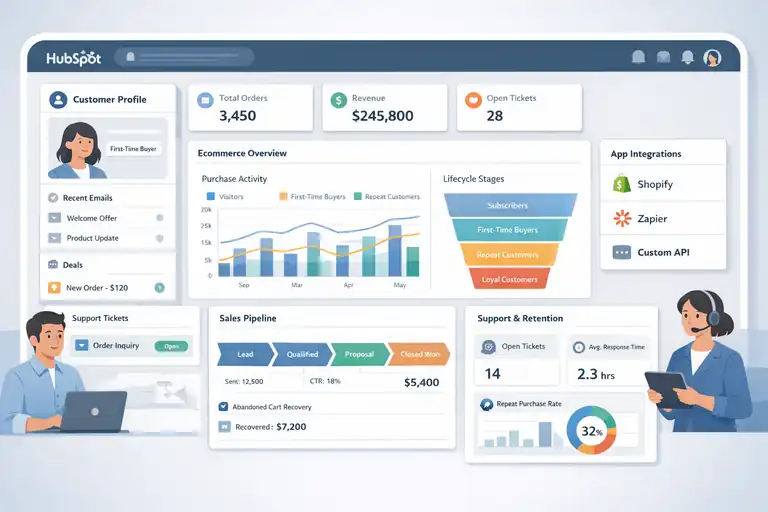
HubSpot works best for ecommerce brands that want one system for marketing, sales, and support, especially as teams grow. It’s not ecommerce-first by default, but it becomes powerful when configured intentionally.
Unified CRM With Marketing, Sales, And Support Data
HubSpot’s biggest strength is data unification. Every team sees the same customer record, which reduces blind spots as your business scales.
Inside a single contact record, you’ll typically see:
- Marketing activity: Emails received, pages visited, and forms submitted.
- Sales context: Deals, notes, and lifecycle stages.
- Support history: Tickets, chat conversations, and resolution times.
For ecommerce brands with higher-order values or B2B-style repeat customers, this unified view prevents awkward handoffs and duplicated messaging.
Ecommerce Data Sync Using Native And Third-Party Integrations
HubSpot relies on integrations to pull ecommerce data into the CRM, and the quality depends on your setup.
Common integration paths include:
- Shopify data sync: Orders, customers, and products synced via native apps or middleware.
- Custom events: Purchase and checkout events tracked using HubSpot’s tracking code.
- Third-party connectors: Tools like Zapier or custom APIs for advanced setups.
Once configured properly, HubSpot becomes a reliable ecommerce CRM, but it does require more upfront planning compared to Klaviyo.
Lifecycle Stages And Deal Pipelines For Online Stores
HubSpot’s lifecycle stages help teams understand where each customer stands in their journey.
For ecommerce, I usually recommend stages like:
- Subscriber: Joined email or SMS but hasn’t purchased.
- First-time buyer: Completed initial order.
- Repeat customer: Purchased two or more times.
- Loyal customer: High lifetime value and consistent engagement.
These stages can trigger automations, internal alerts, or personalized messaging, which makes retention efforts more structured as volume increases.
Personalization Tools For Post-Purchase Engagement
HubSpot’s personalization features work across email, landing pages, and even customer portals.
Practical examples I’ve used include:
- Dynamic product recommendations: Based on past purchases or viewed categories.
- Smart content blocks: Showing different messages to first-time versus repeat buyers.
- Behavior-based follow-ups: Emails triggered by inactivity or repeat visits.
While not as ecommerce-native as Klaviyo, HubSpot excels when personalization needs to span multiple channels beyond email.
If your store needs a scalable CRM with lifecycle stages and multichannel personalization, HubSpot is a reliable long-term choice. Explore HubSpot’s CRM plans here.
Analytics Dashboards For Retention And Repeat Revenue
HubSpot’s analytics are flexible and customizable, which is ideal for teams that want deeper reporting.
Dashboards often track:
- Repeat purchase rate: Over time and by acquisition source.
- Revenue by lifecycle stage: Identifying where retention efforts break down.
- Campaign-assisted revenue: Understanding which touchpoints influence repeat orders.
From my experience, HubSpot shines when leadership needs clear, cross-team reporting that connects retention metrics to broader business goals.
Zoho CRM Ecommerce Tools For Cost-Effective Growth
Zoho CRM is often overlooked in ecommerce, but in my experience, it’s one of the most practical options when budget matters and flexibility is non-negotiable.
It works well for brands that want an ecommerce CRM they can shape around their workflow instead of adapting their business to the software.
Omnichannel Customer Data Across Email, Chat, And Social
Zoho CRM pulls conversations from email, live chat, social media, and phone into a single customer record. In simple terms, it shows you every interaction a customer has had with your brand, no matter where it happened.
This matters more than it sounds. Imagine a customer who:
- Clicked an Instagram ad
- Asked a pre-purchase question on chat
- Bought twice via email offers
Instead of guessing context, Zoho shows the full trail. I’ve seen support teams avoid unnecessary discounts simply because they could see recent engagement and order history in one view.
For ecommerce brands managing multiple touchpoints without a large team, this unified visibility quietly boosts retention.
Ecommerce Integrations With Shopify And Custom Storefronts
Zoho integrates with Shopify out of the box and supports custom storefronts through APIs and extensions. While setup takes more planning than Klaviyo, the trade-off is flexibility.
Common data synced into Zoho includes:
- Customers and contacts
- Orders and purchase frequency
- Products and categories
What I personally like is the ability to map ecommerce data into custom fields. For example, you can track subscription length, reorder cycles, or wholesale versus retail buyers without hacks.
If your store isn’t “standard ecommerce,” Zoho tends to adapt better than most ecommerce CRM platforms.
Workflow Automation For Follow-Ups And Re-Engagement
Zoho’s workflow automation lets you trigger actions based on customer behavior, time delays, or lifecycle changes.
High-impact workflows I’ve seen perform well:
- Follow-up emails sent 7 days after delivery
- Internal alerts when a high-value customer hasn’t reordered
- Re-engagement sequences triggered after 60 days of inactivity
These automations feel less flashy than email-first tools, but they’re reliable. Once set up, they quietly handle retention tasks in the background without constant tweaking.
For lean teams, this “set it and trust it” automation style is underrated.
AI-Powered Insights For Customer Behavior And Trends
Zoho’s AI assistant, Zia, analyzes patterns across customer data and flags useful insights. Think of it as trend detection rather than prediction magic.
Zia can surface things like:
- Customers likely to churn based on engagement drops
- Products associated with higher repeat purchase rates
- Best times to follow up based on past responses
I wouldn’t rely on AI alone, but as a second set of eyes, it’s helpful. Especially when you don’t have a dedicated analyst watching retention metrics daily.
If your store needs automation, custom fields, and omnichannel data without high costs, Zoho is the most adaptable option. See Zoho CRM pricing and features here.
Custom Modules For Ecommerce-Specific Use Cases
This is where Zoho really separates itself. Custom modules let you build ecommerce-specific objects inside the CRM.
Examples I’ve built or seen include:
- Subscription renewal tracking
- Loyalty tier management
- Wholesale buyer accounts
Instead of forcing ecommerce logic into generic fields, you design around your business. For brands with unique repeat-purchase mechanics, this can be the difference between “usable” and “actually effective.”
Brevo Ecommerce CRM For Email, SMS, And Loyalty
Brevo is an ecommerce CRM that blends simplicity with strong multichannel messaging.
I often recommend it to brands that want email, SMS, and basic CRM features without paying enterprise-level prices.
Contact Management Designed For Ecommerce Campaigns
Brevo’s contact system focuses on engagement and transaction data rather than complex sales pipelines. Each contact shows purchase history, campaign activity, and attributes like location or device.
For ecommerce use, this means:
- Faster segmentation for campaigns
- Cleaner lists with fewer duplicates
- Easier compliance with email and SMS consent rules
It’s not trying to be everything, and that’s a good thing. For many stores, clarity beats complexity.
Transactional And Marketing Messaging In One Platform
One of Brevo’s biggest strengths is handling both transactional and marketing messages together.
This includes:
- Order confirmations and shipping updates
- Promotional email campaigns
- SMS notifications and offers
Having everything in one platform reduces deliverability issues and keeps messaging consistent. I’ve seen brands improve open rates simply by sending transactional emails from the same system as marketing campaigns.
It also makes troubleshooting much easier when something goes wrong.
Advanced Segmentation Using Purchase And Engagement Data
Brevo’s segmentation is more powerful than it first appears. You can segment based on:
- Past purchases and order value
- Email and SMS engagement
- Custom attributes synced from your store
A practical example: targeting customers who purchased once, opened the last two emails, but haven’t ordered again in 45 days. That’s a classic repeat-buyer segment, and Brevo handles it cleanly.
For an ecommerce CRM at this price point, that’s impressive.
Automation Scenarios For Repeat Buyer Journeys
Brevo’s automation builder is visual and beginner-friendly, but still flexible enough for advanced flows.
Effective repeat-buyer scenarios include:
- Post-purchase education sequences
- Loyalty point reminders
- Win-back campaigns with escalating incentives
I like Brevo for brands just getting serious about automation. It encourages good habits without overwhelming you with options you won’t use.
Perfect for stores wanting a simple, powerful CRM without enterprise pricing. Try Brevo here and start sending in minutes.
Built-In Reporting For Campaign And Revenue Performance
Brevo’s reporting focuses on clarity over complexity. You can quickly see:
- Revenue generated per campaign
- Engagement trends across email and SMS
- Conversion rates by segment
While it won’t replace advanced analytics tools, it gives you enough insight to make confident decisions. For many ecommerce teams, that’s exactly the sweet spot.
Freshsales CRM For Ecommerce Sales And Support Alignment
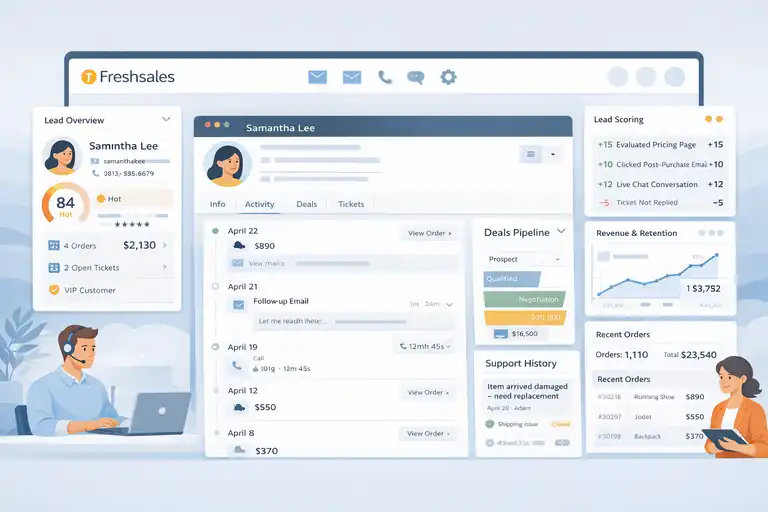
Freshsales works best when ecommerce brands want sales and support teams operating from the same customer truth. It’s not an email-first ecommerce CRM, but it shines when human interaction, deal context, and retention overlap.
Unified View Of Customers Across Sales And Support
Freshsales creates a single customer timeline that blends shopping data with human conversations. In plain language, everyone sees the same customer story instead of fragmented notes across tools.
What shows up clearly in one place:
- Contact details and order-related notes
- Email conversations and call logs
- Support tickets and resolution history
This is especially useful for higher-value ecommerce stores where customers expect continuity. I’ve seen brands reduce repeat complaints simply because agents could see prior issues before replying.
For ecommerce CRM use cases involving subscriptions, B2B orders, or assisted purchases, this shared view prevents awkward “Can you repeat that?” moments.
AI-Based Lead Scoring Using Shopping Behavior Signals
Freshsales includes AI-based lead scoring, which ranks contacts based on how likely they are to convert or re-engage. For ecommerce, this scoring can incorporate browsing behavior and engagement signals.
Examples of signals that increase scores:
- Repeated visits to pricing or product pages
- Clicking post-purchase emails
- Responding to support outreach
This helps sales or retention teams prioritize outreach. Instead of guessing who needs attention, you focus on customers showing intent.
I don’t treat AI scores as gospel, but as a prioritization filter, they’re genuinely useful.
Automation For Follow-Ups, Tasks, And Customer Touchpoints
Freshsales automation handles internal tasks just as well as customer-facing messages. That’s a subtle but important difference compared to marketing-first ecommerce CRM tools.
Common automations include:
- Creating follow-up tasks after high-value purchases
- Assigning accounts to reps when order thresholds are crossed
- Triggering check-in emails after support tickets close
This is ideal if your retention strategy includes human follow-ups, not just automated emails. In my experience, this approach works particularly well for premium or subscription-based ecommerce.
Ecommerce Integration Options For Order And Contact Sync
Freshsales connects to ecommerce platforms through native apps and middleware tools. While it’s not plug-and-play like Klaviyo, it’s flexible.
Typically synced data includes:
- Customer profiles and contact info
- Orders and purchase history
- Custom fields like account type or tier
Once synced, Freshsales feels less like a CRM bolted onto ecommerce and more like a relationship engine layered on top of transactions.
Ideal for subscription stores, high-ticket products, or any brand that benefits from human-assisted follow-ups. See Freshsales CRM plans here.
Custom Reporting For Retention And Revenue Insights
Freshsales reporting focuses on clarity and accountability. You can build reports that tie customer actions to revenue outcomes.
Useful ecommerce CRM reports include:
- Revenue by customer segment
- Retention rates after support interactions
- Sales-assisted repeat purchases
These insights help answer questions like: Are support conversations increasing repeat orders, or just resolving issues? That’s powerful context most ecommerce teams never see.
Drip Ecommerce CRM For Advanced Lifecycle Marketing
Drip is an ecommerce CRM built entirely around lifecycle marketing. If you live in customer journeys, triggers, and personalization logic, Drip feels like home.
Ecommerce-First CRM Built Around Customer Journeys
Drip treats every customer as a moving journey, not a static record. Instead of lists, you work with flows that adapt to behavior.
This includes:
- First-time buyer journeys
- Repeat buyer nurturing paths
- Win-back and churn prevention flows
I like Drip because it forces you to think in systems. You’re not sending campaigns. You’re building experiences that evolve as customers act.
Event-Based Tracking For Browsing And Purchase Behavior
Drip uses event-based tracking, meaning actions trigger automation instantly.
Tracked events often include:
- Product views and category browsing
- Add-to-cart and checkout actions
- Purchases, refunds, and repeat orders
This allows extremely precise targeting. For example, someone who viewed a product three times but didn’t buy can receive a different message than someone who abandoned checkout.
For ecommerce CRM strategies that depend on timing, this level of control matters.
Personalized Email And Onsite Messaging At Scale
Drip combines email with onsite messaging, which shows targeted messages directly on your store.
Practical personalization examples:
- Showing loyalty reminders to returning customers
- Displaying product recommendations based on past purchases
- Hiding offers from customers who already converted
This reduces email fatigue and improves relevance. In my experience, onsite messages quietly lift conversion rates without adding noise.
Deep Shopify And WooCommerce Integrations
Drip’s integrations with Shopify and WooCommerce are deep and reliable. Setup is straightforward, and data syncs cleanly.
You get access to:
- Product-level purchase data
- Customer lifetime value metrics
- Real-time event triggers
For stores built on these platforms, Drip feels native rather than external.
your retention strategy depends on precise triggers, personalization, and customer journeys, Drip gives you unmatched control. Explore Drip’s ecommerce CRM features here.
Revenue Attribution Focused On Repeat Purchases
Drip’s revenue attribution centers on lifecycle impact, not vanity metrics.
You can see:
- Revenue generated per workflow
- Repeat purchase influence by channel
- Long-term value changes after automation updates
This makes optimization practical. You’re not guessing which flows work. You’re measuring them against repeat revenue.

I’m Juxhin, the voice behind The Justifiable.
I’ve spent 6+ years building blogs, managing affiliate campaigns, and testing the messy world of online business. Here, I cut the fluff and share the strategies that actually move the needle — so you can build income that’s sustainable, not speculative.
Related posts:
 Ecommerce Store Guide: 7 Negative Pitfalls to Avoid
 Affordable Ecommerce Email Marketing Agency Services
 Ecommerce Marketing Solutions That Multiply Your Sales
 How to Promote My Store and Get Real Paying Customers
 Ecommerce Marketing Guide: Turn Traffic Into Sales
 Ecommerce SEO Strategy That Drives Buyers, Not Just Rankings