
Table of Contents
Some links on The Justifiable are affiliate links, meaning we may earn a small commission at no extra cost to you. Read full disclaimer.
A freshworks vs hubspot comparison matters more than most software buyers expect, because this choice does not just affect your CRM.
It shapes how quickly your team responds, how easily marketing and sales share data, and how expensive it becomes to scale.
I’ve seen companies pick the “big name” tool, then realize six months later they bought complexity instead of momentum.
In this guide, I’ll walk you through where Freshworks wins, where HubSpot wins, and which platform is more likely to turn software spend into actual revenue for your business.
What Freshworks And HubSpot Actually Sell
Both platforms sit in the CRM and customer platform category, but they approach growth from different angles.
That difference is exactly why revenue outcomes can look very different depending on your team size, sales model, and budget.
Freshworks Is Built Around Cost-Efficient Operational Growth
Freshworks sells a broader software family, but in this conversation the core products are Freshsales and Freshworks CRM, with adjacent marketing and service tools layered in as needed.
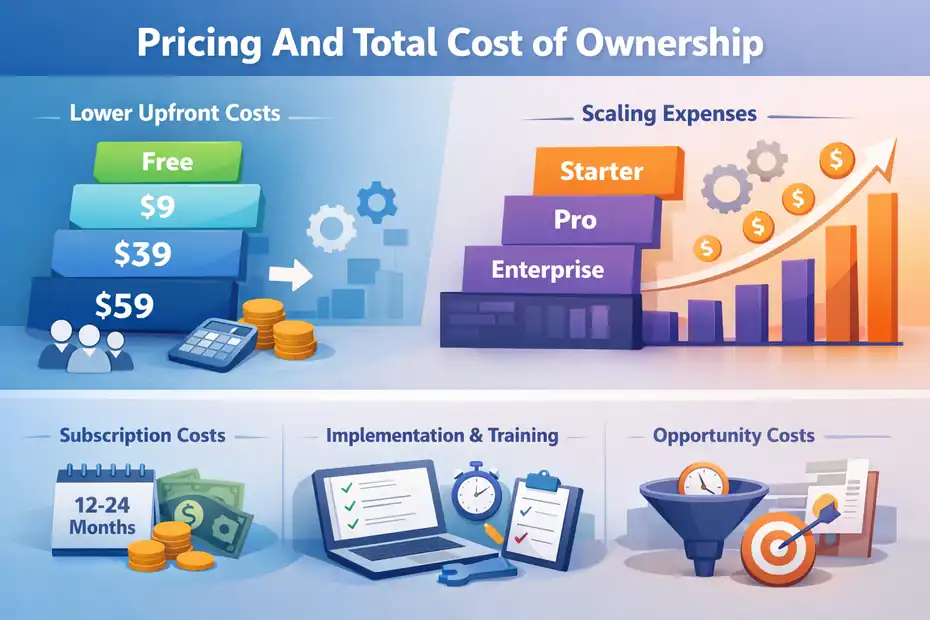
Its CRM pricing starts with a free plan for up to three users, then paid tiers beginning at $9 per user per month billed annually, followed by Pro at $39 and Enterprise at $59.
That pricing alone tells you a lot about who Freshworks wants to serve: growing teams that care about speed, decent automation, and predictable cost.
What I like about Freshworks is that it usually makes sense faster. You do not need a long internal debate to figure out where the sales pipeline lives, how contact records behave, or whether you need a consultant just to create basic automations.
For a lean team, that simplicity can become a revenue advantage because adoption happens earlier. A CRM nobody updates does not drive revenue. A CRM people actually use might.
Imagine a 12-person B2B company with two marketers and five reps. If the team gets call logging, lead scoring, email sequencing, and pipeline visibility without a giant rollout, they can improve follow-up speed in weeks, not quarters.
That does not sound flashy, but faster lead response and cleaner pipeline hygiene are often the boring things that unlock more closed deals.
HubSpot Is Built Around A Unified Growth Engine
HubSpot positions itself as an AI-powered customer platform, not just a CRM. Its Smart CRM has a free entry point, and its paid customer platform starts at $20 per seat per month for Starter, $50 for Professional, and $75 for Enterprise, according to HubSpot’s product catalog.
Individual hubs also have their own pricing structures, including Sales Hub tiers that scale from free and Starter into much more expensive Professional plans.
That product philosophy matters. HubSpot is not really trying to win on lowest cost. It is trying to win on alignment.
Marketing, sales, content, service, automation, and reporting live closer together, which can create a clearer path from traffic to lead to deal to retention. When that system is configured well, revenue attribution is much easier to trust.
This is where HubSpot becomes very strong for companies that already rely on inbound marketing, content, paid acquisition, lifecycle automation, and multi-touch reporting.
In my experience, HubSpot tends to shine when the business needs one commercial system of record rather than one affordable sales tool.
If your revenue model depends on marketing and sales behaving like one team, HubSpot’s architecture can be a real advantage.
The Revenue Question Is Not “Which Is Better” But “Which Friction Hurts You Less”
This is the part many comparison articles miss. Revenue does not come from the platform with the longest feature page. It comes from the platform that removes the right bottlenecks for your business.
Freshworks usually reduces cost friction and admin friction. HubSpot usually reduces cross-team friction and reporting friction.
If your current issue is that reps are inconsistent, follow-up is slow, and budgets are tight, Freshworks may drive more revenue because it gets deployed and used sooner.
If your current issue is that marketing generates leads nobody trusts, attribution is muddy, and service data never feeds expansion strategy, HubSpot may drive more revenue because it connects the full journey.
I believe that is the right lens for this entire freshworks vs hubspot comparison. Not brand prestige. Not feature count. Friction. The platform that removes your most expensive friction usually wins.
Pricing And Total Cost Of Ownership
Software pricing pages tell only part of the story.
Revenue impact depends just as much on seat growth, onboarding effort, add-ons, and how soon your team outgrows the entry plan.
Freshworks Usually Wins The Upfront Cost Battle
Freshsales starts with free for up to three users, then Growth at $9 per user per month billed annually, Pro at $39, and Enterprise at $59.
Freshmarketer also starts low, with paid plans beginning at $15. That gives Freshworks a very clear advantage for small and midsize teams that need useful core functionality before they are ready for a premium stack.
Let me make that practical. Say you have 10 sales users. On a rough annualized basis, Freshsales Growth is dramatically cheaper than any serious mid-market HubSpot setup. Even when you move into Pro, Freshworks often remains easier to justify financially, especially if your marketing operation is still light.
That cost gap matters because every extra dollar spent on software is a dollar that has to be earned back through pipeline conversion, expansion revenue, or team efficiency.
There is also less psychological risk in adopting Freshworks. A founder or revenue leader can say yes without committing to an ecosystem that may become expensive as contacts, seats, and hub usage expand.
For smaller businesses, that keeps the CRM decision from becoming a financial drag on growth.
HubSpot Can Start Small But Gets Expensive As Ambition Grows
HubSpot’s free CRM is real, and the Starter Customer Platform at $20 per seat per month lowers the barrier to entry for small businesses.
Sales Hub Starter pricing also begins low on a per-seat basis, but the meaningful jump usually happens when companies want deeper automation, broader reporting, stronger workflow capability, or multiple hubs working together at a higher level.
HubSpot’s own pricing materials show that Professional and Enterprise tiers move into substantially higher spend territory.
This does not make HubSpot overpriced. It makes it easier to underestimate. A lot of teams compare “starter vs starter” and assume the economics stay similar over time. They usually do not.
The real budget question is this: what will you actually need 12 months from now once you want better reporting, more automations, stronger sales process control, and more serious lifecycle marketing?
That is why HubSpot works best when the business model can absorb higher software spend because the platform supports a higher-value go-to-market motion.
If you are closing large deals, running sophisticated nurture flows, or using content and attribution to improve CAC payback, HubSpot’s price can make sense. If not, it can feel heavy.
Total Cost Includes Admin Time, Training, And Opportunity Cost
The most expensive CRM is often the one that slows down decisions. This is where a true freshworks vs hubspot comparison gets interesting. Total cost is not just subscription price.
It includes setup time, reporting cleanup, user training, process redesign, and the opportunity cost of delayed adoption.
Nucleus Research has reported average CRM returns of $8.71 for every dollar spent, which is a useful reminder that CRM can absolutely pay off. But that return depends on execution, not just purchase.
I suggest thinking about cost in three layers:
- Layer 1: Subscription cost over 12 to 24 months.
- Layer 2: Implementation effort and internal admin time.
- Layer 3: Revenue delayed because your team does not fully adopt the system.
Freshworks often wins Layer 1 and Layer 2. HubSpot can win Layer 3 when unified marketing, sales, and service visibility helps a business convert and retain more efficiently.
That is why the cheapest option is not always the best value, but also why the most comprehensive platform is not automatically the better investment.
Sales Execution And Pipeline Management
If your main goal is to help reps close more deals, the best CRM is the one your sales team updates without constant nagging.
Features matter, but usability and workflow design matter more.
Freshworks Is Strong For Reps Who Need Fast Daily Execution
Freshworks CRM includes familiar essentials like contact and account management, pipeline tracking, Kanban views, built-in phone, email tools, and AI-related add-ons through Freddy.
The practical benefit is that most sales teams can start using it quickly without overengineering the process.
For many businesses, that simplicity translates into cleaner activity data. Cleaner data means more reliable forecasting. More reliable forecasting means better hiring, better budgeting, and fewer quarter-end surprises. In other words, operational simplicity can become a revenue lever.
Here is the kind of team that usually likes Freshworks: outbound-heavy SMB sales, founder-led sales teams transitioning into structure, or account executives who want fewer clicks between lead capture and deal movement.
They do not necessarily need a huge content engine or advanced lifecycle orchestration. They need visibility, accountability, and enough automation to reduce repetitive work.
I’ve noticed that when sales leaders want something “strong but not fussy,” Freshworks is often easier to defend. It gives you pipeline discipline without making your reps feel like they need admin certification to do their job.
HubSpot Is Better When Sales Lives Inside A Bigger Revenue System
HubSpot Sales Hub includes deal tracking, meetings, live chat, prospecting tools, automation, and deeper connectivity with the broader HubSpot platform.
HubSpot also emphasizes AI and unified customer context across its platform, which matters when sellers rely on marketing engagement history and service interactions during deal progression.
Where HubSpot often pulls ahead is context. A rep can see whether a contact opened campaigns, visited high-intent pages, booked meetings, engaged with support, or moved through nurture sequences.
That richer picture can improve timing and message relevance. In revenue terms, that can increase conversion rates, shorten sales cycles, or reduce leakage between handoffs.
Imagine a SaaS company selling into mid-market accounts. The rep is not just chasing raw leads. They are working accounts influenced by webinars, content downloads, demos, and customer success signals.
HubSpot handles that cross-functional narrative better. A sales team in that environment may absolutely create more revenue in HubSpot than in a simpler CRM, even if the sticker price is higher.
For Pure Sales Productivity, The Winner Depends On Complexity
This is where I land: Freshworks is often better for straightforward sales execution, while HubSpot is often better for revenue teams that need shared intelligence across functions.
Choose Freshworks when:
- You need fast adoption
- Your pipeline process is relatively simple
- Your team is budget-sensitive
- You want strong core sales features without ecosystem sprawl
Choose HubSpot when:
- Sales depends heavily on marketing context
- You need tighter handoff visibility
- You care about end-to-end revenue reporting
- You expect the CRM to become your commercial operating system
I believe that is the cleanest sales-side summary. Freshworks helps many teams move faster. HubSpot helps more complex teams think smarter.
The better revenue tool is the one that matches your current operating reality, not the one with the flashier demo.
Marketing, Attribution, And Lead Management
This is the section where the gap often widens.
If your business generates demand through inbound channels, content, email, paid media, and nurture automation, the platform choice affects revenue much more than most buyers expect.
HubSpot Has A Clear Advantage In Marketing Depth
HubSpot’s platform is built around the idea that marketing and CRM data should live together.
Its product pages emphasize integrated marketing, sales, service, content, and AI capabilities on one customer platform, which is exactly why HubSpot has become so common in inbound-led companies.
That unified setup matters because attribution becomes easier to trust. You can connect campaigns, forms, landing pages, lead source behavior, pipeline progression, and customer outcomes more directly.
For leadership teams, this means better answers to revenue questions like:
- Which channels create qualified pipeline, not just leads?
- Which campaigns influence closed revenue?
- Where is the handoff from marketing to sales breaking down?
HubSpot also leans into current marketing trends. Its 2026 State of Marketing materials and 2026 marketing statistics pages show that the company is investing heavily in AI-driven productivity, brand differentiation, and integrated growth execution.
That does not prove automatic ROI, but it does signal where the product is focused.
Freshworks Covers Marketing Basics Better Than Some Buyers Expect
Freshmarketer includes email, journeys, and marketing contact handling, with paid plans starting at $15. For teams that need sensible marketing automation without building a massive inbound machine, this may be enough.
That “enough” point is important. Not every company needs enterprise-style attribution or a content ecosystem with advanced lifecycle segmentation.
A local service business, niche B2B company, or smaller SaaS startup may just need lead capture, segmentation, campaign execution, and clean handoff into sales.
In those cases, Freshworks can still support revenue growth while keeping cost controlled.
I suggest being brutally honest here. Many companies buy advanced marketing software before they have advanced marketing operations. That usually leads to underuse.
If your team sends one newsletter, runs light paid traffic, and relies mostly on outbound or referrals, HubSpot’s extra marketing strength may not translate into extra revenue yet.
Revenue Attribution Usually Favors HubSpot, But ROI Can Still Favor Freshworks
HubSpot is the stronger pick for marketing-led growth because it is better positioned for integrated lead management and attribution.
Freshworks is the stronger pick for leaner teams that need sensible execution without paying for layers they will not use.
Here is the trade-off in plain language:
- HubSpot: Better visibility into how marketing turns into revenue.
- Freshworks: Better odds of keeping software costs aligned with a simpler demand generation model.
If your CEO asks, “Which campaigns created revenue last quarter?” HubSpot usually gives a better answer. If your CEO asks, “Can we stop overspending on software we barely use?” Freshworks often gives the better answer.
Customer Service, Retention, And Expansion Revenue
A lot of revenue comparisons stop at lead generation and pipeline.
That is a mistake. Retention, upsell, and customer experience often decide which platform produces better long-term returns.
HubSpot Is Stronger For Shared Customer Context Across The Lifecycle
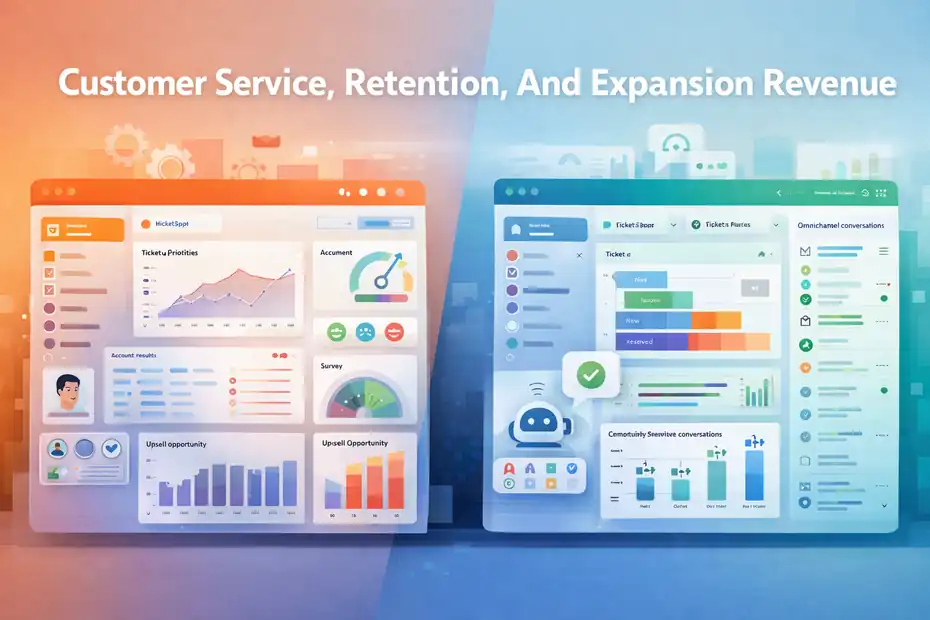
HubSpot presents service as part of the same customer platform used by marketing and sales. Its comparison pages and product materials emphasize features like ticketing, customer success workflows, health-related views, surveys, and other service-connected capabilities inside the broader CRM environment.
The revenue implication is simple: expansion gets easier when account history is not scattered. If support issues, onboarding delays, and customer feedback sit inside the same ecosystem your commercial team uses, account managers can act sooner.
That helps prevent churn and improves upsell timing.
For subscription or recurring revenue businesses, this is a real advantage. A company might lose more revenue from avoidable churn than from weak top-of-funnel performance.
In that case, HubSpot’s full-funnel customer view can outperform a cheaper CRM because it protects existing revenue as well as new revenue.
Freshworks Is Often Better Value For Service-Led SMB Operations
Freshworks has strong service credentials across its wider product line, including Freshdesk and other customer service tools, and it actively positions its customer service software around omnichannel support and AI-enhanced workflows.
That matters for businesses where service efficiency is a growth factor, but not necessarily something that needs a premium all-in-one commercial operating system.
A regional home services business, ecommerce support team, or smaller B2B company may get exactly what it needs from the Freshworks ecosystem at a much lower total cost.
There is also a practical point here: if your service team mostly needs fast ticket handling, SLA visibility, and decent automation, Freshworks can be very compelling.
You do not always need deep revenue orchestration to improve retention. Sometimes you just need quicker resolution and better agent workflow.
Which Platform Drives More Retention Revenue
Customer retention is financially powerful. Freshworks itself cites G2-based data that increasing retention by just 5% can boost profits by 25% to 95%, which is directionally consistent with why service tooling matters so much.
So which platform wins? My answer is conditional:
- HubSpot wins when retention and expansion depend on shared customer data across marketing, sales, and service.
- Freshworks wins when you need service efficiency and acceptable cross-team visibility without enterprise-style spend.
If your revenue model is heavily recurring, this section deserves more weight than most buyers give it. A cheaper CRM that saves money upfront can still lose the overall revenue battle if retention coordination remains weak.
Automation, Reporting, And AI
Automation is where software promises a lot and often disappoints. The best platform is not the one with the most automation buttons.
It is the one your team can confidently build, maintain, and trust.
Freshworks Gives Many Teams The Right Amount Of Automation
Freshworks includes automation and AI-oriented add-ons, with Freddy AI appearing across its product family. Its CRM and related products are clearly moving toward AI-assisted workflows, but the overall product experience still tends to feel more approachable for smaller teams.
That matters because lightweight automation can outperform sophisticated automation that nobody maintains.
I have seen teams get more practical value from simple lead routing, task reminders, deal stage triggers, and basic scoring than from a giant automation architecture that becomes fragile after two staff changes.
Freshworks is usually enough for teams that want to automate repetitive actions without turning the CRM into an operations project. That balance is underrated.
Good automation should reduce friction, not create a dependency on one admin who understands the system better than everyone else.
HubSpot Is Better For Mature Workflow Design And Revenue Reporting
HubSpot has spent years building around connected hubs, lifecycle stages, reporting, and AI. Its current platform messaging continues to emphasize unified data, AI-powered workflows, and cross-functional growth.
The real strength here is compounding visibility. A company can create workflows that move beyond sales reminders into full lifecycle orchestration: lead nurture, qualification, routing, task creation, deal updates, customer onboarding triggers, renewal reminders, and service-based interventions.
When reporting sits on top of that system, leadership gets closer to seeing how operational actions affect revenue outcomes.
That said, advanced workflows only help when your process is already defined. HubSpot can magnify a strong operating model, but it can also expose a weak one.
If your lifecycle stages are messy and your ownership rules are unclear, more automation may just scale confusion.
AI Only Drives Revenue When Data Hygiene Is Strong
Both vendors are pushing AI, and HubSpot’s public materials show a strong commitment to AI across its customer platform. Freshworks is doing the same through Freddy AI and AI-enhanced product positioning.
But I want to cut through the hype. AI does not fix broken CRM discipline. If your data is incomplete, duplicate-heavy, or inconsistently updated, AI will simply generate faster nonsense.
The real sequence is:
- Clean records.
- Clear stages and ownership.
- Reliable activity capture.
- Useful automation.
- AI on top.
In many cases, Freshworks gets teams to steps 1 through 4 faster. HubSpot can extract more value at step 5 when the business is ready for deeper orchestration. That is the honest trade-off.
Common Mistakes Buyers Make In This Comparison
This decision goes wrong in very predictable ways. Most of them have nothing to do with missing features.
Mistake One Is Buying For Future Complexity Instead Of Current Execution
A lot of businesses choose software for the company they hope to become in three years, not the company they are now. That sounds strategic, but it often backfires.
When the platform is too advanced for the current team, adoption falls, setup drags, and revenue improvement gets delayed.
If your team is still building repeatable sales process, Freshworks may outperform HubSpot simply because it gets used. A lighter system with 80% of what you need can beat a richer system operating at 30% adoption.
That is not a software opinion. That is just operational reality.
Mistake Two Is Underestimating HubSpot’s Expansion Cost
HubSpot makes it easy to start. The mistake is assuming it stays that simple once the company wants better reporting, automation, service coordination, or more robust growth infrastructure.
HubSpot’s pricing pages make clear that higher-value tiers and additional platform depth come with materially higher cost.
That can still be worth it. But businesses should model the likely 12-month reality, not the entry-point reality.
Mistake Three Is Overvaluing Feature Count And Undervaluing Team Behavior
The platform that drives more revenue is usually the one that improves daily behavior. Faster follow-up. Cleaner notes. Better lead routing. More reliable dashboards. Better handoffs. Stronger retention action.
Those are behavior wins. Not brochure wins.
I recommend asking every stakeholder one blunt question: “What will this platform help our team do consistently every week that we do poorly today?” The answer to that question is often more useful than 20 pages of feature comparison.
Which One Should You Choose?
There is no single universal winner in a freshworks vs hubspot comparison. There is, however, a clearer winner for specific revenue models.
Choose Freshworks If You Want Faster ROI On A Leaner Budget
Freshworks is the better choice for many SMBs, founder-led teams, and sales-led companies that want strong CRM fundamentals without premium-platform pricing.
Its lower entry pricing, usable sales setup, and generally lighter operational footprint make it easier to roll out and justify.
I would lean Freshworks if your business looks like this:
- You have a small or midsize sales team
- Marketing is relatively simple
- You need pipeline visibility fast
- You care a lot about software efficiency
- You do not need heavy attribution or complex lifecycle orchestration yet
In this scenario, Freshworks often drives more revenue because it improves execution without overwhelming the team or the budget.
Choose HubSpot If Revenue Depends On Full-Funnel Coordination
HubSpot is the better choice when your growth model depends on one connected platform across marketing, sales, and service.
Its unified customer platform, broader hub ecosystem, and stronger positioning for attribution and lifecycle management make it more powerful for businesses with more sophisticated go-to-market operations.
I would lean HubSpot if your business looks like this:
- Marketing generates a meaningful share of pipeline
- Sales needs campaign and engagement context
- Leadership cares deeply about attribution
- Retention and expansion rely on shared customer data
- You can afford a more strategic software investment
In that environment, HubSpot may cost more, but it can absolutely drive more revenue because it improves the whole commercial system.
My Bottom-Line Recommendation
If I were advising a smaller business that mainly wants a practical CRM to help reps move faster and management forecast better, I would usually recommend Freshworks first.
If I were advising a scaling company where marketing, sales, service, and reporting all need to connect tightly to improve acquisition efficiency and customer lifetime value, I would usually recommend HubSpot first.
So, which drives more revenue?
Freshworks often drives more efficient revenue for lean teams.
HubSpot often drives more compound revenue for integrated growth teams.
That is the real answer. Not glamorous, but honest.
Final Verdict
The best freshworks vs hubspot comparison is not the one that declares a universal winner. It is the one that helps you match software to revenue mechanics.
Freshworks is usually the better buy when you need affordability, faster adoption, and strong sales execution without extra complexity. HubSpot is usually the better buy when your revenue engine depends on connected marketing, sales, service, and attribution working together.
If your biggest growth problem is execution friction, Freshworks may drive more revenue.
If your biggest growth problem is coordination friction, HubSpot may drive more revenue.
That is the decision I would make around. Not who has the louder brand, but which platform removes the most expensive bottleneck in your path to growth.
FAQ
What is the main difference in a freshworks vs hubspot comparison?
The main difference lies in complexity and ecosystem depth. Freshworks focuses on simplicity, affordability, and fast adoption for sales teams, while HubSpot offers a more integrated platform connecting marketing, sales, and service. The right choice depends on whether your business prioritizes ease of use or full-funnel coordination.
Which platform is better for small businesses, Freshworks or HubSpot?
Freshworks is often better for small businesses because it offers lower pricing, quicker setup, and easier usability. HubSpot can still work well, but costs increase as you scale. For smaller teams focused on sales execution, Freshworks typically delivers faster return on investment.
Does HubSpot drive more revenue than Freshworks?
HubSpot can drive more revenue for businesses that rely on marketing, automation, and detailed customer journeys. However, Freshworks may generate better results for simpler sales processes by improving speed and adoption. The platform that aligns with your workflow usually produces better revenue outcomes.
Is Freshworks easier to use than HubSpot?
Yes, Freshworks is generally easier to use, especially for teams without technical experience. Its interface and setup process are more straightforward, allowing quicker onboarding. HubSpot offers more advanced features but often requires more time and effort to fully implement and manage.
Which CRM is more cost-effective in the long term?
Freshworks is typically more cost-effective due to lower subscription costs and simpler scaling. HubSpot can become expensive as you add features and users, but it may justify the cost if your business benefits from advanced automation, reporting, and integrated marketing capabilities.

I’m Juxhin, the voice behind The Justifiable.
I’ve spent 6+ years building blogs, managing affiliate campaigns, and testing the messy world of online business. Here, I cut the fluff and share the strategies that actually move the needle — so you can build income that’s sustainable, not speculative.
Related posts:
 How to Start a Blog and Make Money
 Push Traffic Sources: How to Maximize Your ROI with the Best Networks
 How to Set Revenue Goals: Tips for Startups
 Referral Program Ideas: 10 Innovative Ways to Boost Customer Engagement
 Setting Up a Blog for Profit: Expert Step-by-Step Guide
 Freshsales CRM Pricing Comparison: Save More on Upgrades