
Table of Contents
Some links on The Justifiable are affiliate links, meaning we may earn a small commission at no extra cost to you. Read full disclaimer.
Jungle Scout honest review for FBA sellers starts with one uncomfortable truth: no Amazon research tool can give you perfect certainty. What it can do is help you make better bets, faster, with less guesswork.
That is where Jungle Scout still earns attention in 2026. It is built around Amazon product research, keyword discovery, supplier sourcing, and seller analytics, while Amazon’s fee environment keeps getting tighter and less forgiving.
In this review, I’ll break down what Jungle Scout does well, where the data can mislead you, who should buy it, and who should save their money.
What Jungle Scout Is Really Built To Do
Jungle Scout is not magic product-finding software.
It is an Amazon intelligence platform that helps you estimate demand, evaluate competition, discover keywords, track rankings, review supplier signals, and monitor business performance from one ecosystem.
Why FBA Sellers Still Use It
For most FBA sellers, the appeal is simple: Jungle Scout keeps you from making blind inventory decisions. Its web app and browser extension are built to help you research products on Amazon, estimate sales, review pricing trends, and calculate profit projections while you browse.
That matters because Amazon does not hand new sellers a clean view of market demand before launch.
In practical terms, Jungle Scout is strongest when you are trying to answer questions like these: Is this niche too crowded? Are these top listings moving enough units? Is the price stable? Do the margins still work after Amazon fees?
Which keywords are worth targeting first? Those are not glamorous questions, but they are the ones that protect your cash.
I believe this is why the platform still holds its place. It stays focused on the commercial core of FBA: picking the right products, validating demand, and protecting profitability. That is more useful than a bloated toolset that looks impressive but slows you down.
This is also why Jungle Scout is often easier for beginners to adopt than broader seller suites. That ease of use is not just a comfort feature; it reduces decision fatigue.
What It Does Not Do For You
Here is the part many reviews soften too much: Jungle Scout does not “find winners” for you. It estimates. It surfaces signals. It shortens research time. But it does not know your sourcing costs, your packaging constraints, your ad efficiency, your launch execution, or whether your listing will convert.
That distinction matters because many first-time sellers confuse data visibility with business validation. A niche can look attractive in the extension, yet still fail after freight, PPC, refunds, storage, and price compression.
Amazon’s 2026 US fee updates and the fuel and logistics surcharge only make this more important. A product that looked healthy with thin margins can quickly become mediocre once those costs hit.
So the honest framing is this: Jungle Scout is a decision-support tool, not a guarantee engine. If you use it like a scoreboard, it helps. If you use it like a fortune teller, it will disappoint you.
From what I’ve seen, the sellers who get the best value are the ones who already understand that data estimates need manual judgment layered on top.
How Jungle Scout Works In Real Research
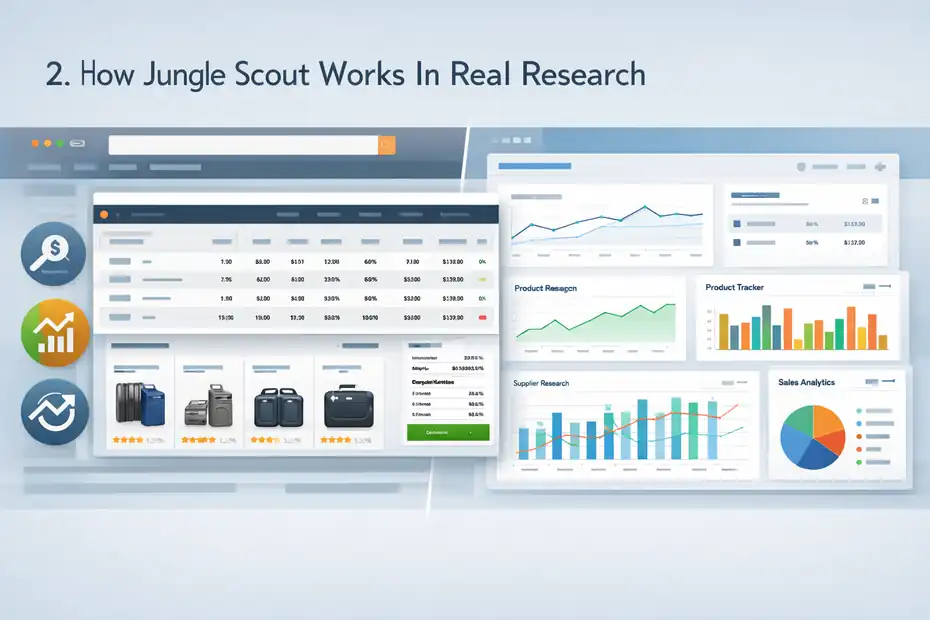
At a practical level, Jungle Scout combines a browser extension with a web application.
The extension helps you evaluate products and search results directly on Amazon, while the web app handles deeper research and ongoing tracking.
The Browser Extension Experience
The extension is one of Jungle Scout’s biggest strengths because it shortens the distance between browsing and analysis.
You can view demand signals, competition data, and profit projections directly on Amazon product pages or search results pages instead of copying ASINs into a separate workflow.
That sounds small, but it changes how research feels. Imagine you are looking at a niche like travel bottle organizers. Instead of manually checking ten listings and guessing momentum, you can scan estimates, prices, and quick metrics while the products are in front of you.
That makes early-stage filtering much faster. You spend less time on categories that are clearly bad and more time on the ones worth serious validation.
I recommend treating the extension like a triage tool. Use it to eliminate weak ideas quickly, not to make your final decision. Its best use case is speed: cutting a pool of 50 ideas down to five.
Then you go deeper inside the web app, review keyword patterns, inspect supplier options, and sanity-check the business model. That workflow feels much more reliable than trying to crown a product winner from extension data alone.
The Web App Workflow
The web app is where Jungle Scout becomes a full operating system for early and mid-stage Amazon research. According to Jungle Scout’s support and product pages, the platform centers on product research, keyword research, listing and rank-related workflows, supplier discovery, and seller performance tracking.
For a newer seller, that matters because product selection rarely fails in one obvious place. Usually, it fails from stacked small mistakes: weak keyword coverage, underpriced freight assumptions, a crowded review landscape, or a listing angle that looks generic.
The web app gives you a way to inspect several of those risk areas without bouncing across five unrelated tools.
For a more established seller, the value shifts. You are less interested in “what should I sell?” and more interested in “where is the margin leaking?” Jungle Scout’s Sales Analytics page positions the tool as a financial command center that helps sellers see profits, fees, and cost-saving opportunities in real time.
With fee changes and surcharges in play, I think that kind of visibility is more valuable now than it was a few years ago.
Product Research: Where Jungle Scout Is Strongest
This is the area where Jungle Scout still feels most natural.
Its product database, opportunity-focused research tools, and extension workflow are built around finding product ideas with demand and manageable competition.
How Good The Opportunity Hunting Really Is
Jungle Scout describes its product research tools as a way to find high-demand, low-competition opportunities and analyze sales trends, pricing, and competitor performance. That promise is directionally useful, but you should read it like a framework, not a shortcut.
In reality, Jungle Scout is very good at surfacing patterns. You can spot price clustering, seasonal behavior, review saturation, and whether top sellers seem to dominate the market. That is enough to save you from a lot of beginner mistakes.
For example, if a niche has five entrenched listings with thousands of reviews and aggressive pricing, you do not need a perfect sales estimate to know the hill is steep.
Where sellers get into trouble is assuming the software’s positive-looking snapshots equal a durable business. A niche can show demand and still be a bad FBA bet because of fragility: patent risk, bundle complexity, breakability, returns, regulatory headaches, or margin erosion after launch.
Jungle Scout helps you see the market surface. It does not inspect every risk hidden below it. That is not really a flaw in the product; it is just the honest limit of marketplace intelligence.
My Honest Take On Sales Estimates
This is the question most sellers actually care about: Can you trust Jungle Scout’s sales estimates? My answer is yes, but only as directional planning data.
Jungle Scout markets its platform around Amazon intelligence, sales estimates, historical depth, and daily refresh cadence for brand-side users, and similar estimate-driven logic powers its seller tools.
That does not mean every number is exact. No third-party Amazon tool has total visibility into every seller’s backend. These tools model demand based on marketplace signals. In practice, I would use estimates for relative judgment, not accounting precision.
If Listing A appears to move far more units than Listing B, that is useful. If the estimate says 612 units and reality is 540 or 700, your decision probably does not change much.
The mistake is using estimated revenue like bankable revenue. I suggest stress-testing every idea. Run a conservative model, a realistic model, and a painful model. Then layer in Amazon’s referral fees, current FBA fees, and the announced 2026 surcharge structure.
If the product only works under an optimistic estimate, it probably does not work. That is the kind of discipline that turns Jungle Scout from “interesting software” into an actually profitable research habit.
Keyword Research And Listing Strategy
After product validation, keyword coverage is the next place where Jungle Scout can pull real weight.
Its Keyword Scout is positioned as an Amazon keyword research tool for uncovering opportunities across organic and paid search performance.
What Keyword Scout Gets Right
Keyword Scout is useful because it does not just help you find phrases; it helps you think in search intent clusters. Jungle Scout highlights organic versus sponsored keyword views and shows competitive keyword insights, which is valuable because Amazon traffic is rarely driven by one perfect phrase.
It usually comes from a mix of main, secondary, and long-tail terms.
Let me make that concrete. Say you are launching a reusable meal prep container set. Your obvious keyword is the head term, but profitable traffic may also come from adjacent purchase-intent phrases tied to size, leak-proof performance, microwave use, stackability, or lunch prep.
A good keyword tool helps you map the buying language, not just the highest-volume phrase. That is where Jungle Scout is genuinely helpful.
I also like that Jungle Scout positions keyword data in relation to both SEO and advertising decisions. That matters because an Amazon listing is not just written for ranking; it is written to convert traffic you may be paying for. Keyword relevance without conversion alignment can waste money fast.
For many sellers, that bridge between search and commercial intent is more valuable than raw volume alone.
Where It Still Needs Human Judgment
Even with good keyword tooling, listings do not optimize themselves. Jungle Scout can help you identify terms and watch rank movement, but it cannot fully understand the emotional or visual reasons shoppers choose one product over another.
That still comes from reading the SERP, studying reviews, and seeing what objections buyers keep repeating.
This is why I never recommend writing a listing by metrics alone. If the top listings all emphasize a feature you do not have, forcing the same keyword angle into your title will not save you.
Likewise, if buyers care most about giftability, cleanup, durability, or a very specific use case, you need that reflected in the page experience, not just the backend keyword strategy. Jungle Scout supports the research, but conversion still comes from positioning.
So yes, the keyword tools are good. But the sellers who get the best outcomes are the ones who use the data to guide messaging, not replace messaging. That is a subtle difference, and I think it is one of the biggest separators between mediocre FBA launches and strong ones.
Supplier Research And Sourcing Validation
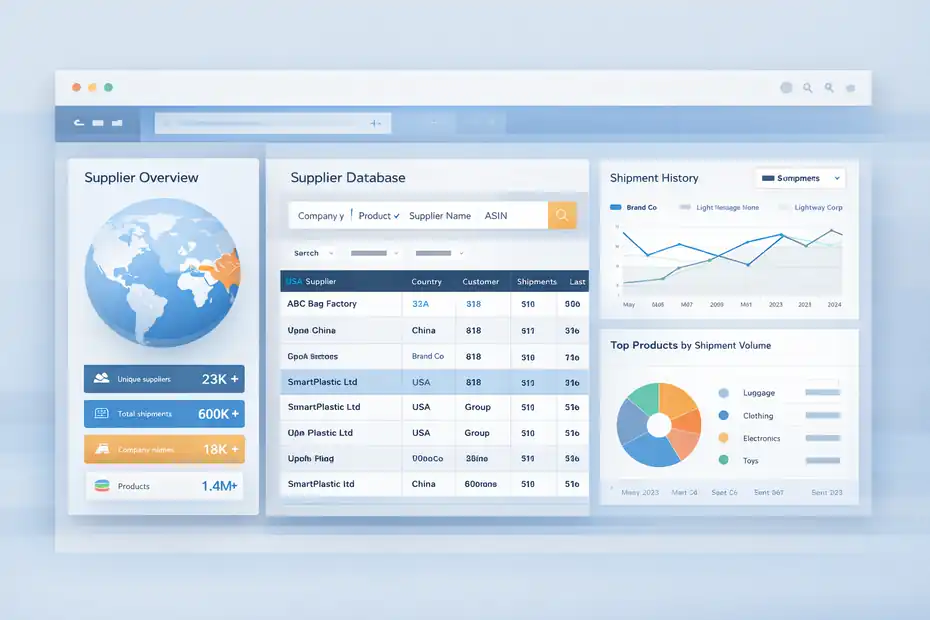
This is one area where Jungle Scout deserves more credit than it usually gets.
Its Supplier Database is built around searchable supplier records, shipment history signals, and the ability to search by product, company, supplier name, or ASIN.
Why Supplier Data Is More Useful Than It Looks
A lot of sellers focus almost entirely on demand research and forget that sourcing quality often determines whether the business survives. Jungle Scout’s supplier data can help you move from “this product might sell” to “can I source this with less guesswork?” That is a major difference.
The ASIN-based angle is especially practical. Jungle Scout says sellers can use Supplier Database to try to identify suppliers tied to products or competitors they are researching.
That does not mean you can perfectly clone a competitor’s supply chain, but it can shorten the path to qualified conversations. Instead of messaging random factories blindly, you can begin with suppliers that already appear relevant to the category.
For newer sellers, this can save weeks of noise. You still need to verify samples, negotiate MOQs, inspect packaging, and confirm compliance. But the database helps you start with better sourcing leads than a cold search engine rabbit hole.
In my opinion, that makes it one of the more underrated parts of Jungle Scout for serious private-label sellers.
The Limitation You Should Not Ignore
Here is the honest drawback: supplier data is a starting point, not a trust guarantee. A shipment record or searchable supplier profile does not mean the factory is ideal for your exact product spec, quality expectations, or production timeline. It also does not replace inspections, sample testing, or contract clarity.
I recommend using Supplier Database for narrowing, not choosing. Build a short list, request comparable quotes, test communication quality, and compare how well each supplier handles detail.
A supplier that is slightly more expensive but clearer and more consistent can easily be the cheaper decision six months later. That is the kind of lesson FBA sellers usually learn the hard way.
So yes, Jungle Scout helps with sourcing. But no, it does not solve sourcing. I know that sounds picky, yet that distinction is exactly where a lot of expensive mistakes begin.
Sales Analytics, Profit Tracking, And Why This Matters More In 2026
For active sellers, Jungle Scout’s Sales Analytics is one of the strongest reasons to keep paying after launch.
Jungle Scout describes it as a real-time sales data and financial command center that helps sellers see profits instantly, keep track of fees, and find cost-saving strategies.
Why Post-Launch Visibility Matters
Many FBA sellers obsess over product research and then go strangely blind after launch. They watch revenue, but not contribution margin. That is dangerous because revenue can rise while profit quietly collapses. Jungle Scout’s analytics positioning is valuable precisely because it focuses attention on financial health, not vanity growth.
And right now, Amazon’s fee structure gives you less room to be casual. Amazon announced 2026 US FBA fee increases averaging about $0.08 per unit and a 3.5% fuel and logistics-related surcharge starting April 17, 2026, applied across FBA fulfillment fees. Those changes are not theoretical; they hit real margin.
That means a tool that helps you watch profits, fees, and cost behavior is no longer just a convenience for scaling brands. It is part of staying sane.
If your margin swings are narrow, even a modest fee shift can change reorder decisions, coupon strategy, or whether a product deserves more ad spend. Jungle Scout is useful here because it keeps those conversations anchored in numbers instead of gut feel.
Who Gets The Most Value From Analytics
If you only have one product and very low order volume, Sales Analytics may feel nice rather than essential. You can still manage plenty with a spreadsheet and discipline. But once you have several SKUs, refunds, ad spend, fee changes, and stock timing issues stacking together, manual tracking gets messy fast.
I’d put it this way: Beginners usually buy Jungle Scout for research, but experienced sellers often keep it for operational visibility. That shift makes sense. Product research gets you into the game; financial visibility keeps you from bleeding out after you enter.
This is also where an honest review needs nuance. Jungle Scout can be “worth it” for completely different reasons depending on your stage. If you are pre-launch, you care about opportunity quality. If you are established, you care about control. The tool can serve both, but not in the same way.
Pricing, Value, And Whether The Cost Makes Sense
Pricing is one of the hardest parts to review cleanly because software value depends on seller stage.
Jungle Scout’s official pricing page shows multiple plans for new and growing sellers under its Catalyst offering, alongside enterprise products for larger brands.
Is Jungle Scout Expensive For What It Offers
My honest answer: it is not cheap, but it is usually cheaper than a bad product decision. That sounds like a cliché, but for FBA it is true. One weak inventory order can cost far more than a year of software.
Where cost becomes a problem is when sellers subscribe too early or too passively. If you are still at the “maybe I want to try Amazon someday” phase, you probably do not need a paid suite yet.
But if you are actively validating niches, checking supplier viability, and building a serious shortlist, a focused research platform can absolutely justify itself.
In my experience, the worst software ROI comes from indecisive usage. Sellers pay for data but do not build a repeatable process. They log in, browse around, feel informed, and still launch based on emotion. That is not Jungle Scout failing. That is research without a framework.
Jungle Scout Vs Broader Alternatives
If you compare positioning, Jungle Scout remains heavily Amazon-centered, while Helium 10 publicly markets itself across Amazon, Walmart, and TikTok Shop seller workflows. Helium 10’s official pricing also shows a broader range of plan tiers and costs.
That difference matters because some sellers do not want the most expansive toolkit. They want the cleanest path to Amazon product research and operational clarity. In that case, Jungle Scout can feel less overwhelming.
On the other hand, if you want a wider multichannel ecosystem or deeper stack complexity, you may find broader suites more appealing.
So the honest value judgment is this: Jungle Scout is not automatically the “best” tool. It is the better fit for sellers who want an Amazon-first workflow with lower cognitive clutter.
If that is you, the pricing can make sense. If you mainly want a giant toolbox because giant toolboxes feel powerful, another platform may scratch that itch better.
The Biggest Mistakes Sellers Make With Jungle Scout
A good review should not just grade the software. It should show where users create their own problems.
And with Jungle Scout, a few mistakes come up over and over.
Mistake 1: Treating Estimates Like Certainty
The first mistake is obvious but expensive. Sellers see an attractive sales estimate and stop asking harder questions. They forget to model fees, landed cost, return risk, and the real ad spend needed to compete. Jungle Scout provides signals; it does not remove uncertainty.
A better workflow looks like this: Estimate demand, check price stability, review review-count intensity, inspect listing quality, validate supplier practicality, then run a conservative margin model. That extra discipline is usually where the real money is made. Most of the time, great FBA decisions do not come from one insight. They come from layered caution.
Mistake 2: Chasing “Low Competition” Without Context
The phrase “low competition” tricks a lot of people. Sometimes a niche looks open because demand is weak, the use case is unclear, or the product is annoying to source.
Other times it looks open because the leaders are sloppy and the opportunity is real. Jungle Scout can show the surface pattern, but you still need human judgment to interpret why the pattern exists.
I suggest reading top negative reviews in every niche you research. That one habit often tells you more than a dashboard alone. You find out what customers hate, what sellers keep getting wrong, and whether there is room for a product angle that is actually differentiated.
Jungle Scout helps identify the market. Review mining helps you understand it.
Mistake 3: Paying For Features You Never Operationalize
The last mistake is buying a serious tool without a serious routine. If you do not set criteria for product screening, keyword grouping, supplier vetting, and profit checks, you will underuse the platform. Then it feels overpriced even if the product itself is solid.
I recommend a simple weekly structure: one session for new niches, one for deep validation, one for keyword mapping, and one for profit review on live SKUs. That turns Jungle Scout into a system instead of a subscription. And systems are where ROI actually lives.
Customer Sentiment And Reputation Signals
No honest review should ignore what customers say after paying.
Trustpilot currently shows Jungle Scout reviews with many positive recent comments, including users mentioning value and support, though reviews naturally include occasional complaints too.
What The Reviews Suggest
The broad signal from public review pages is that many users do find Jungle Scout useful and good value, especially for Amazon selling workflows. That does not prove the tool is perfect, but it does support the idea that the product delivers enough value for a substantial base of paying users.
At the same time, I never treat review platforms as the final truth. Some users are beginners who expected instant wins. Some are advanced sellers with very specific needs. Some only interact with billing or support.
So reviews are best read as reputation context, not as a substitute for matching the tool to your stage.
That is why my own verdict stays grounded in use case. Jungle Scout looks strongest for sellers who want focused Amazon research and operational support without learning a sprawling all-in-one platform. The public sentiment seems consistent with that positioning.
Final Verdict: Is Jungle Scout Worth It For FBA Sellers?
Jungle Scout is a good product, but not for the reasons hype-heavy reviews usually push. It is not worth buying because it promises secret winners.
It is worth buying because it helps you make fewer sloppy decisions across research, keyword planning, supplier vetting, and profit tracking.
Who Should Buy It
You should seriously consider Jungle Scout if you are an Amazon-first seller who wants a cleaner workflow for product research and ongoing business visibility. It is especially useful if you are actively validating products, comparing supplier options, or trying to keep tighter control over fees and profitability.
In 2026, with Amazon costs staying important, that operational visibility matters more than ever.
It also makes sense for sellers who feel overwhelmed by broader tool ecosystems. Jungle Scout’s focused structure is part of its value. Sometimes the best software is not the one with the most buttons. It is the one you will actually use every week.
Who Should Skip It
You should probably skip Jungle Scout if you are not yet serious about launching, if you want certainty instead of estimates, or if you already know you need a much broader multichannel platform.
You should also skip it if you are the type of seller who pays for data but never builds a repeatable research framework. In that situation, almost any tool will feel disappointing.
My final opinion is simple: Jungle Scout is worth it for disciplined FBA sellers, not hopeful gamblers. Use it to narrow risk, validate ideas, and monitor profit. Do not use it as a substitute for judgment. That is the real truth behind the data, and honestly, that is exactly how a good Amazon tool should be used.
FAQ
Is Jungle Scout accurate for FBA sellers?
Jungle Scout is generally accurate for estimating sales trends and demand, but it should be used as directional data rather than exact numbers. It relies on algorithms, not Amazon’s internal data, so small variations are normal. Smart sellers use it alongside margin calculations and market validation.
Is Jungle Scout worth it for beginners?
Jungle Scout can be worth it for beginners who are serious about launching on Amazon FBA. It simplifies product research and reduces guesswork, but it does not guarantee success. Beginners still need to validate suppliers, calculate costs, and understand competition before making decisions.
What are the main features of Jungle Scout?
Jungle Scout includes product research tools, keyword research, supplier database access, and sales analytics. These features help sellers evaluate demand, track competition, and monitor profitability. The platform is designed to support both pre-launch research and post-launch business management within Amazon.
Can Jungle Scout find winning products automatically?
Jungle Scout cannot automatically find winning products. It provides data and insights to help you evaluate opportunities, but success depends on your research process, sourcing decisions, and listing strategy. It is a decision-support tool, not a guarantee of profitable product selection.
How does Jungle Scout compare to other Amazon tools?
Jungle Scout focuses on simplicity and Amazon-specific workflows, making it easier for many sellers to use. Compared to broader tools, it offers a cleaner interface but fewer advanced features. The right choice depends on whether you prefer a focused research tool or a more complex all-in-one platform.

I’m Juxhin, the voice behind The Justifiable.
I’ve spent 6+ years building blogs, managing affiliate campaigns, and testing the messy world of online business. Here, I cut the fluff and share the strategies that actually move the needle — so you can build income that’s sustainable, not speculative.
Related posts:
 How to Use Helium 10 for Product Research Like a Pro
 Jungle Scout Review For Private Label Beginners: Real Profit Insights
 Jungle Scout Review For New Amazon Sellers: Start Or Skip It?
 Jungle Scout Review For Small Amazon Brands: Scale Or Stall?
 15 Trending Dropshipping Products That Sell Right Now
 Dropshipping Guide: Build a Store That Actually Sells