
Table of Contents
Some links on The Justifiable are affiliate links, meaning we may earn a small commission at no extra cost to you. Read full disclaimer.
When I first decided to sell my ecommerce business, I quickly realized that what buyers truly pay for isn’t just the revenue—it’s the value of your assets. Your brand reputation, customer lists, systems, and even your email database can make or break your sale price.
But knowing how to sell ecommerce business assets the right way can mean the difference between a quick, undervalued sale and a lucrative exit that rewards all your hard work.
Let’s break down exactly how to prepare, value, and sell your ecommerce business assets for maximum returns.
Identify Which Ecommerce Assets Hold the Most Value
Before you sell your ecommerce business, the first step is understanding what makes it valuable to a buyer.
Buyers aren’t just purchasing your products—they’re buying your brand, systems, and the trust you’ve built over time.
Audit Tangible and Intangible Assets Before Listing
Think of this as a deep clean of your business. You want to identify every piece of value that comes with your store.
Tangible assets include things like:
- Inventory currently in stock
- Packaging and fulfillment equipment
- Domain name and website hosting
Intangible assets are often where the real value lies:
- Brand reputation and customer loyalty
- Email lists and social media followings
- Supplier agreements and fulfillment systems
In my experience, sellers often underestimate the power of their intangible assets. A buyer values systems that make revenue predictable—like a strong SEO footprint or automated email campaigns.
Determine Which Assets Drive Profitability and Growth
Not all assets are equal. Some directly drive revenue, while others simply exist. Focus on what keeps your business growing even when you’re not working on it daily.
Ask yourself:
- Which products or categories have the best profit margins?
- What channels (email, ads, organic search) bring the most repeat customers?
- Which partnerships or automations save you time and cost?
If your customer acquisition cost is low and retention is high, that’s a huge selling point. It signals sustainability, which buyers pay a premium for.
Classify Assets That Increase Buyer Confidence
Buyers are naturally risk-averse. The more confidence you can provide, the higher your potential valuation.
Here’s what tends to impress buyers most:
- Reliable revenue streams (like subscription products)
- Clear documentation of business operations
- Transferable relationships with suppliers and service providers
I’ve noticed that businesses with transparent data dashboards—like Shopify analytics or Google Looker Studio reports—instantly earn trust. Buyers love clarity.
Exclude Non-Transferable or Low-Value Assets
It’s tempting to throw everything into the deal, but not every asset adds value. Some can even complicate the sale.
Avoid including:
- Personal social media accounts or private email lists
- Tools under personal licenses
- One-off supplier contracts tied to your name
Instead, focus on assets that can be seamlessly transferred. The smoother the transition looks, the more attractive your ecommerce business becomes.
Accurately Value Your Ecommerce Business Assets
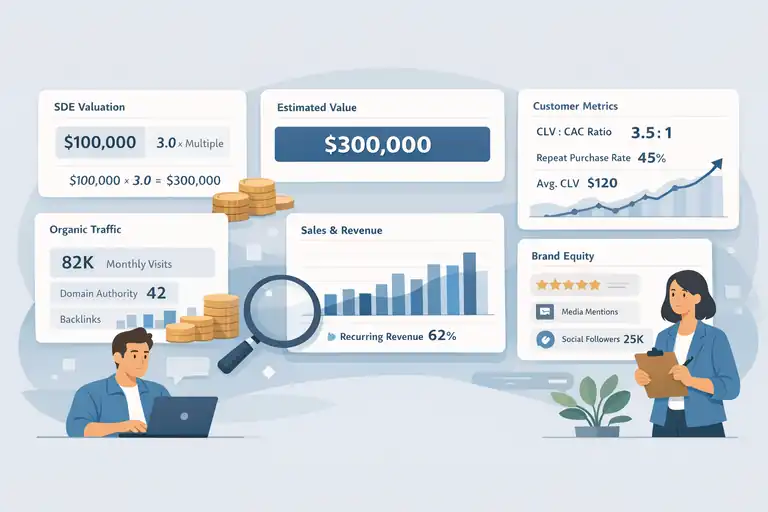
Valuing your business isn’t guesswork—it’s data-driven storytelling. You’re showing a buyer not just what you’ve earned, but what they can earn next.
Use Financial Data to Determine Fair Market Value
Start with a clear, simple valuation method. The most common for ecommerce is the Seller’s Discretionary Earnings (SDE) multiple—typically between 2.5x and 4x your annual profits.
To calculate:
- Take your net profit.
- Add back owner-related expenses (like salary or travel).
- Multiply by an industry-appropriate multiple.
For example, if your SDE is $100,000 and your multiple is 3x, your business is worth around $300,000. Keep in mind: recurring revenue and diversified traffic sources can push that multiple higher.
Factor in Customer Lifetime Value (CLV) and Retention Metrics
Buyers love predictable income. If you can show strong repeat customer behavior, your valuation climbs.
Track metrics like:
- Average CLV (total profit per customer)
- Repeat purchase rate
- Customer acquisition cost (CAC)
A CLV:CAC ratio of 3:1 or better is gold. If you can demonstrate that your business consistently generates profits from returning customers, it’s seen as lower-risk and higher-value.
Account for Brand Equity, SEO, and Digital Footprint
Your online visibility is an asset in itself. A website ranking for high-intent keywords can significantly raise your valuation.
Consider including:
- Organic traffic reports from Google Search Console
- Backlink profiles and domain authority
- Social proof—reviews, media mentions, and influencer collaborations
In one sale I witnessed, a buyer increased their offer by 15% after seeing that the store had strong SEO rankings and a five-year-old domain. Digital reputation matters.
Avoid Common Valuation Mistakes That Lower Sale Price
Many sellers accidentally tank their own valuation by making emotional or rushed decisions.
Here’s what to watch out for:
- Overvaluing unsold inventory or personal labor
- Ignoring seasonality in financial projections
- Mixing personal and business expenses in accounting
Keep your financials clean, separated, and supported with verifiable data. A buyer will almost always uncover inconsistencies during due diligence.
Optimize Your Store Before Selling
Think of this step like staging a house for sale. You’re not changing what you own—you’re presenting it in its best possible light.
Streamline Operations and Automate Key Systems
The less your buyer has to manage manually, the higher your sale price climbs.
Focus on:
- Automating fulfillment with tools like ShipStation.
- Using CRM systems to manage customers efficiently.
- Setting up accounting automations in QuickBooks.
A buyer is paying for ease of ownership. A fully systemized ecommerce business looks more like an investment and less like a job.
Clean Up Product Listings and Improve Store Design
Visual appeal sells, both in products and in businesses. Review your store with a buyer’s eyes.
- Fix broken links and outdated listings.
- Update product photography for consistency.
- Simplify navigation and ensure your checkout is friction-free.
Even minor design improvements—like faster load times or clear return policies—can raise perceived value. According to Shopify data, a one-second delay in page speed can reduce conversions by up to 7%.
Eliminate Debt, Liabilities, and Outdated Inventory
Buyers don’t want financial baggage. Before you sell:
- Pay off outstanding debts if possible.
- Clear out slow-moving or obsolete stock.
- Disclose any liabilities transparently.
When I helped a client remove $12,000 worth of dead inventory, it immediately increased their offer by 10%. Buyers appreciate a clean slate.
Strengthen Supplier Relationships for Smooth Handover
Finally, don’t overlook your supplier network. A buyer wants reassurance that the supply chain will remain stable after transfer.
Here’s what helps:
- Secure long-term supplier contracts if possible.
- Introduce the buyer to key suppliers early.
- Document your ordering process step by step.
If your suppliers trust you, that trust can extend to the new owner. It’s a small gesture that creates a lot of post-sale peace of mind.
Expert Tip: The key to selling your ecommerce business for maximum value isn’t just numbers—it’s presentation. When every asset is documented, automated, and transferable, your business becomes irresistible to the right buyer.
Prepare Financial and Operational Documentation
Once you’ve optimized your store and know what you’re selling, the next step is preparing your financial and operational documents.
Think of this stage as creating a transparent “owner’s manual” for your ecommerce business—it’s what builds trust and speeds up the sale process.
Compile Accurate Financial Statements and Tax Records
Before you can sell your ecommerce business, your numbers need to tell a clear story. Buyers want to see reliable proof of performance.
Start with:
- Profit and loss (P&L) statements from the last 2–3 years
- Balance sheets and cash flow statements
- Tax returns and sales tax documentation
- Bank statements that match your financial records
If you use Shopify, Amazon, or WooCommerce, export detailed sales reports directly from your platform. I’ve seen sellers earn 10–15% higher offers simply because their financial data was organized and verifiable. It signals professionalism and lowers buyer risk.
Pro tip: Use accounting software like Xero to generate clean, audit-ready reports. Buyers love when they can easily verify figures without needing to dig.
Create an Asset Transfer List With Supporting Proof
Every asset included in your sale should be clearly listed and backed by documentation. This avoids confusion later and builds buyer confidence.
Your list should include:
- Domains, websites, and hosting access
- Product inventory with SKU-level details
- Software subscriptions and licenses
- Customer databases, email lists, and social media accounts
For each, add proof of ownership—such as invoices, contracts, or screenshots. One seller I worked with created a shared spreadsheet with expiry dates, renewal fees, and transfer instructions. The buyer said it was “the easiest acquisition experience they’d ever had.”
Document Processes, SOPs, and System Access Information
SOPs (Standard Operating Procedures) are your secret weapon for a smoother transition. They show how your business runs day-to-day—and reassure buyers that it won’t collapse once you step away.
Include written or video walkthroughs for:
- Order fulfillment and inventory management
- Customer support workflows
- Marketing campaigns and ad tracking
- Financial reconciliation and supplier ordering
If you’ve ever trained a new VA or team member, you likely already have these in rough form. Clean them up and store them in one folder. Buyers love when they can hit the ground running.
Use a Virtual Data Room to Share Assets Securely
A Virtual Data Room (VDR) is a secure digital folder where you store and share sensitive information. Think of it like a private Dropbox with permissions and audit tracking.
Popular choices include Google Drive, Dropbox Business, or professional platforms like DealRoom. The goal is simple: control what buyers can see while keeping your data protected.
Inside your VDR, organize files by category—financials, marketing, operations, legal, etc. Use clear naming conventions. This structure not only protects you legally but also makes your business look well-organized and trustworthy.
Choose the Right Platform or Broker to Sell
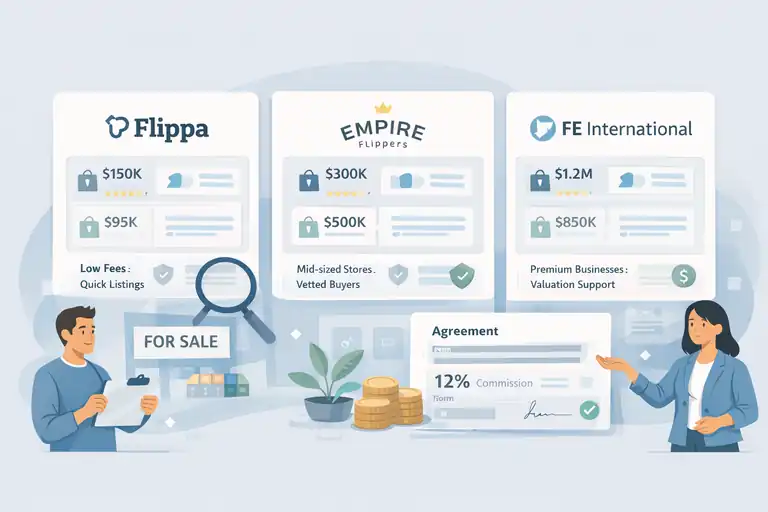
Finding the right channel to sell your ecommerce business is like choosing the right realtor for your house—you need someone who understands your market and buyer psychology.
Compare Marketplace Options for Selling Ecommerce Businesses
If you prefer a self-service route, online marketplaces can be a great starting point.
Top options include:
- Flippa (for smaller stores, usually under $250K valuation)
- Empire Flippers (for mid-size, established ecommerce businesses)
- FE International (for larger or premium sales)
Each platform comes with different fees and vetting processes. I recommend browsing recent listings to see what businesses like yours are selling for. It’s a quick reality check for your pricing expectations.
Work With Specialized Ecommerce Brokers for Higher Valuations
If your business earns over six figures in profit annually, consider using an ecommerce broker. They handle valuations, negotiations, and buyer screening for you.
Brokers like Quiet Light and Website Closers specialize in ecommerce and DTC (direct-to-consumer) brands. They often attract professional buyers, not just side hustlers.
Yes, they charge commission (usually 10–15%), but the trade-off is worth it for many sellers. A skilled broker can often negotiate a deal 20–30% higher than you might secure on your own.
Evaluate Commission Structures and Contract Terms
Before signing with a broker, read the fine print carefully.
Watch for:
- Exclusivity periods (how long you’re tied to the broker)
- Commission rates and minimum fees
- Marketing costs or hidden listing fees
A fair agreement is one where both sides are incentivized to close at the best possible price. I suggest negotiating for shorter exclusivity periods (60–90 days) if you’re testing the relationship.
Leverage Off-Market Buyers for Strategic Offers
Sometimes the best offers never make it to public marketplaces. Strategic buyers—such as competitors or private investors—often pay more because they see synergy value.
Reach out privately to:
- Complementary brands or suppliers
- Previous business partners or investors
- Private equity groups interested in ecommerce portfolios
One client I advised sold his niche pet supplies store off-market for 25% more than its listed value. Why? The buyer already sold to the same audience and saw instant expansion potential.
Market Your Ecommerce Assets Effectively
Even when selling a business, marketing still matters. The way you present your ecommerce store determines how buyers perceive its value.
Craft a Compelling Business Prospectus That Tells a Story
A business prospectus is like a sales brochure for your ecommerce business. It should blend data with narrative—facts with emotion.
Include:
- A concise business overview (what you sell and to whom)
- Financial highlights and growth trends
- Traffic breakdowns by source
- Key differentiators and opportunities for future growth
Don’t be afraid to include your story. Explain why you started, what you’ve achieved, and why you’re selling. It humanizes the deal and helps buyers connect with your brand.
Highlight Key Performance Metrics and Growth Potential
Buyers don’t just care about what your business is—they care about what it could become.
Include key stats such as:
- Revenue, profit, and growth rates (year-over-year)
- Customer retention and repeat purchase rates
- Average order value (AOV) and conversion rates
Show how simple improvements (like expanding to a new marketplace or optimizing ads) could lift revenue. Buyers love clear, realistic growth paths.
Showcase Operational Stability and Scalability
One of the most persuasive selling points is consistency. If your store runs smoothly without your daily involvement, that’s gold.
Demonstrate that you have:
- Reliable suppliers and fulfillment partners
- Stable traffic and repeat customers
- Automated systems that reduce dependency on the owner
If you can show the business is “hands-off” and scalable, your buyer pool widens dramatically. Many investors want passive or semi-passive ecommerce operations.
Use Buyer Psychology to Increase Perceived Value
At the end of the day, selling your ecommerce business isn’t just a financial transaction—it’s a negotiation of perception.
Use these simple psychology-driven tactics:
- Create scarcity by signaling active interest from multiple buyers.
- Emphasize predictable revenue and low-risk growth.
- Frame your business as a turnkey opportunity—ready to operate immediately.
I’ve found that when sellers talk about their business in terms of opportunity, not just performance, buyers become emotionally invested. And emotional investment leads to higher offers.
Expert Tip: Buyers don’t fall in love with spreadsheets—they fall in love with stories. Present your ecommerce business like the living, growing brand it is, and you’ll naturally command more attention and better offers.
Negotiate Smartly and Protect Your Interests
Selling your ecommerce business isn’t just about getting an offer—it’s about securing the right deal. Negotiation is where you turn your hard work into a well-deserved payout.
It’s a mix of preparation, emotional control, and smart strategy.
Set a Realistic Asking Price Based on Market Data
The most common mistake sellers make is letting emotion dictate price. Instead, let data lead the conversation.
Start by looking at comparable sales in your niche using marketplaces like Empire Flippers or Quiet Light. Most ecommerce businesses sell for 2.5x to 4x their Seller’s Discretionary Earnings (SDE). The range depends on stability, diversity of revenue, and growth potential.
Ask yourself:
- Is your business growing or plateauing?
- Are your systems transferable?
- Does your traffic come from multiple sources?
These factors directly influence your valuation multiple. I’ve seen sellers who optimized operations and diversified income get 30% higher offers than competitors with similar revenue.
Personal tip: Price your business slightly above your target but within reason. It gives you room to negotiate while staying credible.
Use Earn-Out Clauses or Equity Retention Strategically
An earn-out clause lets you receive part of your payment over time, based on the business hitting performance goals post-sale. It’s a powerful tool—if used correctly.
Earn-outs are common when:
- The buyer needs reassurance about revenue consistency.
- The business depends on your involvement or unique knowledge.
- The buyer wants alignment for a smooth transition period.
For example, you might agree to 70% upfront and 30% after six months if revenue targets are met.
If you believe in your business’s future, consider retaining a small equity stake. I’ve seen sellers keep 10–15% ownership and earn additional profit when the new owner scales operations.
Handle Buyer Due Diligence With Transparency
Buyers will dig into every corner of your business during due diligence. The best approach is to make it easy for them.
Prepare:
- A clean data room with financial, operational, and marketing reports
- Proof of revenue (screenshots, bank statements, Shopify exports)
- Supplier and vendor contracts ready for review
Transparency builds trust and speeds up the sale. The moment a buyer feels you’re hiding something, the deal slows—or worse, collapses.
Real-world example: A seller I worked with shared a full six-month cash flow forecast upfront. The buyer appreciated the honesty and skipped several due diligence steps, closing two weeks faster.
Negotiate Terms That Protect Post-Sale Obligations
Negotiation doesn’t end with price—it’s also about protection. Pay attention to the fine print, especially around post-sale obligations.
Key clauses to consider:
- Non-compete agreements: Make sure they’re reasonable (1–2 years is standard).
- Transition support: Clearly define how long you’ll assist after the sale.
- Payment schedule: Ensure timelines and triggers for each payment are written into the contract.
Hire an ecommerce-savvy attorney to review the purchase agreement. They’ll catch hidden terms that could cost you later. Remember—once you sign, those obligations are binding.
Ensure a Smooth Asset Handover After the Sale
Once the deal closes, your goal shifts from negotiation to execution. A smooth transition is essential for protecting your reputation and ensuring the buyer’s success.
Create a Transition Plan and Timeline With Clear Milestones
Think of the handover like a relay race—you’re passing the baton, not dropping it.
Create a written timeline outlining:
- Access handovers (domains, platforms, accounts)
- Training and knowledge transfer sessions
- Supplier introductions and contract transfers
- Final verification and sign-offs
Most transitions last 30–90 days, depending on complexity. A clear roadmap prevents confusion and ensures the buyer feels supported.
Train the Buyer on Key Systems and Tools
Even if your buyer is experienced, they won’t know your systems like you do. Schedule a few walkthroughs to teach them the essentials.
Focus on:
- Order management and fulfillment workflows
- Marketing automations (email, ad tracking, SEO tools)
- Customer service scripts and escalation processes
If you use tools like Klaviyo, Google Analytics, or Shopify Flow, record short video tutorials. Buyers love having resources they can revisit after the transition.
Maintain Customer Experience During Ownership Change
One overlooked risk in a business sale is customer confusion. You want the transition to feel seamless from the customer’s perspective.
Here’s how to make it smooth:
- Keep branding and messaging consistent.
- Avoid announcing the ownership change too early.
- Maintain existing customer service response times.
I’ve seen stores lose loyal customers simply because communication slipped during the handover. Consistency protects your legacy—and your buyer’s new revenue stream.
Secure Legal and Financial Finalization of Asset Transfer
Before walking away, make sure every asset and payment is formally transferred.
Double-check:
- Bank deposits match contractual terms.
- Domain, hosting, and software logins are fully transferred.
- Legal ownership of trademarks, IP, and customer data is documented.
Don’t skip this step. Even small oversights—like forgetting to transfer a domain registrar—can create major headaches later.
Manage Legal and Tax Implications of the Sale
Selling your ecommerce business has tax and legal consequences that can impact your final profit. Planning ahead can save you thousands.
Work With an Attorney to Draft a Solid Purchase Agreement
Never rely on generic templates. A proper purchase agreement defines exactly what’s being sold, how it’s paid for, and what each side is responsible for.
It should clearly state:
- Assets included and excluded from the sale
- Payment structure and timelines
- Warranties, representations, and liabilities
- Non-compete and confidentiality clauses
A good attorney ensures there are no gray areas that can be exploited later. It’s worth every dollar for peace of mind.
Address Intellectual Property (IP) and Licensing Transfers
Ecommerce businesses often hold valuable IP without realizing it. This includes product designs, content, brand assets, and software licenses.
Make sure to:
- Transfer trademarks and copyright ownership.
- Reassign software licenses under the buyer’s name.
- Update all legal contracts reflecting the new owner.
Buyers will check for IP issues during due diligence, and unresolved IP conflicts can delay or derail the sale.
Understand Capital Gains and Tax Liabilities
The IRS (and other tax authorities) treat business sales as capital gains, meaning part of your profit will be taxed. But how much depends on how the deal is structured.
Generally, long-term capital gains (assets held over a year) are taxed at lower rates. Work with a CPA to allocate the sale price strategically across tangible and intangible assets.
For example, allocating more toward goodwill can sometimes reduce your immediate tax burden.
Structure the Sale to Minimize Tax Burden
If possible, structure your sale for maximum efficiency.
Options include:
- Asset sale vs. stock sale: Asset sales are more common but can have higher taxes for sellers.
- Installment sales: Spread payments over several years to reduce annual tax load.
- Qualified small business deductions: Explore Section 1202 exclusions if you operate through a corporation.
A qualified tax advisor can walk you through the best setup for your specific situation. Don’t leave this to chance—it directly affects your final take-home amount.
Maximize Long-Term Profit After Selling
Selling your ecommerce business doesn’t mark the end of your journey—it’s a stepping stone to your next chapter. What you do with the proceeds determines how that success multiplies.
Reinvest Proceeds Into New Ecommerce Ventures
Many sellers take their profits and start fresh with a new idea—often applying lessons learned from their first business.
You can:
- Launch a new store in a different niche.
- Invest in other online businesses.
- Partner with brands that need ecommerce expertise.
Your experience is now your most valuable asset. Use it to build something smarter, leaner, and even more scalable.
Build a Personal Brand as an Ecommerce Seller
Sharing your journey publicly can open unexpected doors—consulting, partnerships, even speaking opportunities.
Post on LinkedIn or YouTube about what you learned selling your business. People love authenticity, and it positions you as a credible voice in ecommerce.
Over time, that personal brand becomes its own form of leverage—helping you attract better opportunities and future buyers.
Learn From the Sale to Improve Future Exits
Every sale teaches you something. Maybe your financials weren’t as organized as they could’ve been, or maybe your valuation surprised you. Reflect on it.
Ask yourself:
- What worked well during negotiations?
- What slowed down the sale process?
- What would I do differently next time?
These insights make your next exit smoother—and often, far more profitable.
Maintain Buyer Relationships for Future Collaborations
Don’t disappear after closing. Stay connected with your buyer; you never know when new opportunities might appear.
Sometimes, buyers return for consulting help or partnerships. Others might introduce you to investors or acquisition groups. A simple follow-up email every few months can lead to long-term benefits.
Expert Tip: The best entrepreneurs don’t see selling as an exit—they see it as a transition. When you sell your ecommerce business with strategy, honesty, and foresight, you’re not just cashing out—you’re setting yourself up for your next level of success.
FAQ
What is the best way to sell ecommerce business assets?
The best way to sell ecommerce business assets is to prepare detailed financial records, organize transferable assets, and list your business on trusted platforms like Empire Flippers or Flippa to attract qualified buyers.
How do I value my ecommerce business before selling?
You can value your ecommerce business by calculating your Seller’s Discretionary Earnings (SDE) and applying an industry multiple, usually between 2.5x and 4x, based on growth, stability, and diversification.
How can I maximize profit when I sell my ecommerce business?
To maximize profit, optimize your store’s performance, document systems, strengthen supplier relationships, and highlight consistent revenue streams that boost buyer confidence.

I’m Juxhin, the voice behind The Justifiable.
I’ve spent 6+ years building blogs, managing affiliate campaigns, and testing the messy world of online business. Here, I cut the fluff and share the strategies that actually move the needle — so you can build income that’s sustainable, not speculative.
Related posts:
 Ecommerce Store Guide: 7 Negative Pitfalls to Avoid
 The Best Way to Dropship Without Wasting Money
 How to Launch a Dropshipping Startup From Scratch
 Dropshipping How to Start: Your Complete Beginner’s Guide
 Top Online Store Platforms for Building Income Streams
 Salehoo and Shopify: How to Connect Them for Profit Fast