
Table of Contents
Some links on The Justifiable are affiliate links, meaning we may earn a small commission at no extra cost to you. Read full disclaimer.
If you’re wondering whether serpstat worth it for seo beginners is a yes or a no, my honest answer is this: yes, for the right beginner, but not for every beginner.
Serpstat gives you keyword research, rank tracking, site audits, backlink data, competitor analysis, and a 7-day trial inside one platform, which is a strong package when you want to learn SEO without juggling five tools.
But value depends less on features and more on whether you’ll actually use them on a real site. That’s where most beginners get this decision wrong.
The Honest Answer Up Front
Most people searching this topic do not want a feature list. You want a straight answer you can trust before you spend money and time.
Who Serpstat Is Actually Worth It For
In my view, Serpstat is worth it for beginners who already have a site, a blog, a client project, or a business idea they want to grow with search. That kind of beginner gets immediate value because the platform covers the core SEO jobs in one place: finding keywords, checking competitors, auditing pages, and tracking rankings over time.
Serpstat’s current Individual plan is positioned specifically for freelancers and beginners, starts at $50 per month on annual billing, includes 5 projects, 100 searches per day, 10,000 top-100 keyword position checks, and 30,000 pages to audit. That is enough room for a solo learner running one main site and maybe a side project.
I also think it is a good fit for beginners who learn by doing. If you tend to watch tutorials but never open a real tool, you will not feel the value. But if you like testing keywords, comparing pages, and seeing rankings move week by week, Serpstat can shorten your learning curve because you can connect the theory to actual numbers.
Serpstat also offers a 7-day free trial for Individual or Team access, plus Academy resources and a knowledge base, which lowers the barrier for first-time users.
Who Should Probably Skip It
Here is the part many reviews soften too much: not every beginner needs paid SEO software yet. If you do not have a website, do not publish content, and are still learning what a keyword or title tag is, Serpstat may be too early.
A beginner in that stage often gets more value from free tools, Google Search Console, and writing ten useful articles than from paying for a platform they barely understand.
I would also be cautious if your budget is tight enough that $50 per month would create pressure. When money is limited, you want every subscription to move the business forward. If you are only “playing around” with SEO, that money may be better spent on hosting, content, design help, or simply keeping your runway longer.
The platform may be affordable compared with bigger suites, but “cheaper than premium competitors” is not the same as “cheap for a beginner.”
My One-Sentence Verdict
If you are a serious beginner with a real site and you want one tool to learn keyword research, technical SEO, and rank tracking together, Serpstat is worth testing.
If you are still in the curiosity phase, it is probably too much too soon.
What Serpstat Actually Is
Before deciding whether it is worth paying for, it helps to understand what you are really buying.
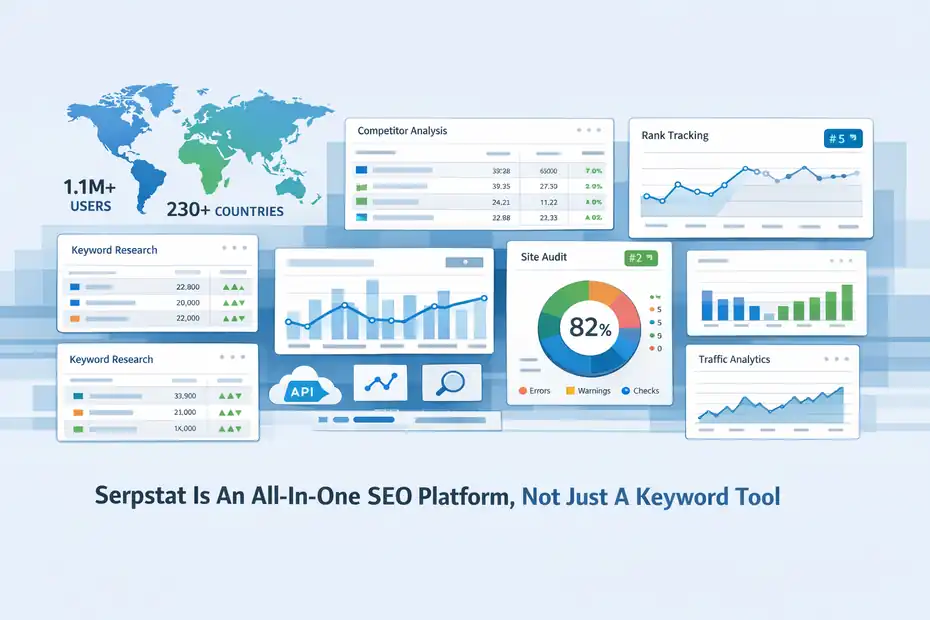
Serpstat Is An All-In-One SEO Platform, Not Just A Keyword Tool
Serpstat positions itself as an all-in-one SEO platform for teams and individuals. On its main product pages, it highlights keyword research, competitors analysis, rank tracking, site audit, backlink analysis, keyword clustering, traffic checking, and API/data solutions.
The company also says the platform is trusted by 1.1 million plus users and supports data across 230 countries, with billions of keywords and backlinks in its datasets.
That matters because beginners often buy the wrong kind of tool. Some tools are fantastic for backlinks but weak for content planning. Others are great for rank tracking but annoying for technical audits.
Serpstat’s main pitch is convenience: Instead of stitching together one tool for keywords, another for audits, and another for competitor insights, you can stay in one dashboard for most early SEO work. In practice, that convenience is a big part of the beginner value proposition.
Imagine you run a small Shopify store selling handmade candles. In one afternoon, you could use Serpstat to find phrases people search, inspect what competing stores rank for, audit your category pages, and track whether your target pages move up over the next month.
That workflow is simpler than trying to patch together three or four free tools with totally different interfaces.
What The Platform Is Best Known For
From the official site, the product’s strongest repeated use cases are competitor research, keyword research, site audits, and rank tracking. User testimonials shown on Serpstat’s own pages repeatedly mention the site audit tool, competitor analysis, and tracking rankings over time.
G2’s review summary also highlights affordable pricing, broad feature coverage, and an intuitive interface, while noting some users feel certain datasets, especially backlink completeness, can be more limited than higher-end alternatives.
That lines up with how I would frame it for a beginner: Serpstat is strongest when you need a broad SEO operating system more than a single best-in-class specialty tool. That distinction matters.
If your goal is “teach me SEO while also helping me do SEO,” an all-in-one platform often makes more sense than a specialist product.
Why SEO Beginners Struggle To Judge Tool Value
This is where I think most “worth it” decisions go sideways.
Beginners Often Buy Features Instead Of Outcomes
New SEOs tend to compare tools by counting features. More dashboards must mean more value, right? Not really. The real question is whether the tool helps you do five beginner jobs better: pick the right keywords, understand competitors, fix technical issues, publish targeted pages, and measure whether anything improved.
Serpstat absolutely covers those jobs on paper. The problem is that beginners often log in, bounce between dozens of reports, and end up overwhelmed. A tool can be powerful and still be a poor purchase if you do not have a simple workflow for using it. That is why I usually tell people to stop asking, “How many features do I get?” and start asking, “What will I do with this next Tuesday?”
A good example is rank tracking. It sounds exciting, but tracking 200 keywords you picked randomly will not help you. Tracking 20 carefully chosen keywords tied to actual pages and business goals will. The same goes for audits. A site audit report can surface real technical issues, but if you do not know which ones matter first, the report becomes noise instead of clarity.
The Hidden Cost Is Not Money, It Is Complexity
In my experience, the real beginner tax is complexity. Serpstat offers multiple tools and usage limits even on the entry plan: projects, daily searches, exports, audits, and position checks. For a serious beginner, that is useful structure. For a casual learner, it can feel like managing inventory in a warehouse before you have sold your first product.
This is why I believe Serpstat is not “beginner-friendly” in the lazy sense of the phrase. It is beginner-friendly for someone willing to learn SEO by doing. That is different. The interface may be approachable, and third-party review summaries do mention usability, but the work itself still requires judgment.
So when people ask whether Serpstat is worth it for SEO beginners, I think the real question is: are you the kind of beginner who wants a guided gym membership, or are you looking for a magic shortcut? If it is the second one, no SEO tool will feel worth it for very long.
What You Get On The Beginner-Level Plan
This is where the price-to-value conversation becomes concrete.
The Individual Plan Is Built For Solo Use
Serpstat’s current Individual plan is marketed for freelancers and beginners. At the annual price shown on the official pricing page, it costs $50 per month and includes 5 projects, 100 searches per day for sites, keywords, and links, 10,000 top-100 keyword position checks, 30,000 pages to audit, and 50,000 export rows.
It includes access to core features like Keyword Research, Site Analysis, Rank Tracker, Site Audit, and Backlink Analysis. The trial is 7 days, and Serpstat notes that entering a card triggers a $1 verification charge and auto-renewal unless canceled before the trial ends.
For a beginner, that package is more usable than it might look at first glance. Five projects is enough for one money site, one staging or side site, and a couple of experiments. One hundred searches per day is also workable if you are focused. You are not doing enterprise research at this level. You are trying to build a keyword list, audit priority pages, and monitor early movement.
Here is a simple way to think about it: If you publish four articles a month and optimize a handful of core pages, the Individual plan is not likely to choke you. If you are running multiple client accounts or crawling large websites, that is when the ceiling arrives quickly.
Quick Plan Comparison For Context
| Plan | Best Fit | Annual Price Shown | Projects | Searches/Day | Position Checks | Pages To Audit |
|---|---|---|---|---|---|---|
| Individual | Freelancers and beginners | $50/mo | 5 | 100 | 10,000 | 30,000 |
| Team | Small agencies or growing teams | $100/mo | Unlimited | 500 | 50,000 | 150,000 |
| Team x2 | Heavier team usage | $169/mo | Unlimited | 1,000 | 100,000 | 300,000 |
| Agency | Large teams and businesses | $410/mo | Unlimited | 5,000 | 500,000 | 1,500,000 |
For beginners, this table reveals something important: the jump from Individual to Team is mostly about scale and collaboration, not about whether you can learn SEO. That is another reason I think the Individual plan is the real “worth it or not” decision point for new users.
Where Serpstat Helps Beginners The Most
Not every feature matters equally at the beginner stage. Some deliver immediate value. Others are nice to have later.
Keyword Research And Competitor Discovery
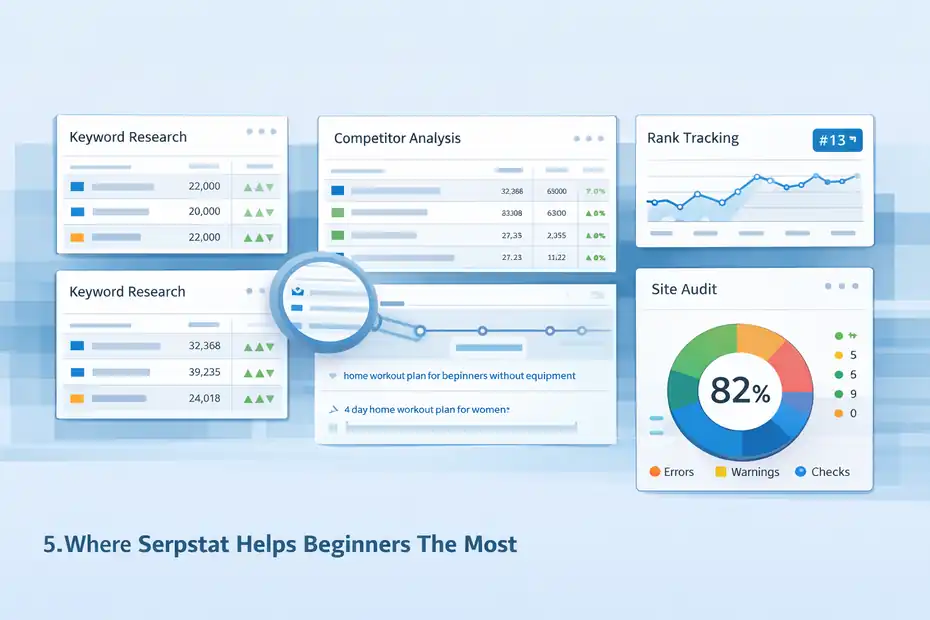
This is probably where most beginners will feel the value first. Serpstat’s keyword research tool surfaces monthly search volume, keyword difficulty, CPC, intent, and AI Overview presence, while its competitor analysis features are designed to show who your real search competitors are and reveal hidden keyword opportunities based on competitor rankings.
That is useful because beginner SEO usually fails at the topic selection stage. People write what they want to say, not what searchers actually want. With keyword and competitor data, you can spot phrases that are more realistic to target and see what kind of pages already rank. Even if the numbers are directional rather than perfect, that is often enough for a beginner to avoid obvious mistakes.
Let me make that practical. Say you run a beginner fitness blog and want to rank for “home workout plan.” That head term is broad and competitive. But competitor-based research might reveal narrower variations like “home workout plan for beginners without equipment” or “4 day home workout plan for women.” Those are not guaranteed wins, but they are closer to the kind of opportunities a newer site can actually pursue.
Site Audits And Rank Tracking
The second major beginner win is feedback. Serpstat’s audit and rank tracking tools give you a way to stop guessing. The site audit tool is built to surface on-site issues, prioritize them, and monitor whether issues decrease over time. The rank tracker supports daily updates, desktop and mobile tracking, competitor rankings, and project migration from other services.
I think this matters more than flashy dashboards. Beginners need a loop: publish, measure, improve, repeat. Without that loop, SEO feels abstract and slow. With it, you can actually see whether your work is leading somewhere.
A realistic example: You publish ten service pages for a local business, but none of them perform. The audit shows duplicate titles, weak meta descriptions, and thin internal linking. The rank tracker shows your pages stuck between positions 18 and 35. That tells you the pages are not invisible; they are under-optimized. That is a fixable problem, and a beginner can learn a lot from seeing that pattern.
Where Serpstat Falls Short For Beginners
An honest review is not useful unless it also shows the tradeoffs.
The Tool Can Still Feel Big When You Are New
Even though Serpstat is positioned for beginners on the entry plan, it is still a serious SEO suite. You are dealing with daily credits, reports, audits, projects, ranking checks, and datasets. That means the experience is better described as “accessible professional software” than “super simple toy version of SEO.”
For some people, that is great. You grow into the tool. For others, it creates friction. If your attention span is already stretched, logging into a full SEO platform can become another source of guilt instead of momentum. I have seen beginners buy a subscription because they felt motivated on a Sunday night, only to avoid the platform entirely by Wednesday because they did not know where to start.
That is not a Serpstat-only problem. It is true of almost every real SEO tool. But it matters here because the biggest beginner risk is underuse. A platform is not worth it just because it can do a lot. It is worth it when your behavior matches the tool’s depth.
Some Data Areas May Not Match Premium Specialists
Third-party review summaries are fairly consistent here: users often like Serpstat’s pricing, usability, and all-in-one coverage, but some mention that certain datasets, especially backlink depth, may not feel as complete as more premium alternatives.
G2’s review summary flags this directly, and some third-party commentary frames Serpstat as a strong value option rather than the absolute leader in every data category.
For beginners, I do not think this is a deal-breaker in most cases. You probably do not need the deepest backlink intelligence on the internet on day one. But it does affect the “worth it” decision if you are comparing it against a specialized, higher-cost tool purely on database strength.
My honest take is this: Beginners usually overestimate how much they need elite data and underestimate how much they need consistency. If Serpstat helps you research, publish, audit, and track every week, that consistency may create more results than owning a more expensive platform you barely use.
How A Beginner Should Use The 7-Day Trial
This is the make-or-break part. A trial only helps if you treat it like a structured test.
A Simple Trial Workflow That Shows Real Value
Here is how I would test Serpstat in a way that answers the “worth it” question fast.
- Day 1: Add one real project. Use your actual site, not a fake test domain. Import or list your top pages and core topics.
- Day 2: Run keyword research. Build a shortlist of 20 to 40 realistic keywords tied to pages you can actually create or improve.
- Day 3: Check competitors. Identify who ranks for your target terms and study which page types Google rewards.
- Day 4: Run a site audit. Focus only on obvious issues that affect crawlability, titles, duplication, or missing basics.
- Day 5: Set up rank tracking. Track a tight group of important keywords, not everything that sounds interesting.
- Day 6: Export and organize. Save keyword lists, page opportunities, and audit priorities.
- Day 7: Decide based on next steps. Ask whether the tool gave you a 30-day SEO action plan you can realistically execute.
This workflow fits the features Serpstat includes during the trial and forces the platform to prove value in a practical way. Serpstat states the free trial provides access to Individual or Team plan features for 7 days.
What A Good Trial Outcome Looks Like
A successful trial is not “I learned every feature.” It is much simpler than that. You should leave the week with three things: a keyword plan, a technical fix list, and a baseline rank-tracking setup.
Imagine you run a new blog about dog nutrition. At the end of a strong trial, you might have found ten low-competition content ideas, discovered that competing pages use clearer query-specific titles, and fixed a batch of missing metadata or crawl issues. That is real momentum. If Serpstat gives you that, then yes, it has likely earned the subscription.
If the trial leaves you confused, scattered, or still unclear about what to do next, that is useful information too. It probably means the tool is ahead of your current stage, not necessarily that the product is bad.
Common Beginner Mistakes When Using Serpstat
This section matters because the tool can be worth it and still fail for predictable reasons.
Mistake 1: Chasing Big Keywords Too Early
A beginner opens a keyword tool and immediately searches giant terms with huge volume. Then they build content around phrases they have almost no chance of ranking for. That is not a Serpstat problem. That is a search strategy problem.
Use the platform to find specific, lower-competition queries with clearer intent. Look for phrases that match a real page type you can publish well. A smaller keyword that brings in buyers or qualified readers is worth far more than a glamorous head term you never crack.
I suggest using competitor insights as a filter here. If every ranking page is from giant sites with massive authority, that is your sign to narrow the topic or change angle.
Mistake 2: Treating Every Audit Warning As An Emergency
SEO beginners love red warnings. It feels productive to “fix errors.” But not all warnings deserve equal attention. If you try to solve everything at once, you burn time without improving outcomes.
Start with issues that affect important pages and basic visibility: broken internal links, duplicate or weak titles, crawlability problems, indexation barriers, and obvious content gaps. Cosmetic issues can wait. Serpstat’s audit is most valuable when you use it as a prioritization tool, not a perfectionism machine.
Mistake 3: Measuring Without Publishing
This is the sneaky one. Beginners sometimes spend hours inside the tool and publish very little. The dashboard becomes the hobby, and the website becomes an afterthought.
I believe the healthiest ratio is simple: every research session should lead to a page update, a new page draft, or a technical fix. If you are not shipping changes, the tool becomes entertainment dressed as productivity. That is when even a good subscription starts to feel like wasted money.
How To Decide If It Is Worth Paying For After The Trial
This decision does not need to be emotional. You can make it based on a few simple criteria.
Ask These Four Questions
- Did it give you clear actions? A tool is worth more when it turns confusion into a next-step list.
- Did you use it more than once? Real value shows up in repeated use, not one excited login.
- Did it replace other subscriptions or messy workflows? An all-in-one tool becomes more valuable when it consolidates work.
- Can your site realistically produce ROI? Even one better-ranking page can justify software cost over time, but only if you are publishing and improving consistently.
For example, let’s say your site sells a $120 digital product with a 3% conversion rate from warm organic traffic. You do not need thousands of new visitors for the subscription to make sense. A few dozen extra qualified visits to the right page each month could shift the math in your favor.
On the other hand, if your site is inactive, has no monetization path, or gets updated once every three months, the subscription may not pay back soon enough.
My Decision Framework For Different Types Of Beginners
Here is how I personally break it down.
- Best fit: Solo site owners, affiliate beginners, niche bloggers, freelancers, and small business marketers who need one platform to learn and execute SEO.
- Maybe fit: Students, early-stage creators, and curious beginners who have a site but no publishing habit yet.
- Poor fit: People with no active site, no SEO workflow, or no budget room for experimentation.
That is why my answer is not a universal yes or no. The phrase serpstat worth it for seo beginners only makes sense when we define the kind of beginner we are talking about.
Final Verdict: Is Serpstat Worth It For SEO Beginners?
Serpstat is worth it for SEO beginners when you are past the theory stage and ready to work on a real website. The current Individual plan is clearly built for that use case, with beginner-level project limits, core SEO features, a 7-day trial, and access to learning resources.
The platform covers keyword research, competitor analysis, site auditing, backlink analysis, and rank tracking in one place, which is exactly the combination many beginners need to stop guessing and start executing.
My honest opinion is that Serpstat sits in a very practical middle ground. It is not the cheapest possible way to learn SEO, because free tools still exist. It is also not positioned as the ultra-premium specialist choice in every data category. But for a serious beginner who wants one dashboard, one workflow, and one place to learn the fundamentals while doing actual SEO work, it makes sense.
So here is the clearest answer I can give you: Yes, Serpstat is worth it for SEO beginners who are actively building something. No, it is not worth it for beginners who are only collecting tools and hoping motivation will appear later.
Use the trial like a real test. Build a keyword list. Audit your pages. Set up tracking. If that process gives you clarity and momentum, you will probably know the answer before the seven days are over.
FAQ
Is Serpstat worth it for SEO beginners?
Serpstat is worth it for SEO beginners who already have a website and want an all-in-one tool for keyword research, audits, and rank tracking. It helps turn SEO theory into action, but beginners without a project may find it overwhelming or unnecessary at an early stage.
What does Serpstat do for beginners?
Serpstat helps beginners find keywords, analyze competitors, track rankings, and audit websites. It provides a structured way to understand what works in search engines, making it easier to plan content and improve site performance without needing multiple separate tools.
Is Serpstat easy to use for beginners?
Serpstat is relatively easy to use compared to many SEO tools, but it still requires learning basic SEO concepts. Beginners who are willing to experiment and follow a simple workflow can quickly understand its features and start using the data effectively.
How much does Serpstat cost for beginners?
Serpstat offers an Individual plan starting at around $50 per month on annual billing. It includes essential features like keyword research, audits, and rank tracking, along with a 7-day trial, making it accessible for beginners testing SEO tools.
Can beginners learn SEO with Serpstat alone?
Beginners can learn practical SEO with Serpstat by using its tools while working on a real site. However, combining it with basic SEO knowledge and consistent content creation will deliver better results than relying on the platform alone.

I’m Juxhin, the voice behind The Justifiable.
I’ve spent 6+ years building blogs, managing affiliate campaigns, and testing the messy world of online business. Here, I cut the fluff and share the strategies that actually move the needle — so you can build income that’s sustainable, not speculative.
Related posts:
 Serpstat Features Overview: Tools That Actually Help
 How Good Is My Website SEO? Find Out Instantly!
 How To Track Seo Rankings Using Squirrly Accurately
 Serpstat Platform Walkthrough Guide: Step By Step
 Serpstat Pros And Cons For Marketers: Honest Verdict
 Serpstat Pricing Explained: Plans, Costs, Hidden Fees