
Table of Contents
Some links on The Justifiable are affiliate links, meaning we may earn a small commission at no extra cost to you. Read full disclaimer.
A strong brand24 online reputation management strategy is not really about “monitoring the internet.” It is about knowing what people say, deciding what deserves action, and turning scattered mentions into smarter moves
I’ve seen too many brands collect alerts and dashboards without ever building a repeatable response system. That is where results fall apart.
In this guide, I’ll walk you through a practical strategy that uses Brand24 as an operating system for reputation work, from setup and daily workflows to crisis prevention, reporting, and scale.
Understand What A Brand24 Online Reputation Management Strategy Actually Means
A real strategy starts before alerts, reports, or dashboards.
You need a clear definition of what reputation means for your business and what signals you want Brand24 to surface.
What Reputation Management Looks Like In 2026
Most people hear “online reputation management” and think about bad reviews. That is part of it, but it is far too narrow. Your reputation is also shaped by social mentions, forum discussions, podcast references, news coverage, creator commentary, and quiet comparison posts where buyers decide whether to trust you.
That matters because customer trust is still heavily influenced by public feedback. BrightLocal’s 2026 research says 68% of consumers will not use a business rated below four stars, and nearly a third only use businesses with a 4.5-star rating or higher. BrightLocal also reports that 49% of consumers trust online reviews as much as personal recommendations.
In my experience, this changes the role of Brand24. It stops being a listening tool and becomes an early-warning system. Brand24 says it tracks public mentions across social media, news, blogs, videos, forums, podcasts, reviews, and more, pulling from 25 million online sources in real time.
That source breadth is exactly why it can support a reputation strategy instead of just a social media checklist.
The Difference Between Monitoring And Managing
Monitoring is passive. Managing is active.
A lot of teams stop at “we got the alert.” That is not enough. A useful brand24 online reputation management strategy needs three layers:
- Detection: Find new mentions quickly and segment them by risk, source, sentiment, and business impact.
- Interpretation: Decide whether the mention is noise, feedback, a sales opportunity, a support issue, or a reputation threat.
- Action: Respond, escalate, document, improve, and report on what changed.
I believe this is the biggest mindset shift. The tool gathers signals, but your process creates results. If a customer posts the same complaint in X, Reddit, and a review site, you do not have three random mentions. You have one repeating trust issue that deserves a root-cause fix.
The Main Goal You Should Optimize For
Do not optimize for mention count alone. That metric is interesting, but it is not the finish line.
A healthier goal is this: Reduce negative surprises while increasing visible trust signals. In plain English, you want fewer public problems that catch your team off guard and more public proof that people like buying from you.
That usually shows up in a handful of practical outcomes:
- Faster response time: You notice issues before they spread.
- Better sentiment mix: You increase positive and neutral brand conversations over time.
- Cleaner search results: More useful, trustworthy, recent content appears around your brand.
- Better internal learning: Product, support, PR, and marketing all use the same public feedback loop.
When you frame your strategy this way, Brand24 becomes easier to use well. You stop chasing every mention and start prioritizing what changes trust, conversion, and retention.
Set Up Brand24 The Right Way From Day One
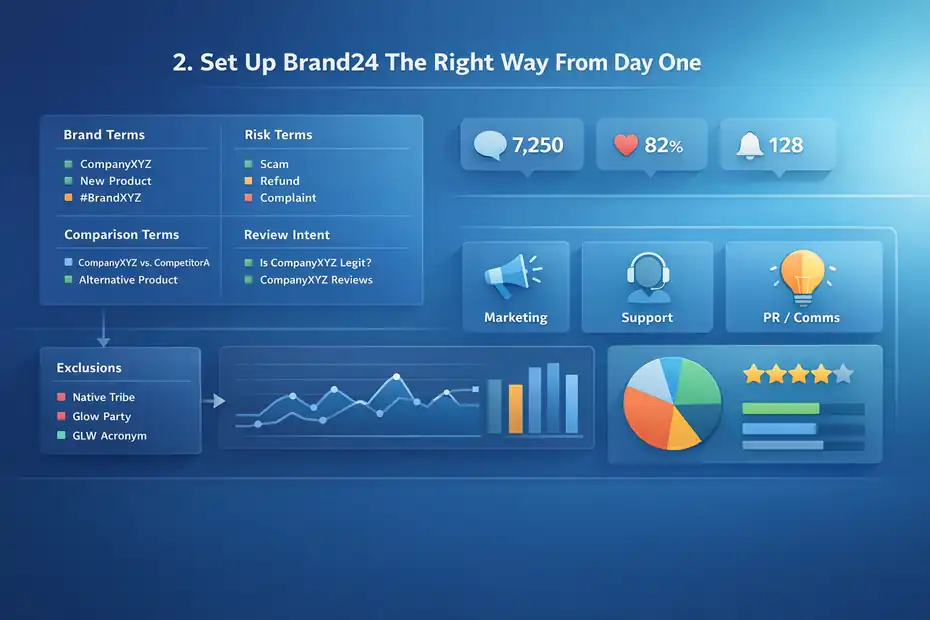
Most Brand24 mistakes happen during setup. If your tracking logic is messy, the rest of your strategy gets noisy fast.
Build Keyword Groups Around Real Reputation Risk
The smartest way to start is not with one brand name. It is with keyword groups.
I suggest splitting your monitoring into separate buckets so your team can tell what kind of mention came in without guessing. For most businesses, that looks like this:
- Brand terms: Company name, product names, branded hashtags, executive names, campaign names.
- Risk terms: “scam,” “broken,” “refund,” “lawsuit,” “complaint,” “cancel,” “doesn’t work,” and similar phrases tied to your brand.
- Comparison terms: Your brand versus competitors, alternative searches, migration questions.
- Review intent terms: Keywords that often appear in pre-purchase posts, such as “is [brand] legit” or “[brand] reviews.”
- Non-branded pain-point terms: The problem people have before they discover your solution.
This matters because Brand24 pricing is tied to keyword/project volume. Its current plans range from Individual with 3 keywords and 2,000 mentions per month to Business with 25 keywords and 100,000 mentions per month, while higher tiers add more AI and reporting depth.
A simple setup shortcut I recommend: Keep “brand defense” keywords separate from “market discovery” keywords. The first group protects reputation. The second helps you learn what the market says before your brand is tagged.
Clean Up Noise Before It Wastes Your Time
Every monitoring tool can become a chaos machine if you skip filtering. Brand24 helps by letting you sort and segment mentions, but the strategy should begin with prevention.
Imagine your company name is also a common word, a surname, or an acronym. You will drown in irrelevant mentions unless you add exclusions.
For example, a skincare brand named “Native Glow” might need to exclude unrelated uses of “native” or entertainment references to “glow.”
Here is the practical move: r=Review the first few days of mentions manually and create a list of recurring false positives. Then use that list to tighten project terms, exclusions, and prioritization rules. This sounds boring, but it saves hours every month.
I’ve found that teams who spend one careful hour on cleanup during week one save themselves weeks of alert fatigue later. That is not glamorous advice, but it is one of the highest-ROI steps in the whole process.
Match Setup To The Team That Will Actually Use It
A brand24 online reputation management strategy fails when ownership is vague.
Brand24’s plans vary by update speed and collaboration level. Lower tiers update more slowly, while Pro and above include real-time updates, unlimited users on larger plans, and additional AI-focused features such as AI Insights, AI Events Detection, and AI Brand Assistant.
So before you finalize setup, decide who needs access and why:
- Marketing: Brand mentions, campaigns, influencers, sentiment trends.
- Support: Complaints, unresolved issues, refund language, bug reports.
- PR/Comms: News spikes, journalist mentions, crisis patterns, narrative shifts.
- Product: Feature requests, repeated pain points, quality complaints.
- Leadership: Weekly summaries, trend snapshots, risk escalation only.
In my view, this is where many small teams overcomplicate things. You do not need everyone in the platform all day. You need the right routing logic so each team sees what matters.
Turn Mentions Into A Daily Reputation Workflow
Once setup is solid, your next job is consistency. Reputation work compounds when your team follows the same routine every day.
Create A Mention Triage System
Not every mention deserves the same energy. That is why a triage system matters.
I recommend using four practical classes:
- Priority 1: High-risk negative mentions from high-visibility sources or customers with influence.
- Priority 2: Actionable complaints, support issues, and review site feedback.
- Priority 3: Neutral questions, comparison posts, and buying-intent mentions.
- Priority 4: Positive mentions, general chatter, and low-impact noise.
This helps your team move from panic mode to process mode. If somebody on Reddit writes a detailed post about a billing issue and the thread starts gaining traction, that deserves a different response than a neutral brand mention in a small forum.
Brand24’s sentiment analysis and mention source coverage make this possible at scale because you can quickly separate positive, negative, and neutral conversations across multiple channels instead of checking each platform manually.
A useful rule: Visibility plus negativity equals urgency. Even a single mention can matter if it comes from the right place.
Respond Publicly, But Fix Privately
A lot of brands get this backward. They either respond publicly and never solve the underlying problem, or they solve the problem privately without leaving any visible trust signal.
The better move is both.
Here is a practical example. Let’s say a customer posts on X that your onboarding process is confusing and no one answered their email. Your response should do three things on the same day:
- Acknowledge: Confirm that you saw the issue.
- Redirect: Move sensitive details into support or DM.
- Close the loop: Return publicly once it is resolved, if appropriate.
That visible follow-through matters because future buyers are watching, not just the upset customer. In many categories, reputation management is conversion optimization in disguise.
I suggest keeping response templates for common cases, but never sounding canned. The template should structure your thinking, not replace empathy.
Log Patterns, Not Just Incidents
One mention is an incident. Ten similar mentions are a pattern.
This is where Brand24 becomes much more valuable than a simple notification inbox. Use it to identify repeated themes by source, sentiment, product line, campaign, or issue type.
Brand24 positions its reporting and customer insight features around understanding what people like or dislike, measuring awareness, and sharing insights with teams.
For example, if you run an ecommerce brand and see complaints cluster around shipping delays every Monday, that is not a copywriting problem. It may be an operations issue creating reputation damage upstream.
I believe the best ORM teams are the ones who feed public signals back into internal decisions. They do not just answer complaints. They reduce future complaints.
Use Brand24 Features To Prevent Small Problems From Becoming Big Ones
A strategy works better when it is proactive. The goal is not to “win” after a reputation issue explodes. The goal is to catch patterns before they become a story.
Use Sentiment Trends As An Early Warning System
Sentiment is not perfect, but it is useful when you read it directionally.
Brand24 highlights AI sentiment analysis as a core feature, and its recent product materials position sentiment as a fast way to separate positive, neutral, and negative mentions and catch meaningful shifts.
Here is how I recommend using it:
- Watch for sudden negative spikes: These usually mean a broken checkout, service disruption, bad campaign reaction, or unhappy creator mention.
- Compare sentiment by source: Review-site negativity means something different from meme-driven negativity on social.
- Track sentiment after fixes: If support solves the issue but public sentiment stays negative, the message did not spread.
A common mistake is treating sentiment like a scoreboard. It is better used like a smoke alarm. You are not trying to prove perfection. You are trying to catch movement early enough to respond intelligently.
Monitor Reach, Not Just Volume
Mention volume can be misleading. Ten negative mentions from low-visibility accounts may do less damage than one complaint picked up by a journalist, creator, or big community.
Brand24 emphasizes reach and awareness metrics so teams can evaluate marketing efforts and benchmark against competitors, not just count mentions.
In practice, this means your daily review should include questions like:
- Did this mention come from a person or publication with real amplification power?
- Is the post likely to rank in search, get indexed, or be referenced later?
- Could this mention influence buyers during consideration?
I’ve seen small brands waste time on low-impact chatter while missing a high-trust review thread that quietly shapes sales for months. Reach helps you avoid that trap.
Build A Simple Escalation Playbook
A brand24 online reputation management strategy gets much stronger when the team knows exactly what happens next after a risky alert appears.
Your playbook does not need to be fancy. It just needs to be clear.
- Level 1: Single complaint, low reach, normal support handling.
- Level 2: Repeated complaint or public criticism from a notable source, route to marketing and support lead.
- Level 3: Fast-moving negative conversation, legal or safety language, or media attention, escalate to leadership and comms immediately.
I suggest documenting who owns each level, the response target time, and the approval path for public statements. That removes hesitation when timing matters.
Build A Review And Search Reputation Layer Around Brand24
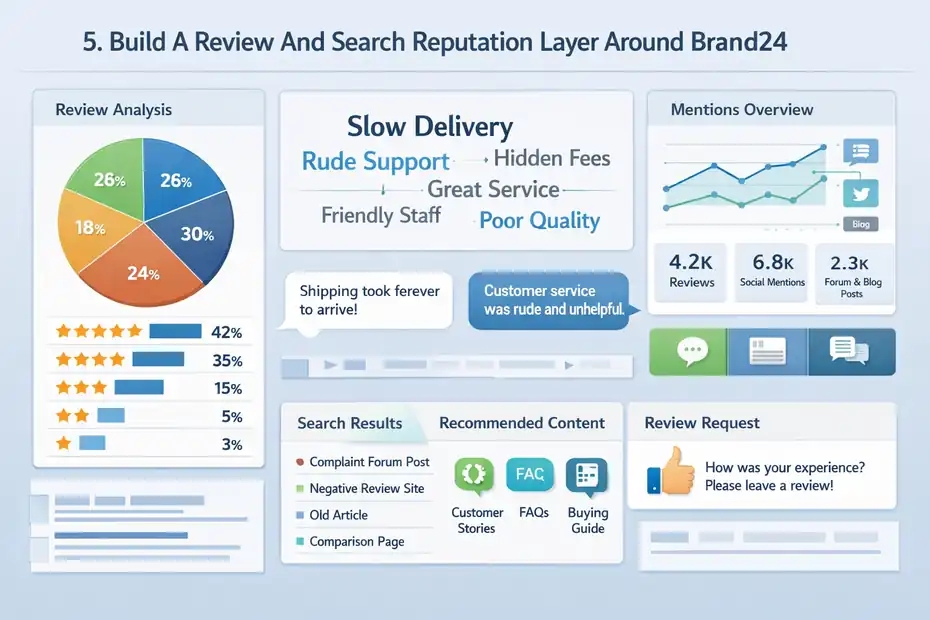
Brand24 is powerful, but your reputation strategy should also shape what future buyers see when they search for you.
Track Review Themes Instead Of Obsessing Over Every Star
Yes, ratings matter. BrightLocal’s latest data makes that clear. But the real leverage often comes from theme analysis.
If negative reviews repeatedly mention “slow delivery,” “rude support,” or “hidden fees,” that language becomes part of your public reputation. Buyers often skim comments before they ever click your site. BrightLocal’s 2026 findings show reviews still play a major role in trust and decision-making, even as discovery behavior evolves.
So rather than asking, “How do we get more reviews?” start with, “What repeated phrases are shaping trust?”
That is where Brand24 helps. Because it tracks review sources alongside broader mentions, you can compare review-site complaints with conversations on social, forums, and blogs. When the same message appears in multiple places, you have a real reputation narrative on your hands.
Create Positive Search Signals On Purpose
Here is something I strongly believe: reputation management is partly content strategy.
If people search your brand and find old complaints, thin review pages, and unanswered threads, you leave your trust story up to chance. A stronger approach is to create and encourage fresh, useful brand-associated content:
- Customer stories and case studies
- FAQ pages that answer common trust questions
- Transparent shipping, billing, and refund explanations
- Founder or expert commentary on issues your audience cares about
- Updated comparison and alternative pages, when appropriate
This is not about burying criticism. It is about making sure accurate, current, helpful content also exists.
Brand24 can support this by revealing the exact questions, complaints, and comparisons people make in public. That gives your content team a live map of what trust gaps need to be filled.
Ask For Proof At The Right Moment
Review generation belongs in the reputation conversation, but timing matters.
Do not ask for feedback at the moment of purchase if the product experience has not happened yet. Ask after the success moment.
For a SaaS company, that might be after activation or first ROI. For ecommerce, it may be after delivery and product use. For services, it is usually right after a solved problem.
I recommend tying review asks to satisfaction triggers, not calendar timing. That creates better sentiment and better public proof without sounding desperate.
Use Reporting To Make Reputation Work Visible Internally
A strategy gets budget and support only when other people can see its value. That is where reporting matters.
Focus Reports On Decisions, Not Vanity Metrics
Brand24 includes reporting and automated sharing features designed to help teams distribute statistics and insights internally.
That said, the best report is not the one with the most charts. It is the one that answers, “What changed, why did it matter, and what should we do next?”
I suggest building reports around five recurring questions:
- What changed in mention volume?
- What changed in sentiment?
- Which sources drove the biggest reputation impact?
- What complaints or compliments repeated most often?
- What action should product, support, PR, or marketing take now?
This makes your reports strategic instead of decorative.
Create A Weekly Reputation Scorecard
For many teams, weekly is the sweet spot. Daily is good for operators, but leadership usually needs a tighter summary.
A simple weekly scorecard can include:
- Total mentions and trend versus last week
- Negative mention count and top causes
- Highest-reach positive mention
- Highest-risk negative mention
- Top repeated issue
- Average response time
- Review rating movement, if relevant
- Actions completed and actions pending
The reason this works is simple: it connects brand perception to action. Instead of saying, “Negative sentiment increased,” you can say, “Negative sentiment increased 18% because of delayed shipping complaints after the warehouse transition, and support updated the delivery expectation page on Tuesday.”
That is a useful business story.
Show Cross-Team Wins
One of the easiest ways to grow internal buy-in is to show how reputation insights helped more than one department.
For example:
- Marketing used repeated comparison questions to write a stronger pricing page.
- Support used complaint themes to improve macros and first-response scripts.
- Product used feature request clusters to prioritize roadmap fixes.
- PR spotted a negative narrative before it spread to industry media.
When teams see that Brand24 is not “just for marketing,” the strategy gets stronger and more sustainable.
Avoid The Most Common Brand24 Reputation Mistakes
Even good tools produce bad outcomes when the operating habits are weak. These mistakes are common, and they are expensive.
Mistake 1: Tracking Too Broadly Too Soon
This happens all the time. A team sets up every possible keyword, gets buried in mentions, and then stops checking the platform.
I recommend starting narrower than you think. Build a core reputation project first, prove the workflow, then expand into competitor tracking, campaign analysis, or broader category listening.
Remember, Brand24 plans scale by keyword count and mention limits, so precision early on helps both clarity and cost control.
Mistake 2: Treating Negative Mentions Like PR Threats Only
Not every negative mention needs a polished brand statement. Many need a practical fix.
If five people complain that your subscription cancellation flow is confusing, that is not just a messaging issue. It is probably a UX issue. When teams treat every complaint as a communications problem, they miss the product or operations problem underneath it.
From what I’ve seen, the best ORM teams are half analysts and half translators. They turn public frustration into internal priorities.
Mistake 3: Ignoring Positive Mentions
This one is easy to miss. Positive mentions are not just nice. They are raw material.
They tell you which proof points matter most, what language customers naturally use, and which outcomes deserve to be amplified in reviews, testimonials, ad copy, and landing pages.
If customers keep praising “fast setup” or “surprisingly human support,” that wording is gold. It is much more persuasive than invented marketing language because it came from real people.
Scale Your Brand24 Online Reputation Management Strategy Over Time
Once the basics work, you can turn the strategy into a long-term advantage.
Expand From Defense To Intelligence
At first, most brands use Brand24 defensively. They want to catch complaints and avoid surprises. That is smart.
But after a few months, the bigger value often comes from intelligence. Brand24 frames its platform around customer insights, competitor analysis, and awareness measurement in addition to reputation protection.
That means you can start using the same setup to answer higher-level questions:
- Which competitor frustrations create positioning opportunities?
- Which creator communities talk about your category most often?
- Which feature claims get praised publicly, and which get doubted?
- Which markets or channels produce the healthiest sentiment?
This is where ORM starts feeding growth.
Add Advanced Projects As Your Process Matures
Once your core workflow is stable, consider adding focused projects for:
- Executive or founder reputation
- Product launch monitoring
- Campaign-specific listening
- Competitor brand comparisons
- Category trust and complaint tracking
- Regional or language-based monitoring
Brand24 says its AI-powered language support covers 108 languages, which can be useful for brands operating across multiple markets.
The important thing is not adding more projects just because you can. Add them when you know who will read the data and what decisions it should influence.
Build A Reputation Flywheel
This is the long-term model I like most:
- Monitor public conversations.
- Detect patterns early.
- Respond visibly and resolve privately.
- Feed insights into product, support, content, and messaging.
- Publish clearer trust-building content.
- Generate better experiences.
- Earn better mentions and reviews.
- Monitor the next wave from a stronger position.
That is the real power of a brand24 online reputation management strategy. It is not a one-time cleanup tactic. It is a system for improving how your brand is perceived because you are continuously learning from the market in public.
Put The Strategy Into Action With A Simple 30-Day Plan
You do not need to roll out everything at once. A 30-day plan is enough to create traction.
Days 1–7: Build The Core Monitoring Structure
Start by setting up your core brand terms, risk terms, and comparison terms. Clean obvious false positives. Decide who owns triage, who handles responses, and what counts as escalation.
Your goal this week is not perfection. It is signal quality.
Days 8–14: Create Response And Escalation Workflows
Now document your triage logic and write lightweight response templates for the most common situations: complaints, questions, review replies, misinformation, and praise.
This is also the right time to define what gets shared with support, leadership, product, or PR.
Days 15–21: Review Patterns And Fix One Root Cause
By now, you should have enough data to spot at least one repeated issue. Pick one and fix it.
Maybe shipping complaints need clearer messaging. Maybe trial users are confused by onboarding. Maybe pricing pages create too many comparison questions.
Solve one real problem and track whether mention quality improves.
Days 22–30: Build Reporting And Scale What Works
Create a weekly report, share it with the right people, and highlight one lesson plus one action. Then decide whether you need broader monitoring, a higher plan, or additional projects.
Brand24’s higher tiers add faster updates, more keywords, larger mention limits, and deeper AI/reporting features, so this is usually the moment when teams can tell whether their current setup still fits.
Final Thoughts
A Brand24 online reputation management strategy works when you treat it like a business process, not a pile of alerts.
That is really the heart of it. You are not buying software to “watch mentions.” You are building a repeatable system for spotting trust signals, fixing public friction, and helping every team hear what the market is already saying out loud.
If I were starting today, I would keep it simple: Track the right terms, clean the noise, triage mentions by risk, respond with empathy, report patterns, and use those patterns to improve the customer experience. Do that consistently, and Brand24 stops being just another dashboard. It becomes one of the most useful feedback loops in your business.
FAQ
What is a brand24 online reputation management strategy?
A brand24 online reputation management strategy is a structured approach to tracking, analyzing, and responding to online mentions using Brand24. It helps businesses monitor brand perception, detect issues early, and improve public trust by turning real-time feedback into actionable decisions.
How does Brand24 help with reputation management?
Brand24 helps by collecting real-time mentions from social media, forums, news, and review sites. It analyzes sentiment, tracks reach, and highlights trends so you can quickly identify negative feedback, respond to customers, and understand how your brand is perceived online.
Why is online reputation management important for businesses?
Online reputation management is important because customer trust heavily depends on public perception. Reviews, comments, and mentions influence buying decisions. Managing your reputation helps reduce negative exposure, improve credibility, and increase conversions by showing that your brand listens and responds.
How do you set up Brand24 for reputation tracking?
To set up Brand24, create projects using your brand name, product names, and related keywords. Add variations and negative keywords to reduce noise. Then organize mentions by sentiment and source, allowing you to quickly identify important conversations and respond effectively.
What are the biggest mistakes in Brand24 reputation management?
The biggest mistakes include tracking too many irrelevant keywords, ignoring negative patterns, and failing to respond consistently. Many businesses also overlook positive mentions, missing opportunities to build trust and strengthen their brand message through real customer feedback.

I’m Juxhin, the voice behind The Justifiable.
I’ve spent 6+ years building blogs, managing affiliate campaigns, and testing the messy world of online business. Here, I cut the fluff and share the strategies that actually move the needle — so you can build income that’s sustainable, not speculative.
Related posts:
 Top Brand24 Competitors Offering Excellent Value
 Brand24 Missing Mentions Troubleshooting: Quick Fix Guide
 Brand24 Pros And Cons For Businesses: Honest Breakdown
 Adsterra Advertising: Boost Your Online Business with High-Quality Traffic
 Online Business Courses: Start Your Entrepreneurial Journey Today
 YouTube CPM Rates: How to Maximize your Profit