
Table of Contents
Some links on The Justifiable are affiliate links, meaning we may earn a small commission at no extra cost to you. Read full disclaimer.
If you’re researching clickmagick pros and cons for marketers, you’re probably at the point where “good enough” tracking no longer feels good enough. Maybe your ad platform reports do not match your actual sales, or maybe you are tired of guessing which campaign really deserves more budget.
I get it.
ClickMagick is one of those tools that can genuinely sharpen your decision-making, but it is not a magic button, and it is definitely not the right fit for every marketer.
This guide walks you through the real advantages, tradeoffs, setup realities, and who should actually pay for it.
What ClickMagick Actually Does For Marketers
ClickMagick sits in the middle of your traffic and conversion flow.
Its job is to help you track clicks, attribute conversions more accurately, filter bad traffic, and push cleaner data back into your ad ecosystem.
What Problem It Solves
Most marketers do not buy a tracking platform because they love dashboards. They buy one because they do not trust the numbers they already have.
When you run paid traffic across Meta, Google, TikTok, email, affiliate links, or funnel pages, the truth gets fragmented fast. One platform claims the conversion. Another platform misses it.
Your store reports revenue, but not always the real source. Your spreadsheet becomes a peace treaty between systems that do not agree. ClickMagick positions itself as a “single source of truth” for clicks, conversions, and customer journeys across channels.
That matters because bad attribution leads to bad budgeting. If one ad set looks profitable only because another tool over-credited it, you scale the wrong thing. If delayed conversions are invisible, you pause ads too early. If bots inflate your click volume, your cost-per-lead looks worse than it should.
This is why ClickMagick appeals most to performance marketers, affiliate marketers, info-product sellers, agencies, and e-commerce advertisers who care deeply about attribution, not just vanity metrics.
In my experience, the more money you spend on traffic, the more expensive “close enough” data becomes.
How It Works In Plain English
At a basic level, ClickMagick gives you trackable links, tracking scripts, attribution logic, and reporting layers that sit above your traffic sources. Instead of relying only on ad platform dashboards, you use ClickMagick to watch what happens after the click.
That includes real-time stats, funnel reporting, split testing, bot filtering, cost syncing, first-party tracking domains, and conversion feedback features. On higher plans, it also includes advanced attribution models, offline and phone sales tracking, and more team capacity.
A simple example: Imagine you run Meta ads to a landing page, send opt-ins into an email sequence, and generate purchases three days later. Without a dedicated tracking layer, Meta might report one story, your email tool another, and your checkout tool a third. ClickMagick is designed to connect those touchpoints so you can see which click source actually started the journey.
That is the promise. The real question is whether the platform delivers enough value to justify the setup effort and monthly cost. That is where the pros and cons matter.
The Biggest Pros Of ClickMagick For Marketers
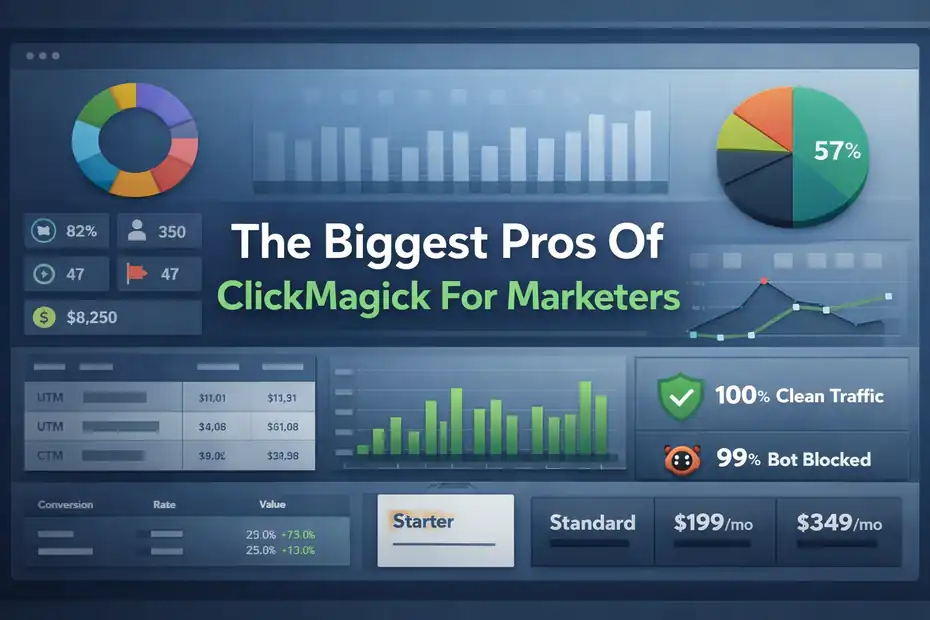
This is where ClickMagick earns its reputation. It is built for marketers who want actionable tracking, not just passive analytics.
Pro 1: It Gives You More Actionable Attribution Than Basic Analytics Tools
A lot of analytics tools tell you what happened. Fewer help you decide what to do next.
ClickMagick’s strength is that it is built around direct-response marketing decisions. Its reporting focuses on clicks, funnel behavior, conversion timing, attribution, and traffic quality.
The company highlights reports such as UTM performance, funnel steps, conversion velocity, and lifetime value reporting, which are much closer to the day-to-day questions a media buyer or funnel marketer asks than standard pageview analytics.
That matters in real life. Let’s say Campaign A gets cheaper leads, but Campaign B produces buyers faster and at a better blended return. A generic analytics setup may leave you stitching that together manually. ClickMagick is designed to surface those differences inside the tracking environment itself.
I believe this is one of the clearest reasons serious marketers stay with it. The tool is not trying to be your all-purpose web analytics suite. It is trying to answer a narrower and more profitable question: which traffic should you scale, fix, or cut?
That focus makes the platform especially useful for paid acquisition teams, affiliate campaigns, and sales funnels where attribution quality directly affects spend decisions.
Pro 2: Bot Filtering And Click Fraud Protection Are Core Value Drivers
One of ClickMagick’s strongest selling points is traffic quality control. The platform says it has world-class bot filtering and claims to block 99% of bots, while Click Shield lets users define behavior rules and stop unwanted clicks from wasting ad spend.
Even if you treat vendor claims cautiously, the value proposition is easy to understand. If your campaigns attract bot clicks, competitor clicks, accidental repeat clicks, or low-intent junk traffic, your campaign data gets dirtier and your ROI analysis gets weaker.
Here is the practical impact:
- Cleaner reporting: You are less likely to optimize against fake engagement.
- Less wasted spend: You reduce budget burn from clicks that were never real opportunities.
- Better optimization signals: Ad platforms perform better when the feedback loop is based on cleaner conversion data.
Imagine you run branded search or retargeting campaigns. Existing customers and curious competitors may click repeatedly, and those clicks can distort your CPA fast. A protection layer can help you avoid paying for the same low-value behavior over and over. That alone can justify the subscription for some advertisers.
This is especially valuable for businesses spending enough monthly budget that even a small percentage of wasted clicks adds up fast.
Pro 3: It Is Built For Marketers, Not Analysts
This sounds subtle, but it is a huge distinction.
Many data tools feel like they were designed for analysts first and marketers second. ClickMagick leans the other way. Its messaging, setup flow, and feature positioning are heavily centered on campaign optimization, speed, and actionable decision-making.
The platform includes a step-by-step setup wizard, one-on-one onboarding on higher tiers, and a daily insights email called Morning Magick that highlights what to scale, pause, or fix.
That approach matters when you are busy. Most marketers do not want to spend their mornings building custom reports. They want to know whether lead quality dropped, whether a new creative is outperforming, and whether a funnel stage is leaking.
I suggest thinking of ClickMagick less as “another analytics tool” and more as a decision support system for paid traffic and conversion tracking. That is why many marketers find it more usable than broader analytics stacks.
There is also a mobile app included across plans, plus API and Zapier access even on Starter, which is a nice sign that the platform wants to stay operationally practical.
Pro 4: Pricing Is Flat-Rate, Which Many Marketers Prefer
ClickMagick emphasizes flat monthly pricing rather than revenue-based pricing, and its current public pricing starts at $79 per month monthly or $66 per month billed annually for Starter, then $199/$166 for Standard, and $349/$291 for Pro.
The company also offers a 14-day free trial and says users are covered by a 30-day money-back guarantee.
For many marketers, that pricing model is psychologically and operationally attractive.
Here is why:
| Plan | Monthly Price | Annual Equivalent | Key Limits |
|---|---|---|---|
| Starter | $79/month | $66/month | 10,000 tracked visitors, 1 user, 1 site/store, 1 ad account per platform |
| Standard | $199/month | $166/month | 100,000 tracked visitors, 3 team members total, advanced attribution, affiliate campaigns |
| Pro | $349/month | $291/month | 1,000,000 tracked visitors, unlimited team members, unlimited ad accounts |
Source: ClickMagick pricing page.
If you hate pricing models that punish growth, ClickMagick will probably feel fairer than some alternatives. The company explicitly positions itself against tools that charge more as your revenue or ad spend increases.
That said, “flat-rate” does not automatically mean “cheap.” For a beginner, $79 per month can still feel steep. For an active advertiser, it may feel modest if the data helps prevent a single bad scaling decision.
The Biggest Cons Of ClickMagick For Marketers
The platform has real strengths, but the drawbacks are real too. And honestly, these cons matter most before you subscribe, not after.
Con 1: The Learning Curve Is Real
ClickMagick tries hard to make setup easier, but the product still lives in a technical part of marketing: tracking, attribution, conversion feedback, link management, and traffic quality control. That means new users can feel overwhelmed fast.
The company includes a setup wizard and training resources, which helps. But even then, the platform assumes you are willing to learn concepts like tracking domains, attribution windows, funnel steps, UTMs, conversion events, and integration logic.
This is the first major con I would flag for casual users. If your current traffic is simple and your campaigns are still small, you might open ClickMagick and feel like you bought a cockpit when you only needed a steering wheel.
A realistic example: a solo creator running one opt-in page, one email sequence, and occasional boosts on Meta may not need advanced attribution models yet. In that case, the platform can feel like too much system for the stage of the business.
From what I have seen, ClickMagick makes the most sense when you already know why bad attribution hurts you. If you do not feel that pain yet, the learning curve can outweigh the benefits.
Con 2: Starter Plan Limits Can Push Growing Marketers Upmarket Fast
The Starter plan includes 10,000 tracked visitors, 1 user, 1 website or store, 1 ad account per platform, 6 months of data retention, basic support, basic bot filtering, and AI insights for 10 active ads. Those limits are fine for smaller campaigns, but they can become restrictive sooner than some marketers expect.
This matters because the jump from Starter to Standard is not tiny. It moves from $79 to $199 monthly on month-to-month billing.
That creates a familiar SaaS tension: the entry plan is accessible enough to test, but serious usage may quickly require the mid-tier.
Here is where that shows up:
- Multiple brands or sites: Starter only includes one site/store.
- Team use: Starter is built for one user.
- More ad accounts: Also limited on the base plan.
- Advanced attribution: Reserved for Standard and above.
So while the flat-rate model is a pro, the tier jump is still a con for marketers operating in the awkward middle stage. You are too advanced for Starter, but not always thrilled about paying Standard pricing yet.
If your growth path includes multiple funnels, team members, or heavier media buying, price planning matters more than the headline subscription number.
Con 3: It Is Not A “Set It And Forget It” Tool
Some marketers buy tracking software hoping the tool itself will solve messy campaign economics. It will not.
ClickMagick can give you better visibility, better filtering, and stronger attribution, but you still need sound traffic strategy, decent offers, clear event setup, and consistent interpretation. If your funnel is weak, ClickMagick will simply help you discover that faster.
That is useful, but it can be disappointing if your expectation is magical performance improvement.
The company does make bold claims around improved optimization and ROI once tracking is fixed. In specific cases, that may absolutely happen. But the lift usually comes from better decisions after better measurement, not from the software alone.
I think this is where some buyer disappointment comes from. The tool is strongest when you already have traffic, a funnel, and enough volume to act on signal. It is weaker as a cure for businesses that still lack offer-market fit or disciplined campaign management.
So yes, ClickMagick can help you scale smarter. No, it cannot replace strategy.
Con 4: Some Of The Marketing Claims Are Stronger Than What Skeptical Buyers Prefer
This is less about the product itself and more about buyer psychology.
ClickMagick’s site uses assertive language around “unbeatable” tracking, guaranteed optimization gains, being the only app proven to block 99% of bots, and being the most battle-tested solution. That kind of messaging may energize direct-response buyers, but it can also make skeptical marketers pause and look for independent validation.
To be fair, the brand clearly knows its market. Many performance marketers like confident positioning. But if you prefer low-hype software buying, you may need to do a bit more due diligence before feeling comfortable.
External reputation signals are generally positive. Trustpilot currently shows ClickMagick at 4.7 stars from 669 reviews, with customer service and responsiveness frequently mentioned. That supports the idea that real users are having solid support experiences. Still, review platforms tend to tell you more about customer satisfaction than implementation fit.
So the real takeaway is simple: do not buy ClickMagick because of the copy. Buy it because your use case clearly needs the capabilities.
Where ClickMagick Fits Best In A Real Marketing Stack
A good tracking platform is only valuable when it matches the way you acquire traffic and measure outcomes. ClickMagick is strongest in a few very specific stack scenarios.
Best Fit 1: Paid Traffic Funnels With Multiple Touchpoints
If your customer journey stretches across ads, landing pages, opt-ins, email follow-up, webinars, sales pages, and upsells, ClickMagick becomes much more compelling.
The more touchpoints you have, the more attribution breaks down in basic setups. This is where features like advanced attribution models, funnel reports, conversion velocity, and first-party tracking domains become meaningfully useful.
Imagine this funnel:
- Meta ad to lead magnet page
- Email nurture over 5 days
- Webinar signup
- Offer purchase on day 7
- Upsell on day 10
That is exactly the sort of journey where simplistic last-click reporting can hide what is truly working. A platform focused on full-funnel tracking helps you avoid over-crediting the final touch and under-crediting the entry point.
If your business looks like this, ClickMagick is not overkill. It is operational clarity.
Best Fit 2: Affiliate Marketing And Link-Centric Campaigns
ClickMagick specifically includes unlimited affiliate campaigns on Standard and above, and the platform has long been associated with affiliate and direct-response marketers.
This fit makes sense because affiliate marketing is heavily link-driven. You care about sub-IDs, source quality, traffic segmentation, split testing, and knowing which placements or promos actually earn money. Link management and attribution are not side features there. They are the business.
This is also one area where practical link tools matter more than broad analytics. If you are rotating offers, comparing traffic sources, and trying to protect margins, a specialized tracker often feels more useful than a generic analytics dashboard.
I would especially consider ClickMagick for affiliate use if you are juggling multiple traffic sources and care about both traffic quality and conversion timing. That combination is where the software earns its keep.
Best Fit 3: Agencies That Need Client-Friendly Tracking Logic
ClickMagick has an agency-specific offering and says agencies receive a 35% discount, with an average client cost of $129 per month. More important than the discount, though, is the positioning: agencies can include it in services or have clients pay directly.
That flexibility is useful because agencies often need a neutral tracking layer between ad platforms, client sites, and CRM or checkout systems.
This can reduce reporting arguments. Instead of relying purely on platform dashboards that clients distrust, agencies can anchor performance discussions in a third-party tracking environment designed around attribution and conversion paths.
That does not automatically make ClickMagick the best choice for every agency. But it does make it especially practical for agencies focused on direct response, lead generation, and paid traffic optimization rather than just top-of-funnel reporting.
When ClickMagick Is Probably Not Worth It
Not every marketer needs a dedicated tracking platform. In some cases, buying ClickMagick too early creates more work than value.
You Are Still In The Very Early Validation Stage
If you have barely launched, your main job is often simpler than attribution optimization. You need a viable offer, clear messaging, a functioning funnel, and enough traffic to learn from.
At that stage, paying for advanced tracking may not be the best use of money or attention. A beginner can spend hours perfecting tracking while the real issue is that the landing page is weak or the offer is not resonating.
I recommend asking one blunt question: are you losing money because of poor attribution, or are you losing money because the marketing itself is not working yet?
If it is the second one, ClickMagick probably is not the first fix.
You Run Mostly Simple, Low-Volume Campaigns
If your setup is one traffic source, one landing page, one simple checkout path, and low monthly spend, the performance gain from ClickMagick may be too small to feel dramatic.
This does not mean the tool is bad. It means the complexity-to-value ratio is off.
A local service business running a handful of branded search campaigns may not need advanced multi-touch attribution. A small creator with occasional email pushes and one offer may not need bot rules, funnel step reports, and cross-device tracking.
In these cases, more measurement can become a form of productive-looking procrastination.
You Do Not Have Time To Implement Tracking Correctly
This one is underrated.
Tracking tools are unforgiving when installed halfway. If events are misfiring, domains are not configured properly, or conversion rules are sloppy, you can end up with false confidence instead of real visibility.
ClickMagick offers support, training, and onboarding. That helps. But you still need either the time or the operational discipline to configure it properly.
If you know your team will subscribe, paste a few scripts, and never finish the setup, save your money.
A Practical Setup Path For Marketers Who Decide To Use It
The smartest way to adopt ClickMagick is to keep the first implementation narrow. You do not need to instrument your entire business on day one.
Step 1: Start With One Funnel And One Traffic Source
This is the setup move I would make first every time.
Pick one funnel that already gets meaningful traffic. Then track one traffic source into it cleanly. That keeps debugging simple and helps you learn the platform in a useful context.
For example, track a Meta campaign into a lead magnet funnel with one primary conversion event. Once the click data, opt-ins, and sales are flowing correctly, then widen the scope.
This reduces two common mistakes: overcomplicating the first implementation and blaming the software for setup chaos that came from trying to do too much at once.
Step 2: Define The Few Metrics That Actually Matter
Do not open ClickMagick and try to monitor everything.
Choose a short list of metrics tied to profit decisions, such as:
- Cost per qualified lead
- Cost per purchase
- Conversion rate by traffic source
- Time to conversion
- Return by campaign or ad angle
ClickMagick becomes much more valuable when you use it to answer a small number of repeatable budget questions. It becomes less valuable when it turns into a giant metrics museum.
Step 3: Use The Trial To Validate A Decision, Not Just “Play Around”
ClickMagick offers a 14-day free trial. Use it with intent.
A good trial goal is not “learn every feature.” A better goal is “prove whether this changes one important marketing decision.”
For example: can you identify one campaign that looked good in-platform but bad in actual tracked profitability? Or one source that looked mediocre until delayed conversions showed up?
If the answer is yes, the software is already paying you in clarity.
Advanced Pros And Cons Marketers Usually Notice After 30 To 90 Days
This is where the honest review gets more useful. Initial impressions are one thing. Daily use is another.
What Gets Better Over Time
After the early learning phase, several advantages tend to compound.
First, your campaign reviews get faster. Morning Magick and real-time reporting are built around identifying changes and decisions quickly. That saves time once your setup is stable.
Second, your confidence improves. That sounds soft, but it matters. Many marketers hesitate to scale because they are not sure their attribution is trustworthy. Better visibility does not just improve reporting. It changes how decisively you act.
Third, your stack becomes easier to interpret. When multiple platforms disagree, a cleaner tracking layer can reduce internal confusion and help teams align around one reporting source.
What Can Get More Annoying Over Time
The biggest long-term friction is usually not the software itself. It is maintenance.
As your offers, funnels, ad accounts, and integrations evolve, your tracking environment also needs upkeep. New pages need scripts. New campaigns need naming discipline. Team members need to follow the same logic. That is not unique to ClickMagick, but specialized tracking amplifies the need for process.
The second friction point is limits. As campaigns grow, tracked visitor caps, data retention needs, and team access can become more pressing. That is where some users start feeling the cost difference between “nice tool” and “critical infrastructure.”
In other words, the better ClickMagick works, the more likely you are to rely on it. And reliance raises your standard for uptime, documentation, and clean implementation.
Final Verdict: Should Marketers Use ClickMagick?
ClickMagick is a strong fit for marketers who already spend real money on traffic, care deeply about attribution, and want a tool built around optimization decisions rather than generic analytics. Its biggest pros are actionable tracking, bot and click-fraud protection, direct-response-friendly reporting, and a flat-rate pricing model that many advertisers prefer.
Its biggest cons are the learning curve, the fact that meaningful usage can push you beyond the Starter plan, and the reality that it still requires disciplined setup and interpretation. It is not a beginner toy, and it is not magic.
My honest take is this:
- Use ClickMagick if: You run paid traffic seriously, need cleaner attribution, manage funnels or affiliate campaigns, and can act on the data.
- Skip ClickMagick for now if: You are still validating your offer, running very simple campaigns, or do not have the bandwidth to implement tracking correctly.
For the right marketer, ClickMagick is not just another dashboard. It can become the system that stops you from scaling the wrong thing. For the wrong marketer, it is a sophisticated layer of complexity you are not ready to use yet.
That is really the whole story behind clickmagick pros and cons for marketers. The tool is powerful. The tradeoff is that power only pays off when your business is ready to use it well.
FAQ
What is ClickMagick and how does it help marketers?
ClickMagick is a tracking tool that helps marketers monitor clicks, conversions, and traffic quality across campaigns. It improves decision-making by showing which ads and funnels actually generate results, helping reduce wasted ad spend and optimize performance with more accurate attribution data.
Is ClickMagick worth it for beginners?
ClickMagick may not be ideal for beginners who are still testing basic offers or low-volume campaigns. Its features are more valuable once you have consistent traffic and need deeper tracking insights. Without that, the learning curve and cost may outweigh the immediate benefits.
What are the main pros of ClickMagick for marketers?
The main advantages include accurate attribution tracking, bot filtering, actionable reporting, and flat-rate pricing. These features help marketers make better scaling decisions, improve ROI, and understand full customer journeys instead of relying on fragmented platform data.
What are the main cons of ClickMagick?
ClickMagick can be complex to set up, especially for new users. The pricing increases quickly as you scale, and it requires ongoing maintenance to keep tracking accurate. It also does not replace strategy, meaning results depend on how well you use the data.
Who should use ClickMagick for tracking?
ClickMagick is best for marketers running paid traffic, affiliate campaigns, or multi-step funnels. It is especially useful for those who need better attribution and want to optimize campaigns based on real performance data rather than relying only on ad platform reports.

I’m Juxhin, the voice behind The Justifiable.
I’ve spent 6+ years building blogs, managing affiliate campaigns, and testing the messy world of online business. Here, I cut the fluff and share the strategies that actually move the needle — so you can build income that’s sustainable, not speculative.
Related posts:
 ClickMagick Link Tracking Review: Boost Conversions Fast
 ClickMagick Pricing Explained: Which Plan Saves Money?
 ClickMagick Affiliate Tracking Software Review For 2026
 How To Create Passive Income Online: 10 Best Ways
 ClickMagick Pricing: How to Get the Most for Your Money
 Is SurveyMonkey Worth It For Affiliate Marketing: Hidden Potential