
Table of Contents
Some links on The Justifiable are affiliate links, meaning we may earn a small commission at no extra cost to you. Read full disclaimer.
Brand24 vs Mention comparison gets a lot more interesting in 2026 because these tools are no longer competing in exactly the same way they did a year or two ago.
If you are trying to choose the best social listening tool, you are really deciding how much depth, automation, and reporting power you need versus how much simplicity you want.
I have gone through the latest official product details, and the biggest takeaway is this: Brand24 looks stronger for feature depth and transparent pricing, while Mention looks more enterprise-focused and now leans heavily into listening, alerts, and analytics rather than publishing.
Understand What This Comparison Really Needs To Answer
Choosing between these two platforms is not just about features.
It is about matching the tool to the kind of work you actually do every week.
What Brand24 And Mention Are Built To Do
Both tools sit in the social listening and media monitoring category.
In simple terms, that means they track online conversations about your brand, products, competitors, campaign hashtags, or industry topics, then turn that chatter into usable insights.
Brand24 says it tracks mentions across more than 25 million sources, while Mention says it analyzes mentions from more than 1 billion sources in real time.
Mention also confirms support for sources such as Reddit, X, Facebook, Instagram, news, forums, blogs, and the broader web.
That sounds similar on the surface, but the practical difference shows up in workflow. Brand24 is positioning itself as a more analytics-heavy listening platform with AI summaries, AI topic analysis, influencer discovery, comparison views, and even LLM visibility tracking.
Mention is positioning itself as a business-grade monitoring and reporting platform with strong Boolean search, reporting, collaboration, and enterprise-style listening controls.
If your goal is “just tell me who said what about us,” both can do that. If your goal is “help me understand why sentiment changed, who moved the conversation, and what to do next,” Brand24 currently gives you more native guidance out of the box.
That is the first major difference I would pay attention to.
Why This Choice Matters More In 2026
Social listening is becoming more important, not less. Grand View Research says the global social media listening market was about USD 10.32 billion in 2025 and is projected to reach USD 20.18 billion by 2030, growing at a 14.3% CAGR. The same report highlights brand management, customer experience, and competitive benchmarking as major growth drivers.
That matters because the buyer expectation has changed. Most teams no longer want a “mention inbox” alone. They want faster crisis detection, better reporting for leadership, clearer sentiment trends, and stronger competitor intelligence.
In my experience, that is exactly where lightweight tools start to feel limiting.
Imagine you run a mid-sized ecommerce brand. A customer complaint thread starts on X, gets picked up by a niche blog, then spreads into Reddit. The wrong tool will show you a spike.
The better tool will help you understand source mix, sentiment trend, influencer impact, and whether the spike is getting worse or fading. That difference is what this brand24 vs mention comparison should really solve.
See The Quick Verdict Before You Go Deeper
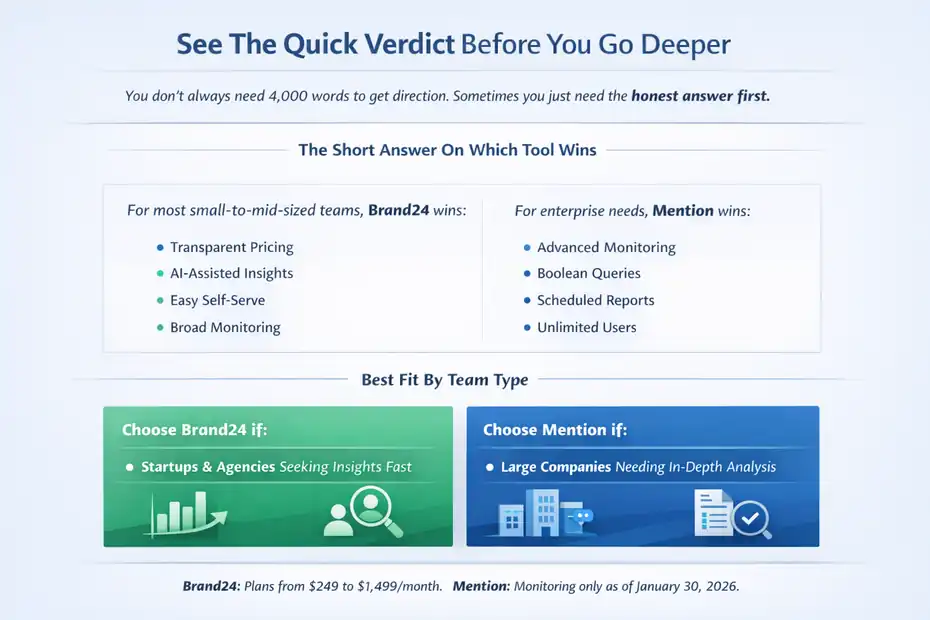
You do not always need 4,000 words to get direction. Sometimes you just need the honest answer first.
The Short Answer On Which Tool Wins
For most small-to-mid-sized teams, I would give the edge to Brand24. It has public pricing, a clearer self-serve path, deeper AI-assisted analysis, broader visibility into what is happening around your monitored terms, and more obvious value if you care about insights rather than raw alerts.
It also includes transparent plans from $249 per month for Individual, $349 for Team, $499 for Pro, $699 for Business, and Enterprise from $1,499, with annual discounts shown on the pricing page.
Mention is still a serious option, especially for companies that want an enterprise-oriented listening setup, advanced Boolean query control, unlimited users on the Company Plan, scheduled reporting, and a more sales-led buying motion.
But there is one huge change you should know: as of January 30, 2026, Mention no longer supports creating, scheduling, publishing posts, or replying and managing conversations from within the product. Monitoring and analytics remain, but publishing and engagement moved out.
That change narrows the role Mention plays in your stack. If you previously saw Mention as a hybrid social media management platform, that assumption is now outdated.
Best Fit By Team Type
Here is the simplest way I would frame it:
- Choose Brand24 if: You want self-serve pricing, stronger AI-assisted interpretation, influencer analysis, clearer dashboards for non-technical users, or better value for growing brands and agencies.
- Choose Mention if: You want a listening-focused enterprise setup, advanced Boolean-based monitoring, scheduled reports, cross-team access with unlimited users, and you are comfortable going through sales for the current Company Plan.
I would not overcomplicate the recommendation. If you are a startup, agency, SaaS company, DTC brand, or lean marketing team that wants usable insights quickly, Brand24 is easier to justify.
If you are a larger organization with more formal workflows and stakeholder reporting needs, Mention deserves a closer look.
Compare Core Monitoring And Data Coverage
This is where buyers often get distracted by marketing language. “Millions of sources” and “real-time monitoring” sound nice, but what matters is what you can actually track and filter.
Which Sources Each Tool Monitors
Brand24 states that it tracks conversations across sources including Facebook, Instagram, X, news, blogs, Reddit, LinkedIn, Medium, Quora, YouTube, TikTok, reviews, Twitch, newsletters, and podcasts, depending on plan level and configuration. Its FAQ also says it collects mentions from more than 25,000,000 sources.
Mention says its monitoring analyzes mentions from over 1 billion sources in real time, and its current Company Plan documentation specifically references Reddit, X, Facebook, Instagram, news, forums, blogs, and the web.
The exact “which tool has more sources” question is harder than it looks because vendor counting methods differ. One platform may count domains differently than another. One may highlight total indexed sources while another emphasizes active searchable sources. I would not treat those numbers as apples-to-apples.
What I would trust more is practical source relevance. If your brand depends on Reddit, news pickups, creator discussions, YouTube chatter, and niche web mentions, Brand24’s source list feels easier to evaluate from the outside because it is more explicit on the pricing page.
Mention absolutely covers major monitoring channels, but it is less transparent publicly about day-to-day usage boundaries unless you go deeper into support or sales.
Query Flexibility And Noise Reduction
Good listening is not just data collection. It is noise reduction. Otherwise you end up tracking every irrelevant use of your brand name and wasting half your time cleaning data.
Brand24 explains that users can refine keywords with required or excluded words using Boolean search and can limit projects by language, source, or specific sites. Mention’s Company Plan explicitly highlights advanced Boolean searches as part of its current offer.
This matters a lot if your brand name is also a common word, a person’s name, or a broad phrase. Think of a startup called “Glow,” “Current,” or “Notion Labs.” Without exclusions and keyword logic, your data turns useless fast.
My take is that both tools can handle serious monitoring logic, but Mention seems to emphasize Boolean depth and structured listening more directly. Brand24 feels more approachable for marketers who want strong filtering without feeling like they are writing a mini search-engine query every day.
Compare Analytics, Sentiment, And Insight Depth
This is the section that usually decides the winner for serious teams.
Brand24’s Analytics Advantage
Brand24 goes beyond simple mention collection with sentiment analysis, Presence Score, trending hashtags, active and influential authors, comparison views, topic analysis, AI Insights, AI Events Detection, AI Brand Assistant, and customizable PDF and email reporting.
Higher plans add real-time updates, Lightning Search, AI Topics, and more advanced reporting support.
That combination is powerful because it reduces the “now what?” problem. A lot of listening tools are decent at telling you that something happened. Brand24 is trying to tell you what changed, what matters, and which angle deserves attention.
A realistic example: Say your SaaS company launches a pricing update. Mention volume jumps 220% over two days. With Brand24-style analysis, you can break that into sentiment direction, which channels drove the spike, which influencers amplified it, what related phrases appeared most often, and whether the discussion clustered around value, confusion, or backlash. That is much closer to decision support than basic monitoring.
I believe this is why Brand24 currently feels more modern in actual use. The product is not only surfacing posts. It is trying to interpret the conversation for you.
Mention’s Analytics Strengths And Limits
Mention still offers valuable indicators like influence and sentiment on its public product page. The Company Plan also includes exports, scheduled reports, advanced listening, collaboration, and optional upgrades such as historical data and API access.
That makes it a credible analytics tool, especially if your team already knows what questions to ask and mainly needs structured monitoring plus reporting. There is a difference, though, between “analytics available” and “analytics proactively guided.” Mention looks more like the former from its current public documentation.
This is not necessarily bad. Some enterprise teams prefer cleaner reporting, control, and custom workflows over more opinionated AI interpretation. But for many buyers, especially marketing teams without a dedicated insights analyst, Brand24’s extra guidance will feel more immediately useful.
So if your main priority is insight depth with less manual interpretation, Brand24 wins this round for me.
Compare Reporting, Collaboration, And Daily Workflow
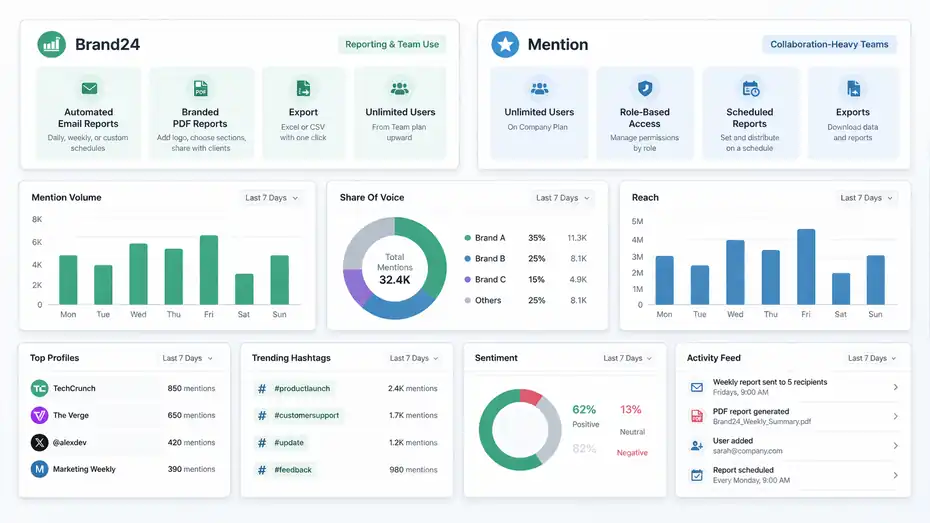
A tool can be great in a demo and still fail in daily usage. Reporting and collaboration decide whether insights actually get shared.
How Brand24 Handles Reporting And Team Use
Brand24 supports automated email reports, branded PDF reports, Excel or CSV export, and customizable report sections including mention summaries, volume and reach graphs, top profiles, trending hashtags, and discussion context. It also offers unlimited users from the Team plan upward.
This is useful if you report to clients, leadership, or multiple departments. Agencies in particular benefit from branded PDFs because clients often do not want dashboard access. They want a clean summary with charts and recommendations.
A practical scenario: Imagine you manage social listening for three ecommerce clients. Every Friday, you need a summary showing weekly mention volume, top media hits, emerging complaints, and campaign sentiment. Brand24 already fits that agency rhythm well. You can package information without making every stakeholder log into the platform.
I also like that Brand24’s plan structure clearly shows where unlimited users kick in. That removes friction when a founder, PR lead, or customer support manager suddenly wants visibility.
How Mention Fits Collaboration-Heavy Teams
Mention’s current Company Plan includes unlimited users, workspace management, role-based access, exports, and scheduled reports. That tells me the product is clearly designed for larger teams that need governed collaboration, not just one marketer checking mentions alone.
Where Mention loses ground for some buyers is public transparency. You can confirm the Company Plan exists and includes serious features, but the buying path is less self-serve and more consultative. That is fine for enterprises. It is less fine for a five-person team trying to compare tools in one afternoon.
I would summarize it like this: Mention looks strong for structured collaboration. Brand24 looks easier to adopt, easier to price, and easier to operationalize quickly.
Compare Pricing, Value, And Buying Friction
This part matters more than many marketers admit. The best tool is not helpful if your team cannot justify it internally.
Brand24 Pricing Is Clear And Easy To Model
Brand24’s pricing page is refreshingly straightforward. Current monthly pricing is listed as $249 for Individual, $349 for Team, $499 for Pro, $699 for Business, and Enterprise from $1,499, with lower annual-billing equivalents displayed as $199, $299, $399, and $599 respectively for the first four tiers.
The plans also show keyword counts, mention limits, user access, and update frequency.
That transparency is a real advantage. You can roughly estimate your cost based on how many brands, campaigns, or competitors you want to monitor and how many mentions you expect.
For example:
- Small brand: Individual may work if you only need 3 keywords and 2,000 mentions monthly.
- Lean internal team: Team looks more realistic with 7 keywords, 10,000 mentions, unlimited users, and hourly updates.
- Agency or growth-stage company: Pro or Business makes more sense because of higher mention caps, real-time updates, and more advanced AI capabilities.
I personally trust tools more when they publish pricing this clearly. It lowers buying friction and makes procurement easier.
Mention Pricing Is More Enterprise-Led Now
Mention’s official support documentation says the Company Plan is its current offering and that older self-serve plans like Solo, Pro, Pro Plus, and Company Lite are legacy plans no longer available. It also notes that historical data and API are upgrades rather than standard inclusions.
That means the practical pricing reality is this: Mention is now a quote-led product for current buyers. If you want a clean public starter price you can compare instantly, you do not really get that from the current official docs.
For some buyers, that is fine. Enterprises are used to custom pricing. But for many teams doing a straightforward brand24 vs mention comparison, it creates uncertainty around value.
I would treat the pricing category as a strong win for Brand24, not only because it may be cheaper in many cases, but because it is far easier to evaluate.
Understand The Biggest Product Difference In 2026
This is the one issue I would not bury halfway down the page.
Mention Is No Longer A Publishing And Engagement Tool
Mention’s help center says that as of January 30, 2026, users can no longer create, schedule, or publish posts from Mention, and can no longer reply to or manage conversations from within Mention. Monitoring, alerts, feeds, and analytics continue to work.
That changes how you should evaluate the platform.
A lot of older comparison content still treats Mention as a combined social media management and listening tool. That is not the right way to frame it now. Today, Mention should be judged primarily as a listening, monitoring, and analytics solution.
This matters because some buyers want one platform for publishing, engagement, and listening. Mention is no longer that all-in-one option. Brand24 is not pretending to be a publishing suite either, so in a strange way this makes the comparison cleaner: it is now much more about listening capability.
Why This Matters For Real Teams
If you run a small team and hoped to manage posting plus monitoring inside one environment, you now need an additional workflow for publishing and responses if you choose Mention. That introduces more operational complexity, even if your listening setup is strong.
For enterprise teams, this may not be a dealbreaker. Many already separate publishing, customer care, PR monitoring, and analytics across multiple platforms. But for startups, agencies, and mid-market teams, losing native publishing and engagement can be a meaningful downside.
I would not call this a fatal flaw. I would call it a scope change. Mention still has value, but the value proposition is narrower than some older reviews suggest.
Match The Right Tool To Your Use Case
This is where the comparison becomes genuinely useful.
Best Choice For Startups, Ecommerce Brands, And Agencies
Brand24 is the stronger fit for most growth-focused teams that need quick setup, transparent pricing, and insight depth without enterprise procurement friction.
Its plans map well to staged growth, and features like AI sentiment, influencer analysis, topic clustering, and branded reports make it easier to convert raw mentions into action.
A few examples where I would lean Brand24:
- DTC ecommerce brand: Track product mentions, campaign hashtags, review chatter, and competitor buzz in one place.
- B2B SaaS startup: Monitor launch response, sentiment around pricing or outages, and competitor comparisons.
- Agency: Create multiple monitoring projects, export reports, and show clients something polished without a complex procurement cycle.
In my view, Brand24 feels especially strong where one person has to wear multiple hats. If you are the marketer, analyst, and client communicator at the same time, it gives you more help.
Best Choice For Enterprise Monitoring Workflows
Mention is a better fit if your organization values advanced Boolean listening, structured workspaces, unlimited users, scheduled reporting, and a more formal company plan environment.
I would lean Mention for cases like these:
- Corporate communications team: Monitor brand reputation, executives, product terms, and crisis signals across large listening queries.
- PR-heavy organization: Use exports and scheduled reports to support recurring executive reporting.
- Teams with established tool stacks: Add Mention as a listening layer rather than expecting it to manage publishing too.
Mention makes more sense when listening is one governed component in a broader ecosystem, not the scrappy all-purpose tool for a small team.
Avoid The Common Mistakes People Make When Choosing
A lot of tool regret comes from bad evaluation, not bad software.
Mistake 1: Comparing Old Product Versions
This is the most obvious trap. Many articles still compare older versions of Mention that included publishing and response tools. That is no longer current as of January 30, 2026.
If you compare based on outdated assumptions, you might choose Mention expecting an all-in-one workflow and only discover later that publishing now lives elsewhere. That creates unnecessary migration pain.
Mistake 2: Buying Based On Source Count Alone
“25 million sources” versus “1 billion sources” sounds decisive, but source-count marketing is messy. What matters is whether the tool reliably tracks the channels your audience actually uses, lets you build clean queries, and gives you usable analytics.
I suggest focusing on four practical tests instead:
- Signal quality: Are the mentions relevant?
- Speed: Do important alerts appear fast enough for your use case?
- Interpretation: Can you understand what happened without exporting everything?
- Reporting: Can you share findings with decision-makers quickly?
The tool with better answers to those questions is the better tool for you, regardless of the bigger homepage number.
Mistake 3: Ignoring Buying Friction
This sounds boring, but it is real. A platform with unclear pricing, custom sales steps, or hidden add-on costs may become harder to keep than a tool with slightly fewer enterprise controls but stronger pricing clarity.
That is one reason Brand24 scores well in this comparison. The decision path is cleaner. For many of us, that matters.
Final Verdict: Which Social Listening Tool Is Best?
This is the conclusion most readers actually want.
My Recommendation For Most Buyers
If I had to recommend one winner for the average reader searching “brand24 vs mention comparison,” I would choose Brand24.
Why? Because it currently offers the stronger balance of transparent pricing, accessible self-serve adoption, AI-assisted analysis, broad reporting options, and growth-friendly plan structure. It is easier to evaluate, easier to buy, and easier to turn into day-to-day insight work.
That does not mean Mention is weak. Mention still looks like a legitimate enterprise-grade monitoring platform with strong listening coverage, advanced Boolean search, collaboration controls, scheduled reporting, and unlimited users on its current Company Plan.
But because Mention no longer handles publishing and engagement inside the platform, and because its current pricing path is less transparent, it is harder to recommend as the default choice for most teams in 2026.
The Simplest Decision Framework
Use this final shortcut:
- Choose Brand24 if you want the best overall balance of insights, usability, reporting, and transparent value.
- Choose Mention if your team needs a listening-first enterprise setup with strong query logic and formal collaboration, and you are fine with a sales-led buying process.
That is the honest answer.
If your team is still undecided, I would judge the tools on one real workflow: monitor one brand term, one competitor, and one campaign hashtag for a week. Then ask which platform made it easier to explain what happened and what to do next. In my experience, that test usually reveals the winner fast.
Quick Comparison Table
| Category | Brand24 | Mention |
|---|---|---|
| Primary focus | Social listening, analytics, AI-assisted insights | Social listening, monitoring, reporting, collaboration |
| Current pricing visibility | Public pricing listed by plan | Current official plan is Company Plan, pricing not publicly detailed in current official docs |
| Entry path | Self-serve trial and pricing | Demo / sales-led path for current plan |
| Users | 1 user on Individual, unlimited from Team up | Unlimited users on Company Plan |
| Monitoring sources | 25M+ sources; explicit source categories shown on pricing/docs | 1B+ sources claimed; official docs list major listening channels |
| Sentiment analysis | Yes | Yes |
| Boolean search | Yes | Yes, strongly emphasized |
| Reporting | Email reports, branded PDFs, CSV/Excel exports | Scheduled reports, exports |
| Publishing and replies | Not positioned as native publishing suite | Removed as of January 30, 2026 |
| Best for | Startups, agencies, ecommerce, lean growth teams | Larger organizations with structured listening workflows |
FAQ
What is the main difference between Brand24 and Mention?
The main difference in a brand24 vs mention comparison is that Brand24 focuses more on AI-driven insights and transparent pricing, while Mention is more enterprise-focused with advanced monitoring and reporting. Brand24 helps interpret data automatically, while Mention emphasizes structured listening and collaboration.
Which tool is better for small businesses, Brand24 or Mention?
Brand24 is generally better for small businesses because it offers clear pricing, easier setup, and user-friendly dashboards. It allows teams to quickly track mentions and generate insights without complex onboarding, making it ideal for startups, ecommerce brands, and agencies.
Does Mention still support social media publishing?
No, Mention no longer supports social media publishing or replying within the platform as of 2026. It is now focused purely on social listening, monitoring, and analytics, which changes how it fits into a marketing or social media management workflow.
Is Brand24 worth the cost for social listening?
Yes, Brand24 is considered worth the cost for many teams because it combines monitoring, sentiment analysis, influencer tracking, and AI insights in one platform. Its pricing is transparent, and the value comes from turning raw mentions into actionable marketing and PR insights.
Which tool provides better analytics, Brand24 or Mention?
Brand24 provides deeper built-in analytics with AI-powered insights, sentiment tracking, and topic analysis. Mention offers solid reporting and monitoring, but Brand24 is generally better for users who want automatic interpretation of data rather than manual analysis.

I’m Juxhin, the voice behind The Justifiable.
I’ve spent 6+ years building blogs, managing affiliate campaigns, and testing the messy world of online business. Here, I cut the fluff and share the strategies that actually move the needle — so you can build income that’s sustainable, not speculative.
Related posts:
 Brand24 Pros And Cons For Businesses: Honest Breakdown
 Audience Data Targeting: Top Tools to Transform Your Business
 Top Brand24 Competitors Offering Excellent Value
 Sprout Social Listening: How It Works for Brands
 Brand24 Missing Mentions Troubleshooting: Quick Fix Guide
 Brand24 Pricing Explained: What You Really Pay For