
Table of Contents
Some links on The Justifiable are affiliate links, meaning we may earn a small commission at no extra cost to you. Read full disclaimer.
Debutify pricing explained can feel oddly confusing the first time you look at it, mostly because Debutify now mixes a free entry point, recurring theme subscriptions, annual discounts, and a separate lifetime-style option called Debutify Prime.
If you are trying to figure out the real monthly cost, what you actually get, and where the traps are, this guide is for you.
I went through Debutify’s official pricing, comparison, refund, and product pages so you can make a cleaner decision before you commit your store design, budget, and growth plans.
What Debutify Pricing Actually Looks Like Today
Debutify is no longer just a simple “one theme, one price” product.
The company now presents pricing through multiple paths, and that is exactly why many store owners feel friction before buying.
Debutify Is Selling More Than One Pricing Model
The first thing to understand is that Debutify has two main theme-related buying paths: the regular Debutify Theme subscription and Debutify Prime, which is positioned as a one-time payment option.
On Debutify’s own comparison content, the subscription product is described as monthly or yearly, with a free plan available, while Debutify Prime is described as one-time payment only and without the same ongoing AI tools or feature evolution.
That distinction matters because the cheapest-looking option is not always the one with the best long-term fit.
In practical terms, this means you are not just asking, “How much is Debutify?” You are really asking three questions at once: Do I want free or paid access, do I want subscription or lifetime-style access, and do I need the newer tools and support that live inside the subscription version?
That is the real buying decision hiding underneath the pricing page.
I think this is where a lot of people go wrong. They compare Debutify to a flat-fee Shopify theme and miss the fact that Debutify is also trying to replace some separate conversion apps. If you do not account for that, the pricing looks expensive. If you do account for it, the math can swing the other way.
Debutify itself claims its setup can reduce third-party app costs and says merchants can save thousands annually by consolidating features. That claim is marketing language, so I would treat it as directional rather than guaranteed, but it does explain the structure.
The Official Numbers Are Real, But They Are Not Presented Perfectly
On Debutify’s own pages, the clearest recurring signals are these: there is a free plan, there are four pricing plans total for the theme, there are monthly and yearly billing options, and paid access starts at roughly the low-$20 range per month, with some official pages citing “starting at $19.50/month,” while other official snippets show annual-billed promotional pricing around $15.60 per month.
Other Debutify comparison pages simplify the entry paid price as “as low as $39/month,” which suggests some pages are speaking about higher tiers, different billing modes, or older pricing snapshots.
That inconsistency is not ideal, but it is common with SaaS and ecommerce tools that run promotions, A/B test landing pages, or maintain comparison content separately from core pricing pages.
From what I can verify in Debutify’s own materials, you should expect a free plan, paid subscription tiers, annual discounts, and a separate lifetime-style path rather than one universally consistent public number everywhere you look.
My advice is simple: Never buy Debutify based on one price screenshot from a blog post or comparison page. Check the live checkout or official pricing page before paying, because Debutify’s own refund policy also says pricing plans may change and subscribers will be notified in advance of changes.
The Debutify Plans, Costs, And What They Usually Mean

This is the part most people want: what the plans probably mean in real store terms, not just plan names on a landing page.
Free Plan: Good For Testing, Weak For Serious Conversion Work
Debutify clearly offers a free plan for the theme. Across its own pages, that free entry point is framed as a starting option for entrepreneurs and early-stage stores, and several comparison pages emphasize that you can start for free before moving up.
That makes the free plan useful for learning the theme interface, testing layouts, and seeing whether Debutify’s workflow feels better than a standard Shopify theme.
The trap is assuming “free” means “enough.” In most cases, free is not the plan people are really talking about when they praise Debutify’s conversion performance.
The paid product is where Debutify places its stronger CRO tools, more widgets, broader support, and continuous releases.
So if your business model depends on upsells, urgency blocks, trust elements, or a more polished sales flow, the free plan is better viewed as a trial lane than a forever solution.
Imagine you are running a small dropshipping store with 15 products and you just want to launch quickly. The free plan might honestly be enough for week one.
But if you are already spending on ads, even a small increase in add-to-cart rate or average order value matters more than the savings from avoiding a paid tier.
That is why I usually see free as a diagnostic tool, not the final destination.
Paid Subscription Plans: Best For Stores That Need Ongoing Growth Tools
Debutify’s own content describes the subscription version as the more complete option for scaling brands because it includes continuous feature rollouts, AI tools, live chat and email support, frequent compatibility updates, and the broader “grows with your business” angle.
That framing is important because it tells you what the subscription is really charging for: not just the theme file, but the ongoing product layer around it.
Official Debutify materials point to paid pricing starting around $19.50 per month, with other official snippets showing annualized offers closer to $15.60 per month, and comparison pages sometimes referencing “as low as $39/month.”
The cleanest way to interpret this is that Debutify has multiple paid tiers, often discounted on annual billing, and different pages emphasize different starting points or plan tiers.
That might sound messy, but the buying logic is still pretty clear. Choose a paid subscription if you want the theme plus ongoing releases, newer AI-oriented tools, onboarding help, and the confidence that Debutify is actively maintaining the product in a fast-moving Shopify ecosystem.
For many merchants, especially those making regular changes to product pages and promotions, that is worth more than a one-time purchase.
Debutify Prime: Attractive Up Front, But Not The Same Product Experience
Debutify Prime is presented as the one-time payment route. On Debutify’s own content, Prime is described as a lifetime-style license with one-time pricing starting at $99 in one official article, while other official comparison content mentions a one-time purchase at $399.
Debutify also says Prime focuses mainly on the theme itself, gives basic lifetime updates, and does not include the ongoing AI tools or the same subscription-style support model.
That price spread tells me one of two things is happening: Either Debutify Prime has multiple license levels, or official pages were published under different promotions or plan structures.
Either way, the important takeaway is not the single number. It is the trade-off. Prime is cheaper over time only if you truly do not need the evolving feature stack of the subscription product.
I would only lean Prime if you are the kind of merchant who values predictable one-time software costs, uses a relatively stable storefront, and does not care much about newer growth features.
If you like active support, frequent product changes, and integrated tools, Prime may look cheaper but feel limiting.
How To Calculate Your Real Debutify Cost
This is where “pricing explained” becomes useful instead of theoretical. Your real cost is rarely just the sticker price.
Start With The Theme Price, Then Add The Shopify Reality
Debutify is a Shopify theme product, so you still need Shopify underneath it. Debutify’s home page is explicit about Shopify trials and positioning around Shopify stores, which means Debutify is not replacing your ecommerce platform cost. It is sitting on top of it.
So your real monthly cost formula usually looks like this: Shopify plan + Debutify plan + any apps Debutify does not replace + payment processing fees + optional services like email tools, review software, subscriptions, or fulfillment tools.
A lot of first-time buyers mentally compare only “Debutify vs free theme,” when the smarter comparison is “Debutify plus fewer apps vs cheaper theme plus more apps.” That is a much more honest budgeting model.
Here is a simple way to think about it:
| Cost Layer | What To Check |
|---|---|
| Platform | Your Shopify subscription |
| Theme | Debutify free, paid subscription, or Prime |
| Missing Features | Extra apps still needed |
| Billing Mode | Monthly vs annual savings |
| Commitment Risk | Auto-renewal, refund limits, upgrade path |
That table might seem basic, but it saves money. I have seen store owners buy a premium theme, then spend another $50 to $200 a month on app stack clutter because the theme did not actually solve their workflow.
Annual Billing Can Lower Cost, But It Raises Commitment
Debutify’s official materials show annual discounts and promotional language such as “save 25%,” and official snippets also show lower annual-billed monthly equivalents. That means annual billing can absolutely improve your effective rate.
The trap is that annual billing lowers monthly math while increasing commitment risk. If you are not confident that Debutify matches your store model, the cheapest monthly-equivalent plan may actually be the most expensive decision.
A theme that saves you $10 or $15 a month is not a bargain if you abandon it after six weeks. This is especially relevant for beginners still changing niches, product catalogs, or branding direction.
My suggestion is to earn your way into annual billing. Use free access or a short paid period first, validate that the theme genuinely improves your setup speed and merchandising flow, then move to annual once you know you will stick with it.
Trial Terms Matter More Than Most People Realize
Debutify’s refund policy says the company offers a free trial, and it also states that if the trial is not canceled before it ends, the customer is automatically subscribed to the selected plan and the applicable fee is charged.
The same policy says subscription fees are non-refundable and renew automatically.
That is one of the biggest traps in this whole pricing model. Even if the theme itself is good, you still need to treat the trial like a billing event waiting to happen. Put the cancel date on your calendar. Save screenshots of the offer. Confirm which plan you selected.
Check whether you entered a payment method. Debutify’s policy page includes slightly mixed wording about payment details for trials, which is another reason not to assume anything.
For many of us, the best way to avoid regret is boring admin: screenshot the checkout, email yourself the renewal date, and review your store within 48 hours before the trial ends. That single habit prevents most “I forgot to cancel” complaints.
The Biggest Debutify Pricing Traps To Watch For
This is the part I wish more pricing guides handled honestly. The traps are usually not scams.
They are gaps between what a buyer assumes and what the product actually includes.
Trap 1: Confusing Subscription Debutify With Lifetime Debutify Prime
Debutify’s own pages make it clear that Debutify Theme and Debutify Prime are not the same experience. The subscription path includes ongoing AI tools, frequent updates, and broader support, while Prime is the one-time option with a more limited support-and-evolution model.
That matters because a lot of buyers see “lifetime” and assume “best deal.” But lifetime only wins when the product remains enough for your needs. If Debutify’s best new features continue landing in the subscription side, Prime can become the cheaper option that quietly costs you flexibility later.
A realistic example: Imagine a store owner buys Prime to avoid recurring fees, then six months later wants newer AI store tools, better onboarding, or tighter platform compatibility improvements. The one-time payment no longer feels like a final decision. It becomes a sunk cost on the way to a subscription anyway.
Trap 2: Reading Promotional Rates As Permanent Rates
Debutify uses promotional language, annual discounts, and comparison content that surfaces different entry price points. Official materials include figures like $19.50/month, around $15.60/month on annual billing, and “as low as $39/month” in some comparison pages.
That does not automatically mean anything deceptive is happening, but it does mean you need to verify the exact billing basis. Is the number monthly with annual prepay? Is it a limited-time promotion? Is it for one tier only? Is it before taxes? Is it a theme plan or a different Debutify product? These details matter because “cheap” can disappear at checkout.
I recommend treating every advertised price as a headline, not a final invoice. The invoice is what counts.
Trap 3: Assuming Refunds Will Save You Later
Debutify’s refund policy is strict. It says subscription fees are non-refundable, subscriptions renew automatically, and refunds are generally limited to cases like overcharges or technical double charges. It also states that the lifetime plan is non-refundable.
That means you should not buy Debutify with a casual “I’ll just refund it if I change my mind” mindset. In my experience, that assumption causes more frustration than the actual price itself. If the billing model is strict, the decision needs to be intentional upfront.
This is also why I suggest using the free plan or short testing window for real evaluation, not just browsing the dashboard. Build a collection page. Edit a product template. Test mobile layout. Check speed. Make the trial period do actual work.
Trap 4: Overestimating How Many Apps Debutify Replaces
Debutify leans heavily into the “stop overpaying for apps” angle and mentions built-in widgets and conversion tools throughout its official pages. That value proposition is real, but it is also easy to oversell to yourself.
Not every merchant uses the same app stack. Some stores still need specialized review tools, subscription apps, B2B functionality, localization, advanced search, custom bundle logic, or post-purchase systems. In other words, Debutify can reduce app spend, but it does not automatically erase it.
A smart buyer estimates replacement value feature by feature. Do not say, “This theme replaces apps.” Say, “This theme replaces these four apps for my store.” That is how you get to a real ROI number.
Which Debutify Plan Makes Sense For Different Store Types
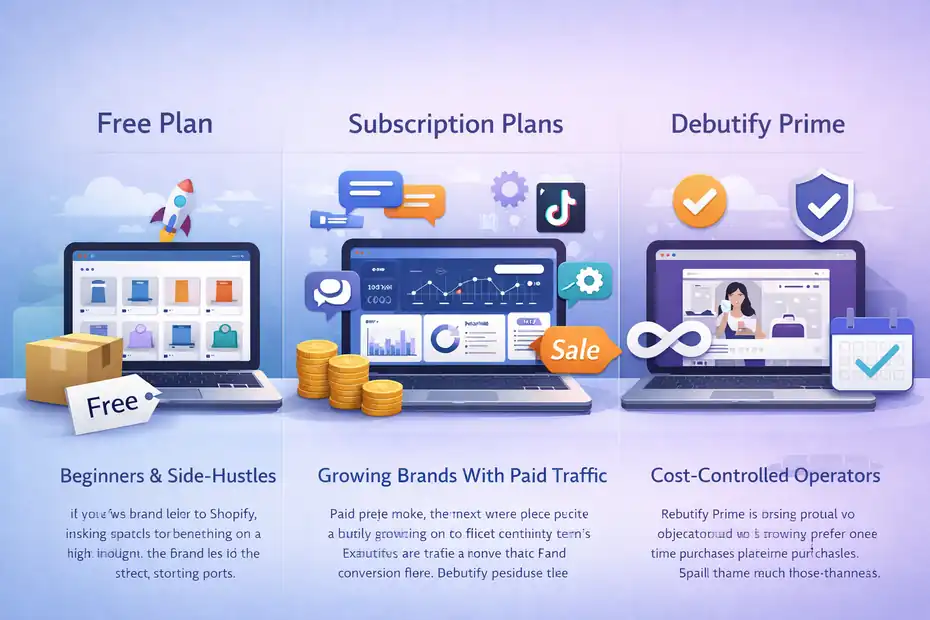
This is where the buying decision gets easier. The right plan depends more on store stage than on price alone.
Best Fit For Beginners And Side-Hustle Stores
If you are brand new to Shopify, testing a niche, or launching on a tight budget, the free plan is the safest starting point. Debutify’s own materials clearly support the idea that free access exists as an entry path.
You are probably a good fit for free if your goals are simple: launch fast, avoid heavy coding, and see whether Debutify’s design system feels intuitive. This works especially well when your biggest risk is not conversion optimization yet. It is overcommitting too early.
I would move beyond free only after you have one of these signals: you are getting real traffic, you need more persuasive sales-page elements, or you are trying to increase average order value. Before that, your bigger problem is likely product-market fit, not theme sophistication.
Best Fit For Growing Brands With Paid Traffic
Paid plans make the most sense when you are already spending on traffic or running a store that lives and dies on presentation and conversion flow. Debutify positions the subscription theme as the better match for scaling brands, and that lines up with common sense.
If you are sending visitors from Meta ads, TikTok, email campaigns, or search, even small conversion gains matter. In that environment, a stronger product page, better trust signals, and smoother merchandising can justify a paid theme much faster than most people expect.
A rough thought exercise: if a paid plan costs around $20 to $40 a month, the question is not “Is that cheap?” The better question is “Can this help me generate one or two extra orders monthly?” For many stores, that is the more useful frame.
Best Fit For Cost-Controlled Operators Who Hate Recurring Software
Debutify Prime is better suited to operators who strongly prefer one-time software purchases and stable store builds. Debutify’s own content positions Prime as more suitable for small stores and first-time founders who want the theme access itself without the broader ongoing stack.
I understand the appeal. Recurring software creep is real, and some merchants are exhausted by yet another monthly fee.
But I would only choose Prime if you are honest about your habits. If you frequently want new features, faster support, or upgraded tooling, Prime is probably not your ending point.
The cheapest plan is the one you do not have to replace later.
How To Choose Without Regretting It
At this stage, the smartest move is not picking the cheapest plan. It is picking the plan that matches your next 90 days.
Use A Simple Decision Filter
Here is the filter I would use:
- Choose Free: You are testing a new store, learning Shopify, or validating products.
- Choose Paid Subscription: You want ongoing feature releases, support, and stronger conversion tooling.
- Choose Annual Billing: You already know Debutify fits your workflow and you want lower effective cost.
- Choose Prime: You want a one-time theme purchase and can live without the subscription product’s evolving extras.
That framework is boring, but it works because it aligns pricing with actual business stage instead of hope.
Ask These Questions Before You Pay
Before you buy, answer these in writing:
- What feature am I actually paying for? Faster launch, better conversion tools, support, or fewer apps?
- What apps will this replace for my store? Name them.
- Am I okay with auto-renewal and limited refunds? Debutify’s policy matters here.
- Would a one-time license frustrate me if subscription-only improvements keep growing? Debutify’s own positioning suggests that is possible.
If you can answer those clearly, you are already ahead of most buyers.
Final Verdict On Debutify Pricing
Debutify pricing explained in plain English comes down to this: The brand offers a free starting point, paid subscription plans for merchants who want the full evolving experience, annual discounts for lower effective monthly cost, and a separate Debutify Prime one-time option for people who value fixed software spend.
The confusion comes from inconsistent pricing snapshots across official pages, promotional rates, and the fact that Debutify Theme and Debutify Prime are not interchangeable products.
My honest take is that Debutify is worth considering if you want a conversion-focused Shopify theme and you are evaluating it as part of your total stack, not as an isolated monthly fee.
The biggest mistakes are buying too much plan too early, assuming refund flexibility that is not really there, and misunderstanding the difference between subscription Debutify and Prime. If you avoid those traps, the pricing becomes much easier to judge.
If you want, I can turn this into a publish-ready SEO article with meta description, FAQ schema, and internal link anchors.
FAQ
What is Debutify pricing and how does it work?
Debutify pricing includes a free plan, paid monthly or yearly subscriptions, and a one-time option called Debutify Prime. The subscription plans offer ongoing updates, support, and tools, while Prime provides lifetime theme access without continuous feature upgrades or advanced tools.
Is Debutify free or paid?
Debutify offers a free plan that lets you use the theme with limited features. However, most advanced tools, integrations, and optimization features are only available in paid plans, which are designed for growing stores that need higher conversion performance and flexibility.
How much does Debutify cost per month?
Debutify pricing starts around $19.50 per month on lower-tier plans, with discounts available for annual billing. Depending on features and promotions, higher plans can cost more, so it’s important to check the latest pricing directly before purchasing.
Is Debutify Prime better than subscription plans?
Debutify Prime is a one-time payment option that includes lifetime access to the theme, but it lacks ongoing updates and newer tools found in subscription plans. It’s better for users who prefer fixed costs, while subscriptions suit those needing continuous improvements.
Are there hidden costs in Debutify pricing?
Debutify pricing does not have hidden fees, but costs can increase if you choose higher-tier plans, annual billing, or still require third-party apps. Also, subscriptions renew automatically and are generally non-refundable, which can catch users off guard.

I’m Juxhin, the voice behind The Justifiable.
I’ve spent 6+ years building blogs, managing affiliate campaigns, and testing the messy world of online business. Here, I cut the fluff and share the strategies that actually move the needle — so you can build income that’s sustainable, not speculative.
Related posts:
 Viral Launch Chrome Extension: The Ultimate Tool for Sellers
 Ecommerce Automation That Saves Time Without Breaking Sales
 Salehoo Directory Free: What You Can Access Without Paying
 Doba Alternatives: Better Dropshipping Platforms Compared
 Debutify Shopify Theme Review: Powerful or Overrated?
 AppScenic Pros And Cons For Dropshipping