
Table of Contents
Some links on The Justifiable are affiliate links, meaning we may earn a small commission at no extra cost to you. Read full disclaimer.
Does QuillBot rewrite better than ai humanizer tools? In most real writing situations, I’d say QuillBot often produces cleaner, more controllable rewrites, while dedicated AI humanizer tools usually push harder to make text sound less robotic.
The catch is that “better” depends on what you actually need: clarity, tone control, originality, speed, or heavy rewriting.
If you are choosing between QuillBot and AI humanizer tools for blog posts, emails, essays, product pages, or SEO drafts, this guide will help you figure out which one fits your workflow without wasting time or money.
What This Comparison Really Means
This topic sounds simple, but the real comparison is not tool versus tool. It is rewrite quality versus rewrite intent.
What “Rewrite Better” Usually Means In Practice
When most people search this phrase, they are not asking whether one button changes more words than another. They are asking whether the output sounds better, reads naturally, keeps meaning intact, and still feels usable without a long cleanup pass.
In my experience, rewrite quality comes down to five things. First, does the tool preserve your original meaning? Second, does it improve flow instead of just swapping synonyms? Third, can you control the tone?
Fourth, how much editing do you still need to do afterward? Fifth, does the result still sound like a real person instead of a machine doing word replacement?
That is why this comparison gets messy. QuillBot is built around paraphrasing and broader writing support, while many AI humanizer tools are built around “humanizing” text and, in some cases, detector-oriented positioning.
QuillBot’s current product pages highlight paraphrasing, grammar, summarizing, tone support, and a wider writing suite. By contrast, some humanizer tools explicitly market detector-passing or “undetectable” positioning as a core value proposition.
So when someone asks, “Does QuillBot rewrite better than ai humanizer tools,” the honest answer is this: QuillBot usually wins for controlled paraphrasing and editing quality, while AI humanizer tools often aim for stronger surface-level “human” variation, sometimes at the cost of accuracy, voice consistency, or clean structure.
The Core Difference Between A Paraphraser And A Humanizer
A paraphraser tries to restate your meaning. A humanizer tries to make text feel more natural, less formulaic, and less obviously AI-shaped. Those goals overlap, but they are not identical.
Let me break that down with a simple scenario. Imagine you have a 700-word draft product review written by AI. It is factually okay, but the tone feels stiff and repetitive.
A paraphraser like QuillBot usually helps you tighten sentences, vary wording, and smooth transitions without wildly changing the message. A humanizer tool is more likely to reshape sentence rhythm, inject contractions, soften patterns, and break predictable AI phrasing.
That sounds great until the tool starts overcorrecting. Some humanizers can introduce odd word choices, blur nuance, or make a professional passage sound casually rewritten. This is why the best output is not always the most aggressively “humanized” output.
I believe that for serious work, especially client writing, academic editing, business copy, and SEO content, controlled rewriting matters more than flashy rewriting. You need an output you can trust, not just one that looks different.
How QuillBot Works Compared With Ai Humanizer Tools
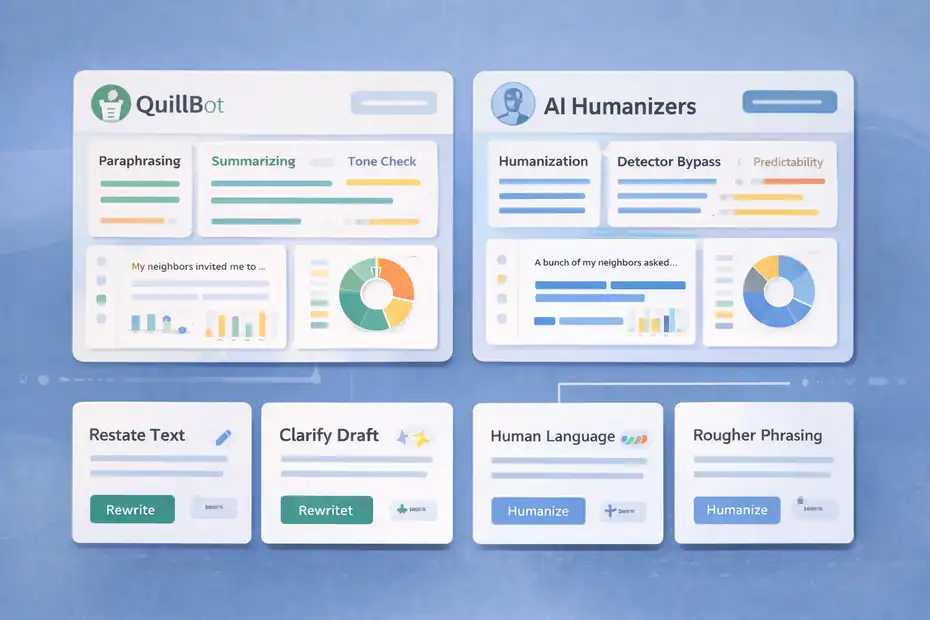
Before deciding which is better, you need to understand what each category is trying to optimize.
How QuillBot Approaches Rewriting
QuillBot positions itself as a writing platform rather than just a single rewrite gimmick. Its product pages center on paraphrasing, grammar correction, summarization, tone analysis, and related writing support. Even the pricing page frames rewriting as part of a larger workflow instead of a one-purpose “make this text undetectable” function.
That matters because it shapes the output. QuillBot tends to rewrite with a stronger emphasis on sentence-level clarity and structure. It often feels like an editor that is trying to preserve your draft while cleaning it up. For many of us, that is exactly what we want when fixing awkward passages, simplifying dense sections, or reducing repetition.
A practical strength here is control. When a tool is built around paraphrasing, the user usually has a clearer relationship with the rewrite. You are not asking it to magically make text “more human.” You are asking it to restate, clarify, shorten, or improve. That narrower task often produces more stable results.
I suggest thinking of QuillBot as a revision assistant. It is not just trying to disguise text. It is trying to reshape it into a better draft.
How Ai Humanizer Tools Usually Approach Rewriting
Most AI humanizer tools are designed around a different promise: making AI-generated text sound more human. On official pages, some go further and directly promote detector-passing language, “undetectable” claims, or bypass-style positioning.
Undetectable AI’s pages emphasize detector outcomes, and HumanizerPro’s public pages similarly frame humanization around sounding human and avoiding AI detection.
That positioning affects how they rewrite. Humanizers often target signals like sentence predictability, repetitive cadence, generic transitions, and polished-but-empty AI phrasing. In plain English, they try to rough up the text just enough to feel less machine-made.
Sometimes that works surprisingly well. A bland AI paragraph can become more readable after a humanizer breaks long sentence patterns, adds conversational phrasing, and removes overused expressions. But the downside is real: the more aggressively a tool chases “human-sounding,” the more likely it is to distort meaning or flatten precision.
This is why I do not think “humanized” automatically means “better written.” Humanized can mean less predictable. It can also mean less accurate.
Where QuillBot Usually Rewrites Better
This is where the comparison becomes useful. There are clear situations where QuillBot has the advantage.
QuillBot Is Usually Better For Controlled Clarity
If your main goal is to improve readability while keeping the original point intact, QuillBot usually does the job more cleanly. It tends to be better suited for business writing, article cleanup, emails, study notes, and any draft where accuracy matters more than transformation.
Imagine you wrote a service page that says the right things but sounds repetitive. You do not want the message reinvented. You want cleaner phrasing, smoother sentence flow, and fewer clunky lines. That is exactly the kind of job where a paraphrasing-first system often beats a humanizer.
I have seen this matter a lot in SEO writing. Search-friendly content already walks a fine line between helpful and repetitive. If you over-humanize it, you can end up with weaker keyword relevance, looser structure, or vague claims. QuillBot’s approach is often safer because it rewrites closer to the original intent.
This also helps with consistency. When you are editing a long article, product description set, or landing page sequence, you want the voice to stay stable across sections. Humanizer tools can sometimes make one paragraph sound casual, the next overly dramatic, and the next oddly generic. Controlled paraphrasing usually creates fewer surprises.
QuillBot Often Wins On Meaning Preservation
Meaning preservation is one of the biggest reasons people keep coming back to QuillBot-style rewriting. A rewrite that sounds fresh but subtly changes the claim is not a win.
Let’s say you have a line like this: “Our onboarding process reduces setup delays for remote sales teams.” A strong paraphrase might become: “Our onboarding process helps remote sales teams get started faster with fewer setup delays.” That keeps the original claim intact.
A weaker humanizer-style rewrite might become: “Our team setup method helps sales groups start more smoothly.” That sounds natural enough, but it softens or alters the meaning. “Remote” disappears. “Onboarding process” becomes vague. “Reduces setup delays” becomes “start more smoothly,” which is not quite the same thing.
That difference matters in SaaS copy, medical content, legal explanations, product specs, academic summaries, and pretty much any text where precision is doing real work.
In my opinion, this is the strongest argument for QuillBot when someone asks, “Does QuillBot rewrite better than ai humanizer tools?” Better writing is not just about sounding relaxed. It is about saying the right thing clearly.
QuillBot Is Stronger For Revision Workflows
QuillBot also fits better into normal editing workflows because it behaves more like a rewriting layer inside a broader writing process. Its platform includes grammar and summarization support in addition to paraphrasing, and that wider workflow can reduce the number of tools you need open at once.
That sounds minor, but it adds up. If you are revising a blog post, you might do this:
- Edit the rough sections with paraphrasing.
- Check awkward sentences with grammar support.
- Compress long sections with summarization.
- Review tone and clarity before publishing.
A dedicated humanizer is usually more narrow. It is often strongest at one dramatic pass rather than iterative editing. If you are doing real revision, QuillBot’s structure can feel more useful because it supports the actual work of writing, not just the cosmetic work of changing wording.
Where Ai Humanizer Tools Can Outperform QuillBot
QuillBot is not automatically better at everything. There are cases where dedicated humanizer tools have a real edge.
Humanizer Tools Can Break Ai Writing Patterns More Aggressively
AI-generated text often leaves fingerprints: repetitive openings, balanced sentence lengths, overuse of transitions, safe vocabulary, and a polished-but-flat tone. Humanizer tools are built specifically to target those patterns.
That means they can sometimes outperform QuillBot when the source text is heavily AI-generated and obviously artificial. If your draft is full of phrases like “In today’s fast-paced digital landscape,” “It is important to note,” and “By leveraging innovative solutions,” a humanizer may push harder to strip that corporate AI glaze away.
This is especially useful for first drafts that were generated too fast. You might paste in 1,000 words of generic AI output, and a humanizer will give you something with more contractions, varied pacing, and less textbook rhythm. It can make the text feel less polished in a good way.
The danger is that aggressive pattern-breaking is not the same as strong writing. It is often a good first pass, not a final draft. You still need human judgment to restore precision, facts, brand tone, and structure.
Humanizer Tools May Feel More Natural In Casual Content
For casual formats like personal blog intros, Reddit-style posts, short opinion pieces, informal emails, and creator scripts, a good humanizer can sometimes produce warmer wording than QuillBot.
That is because conversational writing is not just clean writing. It includes imperfection, rhythm changes, and little bits of personality. Some humanizer tools intentionally add those qualities. The result can feel more relaxed and less editor-polished.
Imagine a short creator newsletter. QuillBot might improve it, but keep it a little too neat. A humanizer might introduce looser phrasing that sounds more like a person talking. When the goal is “less polished, more natural,” that can be useful.
I would still treat this carefully. Casual should not mean sloppy. If a humanizer introduces filler, weak logic, or weird wording, you lose the benefit fast.
Humanizer Tools Are Often Built For A Different Buyer
Another reason humanizers can appear “better” is that they are built for users with a different goal. Some users are not looking for the cleanest paraphrase. They are looking for text that feels less AI-shaped after generation.
Vendor positioning makes that obvious. QuillBot emphasizes writing assistance and paraphrasing, while several humanizer tools foreground detector-facing or anti-robot language in their marketing. That does not automatically make them better, but it does mean they are tuned for a different expectation.
So if your draft is heavily AI-authored and your biggest complaint is “this sounds painfully machine-made,” a humanizer may give you a more dramatic before-and-after.
The Real Test: Output Quality By Use Case

The best comparison is use-case based, because “better” changes depending on the job.
For Blog Posts And SEO Content
For blog posts, service pages, buying guides, and SEO refreshes, I believe QuillBot is usually the safer choice. SEO content needs readability, yes, but it also needs topical consistency, search intent alignment, and controlled terminology.
If you use a heavy humanizer on optimized content, you risk losing keyword phrasing, internal consistency, and semantic relevance. A paragraph written around “email automation software for ecommerce” can turn into a looser paragraph about “smart messaging tools for online brands,” which may sound nice but weakens the page’s search precision.
A practical workflow many writers use is simple: draft, rewrite for clarity, then manually human-edit examples and opinions. That keeps the content useful and rankable without sounding robotic.
I suggest using QuillBot-like rewriting for structural cleanup and then adding your own human layer through examples, opinions, and specifics. That usually outperforms pure humanizer output for SEO because search content needs both clarity and authority.
For Academic And Research-Oriented Writing
For academic or research-oriented writing, meaning preservation matters even more. QuillBot-style paraphrasing is usually the better fit when you need to simplify or restate while keeping nuance intact.
That said, I need to be careful here: any tool-based rewriting in academic settings should follow the rules of your institution or publication. Also, detector scores are not a reliable proxy for authorship.
Turnitin itself states false positives are possible, Vanderbilt disabled Turnitin’s detector for a period over reliability concerns, and recent research has found detector accuracy varies widely with meaningful false-negative and false-positive risk.
So for academic use, the better question is not “Which tool beats detectors?” It is “Which tool helps me improve wording without changing meaning or violating policy?” On that question, QuillBot generally has the stronger case.
For Marketing Copy And Conversion Writing
Marketing copy is more mixed. If you need clean rewrites of landing page copy, product descriptions, or ad drafts, QuillBot is often more stable. If you need a stiff AI paragraph to feel warmer and more conversational, a humanizer can sometimes help faster.
Here is a realistic example. Suppose an AI draft says: “Our platform empowers teams to optimize productivity through seamless collaboration.” A humanizer may turn that into something more natural like: “Our platform helps your team work together without all the friction.” That is a real improvement in many marketing contexts.
But now imagine a pricing page where the wording needs to stay legally and commercially precise. In that case, the safer rewrite is often the better rewrite.
For conversion copy, I usually prefer controlled rewriting first, then manual voice editing second. That gives you better persuasion without random wording drift.
Features, Pricing, And Workflow Value
A good comparison should not stop at output. Cost and workflow matter too.
What QuillBot Offers As A Writing Stack
QuillBot’s current pages present it as a broader writing solution with paraphrasing, grammar, summaries, and related writing tools. Its public pricing page shows a free tier with limits and premium access for expanded functionality, while older QuillBot pricing material listed monthly, semi-annual, and annual premium plans.
The practical takeaway is that QuillBot is not just selling “make this text look human.” It is selling a writing workflow. That matters if you write often.
For many users, the value is not one perfect rewrite. It is being able to revise multiple kinds of text in one place. If you are a student, freelancer, marketer, or content editor, that wider utility can make the subscription easier to justify.
I would describe QuillBot as higher workflow value, especially if you repeatedly rewrite, shorten, clean up, and proofread content across the week.
What Humanizer Tools Usually Sell
Humanizer tools usually sell a narrower but more emotionally appealing promise: turn AI text into human text quickly. Public pricing on Undetectable AI, for example, is usage-based by word volume, while HumanizerPro publicly advertises free usage and premium tiers tied to monthly word counts and higher limits.
That model can be useful if your main problem is repetitive AI text and you do not need a full writing suite. You paste, transform, copy, and move on.
The issue is that a narrow promise can create a narrow value ceiling. If the output still needs a lot of manual fixing, the convenience disappears. You are paying for a dramatic first pass, then spending extra time correcting the drama.
So the best value depends on volume and workflow. If you only need occasional text naturalization, a humanizer may be enough. If rewriting is a regular part of your work, QuillBot often gives you more durable value.
Quick Comparison Table
| Factor | QuillBot | Typical AI Humanizer Tools |
|---|---|---|
| Main purpose | Paraphrasing and writing improvement | Humanizing AI-shaped text |
| Output style | More controlled and structured | More aggressive and conversational |
| Meaning preservation | Usually stronger | More variable |
| Best for | Editing, SEO, academic-style revision, business writing | Casual tone shifts, breaking robotic AI patterns |
| Workflow breadth | Broader writing suite | Often narrower single-purpose flow |
| Risk of odd rewrites | Lower | Higher when rewriting aggressively |
| Pricing model | Free + premium writing suite options | Often word-based or tiered humanization plans |
The table is simplified, but it captures the pattern I keep seeing.
Common Mistakes People Make When Comparing Them
A lot of bad tool decisions happen because the test itself is flawed.
Mistake 1: Testing Only One Paragraph
One paragraph can make any tool look brilliant. The real difference shows up across longer pieces.
A single intro paragraph does not reveal consistency, topic drift, formatting stability, or how a tool handles repeated terms. Many humanizers can impress on a short snippet because the rewrite feels lively. But on a 1,500-word article, that same style can become inconsistent or tiring.
I recommend testing tools on three samples at minimum: a factual paragraph, a persuasive paragraph, and a longer structured section. That reveals whether the tool can preserve meaning, vary tone appropriately, and stay coherent over length.
The goal is not to see which output feels more dramatic. The goal is to see which one needs fewer fixes before you can actually use it.
Mistake 2: Judging Only By “Human Sounding”
“Human-sounding” is a slippery standard. Plenty of weak writing sounds human. Plenty of strong professional writing sounds polished.
If you judge a rewrite only by how casual it feels, you can end up rewarding vagueness, filler, and personality at the expense of clarity. This is especially risky in content that carries information, claims, pricing, instructions, or compliance details.
I think a better scorecard is this:
- Accuracy: Did the meaning stay intact?
- Clarity: Is the rewrite easier to follow?
- Tone fit: Does it match the context?
- Edit load: How much cleanup remains?
- Consistency: Does the whole piece still feel unified?
That framework usually makes QuillBot look stronger for professional work and humanizers look stronger for de-robotizing rough AI drafts.
Mistake 3: Chasing Detector Scores Instead Of Better Writing
This is the biggest mistake, and it is worth saying plainly. Detector scores are not a stable way to judge writing quality.
Turnitin itself acknowledges false positives are possible, and its product updates show that detection models and bypasser-detection logic continue to change over time. Independent and academic sources also show detector performance varies widely.
That means you can spend hours trying to make text “pass” systems that are moving targets anyway. Even worse, chasing that goal can make your writing worse. You start optimizing for detector behavior instead of clarity, trust, and usefulness.
My advice is simple: use rewriting tools to improve the text, not to play cat-and-mouse with detection systems.
How To Choose The Right Option For Your Workflow
This is where the article becomes practical. You do not need the “best tool.” You need the best fit.
Choose QuillBot If You Need Reliable Editing
Choose QuillBot when your biggest need is reliable rewriting with strong control. That includes blog editing, professional emails, study notes, article cleanup, and most content where you care about preserving intent.
It is also a good fit when you want one tool to do more than one thing. If you regularly paraphrase, correct grammar, shorten content, and polish phrasing, QuillBot’s broader writing stack can reduce friction.
A realistic user here might be a freelance writer refreshing client blog content every week. They do not need dramatic transformation. They need consistency, cleaner language, and faster revision. QuillBot tends to fit that pattern well.
Choose A Humanizer If Your Draft Sounds Obviously Ai-Generated
A dedicated humanizer makes more sense when your starting text is heavily AI-generated and visibly robotic. If the main problem is repetitive rhythm, flat tone, generic phrasing, and unnatural smoothness, a humanizer can give you a faster personality shift.
I would still treat it as a first pass, not an end point. Run the text through the humanizer, then manually review every important claim, tighten the weak parts, and restore your actual voice.
This is especially useful for informal drafts, creator scripts, and rough internal content where warmth matters more than precision.
Use Both If You Want The Best Of Both
Honestly, the best workflow for many people is not QuillBot versus AI humanizer tools. It is QuillBot plus selective human editing, and sometimes plus a humanizer when the source draft is painfully robotic.
A practical sequence looks like this:
- Generate or draft the raw content.
- Use a paraphrasing pass to improve clarity and structure.
- Manually rewrite the sections that still sound generic.
- Add real examples, specific opinions, and brand voice.
- Final-edit for flow and accuracy.
That process almost always beats a one-click transformation because strong writing comes from layers, not magic.
Final Verdict: Does QuillBot Rewrite Better Than Ai Humanizer Tools?
The short answer is yes, usually, but only for the kinds of rewriting most people actually need.
Where QuillBot Wins
QuillBot generally rewrites better when you care about clarity, control, consistency, and preserving meaning.
It is the stronger option for SEO content, business writing, structured articles, study material, and any workflow where rewriting is part of a broader editing process. Its broader product positioning and writing-tool stack support that use case well.
If your standard for “better” is “I can use this draft with fewer fixes,” QuillBot often wins.
Where Humanizer Tools Win
AI humanizer tools can outperform QuillBot when the draft is extremely AI-shaped and your first priority is making it feel less robotic fast. They are often better at disrupting obvious AI cadence and making text sound less polished in a machine-like way.
Public marketing from these tools also makes clear that this is the job they are designed to do.
If your standard for “better” is “this no longer sounds like bland AI copy,” a humanizer may feel stronger.
My Honest Recommendation
If you are choosing one tool for serious day-to-day writing, I recommend QuillBot over most AI humanizer tools. It is usually more dependable, more useful across tasks, and less likely to damage the meaning of your text.
If you are dealing with stiff AI drafts and want a more conversational surface quickly, a humanizer can help, but I would never trust it blindly. Use it as a roughing tool, not a finishing tool.
So, does quillbot rewrite better than ai humanizer tools? For clean, accurate, controlled rewriting, yes. For aggressive de-robotizing of obvious AI text, not always. The better choice depends on whether you want a safer editor or a stronger stylistic disruptor.
And if I had to reduce this entire guide to one sentence, it would be this: QuillBot is usually better for writing quality, while AI humanizer tools are usually better at making AI text feel less obviously AI.
FAQ
What is the main difference between QuillBot and AI humanizer tools?
QuillBot focuses on controlled paraphrasing, improving clarity and preserving meaning, while AI humanizer tools aim to make text sound more natural and less robotic. The key difference lies in intent: QuillBot refines structure and readability, whereas humanizers reshape tone and sentence patterns more aggressively.
Does QuillBot rewrite better than AI humanizer tools for SEO content?
Yes, QuillBot generally performs better for SEO content because it maintains keyword structure, clarity, and consistency. AI humanizer tools may disrupt keyword placement and semantic relevance, which can negatively impact rankings if the rewritten content becomes too loose or less aligned with search intent.
Are AI humanizer tools better for making content sound natural?
AI humanizer tools can be better at making text sound conversational and less robotic, especially for casual writing. However, they may sometimes reduce clarity or accuracy. They work best as a first-pass tool, followed by manual editing to ensure the content remains precise and high-quality.
Can QuillBot replace AI humanizer tools completely?
QuillBot can replace AI humanizer tools in many professional writing scenarios, especially when clarity and accuracy matter. However, if your goal is to quickly transform stiff AI-generated text into a more relaxed tone, a humanizer tool can still be useful alongside QuillBot.
Which tool is better for preserving original meaning in rewritten text?
QuillBot is typically better for preserving original meaning because it focuses on structured paraphrasing. AI humanizer tools may change sentence flow and wording more aggressively, which can sometimes alter the intended message or remove important details from the original text.

I’m Juxhin, the voice behind The Justifiable.
I’ve spent 6+ years building blogs, managing affiliate campaigns, and testing the messy world of online business. Here, I cut the fluff and share the strategies that actually move the needle — so you can build income that’s sustainable, not speculative.
Related posts:
 How Long Is the Quillbot Trial? Full Details & Limitations
 QuillBot Turnitin Compatibility Explained For Students
 How To Use Quillbot For Paraphrasing Without Losing Meaning
 How to Use QuillBot Paraphrasing Tool Effectively
 Quillbot Alternative Review: Top 5 Choices
 Where to Find a Safe Quillbot Download—No Viruses, No Spam