
Table of Contents
Some links on The Justifiable are affiliate links, meaning we may earn a small commission at no extra cost to you. Read full disclaimer.
Freshsales review for small business searches usually come from one simple question: is this CRM actually helpful when your team is small, busy, and allergic to bloated software?
I think that is the right question to ask. A lot of CRMs look polished in demos, then turn into expensive admin work once you start using them.
In this guide, I’ll walk you through what Freshsales does well, where it feels overhyped, what small businesses should watch closely, and whether it deserves a place in your sales stack in 2026.
What Freshsales Is And Why Small Businesses Look At It
Freshsales sits in the CRM category, which means it is built to help you manage contacts, track deals, organize follow-ups, and keep your sales activity in one place.
Freshworks positions it around AI, multichannel communication, pipeline management, and automation, with paid plans starting at $9 per user per month and a free plan for up to three users.
What Problem Freshsales Tries To Solve
Most small businesses do not fail because they lack leads. They fail because leads get messy. Notes end up in inboxes, pipeline stages live in somebody’s head, follow-ups happen late, and nobody can tell which deals are real.
Freshsales tries to solve that by combining contact records, deal tracking, communication history, and workflow automation in one system.
Freshworks also highlights built-in phone, chat, email templates, and WhatsApp support, which matters if your team wants fewer disconnected tools.
From what I’ve seen, this is exactly where Freshsales becomes attractive for small teams. It is not just “another CRM database.” It sells the idea of reducing context-switching. That can genuinely help a three-to-ten-person business that cannot afford a complicated tech stack or a dedicated CRM admin.
The free plan being capped at three users also signals who the entry-level version is really for: very small teams that need basic structure before they scale.
The bigger question is whether that promise turns into everyday usefulness. In many cases, yes, but only when your process is simple enough to match the product’s sweet spot. If your sales motion is straightforward, Freshsales can feel clean and efficient. If your workflow is highly customized, the cracks show faster.
Who Freshsales Fits Best
I believe Freshsales makes the most sense for service businesses, agencies, SaaS startups, consultants, local B2B companies, and small sales teams that want one place to manage leads and follow-ups without buying five separate tools.
Review platforms also suggest strong traction with small businesses; Capterra notes it is often used by small businesses for usability and affordability, while G2 shows a steady flow of recent small-business reviews.
Imagine you run a small web design agency. You have inbound leads from forms, referral calls, and WhatsApp messages. You need to qualify leads, set reminders, assign follow-ups, and move deals through stages like discovery, proposal, and closed won. That is a very good Freshsales use case. The CRM gives you structure without demanding enterprise-level setup.
Where it fits less well is in highly technical enterprise sales, deep account-based selling, or businesses with very unusual workflows that depend on complex reporting or heavy customization. Even some positive user reviews mention limited features in certain areas and a learning curve once you move beyond basics.
How Freshsales Works In Practice
On paper, Freshsales covers the standard CRM journey: capture leads, store contact data, track deals, communicate across channels, automate repetitive work, and report on performance.
The reason small businesses care is not the feature list by itself. It is whether those features reduce manual work every week.
The Core Workflow You Would Actually Use
A typical setup starts with contacts and leads entering the CRM through forms, imports, chat, email, or manual entry. From there, your team can assign owners, create tasks, move opportunities through a pipeline, and log communications.
Freshworks also emphasizes Kanban views, which are helpful for smaller teams because they let you see deals visually instead of digging through spreadsheet-like records.
Here is the practical version. A lead arrives from your website. You qualify it, attach notes, schedule a call, and place it into a deal stage. After the call, you send a templated email, set a task for a follow-up, and maybe trigger an automation if the prospect meets certain conditions.
That is the basic promise of Freshsales: fewer dropped leads and fewer “I forgot to follow up” moments.
I suggest looking at this through a time-saved lens. If your current process involves inbox searching, sticky notes, and weekly pipeline guesswork, even moderate CRM structure can create a real payoff.
But if your process is already disciplined in another system, Freshsales needs to offer enough extra convenience to justify migration.
The Features That Matter Most For Small Teams
Not every Freshsales feature matters equally. For a small business, the most useful pieces are usually contact management, deal pipelines, task reminders, email templates, chat, built-in calling, and automation. Freshworks also promotes Freddy AI, which it says helps with insights, email generation, and prioritization.
The hidden strength here is consolidation. Many small businesses start with separate tools for forms, email outreach, notes, and call logging. Freshsales tries to pull more of that into one environment.
That does not make it magical, but it does make adoption easier when a small team is tired of duct-taping systems together. The built-in communication options are especially relevant because every extra app adds both cost and friction.
That said, you should treat AI as a bonus, not the reason to buy. In my experience, CRM AI features often sound more transformative in marketing than they feel in daily use. Helpful suggestions and draft generation can save time, but they rarely fix a weak sales process on their own.
Freshsales Pricing And Value For Small Business
Pricing matters more for small businesses than feature bragging rights. A CRM can be “affordable” in vendor copy and still become expensive once you add users, upgrades, or separate products.
Freshsales currently starts at $9 per user per month, includes a free plan for up to three users, and also offers higher tiers and add-ons.
What The Current Plans Suggest About Value
The free plan is clearly meant for very small teams beginning CRM adoption, with Freshworks listing tools such as Kanban views, email templates, built-in phone, and live chat.
That is a stronger free entry point than many CRMs offer, especially if you want to test basic workflow discipline before paying.
The paid side starts low enough to be interesting for budget-conscious businesses, but I always recommend looking beyond the entry price. CRM costs grow in layers. You may start with one or two users and basic pipeline tracking, then realize you want more automation, more reporting depth, or AI-related add-ons.
Freshworks also lists add-ons such as Freddy AI Agent sessions and CPQ-style document generation, which means your real spend can expand as your use case matures.
That is not a dealbreaker. It is normal SaaS pricing behavior. But it does mean small businesses should judge Freshsales by cost-to-outcome, not sticker price. If it helps your team close even one extra decent client per month, the software usually pays for itself. If it becomes just another system people half-use, even a cheap plan is overpriced.
Freshsales Pricing Snapshot For Small Businesses
| Plan View | What Stands Out | Small Business Take |
|---|---|---|
| Free | $0 for up to 3 users; includes Kanban, email templates, built-in phone, live chat | Good for testing CRM discipline without immediate spend |
| Entry Paid | Starts at $9 per user per month | Low enough for small teams, but only worth it if adoption sticks |
| Higher Tiers | More advanced features and enterprise options | Useful only when your process is mature enough to need them |
| Add-Ons | Freddy AI sessions, document and quote features | Watch total cost as needs expand |
My honest take: The value story is strongest when you use Freshsales as an all-in-one operational hub, not just a place to store contact names.
Freshsales Setup For A Small Business Team
This is where a lot of CRM reviews stay too shallow. A small business does not just need to know what the software does. You need to know whether you can set it up without losing a week.
Freshsales is not the hardest CRM to launch, but it still benefits from a clean plan.
Step 1: Build A Simple Pipeline Before You Import Anything
I recommend starting with your sales stages before importing every contact you have ever collected. Most small businesses make the opposite mistake. They dump a giant spreadsheet into a CRM and then wonder why it still feels chaotic.
A better approach is to define a lean pipeline first. For example: New Lead, Qualified, Discovery Call, Proposal Sent, Negotiation, Closed Won, Closed Lost. That gives Freshsales a structure to work with immediately. Since the platform supports multiple pipelines and visual stages, you can map this in a way your team actually recognizes.
Next, define the minimum fields you need. Name, company, email, phone, lead source, deal value, and next action are usually enough to start. The hidden trick here is restraint. A CRM with thirty custom fields looks sophisticated and usually dies from non-use. A CRM with seven fields your team fills in consistently will outperform it.
Once the pipeline exists, import only active and relevant contacts first. Clean data beats big data every time.
Step 2: Set Up Activity Rules And Follow-Up Discipline
The best CRM setups are not built around records. They are built around behaviors. Freshsales becomes more useful when every lead has an owner, every open deal has a next step, and every call or email creates visible history. That is the difference between a living CRM and a digital graveyard.
I suggest three non-negotiable rules for a small team. Rule 1: no lead sits unassigned. Rule 2: no active deal sits without a next task. Rule 3: every lost deal gets a reason attached. Those rules sound basic, but they improve reporting, forecasting, and sales accountability fast.
Freshsales supports tasks, deal tracking, and communication logging, so the system can reinforce these habits if you configure it well. Imagine a home services company responding to quote requests.
If one rep forgets to follow up after a site visit, that revenue disappears quietly. A CRM rule that surfaces overdue tasks is more valuable than a flashy dashboard in that scenario.
This is also where team buy-in matters. If your team thinks the CRM is “extra admin,” adoption drops. If they see it as a shortcut to fewer missed deals, usage rises.
The Real Pros Of Freshsales For Small Business
Freshsales has real strengths, and some of them are more practical than flashy. The biggest win is not that it claims to do everything.
It is that it can reduce tool sprawl for small teams that need speed and clarity more than enterprise complexity.
Where Freshsales Feels Genuinely Strong
The first real advantage is ease of entry. A free plan for three users, a low paid starting point, and a fairly approachable interface lower the barrier for small companies adopting their first CRM. Recent user feedback on G2 also reflects positive sentiment around organization, workflow support, and usability.
The second strength is communication built closer to the CRM. Freshworks highlights built-in phone, live chat, email templates, and WhatsApp integration.
That matters because when your communication history sits beside the deal, your sales process becomes easier to manage. You are not jumping between tabs trying to remember what happened three days ago.
The third strength is practical automation. Even simple automation can save a small business a surprising amount of time. Auto-assigning leads, triggering reminders, routing follow-ups, and standardizing early-stage outreach can reduce human error. You do not need advanced revenue operations to benefit from that. You just need repetitive work.
I also think Freshsales benefits from being part of the broader Freshworks ecosystem. That can help if your business later wants tighter connections across sales, marketing, or support workflows.
Why Small Teams Often Like It More Than Bigger Ones
Small teams usually value speed, clarity, and “good enough” sophistication. Freshsales plays well in that middle ground.
It is more capable than ultra-basic contact trackers, but it is generally less intimidating than heavyweight enterprise CRMs. Capterra’s material also describes it as suitable for small businesses because of ease of use and affordability.
There is also a psychological benefit here. When a CRM feels manageable, people use it. That sounds obvious, but it is underrated. A perfectly powerful system nobody updates is worse than a lighter system everybody trusts. In many small businesses, consistency beats advanced customization.
If your sales process is modestly complex but not chaotic, Freshsales can hit a useful balance. That is probably its most underrated advantage.
The Cons, Limitations, And Hype Risks
No honest Freshsales review for small business should pretend the product is perfect. There are clear trade-offs, and they matter more once your team moves beyond the beginner stage.
Review platforms show both praise and frustration, including mentions of feature limits, learning curve issues, glitches, and support dissatisfaction from some users.
Where Freshsales Can Disappoint
The first risk is expecting too much from the all-in-one pitch. Yes, consolidation is valuable. But “all-in-one” software often means some parts feel stronger than others.
A small business can love the contact and deal management side, then feel less thrilled with reporting depth, support response, or edge-case customization.
The second issue is scale-related friction. What feels simple at first may become limiting if your sales process gets more layered. Some reviewers specifically mention advanced reporting gaps or limited features compared with other tools.
That does not mean Freshsales is weak overall. It means you should test your real use case rather than buying the headline promise.
The third issue is support and reliability perception. Capterra reviews include both positive comments about support and sharply negative complaints about glitches and unresolved issues. That kind of split tells me implementation experience may vary a lot depending on your setup and expectations.
So, is there hype? Yes, a bit. Mostly around AI and the idea that software alone can create sales discipline. It cannot.
Common Small Business Mistakes When Buying Freshsales
- Mistake 1: Buying it for features you may never use. If your team only needs pipeline visibility and reminders, do not evaluate the product like a 50-person sales org.
- Mistake 2: Migrating messy data without cleanup. A CRM will not purify a bad spreadsheet on contact.
- Mistake 3: Overbuilding the setup. I have seen businesses create too many fields, too many automations, and too many stages before the team even understands the basics.
- Mistake 4: Assuming AI will fix follow-up habits. Freddy may help with prioritization or content assistance, but it does not replace process.
- Mistake 5: Ignoring total cost growth. Add-ons and higher tiers can change the value equation over time.
Freshsales Vs What A Small Business Actually Needs
The most useful review question is not “Is Freshsales good?” It is “Is Freshsales good for the way I sell?” That is where a smarter buying decision happens.
Your business probably does not need the “best CRM on earth.” You need the one that helps your team follow a repeatable sales process.
A Practical Decision Framework
Choose Freshsales if you want a CRM that is relatively approachable, budget-friendly at entry level, and capable of handling core lead and deal workflows with some built-in communication tools. That is especially true if you want to reduce the number of separate tools your team uses each day.
Be more cautious if your sales motion depends on very detailed reporting, unusual custom workflows, or a deep need for best-in-class support during implementation. That is where some user criticism becomes more relevant.
Here is the test I would use. Open your current sales workflow and ask:
| Question | Why It Matters |
|---|---|
| Do we lose leads because follow-ups are inconsistent? | Freshsales can help most when structure is the missing piece |
| Do we want communication and CRM data closer together? | Built-in phone, chat, templates, and WhatsApp may reduce friction |
| Do we need a low-risk starting point? | The free plan and low entry pricing reduce adoption risk |
| Do we need highly specialized reporting or customization? | This is where you should test harder before committing |
If you answered yes to the first three and no to the last one, Freshsales is probably worth serious consideration.
How To Get Better Results From Freshsales After Setup
A CRM only becomes valuable when it changes team behavior. Once Freshsales is live, the real work is optimization.
This is the part most reviews skip, and it is usually the difference between “worth it” and “waste of money.”
The Best Optimization Moves For A Small Team
First, keep your pipeline short and meaningful. Too many deal stages create confusion. I prefer a pipeline where every stage clearly changes what the rep should do next.
Second, use automation only where it removes repetitive effort. Lead assignment, reminder tasks, and basic follow-up triggers are good early wins. Workflow complexity should grow slowly, not explode in week one. Freshsales positions automation and AI as productivity boosters, and that can be true when applied narrowly.
Third, review lost deals monthly. This is one of the most valuable habits in any CRM. Are deals dying on price, timing, qualification, or slow follow-up? Once you categorize losses, your CRM becomes a learning system instead of a storage system.
Fourth, define one or two team metrics that actually matter. For many small businesses, that means response time, stage-to-stage conversion, and close rate. You do not need twenty dashboards. You need a few numbers your team will act on.
That is where Freshsales can quietly outperform expectations: not by being magical, but by making simple sales discipline easier to maintain.
A Small Business Scenario That Shows The Difference
Imagine a five-person B2B service firm generating 80 leads per month. Before CRM structure, 20 percent of leads receive late follow-up, close rates sit around 12 percent, and nobody knows which channel produces the best prospects.
After implementing Freshsales with clear stages, owner assignment, templates, and overdue task tracking, response time improves and fewer leads fall through cracks. Even a small lift in close rate can create meaningful revenue when deal values are healthy.
This is an inference based on how CRM discipline affects conversion mechanics, not a Freshworks-published case study. It is the kind of result small businesses should evaluate during a trial.
I like this example because it shows the truth: The software does not create demand, but it can improve conversion efficiency around demand you already have.
Final Verdict: Hidden Power Or Hype?
Freshsales is not pure hype, and it is not secretly perfect either.
For small businesses, its hidden power is practical: affordable entry, approachable setup, useful communication features, and enough automation to bring order to a messy pipeline.
Its hype shows up when marketing stretches AI and all-in-one claims further than real-world execution always supports.
My Honest Recommendation
I think Freshsales is a strong option for small businesses that want a real CRM without jumping straight into heavyweight complexity. It looks especially attractive when your team is small, your sales process is clear, and your biggest pain point is inconsistent follow-up rather than advanced reporting.
I would recommend it most for businesses that want to centralize contact data, deal stages, and communication without buying a giant enterprise platform. The free plan and low starting price make testing easier, which is a real advantage.
I would be more careful if you already know you need deep customization, highly mature analytics, or white-glove support during rollout. In those cases, Freshsales may still work, but you should validate the edge cases before you commit.
So, hidden power or hype? For the right small business, there is real power here. Just do not buy the fantasy. Buy it for the boring, profitable stuff: faster follow-up, cleaner pipelines, better visibility, and fewer lost opportunities.

I’m Juxhin, the voice behind The Justifiable.
I’ve spent 6+ years building blogs, managing affiliate campaigns, and testing the messy world of online business. Here, I cut the fluff and share the strategies that actually move the needle — so you can build income that’s sustainable, not speculative.
Related posts:
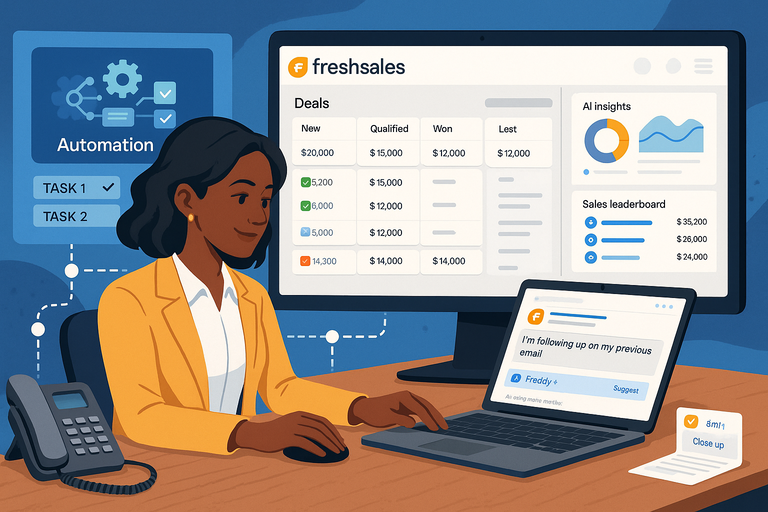 Freshsales CRM Explained: How It Helps You Close Faster
 HubSpot Pricing Breakdown: What You Really Pay For
 Why CRM Freshworks Stands Out From Other Platforms
 Social Media Marketing for Small Business – Best Tips
 Freshworks Vs HubSpot Comparison: Which Drives More Revenue
 Monday Limitations For Small Teams That Can Slow You Down