
Table of Contents
Some links on The Justifiable are affiliate links, meaning we may earn a small commission at no extra cost to you. Read full disclaimer.
Hello Bar pricing explained is really about matching cost to traffic, targeting needs, and how serious you are about conversion optimization. If you are comparing popup builders and trying not to overpay, this is where I’d slow down and look past the headline monthly fee.
Hello Bar currently offers a free Starter plan plus three paid tiers called Growth, Premium, and Elite, with annual billing prices shown on its official pricing page.
The biggest differences are not just price, but popup views, targeting depth, support level, and integration strength.
What Hello Bar Pricing Actually Includes
Hello Bar is not just selling a popup bar anymore. It now positions itself as a broader popup and conversion tool with multiple display types, design controls, targeting options, and email integrations, so pricing only makes sense when you understand what is included across the whole platform.
What You Are Paying For
- Core product access: All plans include unlimited popups and unlimited subscribers, which matters because some competing tools charge by list size or number of campaigns. According to the official pricing page, the real usage limit is popup views, not campaign count.
- Display formats: Hello Bar includes bars, modals, alerts, sliders, and full-page takeovers across its plans, which means even lower-tier users are not boxed into one visual format. That is a strong value point if you want to test more than one style without upgrading immediately.
- Targeting and testing depth: Paid plans include unlimited A/B testing and more customizable targeting, while the free tier does not include A/B testing and uses basic targeting. This is one of the most important pricing divides because better targeting usually drives more qualified leads, not just more leads.
- Support and integrations: Support shifts from basic on lower tiers to priority on higher tiers. Integration access also expands from basic on Starter to advanced or premium on paid plans, which can matter a lot if you rely on an email stack or CRM workflow.
Why Smart Buyers Misread SaaS Pricing Here
- The monthly number is not the full story: Hello Bar’s pricing page presents annual-billing monthly rates. If you skim too fast, you may think that is the default month-to-month price, but the page specifically labels the paid plans as billed annually.
- Views are the real limiter: A business with 8,000 highly qualified monthly visitors and a business with 80,000 casual blog visitors should not choose the same plan, even if both only run one popup. The plan ceiling is based on popup views, so traffic volume shapes cost much more than creative complexity.
- Free is more useful than many people expect: The Starter plan includes unlimited popups and basic email integrations, which makes it useful for testing message-market fit before you spend. But once you need testing, stronger targeting, or higher view limits, that free plan becomes a diagnostic tool rather than a growth engine.
The Official Pricing Snapshot
Here is the clearest current breakdown from Hello Bar’s official pricing page:
| Plan | Official Price Shown | Billing Note | Popup Views | A/B Testing | Support |
|---|---|---|---|---|---|
| Starter | $0 | Free forever | 5,000 lifetime | No | Basic |
| Growth | $39/mo | Billed annually | 50,000/mo | Unlimited | Basic/advanced-level plan messaging |
| Premium | $69/mo | Billed annually | 150,000/mo | Unlimited | Priority/premium-level plan messaging |
| Elite | $129/mo | Billed annually | 500,000/mo | Unlimited | Priority |
This table combines the pricing-page plan cards with the feature comparison section. One thing worth noting is that the lower feature grid on the pricing page also shows older-looking plan figures in some lines, while the plan cards higher on the same page show Growth at $39, Premium at $69, and Elite at $129.
As a buyer, I would treat the main plan cards as the active pricing and verify the checkout total before purchase.
Hello Bar Plan Breakdown By Buyer Type
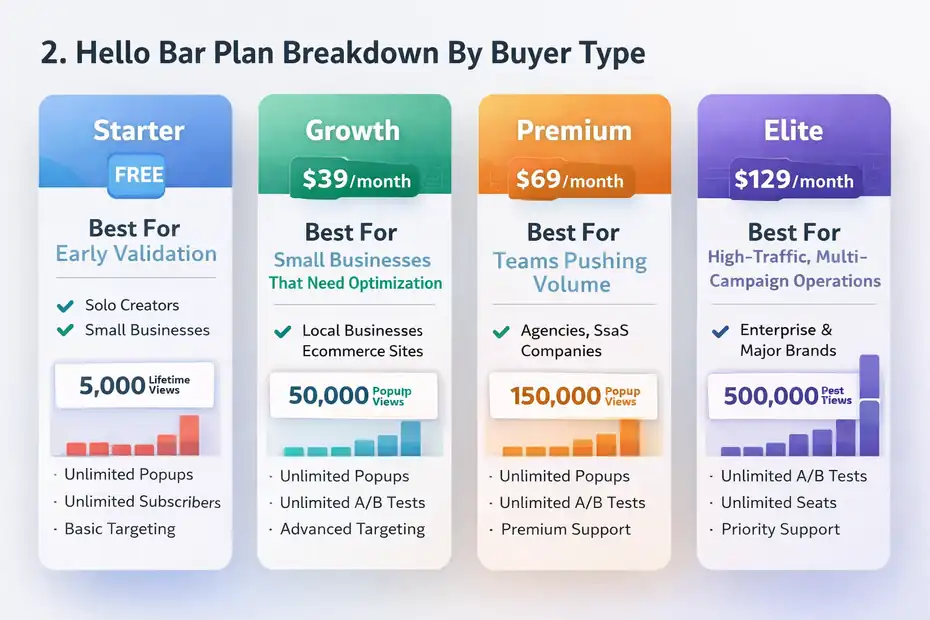
The smartest way to read Hello Bar pricing is to stop thinking like a shopper and start thinking like an operator.
Each tier is built for a different stage of site growth, and buying the wrong one usually means paying for either unused capacity or missing features you will need in a month.
Starter Plan: Best For Early Validation
- Who it fits: The free Starter plan is best for brand-new sites, solo creators, small service businesses, and anyone who wants to validate an offer before committing budget. It gives you unlimited popups and subscribers, but limits you to 5,000 lifetime views and basic targeting, with no A/B testing.
- What that means in practice: If your site only gets a few hundred visits a month, Starter can last long enough to prove whether visitors respond to your lead magnet, discount offer, or newsletter CTA. I think this is where Hello Bar becomes interesting because it lowers the risk of starting.
- Where it starts to break: Once you want to test headlines, target by device or behavior more precisely, or keep popups live on a growing site, the free ceiling gets tight fast. The 5,000-view cap is fine for validation, not for sustained acquisition.
Growth Plan: Best For Small Businesses That Need Optimization
- Who it fits: Growth is the first plan that feels usable for a serious lead-generation program. Hello Bar shows it at $39 per month billed annually and includes up to 50,000 popup views monthly, unlimited popups, unlimited subscribers, unlimited A/B tests, and more advanced support, targeting, and integrations than Starter.
- What that means in practice: This is the tier I would look at for local businesses, content sites, consultants, or ecommerce stores with consistent traffic but lean budgets. You can finally test variations instead of guessing, and that often changes the ROI math completely.
- Why this tier is often the sweet spot: Many businesses do not need enterprise-level volume. They need enough traffic allowance to run multiple offers and enough targeting to avoid annoying visitors. Growth usually checks those boxes without forcing a jump into a much higher spend.
Premium Plan: Best For Teams Pushing Volume
- Who it fits: Premium is listed at $69 per month billed annually for up to 150,000 popup views monthly, with unlimited popups, unlimited subscribers, unlimited A/B tests, premium-level support, stronger design features, and premium integrations.
- What that means in practice: This is where an active publisher, SaaS company, or larger ecommerce brand starts to feel comfortable. You have room to run list-growth campaigns, seasonal offers, and page-specific messaging without watching the meter every week.
- Why the upgrade can make sense: If your site drives revenue from email capture, abandoned cart recovery, or sales announcements, paying more to avoid view bottlenecks can be rational. A single strong campaign can offset the upgrade cost if it captures even a modest number of extra leads or orders. Hello Bar itself says popup conversion rates can range from 2% to 25%, though real performance will vary heavily by offer and audience.
Elite Plan: Best For High-Traffic, Multi-Campaign Operations
- Who it fits: Elite is the highest listed self-serve tier at $129 per month billed annually for up to 500,000 popup views monthly, unlimited seats, unlimited A/B tests, customizable targeting, premium integrations, and priority support.
- What that means in practice: This plan is built for brands with meaningful traffic and a real CRO process, not casual experimentation. If you have multiple stakeholders, ongoing campaign calendars, and pages segmented by intent, Elite is the first tier that feels like a serious operating system rather than a simple plugin replacement.
- When it is overkill: If you are still figuring out your offer, traffic source, or list-building funnel, Elite is probably too much too soon. In my experience, many teams overspend on software before they earn the right to scale.
How Hello Bar Pricing Compares To The Value You Get
Price alone is not useful unless you map it to conversion potential. A $39 plan can be expensive if your offer is weak, and a $129 plan can be cheap if one campaign pays for it in a day.
The Cheapest Plan Is Not Always The Best Deal
- Low price can hide opportunity cost: If you stay on Starter too long, you lose testing. That means you may keep running a mediocre headline or weak CTA because you never collected enough comparison data to improve it. Hello Bar’s plan comparison clearly shows A/B testing is unavailable on Starter and unlimited on paid plans.
- Basic targeting can reduce lead quality: Showing the same message to everyone is simple, but not efficient. Support documentation says custom targeting is not available on the free plan, and the feature grid labels Starter targeting as basic while paid plans are customizable.
- A small monthly fee can unlock better economics: Imagine you get 20,000 monthly visits and sell a $75 product. If better targeting and A/B testing help one extra half-percent of visitors take action on an offer, that can easily cover the difference between free and Growth.
Where Hello Bar Delivers Strong ROI
- Lead capture businesses: Coaches, agencies, SaaS brands, and newsletters can justify paid plans quickly because an email lead often has measurable downstream value. Hello Bar also supports direct integrations with common email tools, which reduces manual work after signup.
- Content-heavy sites: Hello Bar’s product pages emphasize bars, modals, alerts, sliders, inline options, and page takeovers, which gives publishers more ways to match form factor to content intent. That flexibility can improve conversion without making the site feel repetitive.
- Ecommerce stores: Hello Bar explicitly highlights cart recovery, coupon codes, countdown urgency, and offer targeting in its site copy. For stores, even a handful of recovered checkouts can make the platform cost feel trivial.
Where Buyers Should Stay Skeptical
- Pricing inconsistency: The official pricing page includes plan-card prices and a deeper comparison grid that do not line up perfectly in the text extracts. I would not call that a dealbreaker, but I would absolutely verify the live checkout amount before committing.
- Traffic math matters more than feature envy: A founder with 2,000 monthly visits does not need 500,000 popup views. Buying Elite for “future-proofing” is usually emotional spending.
- Tool success depends on your offer: Hello Bar can help surface the message, but it cannot rescue a weak lead magnet or irrelevant promotion. Smart buyers price the software against expected lift, not hope.
How To Choose The Right Hello Bar Plan Step By Step
This is the part most comparison posts skip. You do not pick the right plan by reading feature bullets. You pick it by matching plan limits to your traffic, funnel, and operational maturity.
Step 1: Start With Popup View Volume, Not Sessions
- Look at likely popup exposure: Hello Bar caps by popup views, so estimate how often your campaigns will actually display. A site with 30,000 sessions may generate fewer than 30,000 popup views if rules delay or restrict display. But an aggressive multi-popup setup can also raise view consumption faster than expected.
- Use conservative planning: I suggest choosing a tier where your expected monthly popup views land around 60% to 80% of the limit, not 98%. That gives you room for seasonal spikes, homepage promotions, and test variants.
- Map to official thresholds: The current thresholds shown are Starter at 5,000 lifetime views, Growth at 50,000 monthly, Premium at 150,000 monthly, and Elite at 500,000 monthly.
Step 2: Decide Whether You Need Testing Yet
- If you are still validating one offer: Starter may be enough. Your goal is proof, not precision.
- If you are optimizing performance: Go paid. The official comparison shows no A/B testing on Starter and unlimited A/B testing on all paid tiers. That is not a minor feature. It is the line between guessing and learning.
- Why this matters: Many sites lose conversions because they never test timing, copy, incentive, or form length. Even simple tests like “10% off” versus “free shipping” can change outcomes materially.
Step 3: Check Your Need For Targeting And Integration Depth
- Basic sites can keep it simple: If all you need is one top bar on all pages, Starter might do the job.
- Segmented funnels need more: If you want device targeting, campaign targeting, source targeting, or behavior-based delivery, paid plans are more realistic. Hello Bar’s support docs say custom targeting is not available on the free plan. Its pricing page also highlights location and ad/campaign targeting as part of the platform.
- Integration depth matters operationally: If captured leads need to flow cleanly into your email platform or workflow stack, the stronger integration levels on paid plans can save both time and errors.
Step 4: Match The Plan To Business Stage
- Stage 1: Testing the channel. Use Starter.
- Stage 2: Building a repeatable capture system. Use Growth.
- Stage 3: Running multiple concurrent campaigns. Use Premium.
- Stage 4: Managing high-volume conversion operations. Use Elite.
That framework sounds simple, but it is how smart buyers avoid overbuying. I believe software budgets should follow proof of traction, not fantasy roadmaps.
Feature Differences That Matter More Than Price
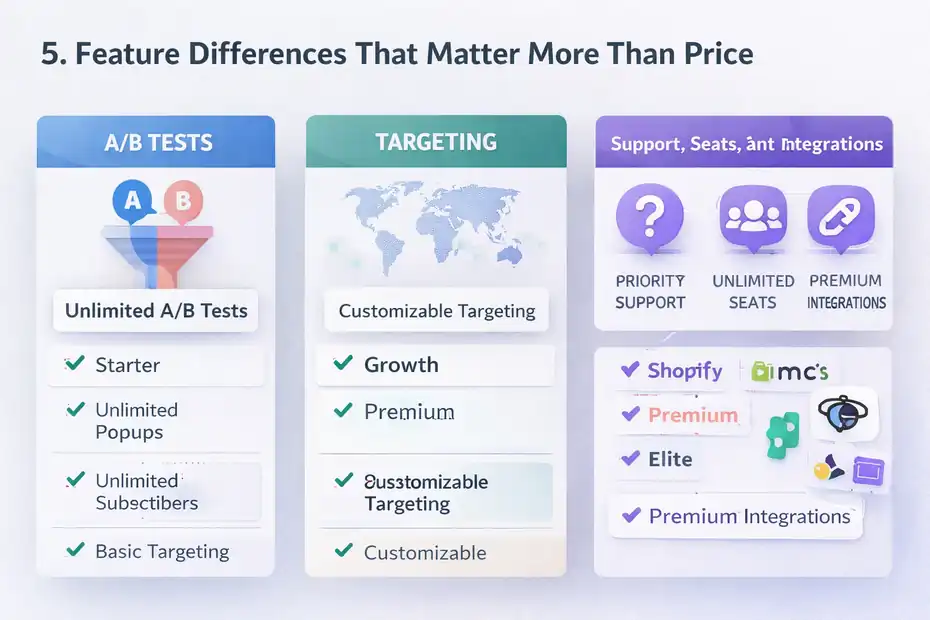
After a certain point, paying more is less about “more popups” and more about better operating leverage. Some features create disproportionate value because they improve relevance, speed, or learning.
A/B Testing Is A Revenue Feature, Not A Nice-To-Have
- Why it matters: A/B testing lets you compare two versions of a campaign to see which performs better. In plain English, it helps you stop arguing about copy and start measuring what visitors actually respond to.
- What Hello Bar includes: The current pricing comparison shows unlimited A/B testing on Growth, Premium, and Elite, but not on Starter.
- How that changes buying logic: If you run promotions regularly, paid plans can outperform free plans even at modest traffic because optimization compounds. A 15% lift on an existing conversion stream is often more valuable than more raw impressions.
Targeting Controls Quietly Make Or Break Results
- Why it matters: Targeting decides who sees what, when, and under what conditions. Better targeting usually means fewer interruptions and better conversion intent.
- What Hello Bar signals: The pricing page labels paid-plan targeting as customizable and Starter as basic. Support docs further state that custom targeting is not available on the free plan. The platform also promotes targeting by location, device, ad, campaign, source, and more.
- Where buyers underestimate this: A generic popup can collect leads. A well-targeted popup can collect the right leads.
Support, Seats, And Integrations Matter For Teams
- Seats: The plan comparison shows unlimited seats on Elite, three on Premium, and one on Growth and Starter. That matters if marketing, content, and ecommerce all need access.
- Support: Priority support appears on higher plans, while lower tiers stay on basic support. When campaigns drive real revenue, faster answers become part of ROI.
- Integrations: Hello Bar labels Starter integrations as basic, Growth as advanced, and Premium and Elite as premium. If your workflow relies on sync reliability, a higher tier may save operational pain that never shows up in a marketing screenshot.
Hello Bar Pricing For Different Business Models
A good pricing decision depends on how your business makes money. The same monthly fee can be cheap for one model and wasteful for another.
Bloggers And Publishers
- Best fit: Starter or Growth for most.
- Why: Publishers often want list growth, content promotion, and gentle onsite prompts rather than hard-sell popups everywhere. Hello Bar’s range of formats, including bars, sliders, alerts, and inline-style options, makes this use case practical.
- Buying advice: I would start free if traffic is low, then upgrade the moment you want to test content upgrades, homepage versus article offers, or returning-visitor messaging.
Service Businesses And Lead Gen Sites
- Best fit: Growth is usually the strongest first paid tier.
- Why: Local services, consultants, coaches, and agencies often do not need huge traffic volume. They need qualified leads, decent targeting, and the ability to test form copy and offers.
- Buying advice: If one qualified lead is worth a few hundred dollars or more, even a small conversion lift can justify paid Hello Bar pricing quickly. In this model, testing is usually more valuable than raw volume.
Ecommerce Stores
- Best fit: Growth or Premium, depending on traffic.
- Why: Stores benefit from popup urgency, discount capture, cart recovery, and segmented promotions. Hello Bar’s site copy specifically references coupon codes, countdown timers, and abandoned-cart recovery style use cases.
- Buying advice: Use the plan decision around campaign variety. If you want homepage offers, collection-page offers, exit-intent capture, and cart messaging all at once, your view usage can rise quickly.
Larger Marketing Teams
- Best fit: Premium or Elite.
- Why: Once multiple stakeholders need access and you are running layered campaigns, seat limits, support level, and higher view ceilings become more important than the sticker price.
- Buying advice: Elite makes more sense when the cost of delay is higher than the cost of software. If a broken campaign during a launch costs thousands, priority support is not fluff.
Common Mistakes People Make When Buying Hello Bar
Most bad software purchases do not happen because the product is bad. They happen because the buyer asks the wrong question.
With Hello Bar, the wrong question is usually “What is the cheapest plan?” instead of “What will this plan let me improve?”
Mistake 1: Choosing Based Only On Monthly Price
- What goes wrong: You save money upfront but lose conversion upside because you skipped testing or targeting.
- Real consequence: A free plan that captures 1% of visitors can be “more expensive” than a paid plan that captures meaningfully more qualified leads.
- Better approach: Price Hello Bar against expected conversion lift, not the software line item alone.
Mistake 2: Ignoring View Limits Until Traffic Spikes
- What goes wrong: Your site grows, a campaign performs well, and suddenly you are too close to the limit for comfort.
- Why it happens: Buyers often think in sessions or users, while Hello Bar prices around popup views.
- Better approach: Track campaign display volume monthly and upgrade before you are forced to react.
Mistake 3: Overpaying For Features You Have Not Earned Yet
- What goes wrong: Founders buy Premium or Elite because it feels “serious,” then barely use the extra capacity.
- Why it happens: SaaS pricing pages are designed to make bigger plans look safer.
- Better approach: Buy the plan that supports your current operating system, then upgrade when a real bottleneck appears. Hello Bar even notes in support content that outliers can contact the team for custom plans if the standard tiers do not fit.
Mistake 4: Not Verifying Pricing At Checkout
- What goes wrong: You build your internal budget around one number and see another on the live purchase flow.
- Why I mention it: The official pricing materials surfaced mixed pricing text in current indexed content, so the safest move is to confirm the live billed amount before approval.
- Better approach: Screenshot the plan card, confirm annual total, and make sure your team understands whether the quoted rate is monthly-equivalent or actual month-to-month billing.
How To Get More Value From Whatever Hello Bar Plan You Choose
Even the best-priced software underperforms when the implementation is lazy. Hello Bar can be inexpensive or expensive depending on how well you use it. The plan matters, but the execution matters more.
Build One High-Intent Offer Before You Build Five Campaigns
- Start narrow: Create one offer tied to a real user intent, such as a discount, checklist, quiz, consultation, or waitlist.
- Why this works: Focus makes it easier to diagnose performance. If five campaigns all underperform, you do not know whether the issue is the traffic, the offer, the timing, or the design.
- My advice: I suggest getting one campaign profitable before expanding formats.
Match Popup Type To User Context
- Bars: Good for sitewide announcements and low-friction visibility.
- Modals and takeovers: Better for stronger calls to action when attention is worth the interruption.
- Sliders and alerts: Useful when you want presence without dominating the screen.
This sounds obvious, but many sites use the loudest format for every goal. That is usually a mistake. The smarter move is to use the least intrusive format that still gets the job done.
Use Design And Triggering Thoughtfully
- Design Assistant: Hello Bar says its Design Assistant can automatically match your site’s colors, fonts, and styling. That can save setup time, especially for lean teams.
- Trigger variety: Hello Bar highlights exit intent, click-based triggers, time triggers, scroll triggers, and other options across its site messaging.
- Best practice: Trigger based on behavior and intent, not impatience. Showing a modal instantly on page load is rarely your highest-converting move.
Track Performance Like A Buyer, Not A Fan
- Watch conversion rate: This is the primary signal.
- Watch lead quality: More emails are not always better emails.
- Watch view-to-conversion efficiency: Paid plans become easier to justify when your conversion per thousand popup views is improving over time.
Is Hello Bar Worth The Price For Smart Buyers?
For the right buyer, yes. But “worth it” depends less on whether Hello Bar is cheap and more on whether you are ready to use its paid features properly.
The platform has scale, broad popup formats, design automation, targeting options, integrations, and a free entry point that lowers initial risk.
It also claims adoption across more than 600,000 websites and displays third-party ratings such as 4.7 on G2, 4.6 on Capterra, and 4.5 on Software Advice on its site.
When Hello Bar Is Worth It
- You already have traffic: Even moderate traffic can justify paid testing.
- You know your offer: The stronger the offer, the easier it is to recover software cost.
- You need a practical CRO layer: If you want to capture more value from existing visitors before spending more on traffic, Hello Bar fits that job well.
When Hello Bar Is Probably Not Worth It Yet
- You do not have traffic: Tools cannot convert visitors you do not have.
- Your offer is unclear: Software cannot fix weak positioning.
- You are buying from fear: Upgrading to a bigger plan before you have evidence is not strategy. It is anxiety wearing a dashboard.
My Honest Take
If I were buying Hello Bar today, I would treat Starter as a low-risk trial environment, Growth as the real value tier for most small businesses, Premium as the volume-and-operations tier, and Elite as the right choice only when traffic and team complexity clearly justify it.
The smartest move is not to chase the biggest plan. It is to buy the smallest plan that gives you the data and control you actually need. Based on the currently published pricing and feature structure, that is the practical way to avoid overspending while still getting meaningful conversion upside.
Final Verdict On Hello Bar Pricing Explained
Hello Bar pricing explained comes down to one simple question: are you paying for access, or are you paying for leverage? Starter gives you access. Growth usually gives you leverage. Premium gives you room. Elite gives you scale.
The official pricing page currently shows Starter at free, Growth at $39 per month billed annually, Premium at $69, and Elite at $129, with feature differences centered on popup views, testing, targeting, support, seats, and integration strength.
For most smart buyers, I think the right process is simple. Start with traffic reality, decide whether optimization matters yet, check whether you need custom targeting and better integrations, then verify the live billed amount before purchase.
Do that, and you will make a much better decision than someone who buys based on the headline price alone.
FAQ
What is Hello Bar pricing and how does it work?
Hello Bar pricing is based mainly on monthly popup views and feature access. Each plan includes unlimited popups and subscribers, but higher tiers unlock A/B testing, advanced targeting, and higher view limits. This means your cost scales with traffic and optimization needs, not campaign quantity.
Is Hello Bar free to use?
Yes, Hello Bar offers a free Starter plan that includes unlimited popups and basic features. However, it has a lifetime limit of 5,000 popup views and does not include A/B testing or advanced targeting, making it best for testing rather than long-term growth.
What is included in Hello Bar paid plans?
Paid plans include higher monthly popup view limits, unlimited A/B testing, advanced targeting options, premium integrations, and better support. These features help improve conversion rates by allowing more precise audience targeting and continuous optimization of popup campaigns.
Which Hello Bar plan is best for beginners?
The Starter plan is best for beginners who want to test popup strategies without spending money. Once traffic grows or optimization becomes important, most users benefit from upgrading to the Growth plan for access to A/B testing and higher view limits.
Is Hello Bar worth the price?
Hello Bar is worth the price if you already have website traffic and want to increase conversions. The ability to test and target campaigns can significantly improve lead generation, making even lower-tier paid plans profitable for businesses with clear offers.

I’m Juxhin, the voice behind The Justifiable.
I’ve spent 6+ years building blogs, managing affiliate campaigns, and testing the messy world of online business. Here, I cut the fluff and share the strategies that actually move the needle — so you can build income that’s sustainable, not speculative.
Related posts:
 Performance Based Marketing: Transform Your Advertising Strategy
 Hello Bar Review For Marketers: Hidden Wins
 Should I Use SurveyMonkey For Lead Generation: Does It Convert?
 AI-Powered Ad Creative: Smarter Ads, Better ROI!
 Voluum Pricing: Which Plan Saves You the Most Money?
 How to Create an Aweber Landing Page That Converts Today