
Table of Contents
Some links on The Justifiable are affiliate links, meaning we may earn a small commission at no extra cost to you. Read full disclaimer.
Jungle Scout Catalyst review for growing Amazon sellers is a question that matters a lot more in 2026 than it did a few years ago.
Amazon is still one of the biggest opportunities in ecommerce, but it is also more crowded, more expensive, and less forgiving when you choose the wrong product, launch with weak keywords, or let ad spend drift without control.
Jungle Scout positions Catalyst as the platform for sellers under roughly $5 million in Amazon revenue, with product research, keyword research, analytics, review automation, and AI-assisted guidance built into one system.
Here’s my honest take: It can be worth it, but only for the right type of seller.
What Jungle Scout Catalyst Is Really Built To Do
Jungle Scout Catalyst is not trying to be everything for every Amazon business.
It is positioned as the seller-focused product in Jungle Scout’s lineup, while Cobalt is the more advanced platform for larger brands and enterprises.
Who Catalyst Is Best For
If you are a private label seller, a growing FBA brand, or a small team that needs one place to research products, validate demand, track keywords, watch competitors, and monitor profitability, Catalyst fits that job pretty well.
Jungle Scout’s own pricing and product pages position Catalyst for companies selling less than $5 million on Amazon, and specifically call it out for product research, opportunity discovery, ASIN-level analysis, launches, listings, sourcing, and tracking up to 200 ASINs.
That matters because a lot of software reviews blur together beginner tools and enterprise tools. I do not think that helps anyone.
If you are running a lean Amazon business and mostly care about questions like “Is this niche too crowded?”, “Which keywords matter?”, “What are my margins after fees?”, and “Are my ads improving or wasting cash?”, Catalyst is aimed at your stage.
Where I think it becomes especially useful is the awkward middle stage. You are no longer guessing your way through your first listing, but you are not big enough to justify expensive enterprise software either.
That is the exact point where fragmented spreadsheets, browser tabs, and instinct start to slow you down. Catalyst tries to replace that mess with one operating layer.
Who Should Probably Skip It
I would not recommend Catalyst blindly to every seller. If your business is almost entirely wholesale, retail arbitrage, or an agency model that needs broad brand and category reporting across huge catalogs, Jungle Scout itself pushes those users toward Cobalt instead.
Cobalt supports deeper market benchmarking, 1P and 3P analysis, more marketplaces, and much larger tracking capacity. Catalyst is capped at smaller-team workflows and product-level insight.
I also think ultra-budget beginners should pause before subscribing. The software can save time and reduce bad decisions, but tools do not rescue weak fundamentals. If you do not yet understand landed cost, contribution margin, search intent on Amazon, or how reviews affect conversion, you may end up paying for features you barely use.
Another group that should think twice is the highly advanced operator who already built a stack around specialized PPC software, custom dashboards, and category intelligence tools. Catalyst may still be useful, but it will feel more like consolidation convenience than a true unlock.
My practical view is simple: Catalyst is strongest for growing Amazon sellers who want better decisions without building an entire tech stack from scratch.
What You Actually Get Inside Catalyst
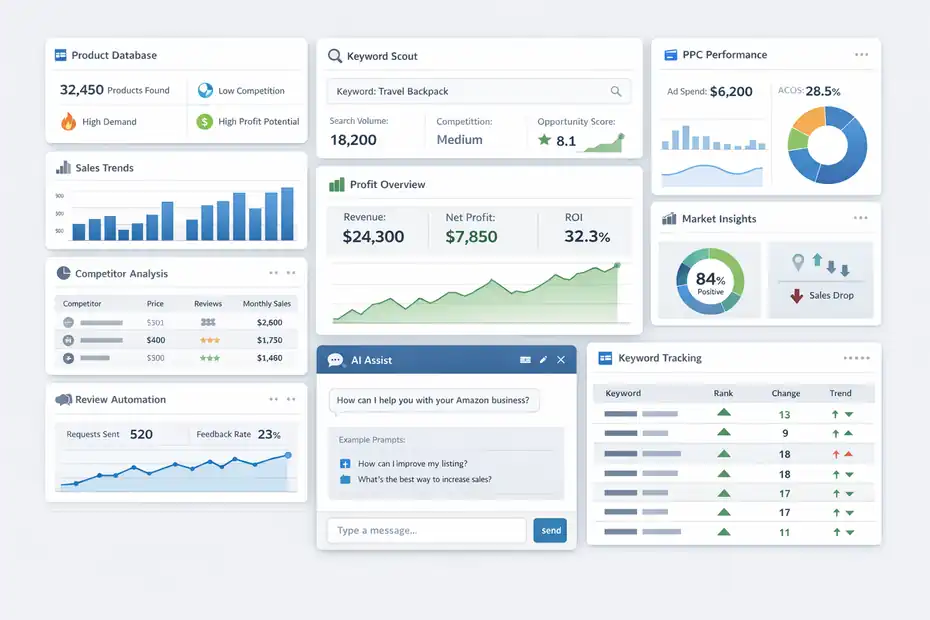
On paper, most Amazon seller tools promise research, optimization, and growth.
The real question is whether the feature mix actually matches how a growing seller works day to day. With Catalyst, the answer is mostly yes.
Product Research And Keyword Discovery
The core of Catalyst is still product and keyword research. Jungle Scout highlights Product Database and Keyword Scout as central tools, and the platform is built around finding high-demand, lower-competition opportunities, analyzing sales trends, reviewing competitor pricing, and tracking keyword visibility across organic and sponsored placements.
That matters because most growing sellers do not fail from lack of effort. They fail because they choose products that look good emotionally but break down under the numbers. Imagine you find a niche with nice sales velocity, but the top listings have thousands of reviews, dominant brand loyalty, and brutal PPC economics.
A tool that shows only “demand” is not enough. You need context.
This is where I think Jungle Scout still earns its reputation. The product research layer helps you evaluate the market before inventory locks you in.
Keyword research then helps you see how shoppers actually describe the item, which is often different from how sellers describe it. That sounds basic, but it is one of the most expensive beginner mistakes on Amazon.
I also like that the workflow connects demand checking to ranking opportunity. That means you are not just asking, “Can this sell?” You are asking, “Can I realistically win traffic and margin here?”
Review Automation, AI Assist, And Operational Support
One interesting part of Catalyst is that it is not just a research tool anymore. Jungle Scout now bundles Review Automation and AI Assist into the broader workflow.
The company’s support documentation says AI Assist Chat can answer questions about selling on Amazon or using Jungle Scout by drawing on Jungle Scout help content, blog content, and selected YouTube transcripts.
I want to be careful here: AI features are often oversold. In my experience, they are useful when they remove friction, not when they pretend to replace judgment.
If AI Assist helps you interpret a feature, get unstuck, or speed up routine listing and optimization tasks, great. If you expect it to make strategic decisions for you, that is where disappointment starts.
Review Automation is more practical. Asking for reviews consistently matters, especially when early social proof can swing conversion. I would not buy Catalyst just for that, but as part of one subscription it adds operational value.
The bigger takeaway is this: Jungle Scout is trying to turn Catalyst from “research software” into a lightweight operating system for sellers. That is smart positioning. Growing sellers rarely need ten disconnected tools. They need fewer moving parts and better decision speed.
Analytics, Performance Tracking, And Competitor Insight
Catalyst also includes analytics and performance views for profitability and trend analysis. Jungle Scout says users can access metrics like ROI and net margin, review sales trends across custom date ranges, and analyze advertising profitability at company, ASIN, and campaign levels.
The platform also emphasizes competitor keyword tracking, ad trend analysis, customer sentiment signals, and market intelligence.
For me, this is where the subscription starts to justify itself for a real business. Product research gets a lot of attention because it is exciting. But once you have active listings, your bigger gains often come from better monitoring: spotting margin erosion, noticing a refund spike, identifying a keyword that lost rank, or catching ad spend that no longer pays back.
Think about a seller doing $40,000 a month on one hero SKU. A 3-point margin loss from rising ad costs or a weak listing update can quietly wipe out more profit than the software fee for the entire year. That is why performance visibility matters more than flashy opportunity scores after launch.
Catalyst will not replace deep finance tools for every operator. Still, for a growing seller who wants research plus usable performance data in one place, it hits a practical sweet spot.
Getting Started With Catalyst The Right Way
The biggest mistake I see with Amazon software is this: sellers subscribe, click around for a week, feel overwhelmed, and then say the tool was not worth it.
Usually the problem is not the tool. It is the onboarding sequence.
Step 1: Set It Up Around One Product Goal
Here is how I would start. Do not begin with every feature. Begin with one business question.
Pick one of these:
- Goal 1: Find a new product opportunity.
- Goal 2: Improve one weak listing.
- Goal 3: Cut wasted PPC spend.
- Goal 4: Decide whether to expand into a related niche.
Then build your first week inside Catalyst around that outcome only. If you start by opening every dashboard, you will learn nothing deeply enough to act.
For example, if your goal is product expansion, I would focus first on Product Database, Keyword Scout, and competitor review patterns. You want to validate demand, pricing range, review pressure, and whether the niche is dominated by entrenched players. If your goal is listing improvement, start with keyword tracking and competitor positioning instead.
This sounds small, but it changes how useful the software feels. Good software becomes “worth it” when it solves a specific problem faster than your old process. Growing sellers do not need more dashboards. They need fewer bad bets.
Step 2: Connect Your Seller Data And Clean Up Your Baseline
If you have a Seller Central account, Jungle Scout recommends the Growth Accelerator or Brand Owner plans for access to the fuller seller-oriented feature set. That recommendation alone tells you something important: Catalyst works best when it is not isolated from your actual store performance.
Before you chase new products, clean your baseline. I suggest looking at:
- Current ASIN profitability: Which products are healthy after fees, returns, and ad spend?
- Keyword position drift: Which important terms are slipping?
- Review momentum: Are new reviews coming in steadily or slowing down?
- Ad efficiency: Which campaigns are only buying visibility, not profitable sales?
This is the less glamorous side of Amazon growth, but it is where software pays off. You do not need perfect attribution to improve. You need a cleaner picture than you had yesterday.
A lot of sellers use research tools as an escape hatch from operational problems. They keep hunting new products when their current catalog still has obvious leaks. Catalyst is useful precisely because it can support both exploration and clean-up.
I would use it to tighten what already exists before adding more complexity.
Step 3: Build A Weekly Decision Rhythm
The sellers who get the most out of these platforms usually turn them into routines. They do not “check the tool.” They run a repeatable review process.
A simple weekly rhythm could look like this:
- Monday: Review sales, margin, and ad trend shifts.
- Tuesday: Check keyword ranking changes and competitor movement.
- Wednesday: Review customer feedback themes and listing gaps.
- Thursday: Research one adjacent niche or product variation.
- Friday: Make one concrete change, then document why.
That last part matters. If you are not recording what changed and what happened after, you are not building a system. You are just reacting.
In my experience, Catalyst is most valuable when used as a decision engine, not a research toy. The data is there, but the habit is what turns data into growth. Even a good platform becomes expensive when you only open it during panic mode.
Where Catalyst Helps Growing Amazon Sellers Most
This is the heart of the review. Software should not be judged by features alone. It should be judged by whether it improves outcomes in the messy middle of real business operations.
For growing sellers, Catalyst does a few things especially well.
It Reduces Product Selection Mistakes
The most painful Amazon mistake is often not poor execution. It is choosing the wrong product in the first place. That one decision can trap cash in inventory, create slow-moving stock, and force you into aggressive discounts or wasteful PPC.
Catalyst helps reduce that risk by combining demand signals, competitor visibility, keyword research, and pricing analysis in one workflow. Jungle Scout specifically emphasizes market intelligence, competitor keyword tracking, sales trends, and pricing analysis for opportunity evaluation.
I think that is where the platform is most defensible. When you are still growing, one bad launch hurts more than one missed opportunity. A mature brand can absorb a failed test. A smaller seller may not recover quickly.
Imagine you are deciding between a garlic press, a travel bottle set, and a pet grooming glove. A weak process looks at monthly sales and gets excited.
A stronger process asks harder questions: how concentrated are reviews at the top, how aggressive are ads, how broad is keyword intent, how price-sensitive is the niche, and do buyers sound unhappy with current options? Catalyst gives you more of that second type of thinking.
That is why I would frame its main value as risk reduction, not just discovery.
It Helps Turn Keyword Research Into Better Listings
A lot of sellers still treat keyword research like a word-stuffing exercise. That is not how ranking or conversion works anymore. You need the right terms, but you also need the right buyer framing.
Catalyst’s keyword and competitor insight features help connect search demand with listing decisions. That is important because shoppers do not just search by product type. They search by use case, problem, material, feature, and urgency.
For example, a seller might optimize around “lunch bag,” while buyers actually care more about “leakproof lunch box bag,” “adult work lunch bag,” or “insulated meal bag for office.” Those are not just keyword variations. They reflect intent layers.
What I like here is the ability to move from research into action. Instead of guessing what belongs in the title, bullets, images, or backend terms, you can shape the listing around actual demand language and competitor gaps.
This is also where AI can be mildly helpful. Not because it writes magic copy, but because it can help summarize patterns faster. You still need judgment. You still need to know your product. But faster interpretation is valuable when you are making repeated listing decisions across multiple SKUs.
It Gives Smaller Sellers A More Mature Operating View
This may be the most underrated benefit. Growing sellers often operate with enterprise-level pressure and freelancer-level systems. One spreadsheet for costs. Another for keyword notes. A browser extension. Ad reports. Seller Central tabs. Random reminders in Slack or Notion.
Catalyst tries to centralize enough of that decision-making so you can operate more like a business and less like a scavenger hunt. Jungle Scout highlights analytics, profit visibility, trend analysis, campaign-level views, and competitor intelligence as part of the same seller product.
That does not mean it replaces every system. It means it reduces fragmentation.
I believe this is why many growing sellers get strong value from all-in-one platforms even when specialized tools exist. It is not always about “best feature in category.” Sometimes it is about decision speed, less tab fatigue, and fewer blind spots between research and execution.
For a founder-led Amazon business, that convenience is not fluff. It is operational leverage.
Where Catalyst Falls Short
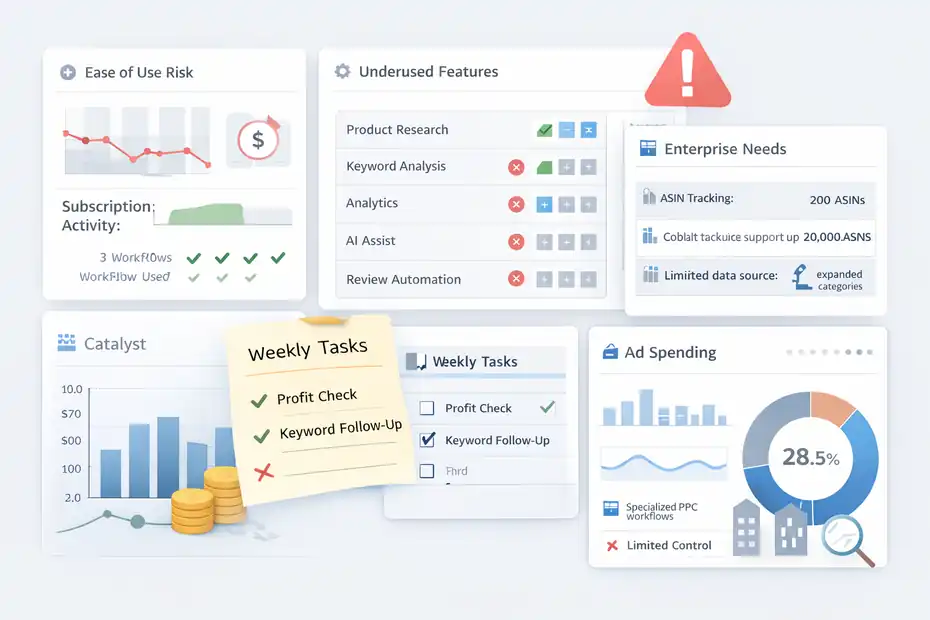
No honest Jungle Scout Catalyst review for growing Amazon sellers should pretend the platform is perfect.
It has real strengths, but it also has clear limitations depending on your stage, budget, and workflow.
The Best Features Only Matter If You Actually Use Them
This sounds obvious, but it is the main reason subscriptions go stale. Catalyst includes multiple layers: research, keywords, analytics, AI support, review automation, and more. That breadth is useful, but it also creates a quiet risk. You may pay for operational depth while using it only as a niche-finder.
If all you do is occasional product validation, then the software can feel expensive relative to use. On the other hand, if you use it weekly for listing iteration, profitability checks, review follow-up, and competitor monitoring, the economics change completely.
This is not really a flaw in Jungle Scout alone. It is a common issue in SaaS. But it matters here because the product is designed as an integrated seller workflow, not just a lightweight extension.
My advice is blunt: Do not buy Catalyst because it seems “professional.” Buy it only if you can name three workflows you will run inside it every week. If you cannot do that, you may be better off with a smaller toolset or just using the extension for a while.
It Is Not A Full Enterprise Market Intelligence Stack
Jungle Scout’s own comparison makes the boundary clear. Catalyst is for smaller and scaling sellers, while Cobalt is for mature brands, agencies, and larger data teams needing broader market, pricing, Buy Box, and category-level intelligence.
Cobalt also supports tracking up to 20,000 ASINs, while Catalyst is positioned around tracking up to 200.
That limitation is not necessarily bad. In fact, I appreciate when software has a defined job. But if your business needs category share analysis at scale, complex retail media visibility, or large-team reporting, Catalyst is not really the right tool.
I would also keep expectations realistic around ad management. Jungle Scout talks about ad insights and profitability improvement, which is useful, but high-volume advertisers often still want specialized PPC workflows depending on complexity.
So the short version is this: Catalyst is strong as growth-stage seller software. It is not the final destination for every brand.
Pricing, Plans, And ROI In 2026
Pricing always affects the answer to “worth it?” more than feature lists do. A tool that is excellent at $49 can be questionable at $149 for the wrong user.
The good news is that Catalyst still appears designed around smaller sellers rather than enterprise budgets.
Current Plan Structure And What It Means
Jungle Scout’s official pricing page shows three Catalyst plans: Starter, Growth Accelerator, and Brand Owner, and notes that annual plans can save up to $360.
It also states the Starter plan is limited to one user, Growth Accelerator includes one user with optional paid seats, and Brand Owner includes ten users with optional paid seats.
Jungle Scout also offers a 7-day money-back guarantee on regularly priced plans rather than a free trial.
Third-party listings on G2 and SaaSworthy currently show Catalyst starting around $29 for Starter, $49 for Growth Accelerator, and higher for Brand Owner, though I would still verify the checkout page before buying because software pricing can change and promotional structures vary.
Here is the practical framing:
| Plan | Best Fit | What Matters Most |
|---|---|---|
| Starter | Newer solo sellers | Lower entry cost, lighter access |
| Growth Accelerator | Most growing sellers | Better match if you actively manage listings and store data |
| Brand Owner | Small brands with teams | More users and broader feature access |
I think most serious growth-stage sellers will land in Growth Accelerator, not Starter. Starter can get you in the door, but the sellers asking whether Catalyst is “worth it” are usually already beyond hobby mode.
How To Judge ROI Without Fooling Yourself
I recommend a very simple ROI test. Do not ask whether Catalyst gives you “more data.” Ask whether it helps you avoid or improve one of these outcomes per quarter:
- One bad product launch avoided
- One profitable keyword cluster uncovered
- One underperforming listing improved
- One ad waste leak reduced
- One margin issue caught earlier
If the software helps with any one of those in a meaningful way, it can pay for itself fast.
Amazon is increasingly competitive. Jungle Scout’s 2025 State of the Amazon Seller report surveyed nearly 1,500 entrepreneurs, brands, and businesses, which tells you how broad the seller base is, and Jungle Scout says its seller-facing ecosystem supports more than $50 billion in annual Amazon revenue.
That does not prove Catalyst is perfect, but it does show the platform is operating in a serious, large-scale seller environment.
The trap is expecting perfect attribution. Software rarely proves ROI in a neat straight line. In real life, the value often comes from compounding smaller decisions that become less sloppy over time.
How Catalyst Compares To The Real Alternatives
Most sellers are not comparing Catalyst to “doing nothing.” They are comparing it to Helium 10, Viral Launch, spreadsheets plus the Amazon extension, or a patchwork of smaller tools. That is the right way to think about it.
Catalyst Vs. Piecing Together Smaller Tools
For some sellers, the cheapest route is a browser extension, a keyword tracker, maybe a profits spreadsheet, and a few manual reports. That can work early on. I do not think it is crazy.
But the hidden cost is fragmentation. You lose time. You forget context. You make decisions later. And you often stop doing the less exciting monitoring work that protects margin.
Catalyst’s main advantage over a patchwork stack is that it keeps research, listing insight, review processes, and performance analysis closer together. For founder-led Amazon brands, that coherence is often worth more than marginal feature superiority in one narrow area.
Here is my honest rule: If your current system still lives comfortably in one brain and two spreadsheets, keep it simple. If your store now has enough moving parts that things are slipping, consolidation becomes valuable.
Catalyst Vs. Competing Amazon Suites
Jungle Scout itself compares its platform to Viral Launch on data accuracy, features, user experience, and affordability, which tells you where it sees the competitive battle.
Third-party comparison listings also put Catalyst head-to-head with Helium 10 and other Amazon suites.
My practical breakdown looks like this:
| If You Care Most About | Better Fit |
|---|---|
| Straightforward product research and growth-stage usability | Catalyst |
| Huge toolkit breadth and deeper feature sprawl | Often Helium 10 |
| Staying lean with minimal monthly software | Smaller stack or extension-first approach |
| Large-brand category and market benchmarking | Jungle Scout Cobalt, not Catalyst |
I would not over-romanticize “all-in-one” as a concept. Some sellers do better with focused tools. But for the growing Amazon seller who wants one cleaner operating layer and does not want to manage a dozen subscriptions, Catalyst makes a strong case.
Real-World Scenarios Where Catalyst Is Worth It
This section is where the decision becomes clearer. Instead of abstract pros and cons, let’s put the software into real business situations. That usually makes the answer obvious.
Scenario 1: You Have One Winning Product And Need The Next One
You are doing decent revenue with one hero product. The pressure now is expansion, but you are terrified of choosing the wrong follow-up SKU. That fear is healthy. Inventory mistakes get expensive fast.
In this case, Catalyst is worth serious consideration. You can use research and keyword tools to narrow adjacent opportunities, compare demand patterns, review competition, and see whether the next product fits your existing customer base or pulls you into a completely different market.
This is one of the cleanest use cases because the software is helping with a high-stakes decision. If it prevents one poor launch, that can save far more than the subscription cost.
Scenario 2: Your Revenue Is Growing But Your Decisions Feel Slower
This is the classic growth-stage pain point. Sales are higher than before, but now everything feels messier. You are spending more on ads, you have more keywords to monitor, more customer feedback to process, and more uncertainty about what actually moved the numbers.
Catalyst is often worth it here too. Not because it is glamorous, but because it helps replace scattered operating habits with a more consistent decision process. Jungle Scout’s analytics, ASIN-level performance views, and competitor insights are built for exactly this middle stage.
I believe this is the strongest “yes” audience for Catalyst.
Scenario 3: You Are Still Testing Whether Amazon Is Your Real Channel
This is where I would be more cautious. If you have not validated product-market fit, are still learning core Amazon mechanics, or are simply exploring the channel, the subscription may feel premature.
That does not mean Catalyst is bad. It just means timing matters. Good software bought too early still feels like bad software.
In that situation, I would focus first on core economics, one product, one listing, and one clear launch process. Then move into a fuller platform when you have enough traction to use it regularly.
Final Verdict: Is Jungle Scout Catalyst Worth It For Growing Amazon Sellers?
For most growth-stage private label and FBA sellers, my answer is yes, Jungle Scout Catalyst can be worth it in 2026. But the reason is not hype, AI, or the number of features on the sales page.
It is worth it when you use it to make fewer expensive mistakes and run a tighter Amazon business.
My Honest Bottom Line
I would recommend Catalyst if you are in this zone:
- You already have traction on Amazon
- You need better product and keyword decisions
- You want less tool sprawl
- You care about profitability, not just revenue
- You are ready to build a weekly operating routine around the data
I would be less enthusiastic if you are still at the “watching YouTube and dreaming about FBA” stage, or if your business already needs enterprise-grade category intelligence far beyond product-level workflows.
My personal read is that Jungle Scout has made Catalyst more relevant for growing sellers by expanding beyond product research into operational support, analytics, AI assistance, and broader performance visibility. That is the right evolution for the market Amazon sellers are dealing with now.
The Simplest Decision Rule
Use this rule and you will probably make the right call:
If your biggest problem is uncertainty, Catalyst helps.
If your biggest problem is discipline, software alone will not fix it.
That may sound blunt, but I think it is the fairest conclusion. Jungle Scout Catalyst is a good fit for growing Amazon sellers who are ready to turn data into regular decisions. For that group, it is not just “worth it.” It can become one of the more practical tools in the business.
FAQ
What is Jungle Scout Catalyst and who is it for?
Jungle Scout Catalyst is an all-in-one Amazon seller platform designed for growing sellers who want product research, keyword tracking, and performance analytics in one place. It works best for private label sellers scaling beyond beginner level but not yet needing enterprise tools.
Is Jungle Scout Catalyst worth it for growing Amazon sellers?
Yes, Jungle Scout Catalyst is worth it for growing Amazon sellers who actively manage listings, track keywords, and optimize profitability. Its value comes from improving decision-making and reducing costly mistakes, especially in product selection and performance tracking.
What features does Jungle Scout Catalyst include?
Jungle Scout Catalyst includes product research tools, keyword discovery, competitor analysis, review automation, and performance analytics. It also offers AI-assisted support and profitability tracking, helping sellers manage both pre-launch research and post-launch optimization efficiently.
How does Jungle Scout Catalyst compare to other Amazon tools?
Jungle Scout Catalyst stands out for its simplicity and all-in-one workflow, making it easier for growing sellers to manage operations. Compared to more complex tools, it focuses on usability and core features rather than overwhelming users with advanced or enterprise-level functionality.
What are the limitations of Jungle Scout Catalyst?
Jungle Scout Catalyst has limits in advanced analytics, large-scale tracking, and enterprise-level insights. It is not ideal for big brands or agencies needing deep category data or managing thousands of ASINs, making it better suited for small to mid-sized Amazon businesses.

I’m Juxhin, the voice behind The Justifiable.
I’ve spent 6+ years building blogs, managing affiliate campaigns, and testing the messy world of online business. Here, I cut the fluff and share the strategies that actually move the needle — so you can build income that’s sustainable, not speculative.
Related posts:
 Jungle Scout Review For Small Amazon Brands: Scale Or Stall?
 Jungle Scout Worth It Review For Amazon Beginners: Save Money Or Waste It?
 Jungle Scout Honest Review For FBA Sellers: Truth Behind The Data
 Jungle Scout Review For Private Label Beginners: Real Profit Insights
 How to Make Money Dropshipping: 7 Secrets to a $10K/Month
 How to Use Jungle Scout Amazon for Product Sourcing