
Table of Contents
Some links on The Justifiable are affiliate links, meaning we may earn a small commission at no extra cost to you. Read full disclaimer.
If you’re looking for a real-world brand24 review for marketers, the honest answer is this: Brand24 is powerful in the areas that matter most to lean marketing teams, but it can feel overhyped if you expect enterprise-grade social listening depth at a budget-friendly price.
It sits in that very practical middle ground between basic mention tracking and heavier, more expensive platforms.
Brand24 tracks mentions across social media, news, blogs, videos, forums, podcasts, reviews, and other public sources, with AI-driven sentiment, reporting, and alerting layered on top.
It also now includes AI features such as AI Insights, AI Events Detection, and an official ChatGPT app connection.
What Brand24 Actually Is And Who It Is Best For
Brand24 makes the most sense when you need fast visibility into online conversations without buying a giant enterprise suite.
For many marketers, that is exactly the job.
What Brand24 Does In Plain English
Brand24 is a media monitoring and social listening tool. In simple terms, it watches the public internet for mentions of your brand, product, campaign, competitor, or keyword and pulls those mentions into one dashboard.
From there, you can track volume, reach, engagement, sentiment, hashtags, sources, and discussion context. Brand24 says it collects data from more than 25 million online sources and supports 108 languages, which is a meaningful selling point for brands with broader geographic reach.
What I like here is the product positioning. Brand24 is not pretending to be everything. It is built to answer a marketer’s everyday questions fast: Who is talking about us? Is sentiment getting worse? Which campaign generated the spike? Where are these conversations happening? Which creators are driving the buzz?
Those are practical questions, and Brand24 is generally well aligned with them.
The setup model is project-based. You create a project around keywords, then narrow the stream with required or excluded words, language filters, sources, and site restrictions. That matters because raw social listening without filtering becomes noise very quickly.
Brand24’s Boolean-style filtering is one of the reasons the tool feels usable for smaller teams instead of overwhelming.
Which Marketers Will Get The Most Value
In my experience, Brand24 is strongest for four groups.
- In-house marketers: Good for tracking brand mentions, campaign reactions, PR coverage, and reputation shifts without needing a full analytics department.
- Agencies: Useful when you need client-friendly reports, unlimited users on several plans, and quick competitive snapshots.
- PR and communications teams: Helpful for catching press mentions, monitoring brand risk, and identifying sudden spikes in negative conversation.
- Lean ecommerce or SaaS teams: Solid when you want customer feedback, influencer discovery, and awareness tracking in one place.
Where it is less ideal is for organizations that need deep social publishing, community management, paid social workflows, or highly customized cross-channel attribution inside one product. Brand24 is a listening-first platform.
That sounds obvious, but it matters because some marketers buy a listening tool and then get disappointed that it is not also a full social suite.
How Brand24 Works In A Real Marketing Workflow
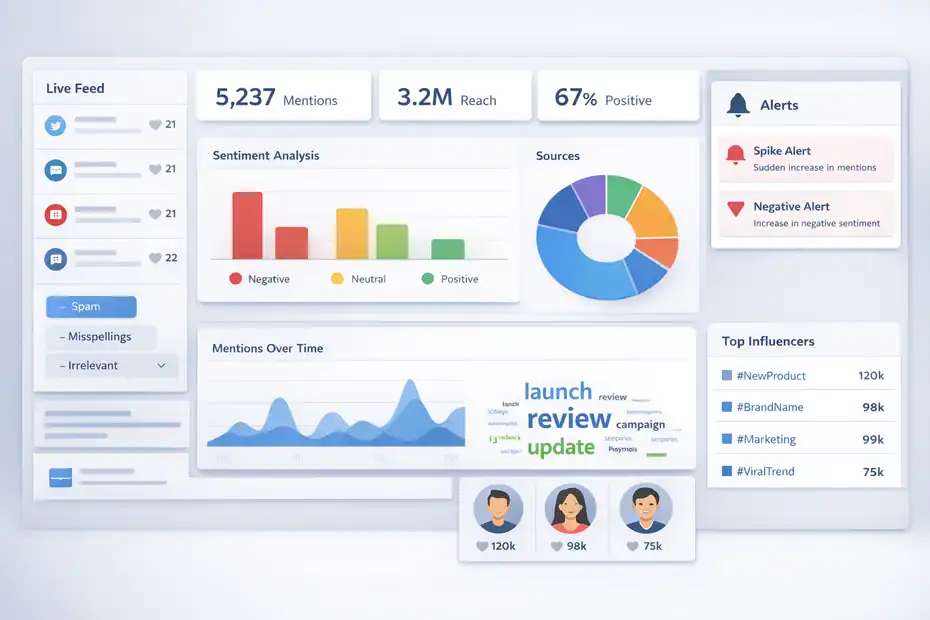
Before you decide whether the tool is worth it, you need to know what the day-to-day experience is actually like.
This is where many software reviews get too vague.
How Data Collection And Alerts Work
Brand24 starts with keyword-based monitoring. You enter your brand name, product name, campaign hashtag, competitor, executive name, or topic cluster. Then the platform scans public online sources and brings those mentions into a live feed.
Depending on the plan, updates range from every 12 hours on the entry tier to real-time on higher plans.
That update speed is not a small detail. If you are using Brand24 for reputation management or product launch monitoring, real-time matters. If you are just doing weekly awareness reporting for a small brand, slower refresh may be enough.
This is one reason I do not recommend judging the whole platform by the cheapest plan alone.
A typical workflow looks like this:
- Step 1: Create a project for your brand or campaign.
- Step 2: Add exclusions for noisy terms, misspellings, or irrelevant industries.
- Step 3: Set alerts for spikes in mentions or negative sentiment.
- Step 4: Review the feed daily or weekly depending on the campaign intensity.
- Step 5: Tag key mentions for reporting, outreach, or escalation.
That process is simple, but simplicity is often what teams need. A tool becomes valuable when your team actually uses it.
What Metrics You Can Really Use
Brand24 includes mention volume, engagement, reach tracking, source analysis, trending hashtags, most-shareable links, word cloud context, and sentiment segmentation.
It also layers on AI capabilities such as AI Sentiment Analysis, AI Events Detection, AI Brand Assistant, AI Insights, and AI Topics in higher plans.
Here is the important nuance: these metrics are best used directionally, not as absolute truth. Reach estimates in listening tools are useful for relative comparison and trend spotting, but I would not treat them as the same thing as first-party analytics from your own ad platform or website analytics.
That is not a Brand24 flaw specifically. It is just how this category works.
For marketers, the value is usually in pattern recognition:
- Volume spikes: Did the campaign actually create conversation?
- Sentiment shifts: Are people reacting positively or negatively?
- Source mix: Are mentions happening in news, Reddit, X, reviews, or blogs?
- Influencer visibility: Which accounts are amplifying the conversation?
- Topic clustering: What themes keep showing up around the brand?
Used that way, Brand24 becomes much more practical and much less “dashboard theater.”
The Features That Make Brand24 Worth Paying For
This is where Brand24 earns its reputation. Not every feature is equally valuable, but a few are genuinely useful for marketers trying to move fast.
Sentiment Analysis, AI Insights, And Event Detection
Brand24’s AI sentiment analysis is one of its biggest selling points. It classifies mentions as positive, negative, or neutral and helps surface shifts in brand tone.
On higher plans, AI Events Detection and AI Insights aim to identify unusual spikes and summarize what is happening.
In plain English, that means the tool tries to answer, “Something changed. Why?” That is a much better experience than forcing you to manually inspect hundreds of mentions.
I would still sanity-check the output. Sentiment tools have improved a lot, but sarcasm, slang, mixed opinions, and niche context can still fool them.
From what I’ve seen, Brand24 is most useful when AI narrows the investigation for you rather than replacing your judgment. That is how smart teams use these tools anyway.
A realistic example: Imagine your skincare brand sees a 45% jump in mentions after a creator post. Without context, that sounds great. Brand24’s sentiment and event detection might show that the spike is tied to complaints about packaging leakage rather than excitement about the formula. That distinction saves you from reporting a “successful awareness spike” when you actually have a product issue.
Reporting, Dashboards, And Team Sharing
Brand24 is built for reporting better than a lot of cheaper mention tools. The platform emphasizes automated reports, team sharing, and dashboard readability, and user feedback frequently highlights clear graphs and ease of use.
This matters more than people admit. A listening tool can have strong data coverage, but if you cannot turn the findings into a clean weekly summary for your boss or client, adoption drops.
Brand24 seems to understand that the job is not just collecting mentions. The job is helping marketers communicate what happened.
The strongest reporting use cases are:
- Weekly brand health snapshots
- Campaign recap decks
- PR coverage summaries
- Competitor mention comparisons
- Reputation alerts for leadership
I would not call the reporting layer revolutionary. I would call it practical. And in marketing software, practical often beats flashy.
Source Coverage And Why It Matters
Brand24 highlights coverage across social media, news, blogs, videos, forums, podcasts, reviews, newsletters, and more. The platform specifically lists sources such as X, Facebook, Instagram, YouTube, LinkedIn, Reddit, Spotify, Telegram, TripAdvisor, and App Store among its monitored environments.
That variety is one of the product’s best strengths because modern brand perception is fragmented. Your audience might praise you on Instagram, complain on Reddit, ask questions in forums, and leave damaging reviews elsewhere. A tool that only sees one slice of that conversation will mislead you.
That said, coverage is never the same as perfect access. Some platforms are harder for any listening tool to capture deeply because of API limits, privacy settings, or data access policies. So I would view Brand24’s source coverage as broad and useful, not magical.
Where Brand24 Starts To Feel Overhyped
This is the part most brand24 review for marketers articles gloss over. Brand24 is good, but it is not flawless.
Some complaints are predictable for the category. Others are worth taking seriously.
The Biggest Drawbacks Marketers Should Know
Independent reviews point to several recurring friction points: some users want more flexible feature packaging, some mention confusion around linking Meta platforms, some say cancellation can be annoying, and others note occasional gaps in news capture that require manual additions.
None of those issues automatically kill the product, but they do shape the buying decision.
Here is how I would translate those drawbacks into plain buyer language:
- Noise management can still take work: Keyword tools always need cleanup.
- Not every source is equally smooth: Especially where external platforms control access.
- Some workflows are not as elegant as they could be: Competitor comparison is useful, but some users want a better dedicated module.
- Subscription flexibility matters: Monthly access exists, but not every user loves the account management experience.
If you expect “set it and forget it” perfection, you will probably feel underwhelmed. Brand24 still requires a thoughtful setup, regular filtering, and human interpretation.
Why Some Marketers Love It While Others Do Not
A lot of software disappointment comes from mismatch, not bad software. Brand24 tends to be loved by marketers who want focused listening, clear dashboards, and better value than enterprise PR monitoring suites.
It tends to disappoint people who wanted a broader social media operating system or who assumed AI would eliminate all manual review.
I believe this is the core truth about the product: Brand24 is strongest as a fast intelligence layer for marketing and PR, not as a universal command center.
That distinction explains the split in reviews. A startup marketer comparing Brand24 with very expensive PR monitoring tools may see excellent value. A large enterprise team comparing it with premium intelligence platforms may see compromises.
Both reactions can be valid at the same time.
Brand24 Pricing And Whether The Cost Makes Sense
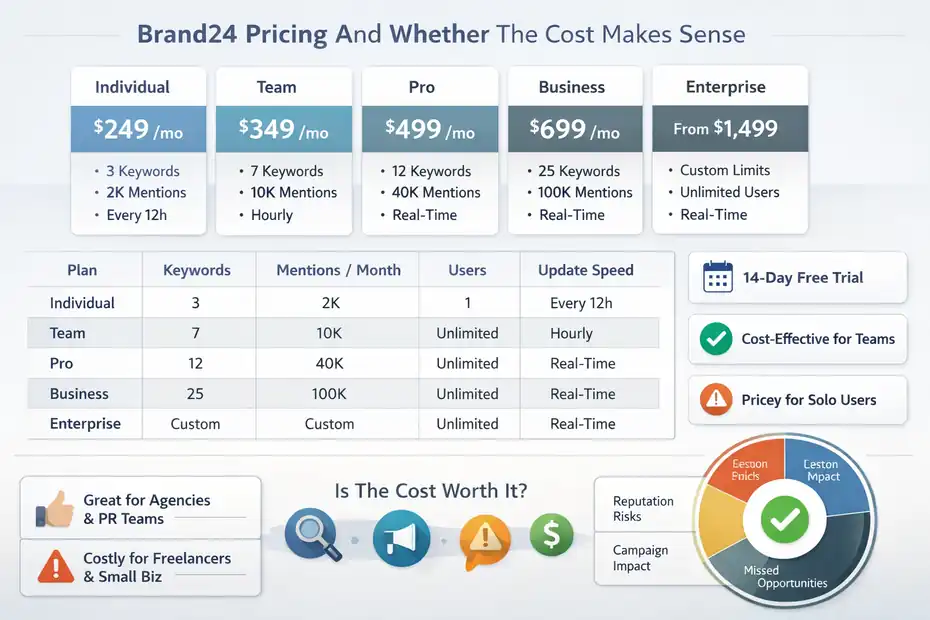
Pricing is where buyers usually decide whether a tool is “powerful” or “overhyped.” Expectations change fast once real dollars enter the conversation.
Current Plans And What You Get
Brand24 currently offers five plan levels: Individual, Team, Pro, Business, and Enterprise. The Individual plan starts at $249 monthly or $199 billed annually, while Team is $349 monthly or $299 annually.
Pro is $499 monthly or $399 annually, Business is $699 monthly or $599 annually, and Enterprise starts at $1,499. The lower tiers differ sharply in keyword counts, mention limits, users, and update speed. Real-time updates begin on Pro and above.
A quick comparison helps:
| Plan | Starting Price | Keywords | Mentions / Month | Users | Update Speed |
|---|---|---|---|---|---|
| Individual | $249 monthly | 3 | 2K | 1 | Every 12h |
| Team | $349 monthly | 7 | 10K | Unlimited | Every hour |
| Pro | $499 monthly | 12 | 40K | Unlimited | Real-time |
| Business | $699 monthly | 25 | 100K | Unlimited | Real-time |
| Enterprise | From $1,499 | Custom | Custom | Unlimited | Real-time |
The free trial is 14 days, which is long enough to test signal quality if you set up your project properly.
Is Brand24 Expensive Or Fairly Priced
My honest take is that Brand24 is not cheap for solo marketers, but it can be very cost-effective for teams that would otherwise piece together multiple tools or step up to much pricier competitors.
It is helpful to ask one simple question: what would missing a reputation issue, influencer opportunity, or campaign signal cost you? If Brand24 helps you catch one damaging customer trend before it spreads, or helps you prove campaign impact in a client renewal meeting, the cost can make sense fast.
On the other hand, if you only want occasional mention checks, the entry tier may feel expensive relative to your usage. That is especially true for freelancers or very small businesses.
Independent reviews often praise the cost-benefit ratio and ease of use, especially compared with bigger PR monitoring platforms.
So my verdict on pricing is this:
- Fair for agencies, PR teams, and active in-house brands
- Potentially steep for solo operators with limited monitoring needs
- Best value starts when the tool influences decisions, not just reporting
How Brand24 Compares To The Alternatives Marketers Usually Consider
A review is not very useful unless it helps you decide whether this is the right tool compared with other options.
Brand24 Vs Enterprise Listening Platforms
Brand24 is often considered against larger platforms such as Brandwatch, Talkwalker, or Meltwater in real buyer journeys. User comments on Capterra specifically mention evaluating those tools and choosing Brand24 for price, ease of use, or SaaS flexibility rather than long commitments.
This is usually the trade-off:
- Brand24: Faster to learn, more affordable, easier for smaller teams to operationalize.
- Enterprise suites: Often deeper in customization, analysis depth, governance, and large-scale research use cases, but much heavier on cost and setup.
If you run a mid-market brand or agency, Brand24 often lands in a sweet spot. If you need global enterprise intelligence with large analyst teams and deep workflow governance, heavier tools may still win.
Brand24 Vs Lighter Monitoring Options
Brand24 also competes with lighter or adjacent tools. Some marketers compare it with Hootsuite, Semrush, or low-cost alert systems, but those products usually solve a slightly different problem.
In simple terms:
- Basic alerts: Fine for surface-level mention detection, weak for analysis.
- Social suites: Better for publishing and engagement workflows, often less specialized in listening depth.
- SEO suites: Useful for search visibility and content insights, but not built primarily for live brand mention intelligence.
- Brand24: Best when you specifically want conversation monitoring, sentiment, reporting, and fast brand insight.
I suggest buying Brand24 only if listening is a real operational need. If listening is just a nice-to-have bullet on your software wishlist, you may never use it enough to justify the cost.
The Best Use Cases For Marketers Who Want Fast Wins
This is where Brand24 feels most powerful. It shines when tied to a clear job.
Campaign Monitoring And Brand Health Tracking
One of the strongest use cases is campaign monitoring. You can create a project around a campaign name, slogan, hashtag, product launch, or branded keyword set and watch conversation volume, reach, engagement, and sentiment move over time.
Brand24 also supports hashtag tracking and influencer discovery around campaign terms.
Imagine you launch a B2B webinar series. Paid clicks look average, but Brand24 shows a surge in LinkedIn and blog mentions after one speaker quote gets shared widely.
That tells you the real winner was not the registration ad creative. It was the thought leadership angle. That is the kind of insight performance dashboards often miss.
For brand health, Brand24 is also useful because it centralizes scattered feedback. Marketers can catch complaint clusters, spot recurring objections, and see whether messaging changes improve sentiment over time. That is especially valuable if your customer research process is otherwise weak.
Competitor Monitoring And Influencer Discovery
Brand24 is also good for competitor watching. You can create separate projects for competitor brands and compare mention volume, themes, and general sentiment trends.
The tool is not perfect here, and some users want a cleaner dedicated competitor comparison experience, but it is still very workable for practical market awareness.
For influencer discovery, the tool helps surface people already talking about your space or brand. I like this more than cold database prospecting because it starts with actual conversation, not just follower counts.
A realistic scenario: if you are marketing a new fitness app, Brand24 may help you find smaller creators already mentioning your product category with solid engagement. Those creators are often better partners than a large influencer with broad reach but weak category relevance.
That is where Brand24 feels genuinely useful instead of theoretical.
Setup Tips That Make Or Break Results
Most failed social listening setups are not tool failures. They are keyword failures. Brand24 is no exception.
How To Set Up Projects So You Do Not Drown In Noise
The smartest thing you can do is tighten your project logic from day one. Brand24’s own FAQ notes that projects can be refined with required or excluded words, plus language, source, and site filters. Use those aggressively.
Here is a setup structure I recommend:
- Step 1: Start with your exact brand name, product names, campaign hashtag, and common misspellings.
- Step 2: Add exclusions for unrelated industries, places, or people using the same word.
- Step 3: Separate competitor tracking into its own project.
- Step 4: Create one project for broad brand health and one for major campaigns if budget allows.
- Step 5: Review the first week of mention quality before trusting the reports.
For example, a brand named “Glow” will produce terrible data unless you exclude unrelated beauty, energy, and slang contexts. A narrow setup always beats a messy “track everything” approach.
Which Teams Should Use Alerts, Reports, And AI Features First
Do not try to activate every feature on day one. That usually leads to confusion.
A better rollout is:
- Week 1: Focus on mention quality and noise reduction.
- Week 2: Turn on alerts for spikes and negative sentiment.
- Week 3: Build one repeatable weekly report for leadership or clients.
- Week 4: Start using AI summaries and topic analysis to speed review.
That sequence matters because AI summaries are only as useful as the underlying project quality. If your feed is messy, the insights will be messy too.
I also recommend assigning ownership. One person should own keyword refinement, alert logic, and report templates. Shared dashboards are great, but shared ownership often means nobody optimizes the setup.
Advanced Optimization Strategies For Serious Marketing Teams
Once the basics are working, Brand24 becomes more valuable when you move from passive monitoring to active decision support.
How To Turn Brand24 Data Into Better Marketing Decisions
The most mature teams do not just monitor mentions. They use them to change campaigns, messaging, content, and positioning.
Here are a few ways to do that:
- Messaging optimization: Pull recurring positive phrases from customer mentions and test them in landing pages or ads.
- Objection handling: Review negative sentiment clusters and turn them into FAQ updates, sales enablement, or onboarding fixes.
- Content strategy: Use trending terms and discussion context to identify content topics real people already care about.
- Competitive positioning: Watch what customers praise about competitors and where they complain, then sharpen your differentiation.
That is where the tool moves from “interesting dashboard” to “marketing intelligence engine.”
If I were running demand gen, I would pair Brand24 findings with CRM notes, search query data, and customer interviews. That mix is much stronger than any one data source on its own.
Using The ChatGPT App Connection Without Falling For AI Hype
Brand24 now offers an official ChatGPT app integration that lets users query their live Brand24 project data conversationally.
Brand24 positions it as a fast access layer for mentions, sentiment, influencers, and competitors rather than a replacement for the core dashboard.
This is interesting, and I think it has real workflow value. But I would use it the right way.
Good use cases include:
- Quick weekly summaries
- Spike investigations
- Competitor briefing drafts
- Influencer shortlists
- Stakeholder Q&A
Bad use cases include blindly trusting every AI summary without checking underlying mentions.
The smartest approach is to let conversational AI save time on analysis and summarization while keeping the dashboard as your source of truth. Used that way, the integration is not just hype. It is a real productivity boost.
Final Verdict: Powerful, Overhyped, Or Both
Brand24 is a strong tool for marketers, but only when judged for the job it is actually built to do. It is powerful for monitoring brand mentions, spotting sentiment shifts, tracking campaigns, finding influencer opportunities, and producing clean reports without the weight of enterprise software.
Its broad source coverage, project-based filtering, AI summaries, and real-time monitoring on higher plans make it genuinely useful for in-house teams, agencies, and PR-focused marketers.
At the same time, it can feel overhyped if you expect flawless sentiment analysis, perfect source capture, frictionless platform linking everywhere, or a full social media operating system. Some reviewers also call out cancellation friction, occasional missed news mentions, and a desire for more flexible packaging or stronger competitor comparison UX.
So here is my honest conclusion.
Brand24 is not overhyped for marketers who need a focused listening and reputation tool they will actually use. It is overhyped for buyers chasing an all-in-one miracle platform.
If you are a marketer asking, “Will this help me understand what people are saying about my brand and act faster on that insight?” the answer is yes, probably. If you are asking, “Will this replace every social, PR, analytics, and research workflow we have?” no, it will not.
That is not a weakness. It is just the truth.
And in software buying, truth is a lot more useful than hype.
FAQ
What is Brand24 and how does it help marketers?
Brand24 is a social listening tool that tracks online mentions of your brand, competitors, or keywords. It helps marketers monitor sentiment, measure campaign impact, and identify trends across social media, blogs, and news, making it easier to respond quickly and improve marketing strategies.
Is Brand24 worth it for small marketing teams?
Brand24 can be worth it for small teams that actively track brand mentions and campaigns. It saves time by centralizing data and providing insights in one place. However, for occasional use, the pricing may feel high compared to simpler monitoring tools.
How accurate is Brand24 sentiment analysis?
Brand24 sentiment analysis is generally reliable for spotting trends, but it is not perfect. It can misinterpret sarcasm or context. Marketers should use it as a directional guide and manually review important mentions for more accurate insights.
What are the main limitations of Brand24?
Brand24 has limitations such as occasional missing mentions, required keyword refinement, and less advanced analytics compared to enterprise tools. Some users also report friction with setup or subscription management, which can impact the overall experience.
How does Brand24 compare to other social listening tools?
Brand24 offers a balance between affordability and functionality compared to enterprise tools. It is easier to use and quicker to set up, but it lacks some advanced analytics and customization features found in higher-end platforms.

I’m Juxhin, the voice behind The Justifiable.
I’ve spent 6+ years building blogs, managing affiliate campaigns, and testing the messy world of online business. Here, I cut the fluff and share the strategies that actually move the needle — so you can build income that’s sustainable, not speculative.
Related posts:
 Brand24 Pros And Cons For Businesses: Honest Breakdown
 How To Use Brand24 For Brand Monitoring Like A Pro
 Sprout Social Listening: How It Works for Brands
 CallRail Call Tracking: How It Works and Why It Matters
 Brand24 Vs Mention Comparison: Best Social Listening Tool
 Brand24 Missing Mentions Troubleshooting: Quick Fix Guide