
Table of Contents
Some links on The Justifiable are affiliate links, meaning we may earn a small commission at no extra cost to you. Read full disclaimer.
If you’ve been running an online store for a while, you’ve probably heard the term headless ecommerce platform tossed around a lot lately. At first, it might sound like tech jargon, but in reality, it’s one of the most powerful shifts happening in digital commerce.
I’ve seen many brands—both new and established—switch to headless systems because they promise faster growth, better flexibility, and a smoother customer experience.
But does going headless really make your ecommerce business scale faster, or is it just another buzzword? Let’s break it down.
Understanding What A Headless Ecommerce Platform Really Means
A headless ecommerce platform might sound complex, but it’s actually a simple idea: it separates the visible part of your online store (the “frontend”) from the behind-the-scenes engine (the “backend”).
This structure gives businesses more flexibility to create unique, high-performing shopping experiences without being limited by a single platform’s design or features.
How Headless Commerce Separates Frontend and Backend
In traditional ecommerce, the frontend (what customers see) and backend (where you manage products, inventory, and payments) are tightly connected.
This is great for simplicity—but it also means every change you make on one side can affect the other.
In a headless setup:
- The frontend can be any digital interface—like your website, app, social media shop, or even voice assistant.
- The backend handles core operations like order management, inventory, and checkout.
- These two communicate through APIs (Application Programming Interfaces), which are like digital translators that pass data between systems.
I like to think of it as building with Lego blocks. You can mix, match, and upgrade pieces without rebuilding the entire structure. This independence lets teams innovate faster and tailor the customer experience exactly how they want.
Why This Architecture Offers More Flexibility for Developers
For developers, headless commerce feels like a breath of fresh air. Instead of wrestling with rigid templates or outdated systems, they can use modern tools and frameworks like React, Next.js, or Vue to design rich, dynamic shopping interfaces.
A few advantages stand out:
- Freedom to experiment: Teams can test new features or layouts without breaking the backend.
- Faster innovation: Frontend and backend teams can work simultaneously instead of waiting on each other.
- Consistent updates: Developers can push changes in smaller chunks, making improvements easier to manage and less risky.
From my experience, this separation removes the “bottleneck effect” that often slows down ecommerce innovation. It’s not just about flexibility—it’s about speed and control.
The Key Difference Between Traditional and Headless Systems
Traditional ecommerce platforms like early Shopify or Magento versions are monolithic—meaning everything is bundled together. Headless platforms, however, are decoupled.
Here’s how that plays out in practice:
- Traditional: Changes to design, layout, or user flow require updates to the core system.
- Headless: You can redesign or launch new channels without touching the backend.
- Traditional: Customizations are limited to what the platform allows.
- Headless: You can build anything you can imagine, powered by APIs.
In short, a traditional setup is like buying a pre-built house—you can decorate it, but you can’t move the walls. Headless commerce gives you the land and materials to build your dream home from the ground up.
Why Brands Are Switching To Headless Ecommerce Platforms
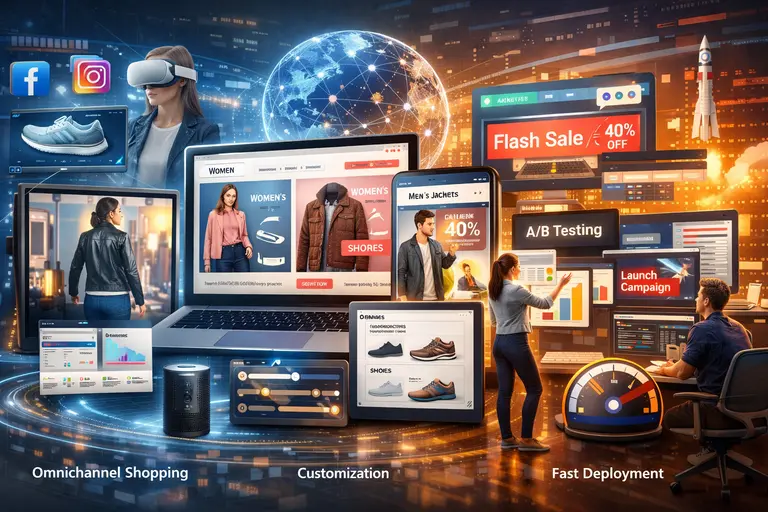
The rise of headless ecommerce isn’t just a tech trend—it’s a business decision.
Brands are moving this way because it gives them more control over the customer experience, greater flexibility across channels, and the agility to adapt quickly to market shifts.
The Demand for Omnichannel Shopping Experiences
Today’s customers don’t shop in one place. They browse on Instagram, compare on Google, and buy through mobile apps. A headless ecommerce platform makes it easier to serve them consistently across all these touchpoints.
- Unified brand experience: Whether a shopper is using a smartwatch or laptop, the design and data stay in sync.
- Instant updates: You can launch campaigns or adjust product info across multiple channels in real time.
- Cross-device flexibility: APIs allow seamless integration with new technologies—AR, VR, voice commerce, and more.
A 2024 Adobe study found that omnichannel customers spend 30% more on average than single-channel shoppers. Headless commerce is what makes that level of integration possible without breaking existing systems.
How Customization Drives Better Customer Engagement
Customization is at the heart of modern ecommerce. With headless systems, brands can personalize every touchpoint—from product recommendations to checkout flows—without relying on rigid platform templates.
Here’s what that looks like in action:
- Tailored homepages for different audiences or geographies.
- Dynamic content that changes based on browsing behavior.
- Real-time pricing or promotions driven by customer data.
In my experience, headless ecommerce empowers creative teams to deliver experiences that feel human. Instead of “fitting into” a platform’s constraints, you build one that fits your customer’s expectations.
Faster Deployment of Features and Marketing Campaigns
Traditional ecommerce updates can feel like waiting for paint to dry. Every design tweak, feature addition, or promo launch often needs full development cycles. Headless systems solve that.
Because the frontend operates independently:
- Marketing teams can push content or new landing pages instantly.
- Developers can release updates without affecting store operations.
- Businesses can A/B test ideas faster and scale winning versions immediately.
That agility means brands can move at the speed of customer demand—something essential in today’s fast-changing retail landscape.
How A Headless Ecommerce Platform Helps You Scale Faster
When it comes to growth, a headless ecommerce platform isn’t just about flexibility—it’s about building a foundation that can handle more traffic, products, and customers without slowing down or breaking.
Improving Site Speed and Performance Across All Devices
Speed is money in ecommerce. A delay of just one second in page load time can reduce conversions by 7%, according to Akamai research.
Headless commerce improves speed because it decouples heavy backend processes from what the user sees.
Why it matters:
- You can use lightweight, optimized frontend frameworks.
- APIs only load the data that’s needed, reducing unnecessary requests.
- Faster pages mean better SEO rankings and happier customers.
In short, headless systems give you performance optimization that traditional platforms can’t match.
Scaling Content and Product Updates Effortlessly
As stores grow, managing hundreds—or thousands—of products becomes challenging. Headless platforms make scaling simple because they centralize your backend operations and push updates across all channels automatically.
Imagine updating product descriptions once and seeing the changes reflected instantly on your site, app, and third-party marketplaces. That’s the efficiency headless architecture offers.
Real-world example: A fashion retailer can sync seasonal collections across global storefronts using APIs, ensuring consistent brand messaging without manual updates.
Enabling Global Expansion Through API-Driven Architecture
If you plan to scale internationally, a headless ecommerce platform gives you the agility to adapt to new markets quickly. APIs make it possible to localize your site—languages, currencies, taxes—without building new infrastructure.
Key advantages for global growth:
- Connect regional payment systems easily.
- Deliver localized content through CMS integrations.
- Maintain unified inventory and order data globally.
From what I’ve seen, brands that go headless expand faster because they can adapt locally while maintaining a single, efficient backend system.
The Role of APIs in Accelerating Headless Ecommerce Growth
APIs are the lifeblood of a headless ecommerce platform. They connect every moving part—frontend interfaces, backend systems, third-party tools—so data flows smoothly without friction.
If you think of your online store as a body, APIs are the veins keeping everything alive and communicating.
How APIs Connect Multiple Systems Seamlessly
APIs, or Application Programming Interfaces, act as digital messengers that let different applications talk to each other. In ecommerce, this means your website, inventory system, and marketing tools can all exchange information instantly.
For example:
- When a customer adds an item to their cart, an API tells your backend to reserve that product in inventory.
- When a sale happens, APIs automatically update your order management system, CRM, and analytics dashboards.
- When you change a product detail, that update reflects across every channel in real time.
I’ve seen firsthand how this seamless data flow eliminates manual work and errors. It ensures customers always see accurate prices, inventory, and order statuses—no matter where they’re shopping.
Pro tip: Think of APIs as your ecommerce store’s “connective tissue.” The more efficiently they’re built and organized, the faster and more consistent your business operations become.
Using APIs to Integrate Marketing, CRM, and Inventory Tools
One of the biggest advantages of a headless setup is how easily it integrates with external tools through APIs. You can plug in best-in-class solutions rather than being stuck with whatever your ecommerce platform provides.
Here’s how that might look in practice:
- Marketing: Connect tools like Klaviyo or HubSpot for automated, data-driven campaigns.
- CRM: Sync customer data between your store and platforms like Monday or Zoho for personalized service.
- Inventory: Tie your ecommerce backend to warehouse systems for real-time stock updates.
This “composable commerce” approach lets you build your own ecosystem of specialized tools that talk to each other perfectly. In other words, instead of relying on one giant system that tries to do everything, you create a flexible, tailored setup that does exactly what you need.
From what I’ve seen, this modular design gives you more freedom to test, swap, or upgrade tools without disrupting your store.
Building a Tech Stack That Supports Long-Term Growth
The beauty of APIs is scalability. As your ecommerce business grows, you’ll need to add new features, integrate new systems, and expand into new markets. A strong API foundation makes that evolution smooth.
When building your tech stack, keep these principles in mind:
- Start with a solid backend: Choose a platform with robust API support like Shopify Plus, BigCommerce, or Commercetools.
- Prioritize flexibility: Ensure APIs can handle multiple data types and heavy traffic.
- Future-proof your integrations: Opt for REST or GraphQL APIs—they’re modern standards that make scaling simpler.
In my experience, a scalable tech stack isn’t built overnight. It evolves alongside your business, and the more “headless-ready” your systems are, the faster you’ll be able to adapt when new technologies come along.
Comparing Headless Ecommerce Platforms vs. Traditional Ones
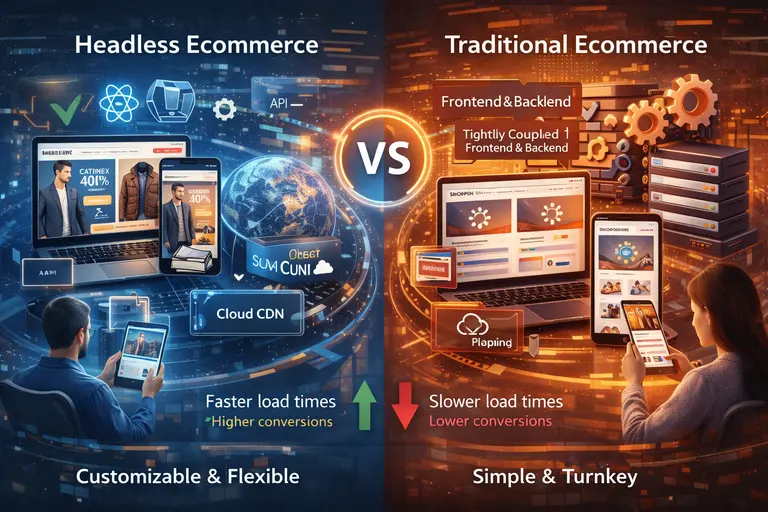
Deciding between a headless ecommerce platform and a traditional one can feel like choosing between custom freedom and plug-and-play simplicity.
Each approach has its pros and cons—what matters is aligning your choice with your business goals.
Performance Differences That Impact Conversions
Let’s start with performance. Traditional ecommerce systems load both frontend and backend together, often making sites heavier and slower. Headless platforms, on the other hand, load only what’s needed for the customer view through APIs, dramatically improving speed.
Here’s what that means for your store:
- Pages load faster, reducing bounce rates and increasing conversions.
- API-driven frontends allow for caching and preloading, improving mobile experience.
- You can use CDN (Content Delivery Network) optimization for faster global delivery.
According to Google, a one-second delay in mobile load time can cut conversion rates by up to 20%. That’s why speed—something headless architecture naturally supports—is not just a tech advantage but a revenue driver.
Flexibility and Customization: What You Gain and What You Lose
Headless commerce gives you near-total design freedom. You can create unique layouts, personalized experiences, and multichannel interfaces that truly represent your brand.
Traditional platforms, meanwhile, offer simplicity but often restrict deep customization.
What you gain with headless:
- Freedom to use modern frontend frameworks like React, Vue, or Next.js.
- Ability to tailor user experiences across every device and channel.
- Freedom to experiment quickly without backend interference.
What you lose:
- Some built-in simplicity—headless systems require more setup.
- You may need a stronger development team or partner.
- Managing multiple systems can add initial complexity.
In my view, headless isn’t always better—it’s just different. If you crave control and customization, headless is your path. If you prefer simplicity and speed to launch, traditional might suit you better.
Maintenance, Cost, and Scalability Considerations
Traditional ecommerce platforms often bundle hosting, maintenance, and updates.
That means less work—but also less flexibility. With headless commerce, you handle more components independently, which gives you power but also more responsibility.
Key differences:
- Cost: Headless setups may start higher due to custom development but pay off as you scale.
- Maintenance: You control performance, integrations, and security updates.
- Scalability: API-driven systems scale effortlessly with traffic, new markets, and features.
I usually recommend headless for businesses hitting growth ceilings with their current setup—especially those expanding internationally or needing deep personalization.
The investment often pays back in speed, customer satisfaction, and agility.
The Challenges of Going Headless (And How to Overcome Them)
Switching to a headless ecommerce platform isn’t a magic fix. It comes with challenges that need thoughtful planning. The good news? Every challenge has a clear path forward if you know what to expect.
Managing Technical Complexity and Development Costs
Headless commerce can be complex, especially for non-technical teams. You’re building a system with many moving parts—frontend, backend, APIs, hosting, integrations.
How to manage it:
- Start small: Consider going partially headless (e.g., headless CMS or mobile frontend first).
- Use pre-built frameworks: Shopify Hydrogen or BigCommerce’s API SDKs can speed up development.
- Budget realistically: Allocate funds not just for setup but also for maintenance.
From experience, the biggest pitfall is underestimating long-term development needs. Having an experienced team or agency partner makes a huge difference.
Ensuring Seamless User Experience During Migration
A smooth migration is critical. When moving to headless, you don’t want customers to notice downtime or broken links.
Tips for a seamless transition:
- Migrate gradually—start with one storefront or region.
- Keep URLs and metadata consistent to protect SEO rankings.
- Test everything in staging before going live.
One brand I worked with rolled out its headless store region by region over three months. This phased approach allowed them to fix small issues without major disruptions—a smart move I always recommend.
Choosing the Right Development Team or Partner
Going headless is a team effort. You need developers who understand modern frameworks, APIs, and ecommerce logic.
What to look for:
- Proven experience with headless builds (ask for previous examples).
- Familiarity with your chosen platform’s API system.
- Strong understanding of UX and conversion optimization.
If you’re not technical yourself, partnering with an ecommerce agency that specializes in headless architecture is worth it. The right team doesn’t just build the system—they future-proof it for scalability and performance.
Pro Tip: Headless ecommerce is not about complexity for its own sake—it’s about freedom. Start where it makes sense, iterate, and let data guide your expansion. The transition might be challenging at first, but once your systems start communicating seamlessly, you’ll realize just how powerful this architecture can be for scaling your brand.
Key Features To Look For In a Headless Ecommerce Platform
When choosing a headless ecommerce platform, it’s easy to get caught up in buzzwords. But what truly matters are the core features that make your business faster, more flexible, and easier to scale.
Let’s focus on what you really need to look for before making that leap.
Scalable API Architecture and Developer-Friendly Frameworks
At the heart of any good headless ecommerce platform lies a solid API system. This is what allows your frontend (the store your customers see) to communicate smoothly with your backend (where all your data lives).
Here’s what to prioritize:
- High-performance APIs: Make sure they can handle spikes in traffic during big campaigns without slowing down.
- Clear documentation: Developers need structured, readable API guides to integrate tools efficiently.
- GraphQL support: It’s faster and more efficient than traditional REST APIs, letting your store fetch exactly the data it needs—nothing more.
In my experience, scalable APIs are what separate a flexible ecommerce system from one that collapses under growth.
For instance, I’ve seen mid-size retailers double their product catalogs without needing major infrastructure changes simply because their APIs were built to scale from day one.
Support for Multiple Frontend Frameworks Like React or Vue
One of the greatest benefits of a headless approach is the freedom to design your store’s frontend however you want. Frameworks like React, Next.js, or Vue.js give you that creative control while keeping performance lightning-fast.
Here’s why this flexibility matters:
- You can create a custom UX that feels native on every device.
- Developers can build progressive web apps (PWAs) that work offline and load instantly.
- You can test new designs without touching backend logic.
A good headless platform won’t lock you into one framework. Instead, it’ll integrate easily with whichever frontend your team prefers. That’s what makes the architecture future-proof—you can evolve your design stack as technology advances without starting from scratch.
Security, Compliance, and Speed Optimization Capabilities
Security is non-negotiable, especially in ecommerce. A headless setup changes how data moves between systems, which means your platform needs robust protection at every layer.
Look for these key safeguards:
- PCI-DSS compliance: Ensures safe payment processing and protects customer data.
- OAuth 2.0 authentication: Keeps APIs secure and prevents unauthorized access.
- Built-in caching and CDN support: Improves load times globally while reducing strain on servers.
In my view, the best headless ecommerce platforms handle performance and security quietly in the background—so you can focus on growth, not fire-fighting.
A fast, secure storefront builds trust and directly impacts conversions.
Best Headless Ecommerce Platforms To Consider in 2026
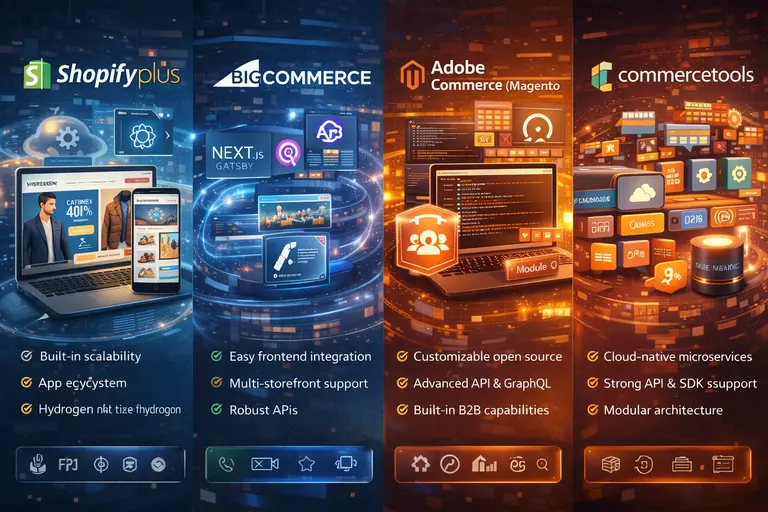
Choosing the right headless ecommerce platform depends on your size, budget, and technical needs.
Below are the top options in 2026 that balance flexibility, scalability, and ease of use—each one suited for different types of businesses.
Shopify Plus and Its Headless Capabilities
Shopify Plus remains one of the most popular headless options because it combines enterprise-grade infrastructure with simplicity. Through its Storefront API and Hydrogen framework, you can design fully custom frontends while keeping Shopify’s rock-solid backend.
What makes it stand out:
- Built-in scalability and global CDN performance.
- Access to Shopify’s vast app ecosystem.
- Developer tools like Hydrogen (React-based) for faster builds.
I’d say Shopify Plus is perfect if you already run a Shopify store and want to “go headless” without rebuilding your entire tech stack. It’s the most accessible on-ramp to enterprise-level headless commerce.
BigCommerce for API-First Integrations
BigCommerce has built its reputation around being API-first, meaning it was designed for headless functionality from the ground up. It offers strong API coverage—over 90% of platform features are accessible through APIs.
Why brands love it:
- Simple integration with modern frontends like Next.js or Gatsby.
- Built-in multi-storefront support.
- Robust REST and GraphQL APIs for smooth data exchange.
BigCommerce is ideal for brands managing multiple channels or regions. I’ve seen international retailers use it to run several localized stores under one backend—something traditional platforms struggle with.
Adobe Commerce (Magento) for Enterprise-Level Control
If you need full control and deep customization, Adobe Commerce (formerly Magento) remains a top-tier choice. It’s not as plug-and-play as Shopify or BigCommerce, but it shines for businesses that want complex integrations and unique workflows.
What makes it powerful:
- Highly customizable open-source foundation.
- Advanced API and GraphQL layer for headless builds.
- Built-in B2B capabilities for bulk orders and custom pricing.
From experience, Adobe Commerce works best for larger enterprises with dedicated tech teams. The upfront investment pays off when you need to build a deeply tailored shopping experience that matches your brand’s complexity.
Commercetools and Its Cloud-Native Ecosystem
Commercetools is often described as the pioneer of true headless commerce. It’s a cloud-native, API-first platform built entirely around composable architecture—perfect for brands ready to scale globally and innovate fast.
Core strengths:
- Microservices architecture that scales automatically.
- Strong developer support for APIs, SDKs, and integrations.
- Modular structure allowing brands to plug in only what they need.
Commercetools is for teams that think long-term. If your vision includes global expansion, multi-brand management, or heavy use of personalization and AI, this platform gives you the backbone to grow without rebuilding.
When You Should (And Shouldn’t) Switch to Headless Commerce
Headless commerce isn’t for everyone. It’s powerful, yes—but it also comes with more complexity and cost upfront. Understanding when the switch makes sense can save you a lot of headaches (and money).
Indicators Your Current Setup Is Holding You Back
You might be ready to go headless if your current ecommerce platform feels like it’s getting in your way rather than supporting your goals.
Common red flags include:
- Slow page load speeds and poor mobile performance.
- Difficulty customizing checkout or design experiences.
- Limited integration options with third-party tools.
- Bottlenecks when adding new channels or regions.
In simple terms, if your growth feels restricted by technology rather than strategy, that’s your cue to consider a headless solution.
When Headless Might Be Too Complex for Your Business
On the other hand, headless commerce might be too much if you’re still building your foundation. For small businesses or startups, simplicity often wins over flexibility.
Scenarios where headless might not fit yet:
- You’re not ready to invest in custom development.
- Your team lacks technical expertise to maintain multiple systems.
- Your focus is on validating a product or market, not full customization.
In my experience, many businesses do better starting with a robust all-in-one solution like Shopify or BigCommerce, then transitioning to headless later once they’ve grown enough to justify it.
How to Decide Based on Your Growth Stage and Goals
The right time to switch depends on your growth maturity. Here’s a simple framework I often share:
- Early stage: Stick with an all-in-one platform. Focus on revenue and product-market fit.
- Growth stage: Consider partial headless (e.g., using a headless CMS with Shopify).
- Scaling stage: Move fully headless when you need more performance, flexibility, and global reach.
A brand I worked with waited until they hit consistent six-figure monthly revenue before transitioning to headless. By then, they had the data, the resources, and the team to make it worthwhile. That’s the kind of strategic timing I recommend.
Expert Tip: Don’t go headless just because it sounds cutting-edge. Go headless because your customers—and your team—will genuinely benefit from the added speed, flexibility, and scalability. The best time to make the switch is when your current system starts holding you back, not when you’re still figuring things out.
Step-By-Step Process To Transition To a Headless Ecommerce Platform
Switching to a headless ecommerce platform doesn’t have to feel overwhelming. The key is to approach it like a well-planned renovation — not tearing down the whole house at once, but carefully rebuilding one room at a time.
Here’s a clear, practical roadmap I often recommend when guiding brands through this transition.
Conducting a Tech Stack Audit and Setting Goals
Before making any big changes, take an honest look at your current setup. Identify what’s working, what’s slowing you down, and where your ecommerce system is holding you back.
Here’s how to start your audit:
- Map your current tools: List everything from your CMS (content management system) to your inventory and marketing integrations.
- Assess pain points: Are you facing slow load times, design limitations, or poor mobile conversions? Note them down.
- Define measurable goals: For example, improving site speed by 40% or enabling API-driven personalization across channels.
I’ve seen too many brands jump into headless projects without a clear “why.” That often leads to unnecessary complexity. Setting goals first helps you stay grounded and ensures every tech decision aligns with real business outcomes.
Expert insight: Don’t focus only on technology—focus on customer experience. If the change doesn’t make shopping easier, faster, or more enjoyable, it’s not worth the effort.
Selecting the Right Backend and Frontend Technologies
Once your goals are clear, the next step is choosing your tools—the building blocks of your headless ecosystem. Your backend will manage the core ecommerce logic, while the frontend will control how your store looks and feels.
Backend recommendations:
- Shopify Plus or BigCommerce for stability and scalability.
- Adobe Commerce (Magento) for enterprise customization.
- Commercetools for a fully modular, API-first setup.
Frontend frameworks to consider:
- React (especially Shopify’s Hydrogen) for dynamic, fast-loading stores.
- Next.js for SEO-friendly, server-side rendering.
- Vue.js for lightweight, flexible frontends.
From what I’ve seen, pairing Shopify Plus with a React-based frontend is one of the smoothest transitions for growing brands. It balances simplicity with power.
Quick tip: Choose technologies your team already understands. A fancy stack is useless if your developers struggle to maintain it.
Testing, Launching, and Optimizing Post-Migration
Migration is where everything comes together. But before you hit “launch,” it’s crucial to test every piece thoroughly. This is your chance to catch potential issues before they reach your customers.
Best practices for testing and rollout:
- Run performance tests: Check API response times and page load speeds under traffic.
- Audit user experience: Test checkout, search, and mobile responsiveness across devices.
- Stage rollouts: Consider soft-launching in one region or product category first.
Once live, keep monitoring. A headless setup gives you flexibility to fine-tune continuously—adjust layouts, add integrations, and analyze customer behavior in real time.
One brand I worked with launched its headless storefront in just one product category first.
Within 30 days, conversions improved by 18%. That early win made the full migration much smoother (and justified the investment to stakeholders).
Future Trends Shaping Headless Ecommerce Platforms
Headless commerce isn’t standing still. The next wave of innovation is already here—blending AI, immersive tech, and modular systems to create experiences that feel almost predictive.
Let’s look at the trends defining where ecommerce is heading.
AI-Powered Personalization and Predictive Shopping
Artificial intelligence is transforming how brands understand and serve customers. In a headless environment, AI tools connect through APIs to deliver smarter, faster personalization.
How it’s evolving:
- AI-driven recommendation engines show products based on behavior, not just categories.
- Predictive algorithms anticipate what shoppers want before they search for it.
- Real-time personalization adjusts homepage banners or checkout flows dynamically.
A recent Salesforce study found that 61% of customers expect brands to anticipate their needs. With headless architecture, integrating these intelligent systems becomes seamless.
Personally, I think AI will soon make “static” ecommerce experiences a thing of the past.
Voice Commerce, AR, and IoT Integration Opportunities
The way people shop is expanding beyond screens. Voice assistants, augmented reality (AR), and connected devices are opening up new buying experiences—and headless systems are uniquely suited for these channels.
Real-world possibilities:
- Shoppers can use voice commands to reorder products or check delivery status.
- AR tools let customers visualize furniture or clothing in real-world environments before purchase.
- IoT-enabled devices (like smart fridges or cars) can automatically reorder essentials.
Because headless ecommerce platforms use APIs, integrating these technologies doesn’t require rebuilding your store—it’s simply plugging into new endpoints. That’s what gives this model long-term adaptability.
The Rise of Composable Commerce Architectures
Composable commerce is the next natural step beyond headless.
It means building your ecommerce stack using the best tools for each function—payment, search, content, analytics—rather than relying on one giant system.
Why it matters:
- You get flexibility to replace or upgrade individual components anytime.
- It reduces vendor lock-in, keeping your tech stack modern and competitive.
- It supports faster innovation since teams can work on separate modules independently.
I like to think of composable commerce as the “Spotify playlist” version of ecommerce tech. You pick only what fits your vibe—and switch things up whenever you want.
Final Thoughts: Is Headless Ecommerce the Fastest Way to Scale?
After diving deep into this, the big question remains: Is headless ecommerce really the faster way to scale? The short answer—yes, but only if you approach it strategically.
Weighing Long-Term Benefits Against Short-Term Complexity
Headless ecommerce gives you speed, flexibility, and future-proof scalability—but it also adds upfront complexity. It’s not a shortcut; it’s a smarter investment in long-term performance.
In the short term, you’ll spend more time setting up architecture and integrations. But the payoff comes later when you can expand to new markets, test faster, and deliver personalized experiences your competitors can’t match.
If your business plans to grow aggressively or operate across multiple channels, headless architecture offers the foundation to do it without constant replatforming.
How a Strategic Headless Approach Unlocks Growth Potential
The key to success lies in strategy. Start with clear goals, build a scalable foundation, and invest in the right team or partners. From there, headless systems give you:
- Consistent branding across every digital touchpoint.
- Faster innovation through modular development.
- Endless integration possibilities through APIs.
In my experience, brands that approach headless commerce as a phased evolution—not an overnight change—tend to scale faster and sustain that growth.
Pro Tip: Start Small—Test Headless Features Before Fully Migrating
Here’s my personal advice: you don’t need to go all-in right away. Try a partial headless approach first.
Ways to experiment:
- Use a headless CMS (like Contentful or Sanity) for content management while keeping your current ecommerce backend.
- Test a custom headless landing page to see how it impacts conversions.
- Slowly decouple sections like checkout or product listings before a full rebuild.
This gradual approach lets you prove the ROI, learn from real user behavior, and build confidence before committing to a complete migration.
Final reflection: Headless ecommerce isn’t just a tech trend—it’s the next stage in ecommerce evolution. If you’re looking to scale faster, deliver richer experiences, and future-proof your business, going headless (strategically) might just be the smartest decision you make.

I’m Juxhin, the voice behind The Justifiable.
I’ve spent 6+ years building blogs, managing affiliate campaigns, and testing the messy world of online business. Here, I cut the fluff and share the strategies that actually move the needle — so you can build income that’s sustainable, not speculative.
Related posts:
 Composable Commerce Explained: The Future of Online Stores
 What Is Headless Commerce and Why It’s Transforming Ecommerce
 WordPress Ecommerce Developer: 6 Trends Shaping the Future
 Best Platform to Sell Online for Fast Growth and Low Fees
 Ecommerce Automation That Saves Time Without Breaking Sales
 Top Online Store Platforms for Building Income Streams